





Table of Content
At the time of placing an order in logistics companies, what is important to you? the answer is simple, the fast delivery of cargo, on time, excellent customer service, and low price.
Today, in an increasingly competitive market, customers are more attentive to customer service, because customers are looking for a partner who can understand their needs and can solve any problems.
A good logistics company is not just able to deliver cargo on time and at the lowest price, it is one that can be trusted and whose employees will help you at every step of the way: from placing an order to delivery of cargo.
In this article, I will discuss customer service in logistics, its role, and ways to improve it.
What is Customer Service in Logistics?
Customer service logistics is the practice of creating positive experiences through the supply chain of goods and services. The service logistic organizes the transit of material and information throughout a company according to defined procedures. Its main functions are: to receive, store and deliver products, to ensure the proper flow of purchases and sales, and to manage internal transport.
A company has always had a “logistics” department even if this has never been formalized. It is the department that controls the reception and shipment of goods that come in and out of the warehouse. Its activities are mainly administrative and are performed by the more humble employees, who do not have direct contact with customers.
In order for the logistics department to provide excellent service, it is necessary that all employees have a general idea of how the company goes about its business, what type of activity they perform, and the cycles they undergo to meet customer deadlines. And, it is also important to know the difference between customer and client to deliver personalized service.
What is the Role of Customer Service in Logistics?
Excellent customer service is not only important to get and retain customers, but also the main source of competitive edge. But customer service is a very essential part of the logistics industry.
Consumer goods often have a very short lifetime, so the quick response time to customers and accurate information is essential. A good logistics company must always watch and reflect the market trend as well as its customer requirements, then offer suitable solutions to meet all customers’ needs.

The key role of customer service in logistics is to solve customer queries after the sale and make them feel satisfied with the delivery. The customer service department will provide support for the customers on all the queries about their orders. It is a department that plays a vital role in logistics and helps in building long-term relationships with customers.
Businesses need to look out for the customers’ satisfaction when they are making deliveries. If they fail to do so, customers may have second thoughts and may not trust them as they would like to. The lack of proper customer service on delivery can result in negative reviews on social media platforms which can hurt the reputation of a business.
Key Responsibilities of Customer Service in Logistics
Customer service in logistics involves more than answering questions after a shipment has been dispatched. It supports customers throughout the entire logistics journey, from the initial inquiry and order confirmation to delivery and post-delivery assistance.
The key responsibilities of a logistics customer service team include:
Providing Shipping Information
Customers need clear information about shipping costs, delivery timelines, service availability, documentation, and possible restrictions before placing an order. Accurate answers at this stage help businesses set realistic expectations and avoid misunderstandings later.
Confirming and Processing Orders
Customer service teams may help verify order details, delivery addresses, quantities, shipping methods, and special handling requirements. Detecting incorrect information early can prevent failed deliveries and unnecessary costs.
Sharing Shipment Updates
Customers expect to know when an order has been processed, dispatched, delayed, or delivered. Providing timely updates reduces uncertainty and limits repetitive “Where is my order?” inquiries.
Resolving Delivery Problems
Logistics customer service teams handle situations such as delayed shipments, damaged goods, missing packages, incorrect addresses, failed delivery attempts, and incomplete orders. Their role is to investigate the problem, coordinate with the relevant department, and keep the customer informed until it is resolved.
Managing Claims, Returns, and Complaints
When a shipment is lost or damaged, customers need a straightforward process for submitting evidence, making a claim, arranging a return, or requesting compensation. Clear ownership and regular follow-ups can prevent already-frustrated customers from becoming more dissatisfied.
Coordinating Between Customers and Operations
Customer service acts as a bridge between customers, drivers, carriers, warehouse teams, and account managers. This coordination ensures that the customer receives accurate information instead of being transferred repeatedly between departments.
Importance of Customer Service in Logistics
The importance of customer service in logistics is a common practice for companies to offer customer service as a means to an end: satisfying customers in an effort to reduce churn, increase retention and ensure future business. However, customer service should be a company’s number one priority.
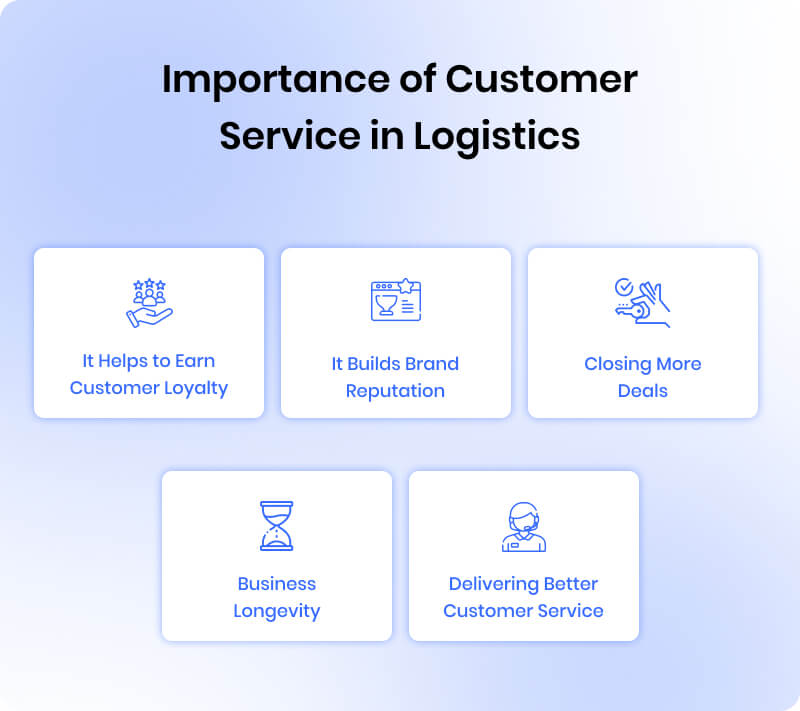
Let’s take a look at some of the key points to clearly show why customer service in logistics is important.
1. It Helps to Earn Customer Loyalty
To earn customer loyalty, it’s first important to know what customers want. They want to be treated with respect and feel like they are being listened to.
When customer service is bad or good, people tell other customers about it. As a business owner, it can be scary to think about how much is riding on your customer’s experience with your business.
However, 42% of consumers surveyed in a 2013 study said they would switch brands within the next 24 hours if there was an issue with their customer experience.
Some businesses focus more on their products or service rather than on the customers themselves. Those businesses tend to falter and fade away. Other companies focus on customer service, causing a strong bond to form between them and their customers.
2. It Builds Brand Reputation
Excellent customer service reflects in the way companies treat their customers. Not only it is an essential part of the business, but it is also very important to have a good reputation and even more so when you have a brand.
The customer experience is key to positioning your product as a quality one and that’s why it is also necessary to make sure that your past and current customers are posting positive reviews on social media.
So always remember that unless your customer service is outstanding, you won’t have a very good reputation, which is the most important aspect of any business nowadays. Customer service must be efficient, courteous, friendly, and reliable.
3. Closing More Deals
How many times have you used a company only to get terrible service that makes you regret your decision? Unfortunately, not every customer gets excellent customer service (ECS). But great customer service can be the determining factor in whether someone is a customer for life or not.
Excellent customer service helps to close more deals. It is not just about service, but more about building a relationship and fully engaging with the customer.
4. Business Longevity
In the world of e-commerce, excellence in customer service can make the difference between a sale and a lost customer. Today’s customers are savvy and able to reward businesses that offer exceptional service with their loyalty. However, if you’re lacking in this area, you may end up losing valuable income as your customers shop for a better experience.
- The first is to make the customer feel important. The most important thing to know is what you like about your service. It does not matter if you are a business owner or an employee.
- Secondly, it can make customers feel confident. Customers will come back because they feel confident with your service. Remember that when people feel good, they tend to return. This can be achieved by listening to them and treating them with respect.
- Lastly, customer service provides a sense of satisfaction and loyalty. Once customers feel that they have been treated fairly and they feel comfortable, they will come back. They will also tell their friends about their own experiences so that their friends can come too.
5. Delivering Better Customer Service
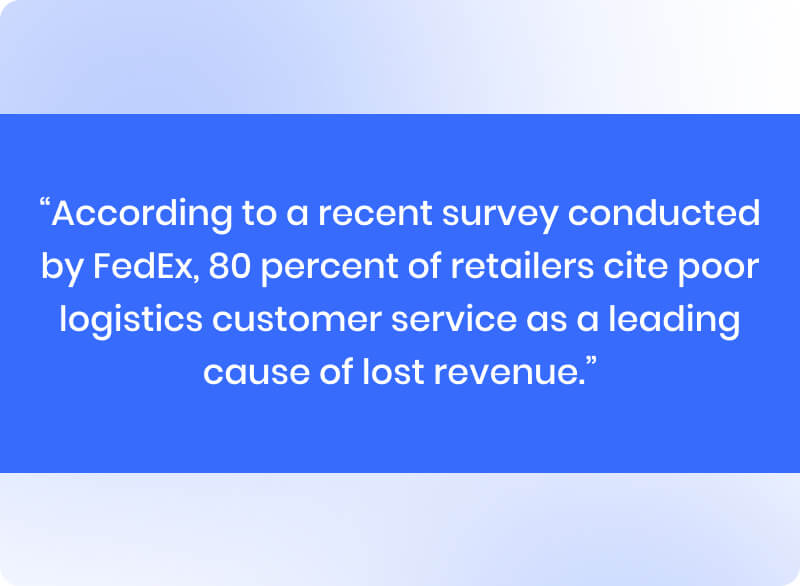
84% of consumers that have an issue with a brand will never complain directly to the brand itself, they’ll go straight to social media. So keep in mind, that customers who have an issue with your business have no loyalty to you as an individual or to your brand as a whole.
There is a lot of data about customer service being one of the top drivers of revenue and retention, yet customer service is all too often the afterthought. Why should you deliver better customer service? Well, there are plenty of reasons including
- Better customer service leads to customer loyalty and increased revenue
- It can make customers “brand evangelists”
- It can help you recruit and retain better employees
- Delivering better customer service has been shown to actually increase your daily productivity
- It can improve your supply chain too by helping you develop a deeper understanding of your customer’s needs
- And finally, it’s just the right thing to do
Common Customer Service Challenges in Logistics
Logistics operations involve multiple teams, systems, carriers, and external conditions. As a result, providing a consistent customer experience can be difficult.
Here are some of the most common challenges.
1. Fragmented Customer Information
Customer data may be spread across a transport management system, warehouse software, email inboxes, messaging platforms, and spreadsheets. When agents cannot access complete information, customers may receive delayed or conflicting answers.
A centralized support workspace can help agents view conversations, order details, previous complaints, and customer information in one place.
2. Unpredictable Shipment Delays
Bad weather, customs inspections, traffic congestion, port disruptions, vehicle problems, and carrier capacity issues can all affect delivery schedules.
Although logistics companies cannot prevent every delay, they can control how they communicate it. Customers should be informed as soon as a disruption is identified, along with the reason, revised timeline, and next available action.
3. High Volumes of Repetitive Questions
Questions such as “Where is my shipment?”, “When will it arrive?”, and “Can I change the delivery address?” can consume a significant amount of agent time.
Self-service tracking, automated notifications, AI agents, and chatbots can handle many routine requests, allowing human agents to concentrate on complex cases.
4. Communication Silos
A customer may contact sales, operations, warehouse staff, drivers, and support teams about the same shipment. When these teams do not share information, customers are forced to repeat their concerns.
Clear internal ownership and connected communication systems help prevent this fragmented experience.
5. Maintaining Service Quality While Scaling
As shipment and customer volumes increase, support requests also grow. Without proper workflows, service levels may fall, response times may increase, and unresolved cases may be overlooked.
Logistics companies need scalable support processes, automation, routing rules, and service-level targets to maintain quality as the business grows.
6. Balancing Automation With Human Support
Automation can provide faster responses and round-the-clock availability, but some situations require empathy, judgment, or negotiation.
Customers should be able to move easily from an automated interaction to a qualified human agent when dealing with damaged shipments, high-value orders, urgent deliveries, or complex claims.
Best Practices for Excellent Customer Service in Logistics
Improving logistics customer service requires a combination of communication, technology, employee training, and operational coordination.
Communicate Before Customers Need to Ask
Do not wait for customers to contact you after something has gone wrong. Send proactive updates when an order is confirmed, dispatched, delayed, rescheduled, delivered, or unsuccessfully attempted.
A useful delay notification should explain:
- What happened
- How the delivery is affected
- The updated delivery estimate
- What the customer needs to do
- Where the customer can get further support
Even when the news is negative, timely and transparent communication helps preserve trust.
Set Realistic Delivery Expectations
Avoid promising a delivery time that operations or carriers may not be able to meet. Clearly communicate cutoff times, estimated delivery windows, service limitations, and possible causes of delay.
Customers are generally more understanding when expectations are established early and updated honestly.
Offer Support Across Multiple Channels
Customers may prefer to contact a logistics provider through live chat, phone, email, WhatsApp, social media, or a customer portal. Offering multiple channels makes support more accessible.
However, every channel should be connected. An agent responding through live chat should be able to view earlier emails, messages, and support tickets without asking the customer to explain everything again.
Create a Clear Escalation Process
Not every logistics issue can be resolved by the first agent. Support teams should know when and how to escalate cases involving:
- Lost or damaged shipments
- Customs or compliance problems
- Failed delivery attempts
- High-value customers or shipments
- Refunds and compensation
- Repeated service failures
- Urgent or time-sensitive deliveries
Each escalated case should have an owner, priority level, deadline, and documented next action.
Empower Customer Service Agents
Agents should have access to shipment details, tracking information, customer history, policies, and approved resolution options. They should also have enough authority to solve common problems without waiting for multiple managerial approvals.
For example, an agent may be permitted to arrange a redelivery, update an address before dispatch, issue an approved service credit, or create a priority ticket.
Standardize Responses Without Sounding Robotic
Templates can help agents respond consistently to common situations, but responses should still reflect the customer’s specific problem.
A good response should acknowledge the issue, provide the latest information, explain what is being done, and state when the customer can expect another update.
Maintain a Complete Record of Every Interaction
Document customer requests, promises, delivery changes, complaints, and resolutions. This helps different teams coordinate effectively and protects customers from having to repeat information.
A complete interaction history is particularly useful when a case moves between automated support, frontline agents, operations teams, and managers.
Collect and Act on Customer Feedback
Customer surveys, support conversations, complaint categories, and online reviews can reveal recurring operational problems.
For example, repeated complaints about inaccurate delivery estimates may indicate a tracking or route-planning issue rather than a customer service problem. Feedback should therefore be shared with operations, warehouse, product, and management teams.
How to Improve Customer Service in Logistics?
The key to delivering better customer service is that it’s not really about you, it’s about the customer. Take a few moments today to think about how you can deliver the best possible experience for your customers. Think about how you can provide a level of service that takes the relationship beyond “transaction” and into something more meaningful.
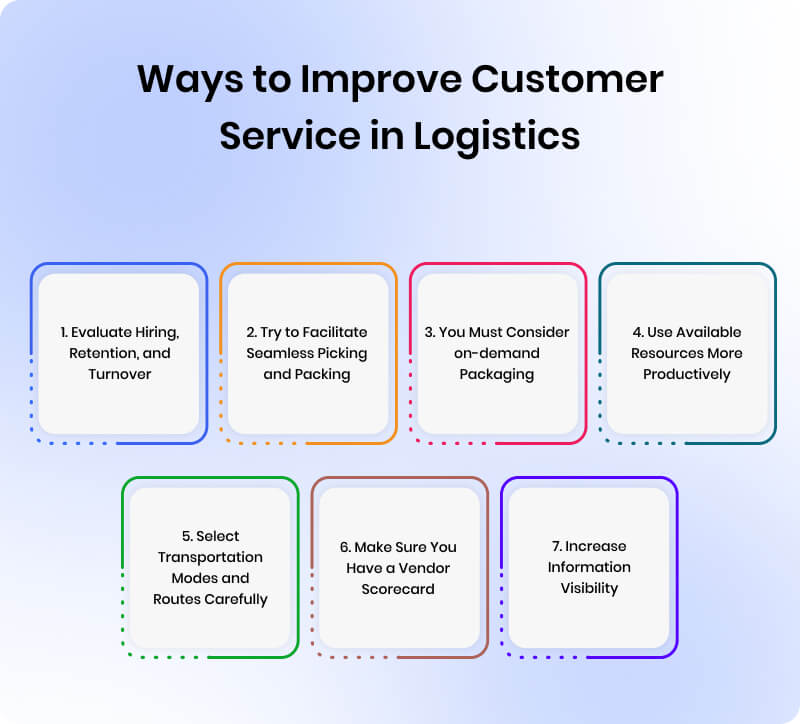
- Evaluate Hiring, Retention, and Turnover
- Try to Facilitate Seamless Picking and Packing
- You Must Consider on-demand Packaging
- Use Available Resources More Productively
- Select Transportation Modes and Routes Carefully
- Make Sure You Have a Vendor Scorecard
- Increase Information Visibility
Here are some of the great ways to deliver effective customer service in logistics.
1. Evaluate Hiring, Retention, and Turnover
You may well know what to do regarding the continuous work loss rate and how dangerous it can be for your company’s future but are you ready for the grim truth? It won’t turn any better overnight. You’ll have to take note of some vital factors to effectively address the issue and increase the retention rate straight away.
There are two fundamental parts where loss can turn into a real risk for you. The first one is high worker turnover, and the other one is dissatisfaction that takes after high worker loss.
Here are possible solutions to decrease dissatisfaction and keep your workers:
- Acknowledge that your staff is not just other assets. They are individuals.
- Create a sound money-related arrangement and treat your staff with respect.
- Make a culture in which there’s passionate cooperation.
- Learn to comprehend your workers’ necessities. Give them trust and influence over their own particular development.
- Fulfill the requests that you make to your staff and give reasons for why you make these requests.
2. Try to Facilitate Seamless Picking and Packing
The picking process plays a significant role in the customer experience of your warehouse. The picking and packing procedure has a greater effect on the overall customer experience than most organizations think. There are three major components of the order and supply chain process that affect the customer experience:
Shippers and receivers must keep the client or receiver apprised of the status of an order. Packaging orders and products inside the containers should be planned. Picking an item should be easy to do and fast.
3. You Must Consider on-demand Packaging
Logistics customer service improvements have been a hot topic lately throughout supply-chain and e-commerce circles. On-demand bundling is the practice of bundling supply chain orders and putting them in a container or truck together with the intent of shipping them to a common location. This can save money and time, improve safety, and reduce leakage.
4. Use Available Resources More Productively
The cost of logistics is growing every year. This is due to the fact that more and more work is performed by specialized logistics personnel who are trained to perform certain activities.
The fact is that the number of crates and boxes grows, as does the number of documents, customs formalities, etc. If you are even thinking about how to optimize your logistics, you should really think about using available resources productively.
5. Select Transportation Modes and Routes Carefully
This can be a challenge if you own a global logistics company because you have customers in many different places. You need to know the right mode of transportation to use when moving goods and the luggage or containers in which to transport them.
Most businesses focus solely on speed and cost when choosing their transportation methods. But there’s more to it – the logistics of getting things to customers.
By paying attention to how the packages are transported, companies can improve customer service by addressing priorities like safety, accounting for weather conditions, and being proactive about damage or theft.
6. Make Sure You Have a Vendor Scorecard
It helps you identify, measure and manage their performance. As a buyer, you will be able to measure your suppliers by using the data from surveys. The vendor scorecard allows you to visualize the current state of your business relationship with those suppliers.
A good vendor scorecard enables you to optimize the performance of suppliers through regular communication and data analysis.
For example, the scorecard allows you to measure how easy it is for their delivery and distribution managers to order their goods, as well as monitor their performance in relation to timely delivery and quality of products or services rendered.
7. Increase Information Visibility
The worldwide logistics industry has seen a huge growth in the past decade, with an increase in the number of goods transported each year.
The worldwide logistics industry has seen huge growth in the past decade, with an increase in the number of goods transported each year. In North America alone, the value of American imports has increased by 60 percent while imports from China have increased by over 300 percent.
And globally, last year’s volume of international freight traffic rose to 3.3 trillion tons. This growth means that logistics companies and their service providers are handling more cargo than ever before, with more destinations and modes of transport to manage.
To tackle this, incorporating logistics management software into operations is a pivotal aspect of enhancing information visibility within the logistics industry. It will help them to achieve real-time tracking of shipments, predictive analytics for more accurate delivery estimations and supply chain optimization to identify and address inefficiencies.
Customer Service Metrics for Logistics Companies
Logistics companies should measure both operational performance and the quality of customer support. The following metrics can help identify service gaps.
First Response Time
First response time measures how long customers wait before receiving an initial response. Faster responses reassure customers that their issue has been received, especially during delays or delivery disruptions.
Average Resolution Time
This measures how long it takes to fully resolve a customer issue. It can be tracked by complaint type, such as address changes, damaged shipments, missing packages, or failed deliveries.
First Contact Resolution
First contact resolution shows the percentage of customer problems solved during the first interaction. A low rate may indicate that agents lack access to information, authority, or the right tools.
Customer Satisfaction Score
A customer satisfaction survey can be sent after a support conversation or case resolution. It helps measure how customers feel about the service they received.
On-Time Delivery Rate
Although this is primarily an operational metric, it directly affects customer satisfaction. It measures the percentage of shipments delivered within the promised timeframe.
Delivery Exception Rate
This tracks the percentage of shipments affected by delays, address problems, damage, failed attempts, or other exceptions. Reviewing this metric alongside complaint data can reveal the causes of customer dissatisfaction.
Ticket Reopen Rate
A reopened ticket often means that the original solution was incomplete or the issue returned. A high reopen rate may indicate poor communication or weak case ownership.
Customer Effort Score
Customer effort score measures how easy it was for the customer to get help. Logistics companies should aim to reduce transfers, repeated explanations, unnecessary forms, and long waits.
Example of Good Customer Service in Logistics
Suppose a shipment scheduled for Tuesday is delayed because of severe weather.
A poor customer experience would be to leave the tracking status unchanged and wait for the customer to call.
A better approach would be to:
- Detect the delay through the delivery or transport management system.
- Notify the customer before the expected delivery time.
- Explain the cause of the delay.
- Provide a revised delivery estimate.
- Offer an easy way to speak with support.
- Send another update if the estimated timeline changes.
- Confirm when the shipment has been delivered.
The company may not have been able to prevent the delay, but it can still create a positive service experience through transparency, accountability, and timely communication.
How REVE Chat Can Improve Customer Service in Logistics
REVE Chat enables logistics companies to manage customer conversations across live chat, messaging channels, and other digital touchpoints from a unified platform.
A logistics business can use REVE Chat to:
- Answer shipment and delivery questions through live chat
- Provide 24/7 responses to common inquiries with an AI Agent or chatbot
- Collect tracking numbers and customer details automatically
- Guide customers through address changes, delivery requests, and complaint submission
- Route complex cases to the appropriate human agent or department
- Create tickets for lost, delayed, or damaged shipments
- Maintain a complete history of customer conversations
- Support customers through channels such as websites, WhatsApp, Facebook, and Instagram
- Send proactive updates or targeted WhatsApp notifications
- Monitor conversations and agent performance from one platform
For example, an AI Agent can collect a customer’s tracking number, identify that a shipment has been delayed, explain the latest status, and transfer the conversation to a human agent when compensation, redelivery, or further investigation is required.
This combination of automation and human support helps logistics companies respond faster without removing the human assistance customers need during complex or sensitive situations.
So, what are you waiting for? Sign up now and enjoy 14 days free trial.
Frequently Asked Questions
Customer service in logistics refers to the support provided to customers before, during, and after the movement of goods. It includes answering shipping questions, providing delivery updates, resolving shipment problems, managing complaints, and coordinating with operational teams.
Customer service helps logistics companies build trust, retain customers, protect their reputation, and differentiate their services. It is especially important when shipments are delayed, lost, damaged, or affected by unexpected disruptions.
Common issues include shipment delays, damaged goods, missing packages, inaccurate tracking information, incorrect delivery addresses, failed delivery attempts, poor communication, and slow complaint resolution.
They can improve communication by sending proactive notifications, providing real-time tracking, offering omnichannel support, maintaining consistent information across departments, and clearly explaining delays and next steps.
AI can answer routine questions, collect tracking information, provide shipment updates, classify customer requests, create tickets, and route complex issues to human agents. Human support should remain available for complaints, claims, urgent cases, and sensitive conversations.
Important metrics include first response time, resolution time, first contact resolution, customer satisfaction, customer effort score, ticket reopen rate, on-time delivery rate, and delivery exception rate.
A good logistics customer service agent communicates clearly, listens carefully, remains calm under pressure, understands logistics processes, takes ownership of cases, and provides accurate updates. Agents should also know when to escalate an issue or involve an operational team.
Build AI-powered support with Wize AI
Connect business knowledge, automate support conversations, and improve response quality without managing a complex AI stack.
Explore Wize AI Agent Rate the article

Juwel Rana
Senior Content Writer
Juwel is a Sr. Content Writer at REVE Chat. He specializes in writing about customer service and customer engagement. He is passionate about helping businesses create a better customer experience.
He strongly believes that businesses will be able to understand their customers better and ultimately create more meaningful relationships with them.
View all articles