


Customer Journey Mapping: How to Create a Customer Journey Map
- August 10, 2026
- 16 mins read
- Listen
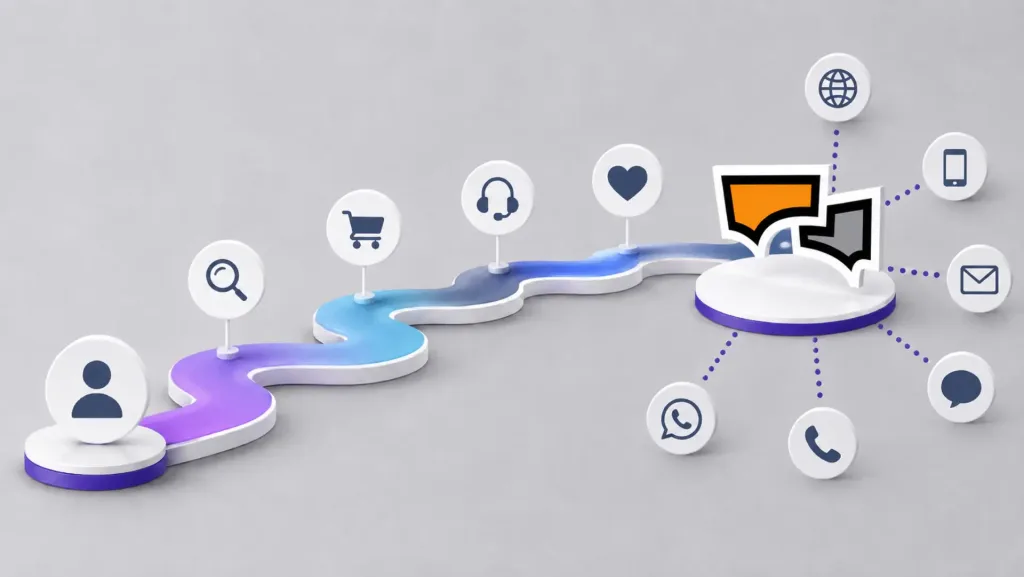
Customer journey mapping is the process of visualizing how customers interact with a business while working toward a specific goal. It helps companies understand customer actions, expectations, emotions, and pain points across different stages. Modern journeys are often complex because customers move between websites, social media, email, live chat, mobile apps, sales teams, and support channels.
A well-designed journey map helps businesses identify gaps, improve important touchpoints, and create a more consistent experience. This guide explains the key components, stages, map types, creation process, and ways to turn journey insights into meaningful improvements.
What Is a Customer Journey Map?
A customer journey map is the visual representation that deals with the end-to-end experience of a customer persona with a brand, product, or service. It starts with defining the specific goals and expectations that drive a customer’s journey, which are also informed by data-driven personas.
The map shows the sequence of customer actions across multiple channels where tangible interactions occur. Within the specific timeline, the map captures the internal questions and decisions made by the customer, along with how the company responds at each stage.
Additionally, it maps the customer’s emotions as well, visualizing the psychological ups and downs to reveal hidden pain points like bottlenecks, errors, or unmet needs.
These insights are organized by the customer journey map, with which businesses can identify high-impact opportunities for improvement. It allows teams to optimize processes, reduce friction, and foster a more customer-centric culture that ultimately drives better business results and retention.
Why Is Customer Journey Mapping Important?
Customer journey mapping transforms how a business understands and interacts with its target audience. Here’s an elaboration on the importance of this process:
1. Understand the Experience From the Customer’s Perspective
Customer journey mapping forces businesses to step into their customer’s shoes and see their own brand from an external point of view. This is significant because companies often have the institutional knowledge customers lack, leading to a disconnect in how products are actually used as opposed to how they were intended.
2. Identify Pain Points and Journey Drop-Offs
The mapping process identifies the pain points of the customer experience. By examining the sequential actions, businesses pinpoint specific bottlenecks, errors, or areas of frustration that might otherwise go unnoticed.
Very importantly, it helps determine if the particular friction is merely an annoyance or a major bottleneck causing drop-offs and abandonment of the entire buying journey.
3. Prioritize High-Impact Touchpoints
Not all interactions are equal; journey mapping helps identify the moments that matter the most. By focusing on the high-impact touchpoints, organizations can prioritize their efforts and investments to ensure they are fixing the most critical issues first.
4. Align Marketing, Sales, Product, and Support Teams
One of the greatest internal benefits of customer journey mapping is that it breaks down departmental isolations and creates a shared mental model with a common language across the organization. This internal alignment establishes a customer-centric culture where business decisions are made based on unified insights rather than fragmented departmental goals.
5. Improve Personalization and Omnichannel Engagement
Modern consumers often use more than three different channels to communicate with businesses, which makes the customer journeys highly complex. Mapping these interactions enables omnichannel marketing and service by ensuring that a customer who interacts with a social media ad receives a consistent, contextualized experience when they later visit the website or contact support.
6. Improve Onboarding, Retention, and Loyalty
A well-mapped customer journey helps businesses improve onboarding so new users can achieve their goals faster. It also tracks what happens after the purchase, helping companies provide better support, build loyalty, and encourage repeat business.
Key Components of a Customer Journey Map
Here’s an elaboration of the key components of the customer journey map.
1. Customer Persona
A customer persona is a research-based profile of a specific audience group. It shows the customer’s needs, goals, motivations, behaviors, and challenges. A useful persona may also include details such as job role, professional goals, and product expectations. These profiles should be based on real customer interviews and business data rather than internal assumptions.
2. Journey Scenario and Goal
A journey scenario explains the specific situation taking place along with the customer’s goal. This could be buying a product, solving a support issue, or renewing a subscription. It may reflect a current process or a future experience the business plans to create. Predicting the scenarios and goals helps businesses understand customer expectations and measure whether the journey successfully meets their needs.
3. Journey Stages
From initial contact to long-term advocacy, journey stages are the phases that organize the timeline of a customer’s experience. While these vary by industry, common phases include Awareness, Consideration, Decision, Onboarding, and Loyalty.
4. Customer Actions
Customer actions represent the tangible behaviors and steps a persona takes throughout each journey phase. Tracking these actions allows companies to see if customers are taking unexpected detours or following the intended path.
5. Touchpoints and Channels
Touchpoints are every instance where a customer comes into direct contact with the brand, while channels are the platforms where these interactions occur, such as social media, email, live chat, or physical stores. Identifying touchpoints helps spot inconsistencies in communication.
6. Customer Questions and Expectations
This component captures the internal thoughts and needs for information of a persona at different stages of their journey. Customer expectations are shaped by prior experiences, industry norms, and competitors’ offerings. Understanding the inner stream of thoughts helps businesses meet users where they are and provide the right information before it is even asked for.
7. Emotions and Sentiment
Mapping emotions and sentiment adds a psychological layer to the journey. The sentiment analysis visualizes feelings such as excitement, confusion, or frustration. These significant moments define the overall memory of the brand; getting them right is critical for driving loyalty.
8. Pain Points
Pain points are specific instances of friction, such as bottlenecks, errors, or unmet needs, that disrupt the customer’s progress towards their goal. Identifying these frictions is a primary goal of journey mapping, as it reveals why customers might abandon their carts or switch to a competitor.
9. Business Response and Opportunities
The business response looks at the internal systems, processes, and teams that support the customer experience. This helps businesses find the real causes of problems, such as poor coordination between departments or limited resources.
Common Stages of the Customer Journey
The stages of the customer journey are:
1. Awareness
In the Awareness stage, a customer becomes aware of a problem that requires a solution. They may discover a brand or product through marketing efforts, social media ads, or independent research.
2. Consideration
During the consideration stage, customers evaluate their options by conducting detailed research. They often read online reviews, compare features across different websites, or consult friends to narrow down choices.
3. Decision or Purchase
In the decision stage, the customer finally selects a solution and completes a purchase. Actions here might include signing up for a trial, booking a demo, or using a digital storefront to finalize the transaction
4. Onboarding and Adoption
In the onboarding and adoption phase, the customer begins using the product or receiving the service. The business now focuses on guiding the user to ensure they receive value quickly and effectively.
5. Retention and Support
During retention and support, companies provide ongoing customer service and troubleshooting to help users resolve problems. The goal is to maintain the relationship by ensuring the customer continues to receive value from the product.
6. Loyalty and Advocacy
The final stage, loyalty and advocacy, involves transforming satisfied users into long-term stakeholders. These customers enter a loyalty loop, where they choose to renew or purchase again based on positive past experiences. Ultimately, these individuals become brand advocates who recommend the company to others or leave positive public reviews.
Learn More: B2B Customer Journey Map with Stages & Examples
Types of Customer Journey Maps
Let’s elaborate on the types of customer journey maps:
1. Current-State Journey Map
A current-state map visualizes the actions, thoughts, and emotions customers experience today while interacting with your company. This is the most common type used to diagnose existing friction, bottlenecks, and unmet needs. By portraying reality as it presently exists, teams can pinpoint specific challenges and prioritize improvements for their existing products and services.
2. Future-State Journey Map
Future-state maps project the ideal experience a company aims to create for its customers in the future. These strategic visualizations are essential for redesigns, transformation projects, or launching visionary new offerings. By focusing on what should be, they allow organizations to set benchmarks for improvement and align cross-functional teams around long-term strategic goals.
3. Day-in-the-Life Journey Map
This map captures a persona’s wider daily activities and circumstances, including interactions occurring outside your specific brand. It provides a broader lens into the customer’s world, revealing how a product fits into their overall routine
4. Service Blueprint
A service blueprint connects visible customer experiences with backstage internal systems, people, and workflows. This strategic tool is best for discovering root causes of friction and streamlining the complex organizational processes required to deliver customer value
How to Create a Customer Journey Map in 8 Steps
Creating an effective customer journey map requires more than listing customer touchpoints. It should be based on real customer data and focused on a specific goal. Here are the eight steps to build a journey map that helps your business identify problems and improve the customer experience.
Step 1: Define the Objective and Scope
Start by deciding why you are creating the map. Identify the problem you want to solve, the specific journey you want to study, and where that journey begins and ends.
You should also determine which customer persona the map represents and what that customer is trying to achieve. For example, you may map the journey of a first-time buyer completing a purchase or a new user setting up an account.
Step 2: Collect Customer Research and Data
A reliable journey map should be based on real customer behavior rather than internal assumptions. Use both qualitative and quantitative data to understand what customers experience.
Useful sources include:
- Customer interviews
- Surveys and feedback
- Website analytics
- Funnel and conversion data
- CRM records
- Sales call notes
- Live chat and call transcripts
- Support tickets
- Search queries
- Customer reviews
- Churn and retention data
Combining these sources helps reveal what customers do, what they expect, and where they face difficulties
Step 3: Select or Create the Customer Persona
Choose the customer persona whose journey you want to map. The persona should represent a specific audience segment with shared goals, needs, behaviors, and challenges.
Avoid combining several customer groups into one map. If customers use different channels, have different expectations, or follow different paths, create a separate journey map for each group.
Step 4: Define the Journey Stages
Divide the customer’s journey into clear and logical stages. These stages should reflect how the customer experiences the process rather than how the company organizes its departments.
Common stages may include awareness, consideration, purchase, onboarding, support, retention, and advocacy. However, the exact stages will depend on the journey being mapped.
For example, a support journey may include identifying a problem, searching for help, contacting support, resolving the issue, and providing feedback.
Step 5: Map Actions, Touchpoints, and Channels
For each stage, document what the customer does and how they interact with the business.
Consider:
- What action does the customer take?
- Where does the interaction happen?
- What information do they receive?
- What questions or decisions arise?
- How does the company respond?
Touchpoints may include websites, emails, social media, live chat, phone calls, mobile apps, advertisements, sales representatives, or physical locations.
This step helps businesses understand how customers move between different channels throughout the journey.
Step 6: Add Expectations, Emotions, and Pain Points
Next, examine how customers feel at each stage. Identify what they expect, where those expectations are met, and where the experience causes confusion or frustration.
Look for:
- Moments of confidence or satisfaction
- Points of uncertainty
- Delays or unnecessary steps
- Missing information
- Inconsistent communication
- Stages where customers may abandon the journey
You can add a sentiment line to the map to show emotional highs and lows. Sudden drops in sentiment often reveal important pain points, while positive peaks show which parts of the experience are working well.
Step 7: Identify and Prioritize Opportunities
Once the pain points are clear, identify practical ways to improve the journey. Avoid choosing solutions before fully understanding the cause of each problem.
For every major pain point, evaluate:
- Its impact on the customer
- How often does it occur
- Its impact on the business
- The effort required to solve it
- The team responsible
- The possible improvement
For example, a high checkout abandonment rate may lead to opportunities such as simplifying the form, offering real-time assistance, or providing clearer delivery information.
Prioritizing opportunities helps the business focus resources on improvements that can create the greatest impact.
Step 8: Validate, Implement, and Update the Map
Before treating the journey map as final, validate it with customers and employees who regularly interact with them.
Use:
- Customer feedback
- Frontline employee insights
- Website and product analytics
- Sales and support data
- Usability testing
- Journey testing
After validation, assign responsibility for each improvement and begin implementing the most important changes. Track relevant metrics to determine whether the changes improve the journey.
How to Turn Journey Map Insights Into Action
A customer journey map is only valuable when it leads to real improvements. Once the journey has been mapped, businesses should identify the most important problems, assign responsibility, measure results, and continue refining the experience.
1. Prioritize Moments That Matter
Not every touchpoint has the same impact on the customer. Focus first on moments that strongly influence purchase decisions, satisfaction, abandonment, retention, or loyalty. By prioritizing improvements at these critical junctures, organizations ensure they are making the highest-impact investments to influence purchase decisions, satisfaction, and long-term loyalty
2. Connect Frontstage and Backstage Processes
Internal systems and processes often cause customer-facing problems. A delayed response may result from unclear team ownership, disconnected tools, limited resources, or an inefficient approval process.
For each major pain point, identify the internal process, policy, system, or team responsible for it. This helps the business solve the root cause rather than only address the visible problem.
3. Assign Owners to Improvements
Every improvement should have a responsible team or individual. Without clear ownership, journey map findings may remain as ideas without being implemented.
For example, the product team may own onboarding improvements, while the support team may handle response-time issues. Clear responsibilities also make it easier to track progress and maintain accountability.
4. Define Success Metrics
Choose metrics that show whether the changes are improving the journey. The right metrics will depend on the stage and problem being addressed.
Common metrics include:
- Conversion rate
- Checkout abandonment
- Demo bookings
- First response time
- Resolution time
- Customer satisfaction
- Onboarding completion
- Product adoption
- Retention
- Renewal
- Churn
Set a baseline before making changes so you can compare performance afterward.
5. Test and Continuously Improve
Customer journeys are not static; they must be validated and iterated over time. Before rolling out major changes, businesses should pilot them with smaller groups, develop a hypothesis about how a specific change will address a functional or emotional need, and compare performance before and after implementation. Regular audits and monthly or quarterly updates ensure the map stays aligned with evolving customer behaviors and market conditions
How REVE Chat Helps Improve Omnichannel Customer Journey Touchpoints
Customer journey mapping for omnichannel experiences is a methodology for outlining the various routes customers take across digital and physical platforms, ensuring that no customer slips through the cracks as they move between separate channels. REVE Chat provides a suite of tools designed to optimize such omnichannel customer journey touchpoints by integrating AI automation with real-time human assistance.
1. Bring Customer Conversations Into a Unified View
REVE Chat’s Smart Single Inbox consolidates omnichannel conversations from websites, WhatsApp, Facebook Messenger, Instagram, and email into one dashboard. This unified view eliminates fragmented interaction histories, providing a full conversation history that ensures continuity even when a customer switches channels.
2. Engage Customers at High-Intent Touchpoints
To capture customers during critical moments, REVE Chat offers Advanced Monitoring to track live visitors, browsing behavior, and activity in real-time. This allows businesses to proactively engage high-intent users through Live Chat at the precise moment they may need assistance. Additionally, AI Agents can be deployed to instantly automate support and sales conversations, ensuring no high-intent inquiry is lost due to response delays.
3. Identify Recurring Questions and Friction
REVE Chat’s Contact Manager stores customer profiles and interaction details, which can be analyzed alongside support logs to reveal behavioral patterns. AI-powered features like Sentiment Detection & Analysis help identify emotional lows, while AI Copilot provides summaries of long chat sessions to help teams quickly understand the context of recurring friction.
4. Guide Customers Through Complex Processes
Co-browsing allows agents to virtually guide customers through their website journey in real-time, using on-screen drawing and mouse pointer visibility to clarify intent while masking sensitive data. Video Calls can be launched directly from a chat session to provide high-touch consultations or demos, helping to resolve issues that text-based communication cannot easily address.
5. Combine AI Assistance With Human Support
REVE Chat allows businesses to automate routine interactions while maintaining a path for human intervention. Wize AI Agents can handle up to 85% of standard inquiries, such as FAQs and product recommendations, freeing up staff for critical tasks.
For complex or sensitive issues, the system facilitates a Human Handover, transferring the customer to a live agent with the complete chat history and context intact. Throughout this process, AI Copilot assists human agents with real-time suggested replies and knowledge base recommendations to improve the accuracy and speed of their response.
Final Thoughts
Customer journey mapping helps businesses understand and improve their customers’ experiences. By creating a visual representation of the steps a customer takes in their interactions with a company, businesses can identify pain points, opportunities for improvement, and ways to create more value for their customers.
It allows businesses to see their customer interactions from the customer’s perspective. This can help businesses identify areas where they are falling short and make changes to better meet the needs of their customers.
As we’ve discussed, REVE Chat helps businesses strengthen these important touchpoints through Live Chat, Wize AI Agent, omnichannel messaging, co-browsing, and video chat. With real-time assistance and connected customer conversations, teams can reduce friction and provide a smoother experience across the journey.
Try out REVE Chat by starting your free trial or booking a demo.
Frequently Asked Questions
Common customer journey stages include awareness, consideration, purchase, onboarding, support, retention, and advocacy.
Customer persona, scenario, goal, journey stages, actions, touchpoints, channels, expectations, emotions, pain points, business responses, and opportunities for improvement; these components should be included in a customer journey map.
Customer journey mapping helps businesses understand the experience from the customer’s perspective. Customer journey mapping is important for creating more consistent customer experiences that can support conversion, satisfaction, retention, and loyalty.
A customer journey map should be reviewed regularly and updated whenever customer behavior, products, services, channels, or business processes change.