




Table of Content
AI SUMMARY
Quick Answer
Customer engagement is essential for building stronger relationships, improving satisfaction, and encouraging long-term loyalty. Businesses can increase customer engagement by understanding customer needs, personalizing interactions, providing real-time support, and connecting communication across multiple channels. Effective strategies include proactive messaging, useful content, customer feedback, loyalty programs, and AI-powered automation. Measuring engagement through conversion rates, retention, customer satisfaction, and lifetime value helps businesses evaluate performance. Solutions like REVE Chat combine live chat, Wize AI Agent, and omnichannel communication to deliver timely, relevant, and consistent customer experiences.
Effective customer engagement starts with relevant, timely, and useful interactions. Promotional messages or marketing campaigns are not the only way for customer engagement.
Websites, live chat, messaging channels, negotiations, and support are all involved in increasing customer engagement.
The goal of engagement for businesses is to keep customers interested and informed in their journey with a connected experience. It involves understanding customer needs, reaching them through the right channels, personalizing responses, and responding at the right time.
This article explains how to increase customer engagement using strategies, examples, and marketing and retail approaches.
What Is Customer Engagement?
Customer engagement is the interaction between a business and its customers throughout their consumer journey. These interactions can happen before, after, and during a purchase, and across different channels.
Communication can be initiated by both sides. A customer might read a blog or be interested in a product and reach out to the business. The business can also initiate through proactive chats.
However, customer engagement goes beyond simply reaching out to people with messages. Strong customer engagement results in buyers being truly meaningfully engaged, good enough to respond, participate, continue conversations, and take further action.
Why Increasing Customer Engagement Matters
Increasing customer engagement ensures more opportunities to understand and support more and more customers, helping businesses to build stronger relationships.
When customers regularly have useful and relevant interactions with a business, they are more likely to stay connected, return for future purchases, and develop greater trust in the brand.
Stronger engagement improves customer satisfaction and retention. More conversations, back-and-forth feedback, and support interactions allow businesses to learn about customers’ needs, their difficulties, and their expectations of the business. It creates an opportunity to improve business functions for customers.
Sales and marketing teams also benefit from increased customer engagement. It identifies customer interests, answers questions, nurtures prospects, and moves potential buyers towards conversion.
For customer service and success teams, it helps maintain relationships after the sale and encourages long-term loyalty and advocacy.
10 Strategies to Increase Customer Engagement
A combination of understanding, personalization, timely communication, helpful content, and consistent experiences across the customer journey becomes an effective customer engagement strategy.
1. Understand What Your Customers Actually Need
Strong engagement starts with knowing what customers expect from your business. You can learn that from customer research, behavioral data, purchase history, support conversations, and feedback. This can reveal what customers are interested in, where they struggle, and what motivates them to take action.
Customer journey analysis identifies important moments where people need information or assistance. For instance, repeated questions about delivery during checkout may indicate that shipping information needs to be easier to find.
Instead of treating every customer the same way, segment them according to characteristics such as interests, purchase behavior, lifecycle stage, or previous interactions.
2. Personalize Customer Interactions
Personalization should go beyond adding a customer’s name to an email. Relevant engagement can be shaped by what customers browse, purchase, ask about, or have interacted with previously.
Existing customers may benefit from suggestions related to previous purchases, while someone who recently contacted support may need follow-up information related to that conversation.
Customer history, where they are in their journey, what they browse, and past support issues can all help you understand them better. When your messages match what the customer is trying to do, engagement feels more relevant and useful.
3. Create an Omnichannel Customer Experience
Customers frequently interact with businesses through more than one channel. Someone may discover a product on social media, visit the website, ask a question through live chat, receive an email, and later contact the business through WhatsApp.
An effective omnichannel customer engagement strategy connects these interactions instead of treating each channel separately. Customers should not have to repeatedly explain the same issue or restart their journey every time they switch channels.
4. Make Real-Time Customer Conversations Easier
Some customer questions are most valuable when they are answered right away. Live chat and messaging make it easy for customers to get quick answers while they are still on your website or app.
This allows sales teams to support customers during important buying decisions and helps support teams solve problems before customers become frustrated or leave.
Easy access to support removes confusion, speeds up decision-making, and keeps customers engaged at the moment they are most interested.
5. Engage Customers Proactively at the Right Moments
Businesses do not always have to wait for customers to initiate engagement. Relevant proactive communication can encourage interaction when customer behavior suggests that assistance or information may be useful.
Timing is important. Sending more notifications does not automatically create better engagement. Too many irrelevant messages can have the opposite effect.
Proactive engagement should therefore be connected to meaningful customer behavior, lifecycle stages, or specific actions.
6. Provide Useful Content Throughout the Customer Journey
Helpful content gives customers another reason to continue interacting with a business. However, the type of information they need may vary as they move through the buying journey.
A first-time visitor may benefit from educational blogs, guides, or videos that help them understand a problem. Someone evaluating a purchase may need product comparisons, FAQs, demonstrations, or detailed feature information.
On the other hand, existing customers may rely more on tutorials, knowledge bases, webinars, and troubleshooting resources.
7. Improve Customer Onboarding
Customer engagement does not end once someone signs up or completes a purchase. The onboarding stage is often one of the first opportunities to build a longer-term relationship.
Welcome messages, tutorials, guided product adoption, FAQs, knowledge resources, and proactive assistance can help new customers understand how to get value from their purchase.
8. Collect Customer Feedback and Act on It
Customer feedback provides a direct view into what people value and where their experience can improve. Businesses can collect it through surveys, reviews, support conversations, social media, post-interaction questionnaires, and direct customer discussions.
Recurring complaints may reveal a problem in the customer journey, while repeated feature requests or questions can highlight opportunities to improve products, services, or content. Businesses can also close the feedback loop by informing customers when important changes have been made.
9. Build Loyalty Beyond the First Purchase
A customer’s first conversion should be the beginning of continued engagement rather than the end goal. Businesses can maintain the relationship through loyalty programs, personalized offers, customer communities, referrals, milestone messages, and relevant re-engagement campaigns.
Businesses should also recognize customers at different stages of the relationship instead of directing all efforts toward acquiring new buyers. Maintaining useful communication with existing customers can support stronger retention, repeat business, and long-term loyalty.
10. Use AI and Automation Without Losing Human Interaction
AI and automation make it easier to increase customer engagement without requiring human teams to manually manage every interaction. They can provide around-the-clock responses, answer common questions, identify customer intent, personalize communication, and trigger engagement based on customer behavior.
At the same time, not every conversation should remain automated. Human interaction has its own value and familiarity. Complex problems, sensitive situations, detailed consultations, and high-value interactions will require human judgment and deeper assistance.
KEY TAKEAWAY
How to Increase Customer Engagement
Increase customer engagement through personalized experiences, timely support, omnichannel communication, and AI automation to build stronger relationships, improve satisfaction, and encourage long-term loyalty.
How to Increase Customer Engagement in Marketing and Retail
How businesses increase customer engagement depends on the context. Marketing focuses on delivering relevant communication, while retail engagement centers on product discovery, purchasing, and post-purchase experiences.
In both marketing and retail, engagement improves when businesses genuinely and considerately respond to customers instead of sending generic messages.
In marketing, engagement often comes from sending the right message at the right time. In retail, engagement happens at every step of the shopping experience.
After the purchase, order updates, related product reminders, and loyalty rewards help keep them connected to the brand. Even after the sale, thoughtful follow-ups and relevant offers can turn a one-time buyer into a returning customer.
Across both marketing and retail, the goal is to make every interaction count.
How to Measure Customer Engagement
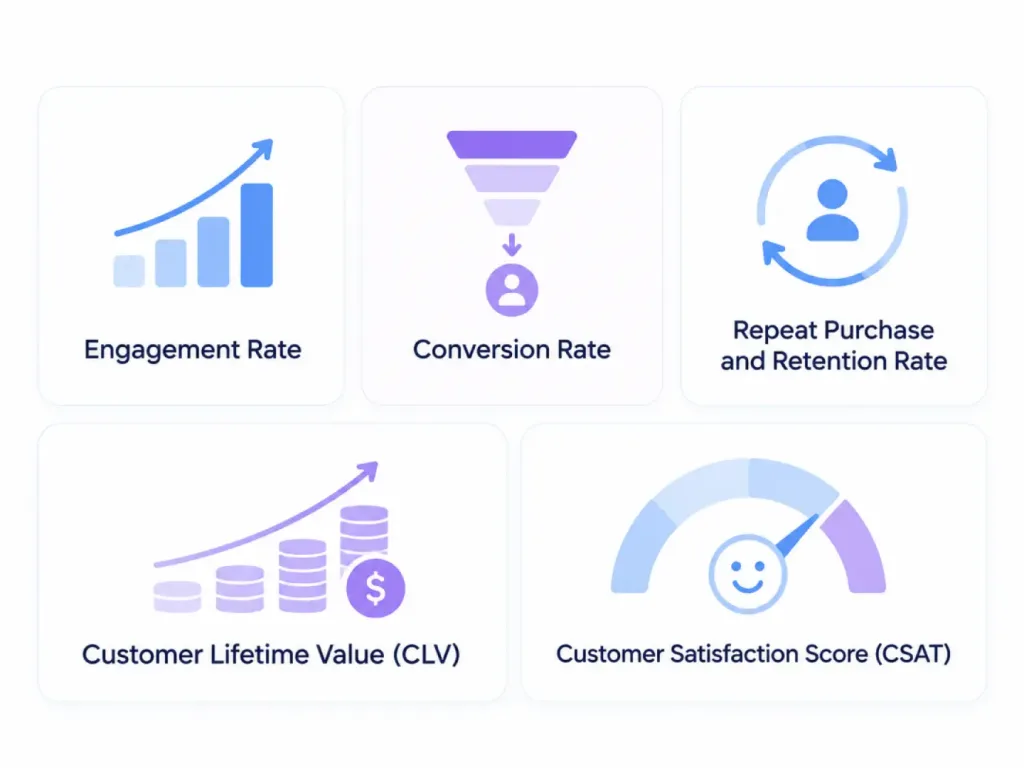
A combination of behavioral, transactional, and experience-based metrics can help measure the results of customer engagement:
Engagement rate: Shows how actively customers interact with content, campaigns, or digital experiences.
Conversion rate: Measures how many engaged customers complete a desired action, such as making a purchase or booking a demo.
Repeat purchase and retention rate: Indicate whether customers continue buying from or staying with the business over time.
Customer lifetime value (CLV): Helps assess the long-term value of the customer relationship.
CSAT (Customer Satisfaction Score): Measures customer satisfaction and willingness to recommend the business.
Campaign and conversation metrics: Track responses, clicks, message interactions, conversation volume, and other channel-specific activity.
How REVE Chat Helps Increase Customer Engagement
Here’s how REVE Chat helps businesses engage customers across different stages of the journey:
1. Engage Customers Instantly
Live Chat is a convenient tool from REVE Chat, allowing customers to connect with the sales or support team through the website. Agents can respond to visitors’ questions in real time, understand their requirements and intent, and guide them towards the next step.
2. Automate Customer Engagement With Wize AI Agent
Wize AI Agent provides around-the-clock availability to customers and visitors. It can understand customer queries and intent, and respond with relevant information from connected business knowledge and data sources.
Wize AI Agent can assist in areas like product discovery and recommendations, answering questions and performing support actions. The agent can also hand the conversation over to an available live agent when human involvement is a must.
3. Connect Conversations Across Channels
REVE Chat’s omnichannel inbox brings multiple messaging channels together. This allows teams to manage customer inquiries from one platform. Agents can respond in a centralized way without having to switch between channels, as they can access customer information and conversation history uniformly.
4. Reach Customers Through Proactive Engagement
Proactive engagement can be the first step in customer engagement. REVE Chat’s proactive engagement and campaigns are used to reach customers with timely messages based on relevant situations, helping encourage interaction at important points in their journey.
Conclusion
Customer engagement focuses on increasing the value and usefulness of customer interactions, making them timely, relevant, and connected throughout the journey.
Start by understanding what your customers need, then personalize their experiences, connect conversations across channels, and engage them at moments when support or information matters most.
AI and automation can help scale these efforts, while human teams add the judgment and personal support that more complex interactions require. More importantly, measure engagement regularly and use what you learn to improve your approach.
REVE Chat can help bring AI-powered automation, live chat, omnichannel communication, and human engagement together to create more connected customer experiences. Try out REVE Chat by booking a demo to know how it benefits your business to increase customer engagement.
Frequently Asked Questions
The most effective ways to increase customer engagement include personalizing interactions, providing quick customer support, creating useful content, and communicating through customers’ preferred channels.
Small businesses can improve customer engagement by responding quickly to inquiries, understanding customer preferences, and providing personalized service. Live chat, social media, email marketing, and loyalty programs can help businesses build stronger relationships
Customer engagement refers to how customers interact with a business throughout their journey, while customer satisfaction measures how pleased they are with specific experiences. Engagement involves activities such as browsing, messaging, purchasing, and providing feedback.
Businesses can measure customer engagement through engagement rate, conversion rate, repeat purchase rate, customer retention rate, and customer lifetime value (CLV). Customer Satisfaction Score (CSAT), campaign responses, and conversation metrics also provide useful insights.
Build AI-powered support with Wize AI
Connect business knowledge, automate support conversations, and improve response quality without managing a complex AI stack.
Explore Wize AI Agent Rate the article

Noshin
Sr. Content Writer
Noshin Nisa is a senior content writer at REVE Chat with 3 years of experience in blog and website content writing. Her interests include SaaS, AI Technologies, and Customer Communication. Nisa likes to stay up to date with tech trends and new updates in this field. She likes to convey meaningful communication through her writing.
View all articles