




Table of Content
AI SUMMARY
Quick Answer
This blog reviews 12 e-commerce tools across six key areas: store building, payments, inventory, marketing automation, customer support, and analytics. It explains how tools such as Shopify, Stripe, Cin7, Klaviyo, REVE Chat, Google Analytics, and Hotjar help businesses automate operations, improve customer experiences, manage sales, and support growth. It also compares limitations, pricing, integrations, scalability, and ideal use cases. The main takeaway is to choose a connected toolset based on business needs, budget, security, and future growth.
Running an ecommerce site can wear you out quickly. Customers message at odd hours with the same questions such as where’s my order, does this fit, can I return it?
Also, abandoned carts pile up because no one nudges the shopper at the right moment. Inventory gets messy, support teams burn out from repetitive chats, and personalization feels impossible when you’re handling hundreds of visitors.
You felt that frustration until you looked at AI agents that are built for eCommerce stores. They step in to answer those common queries instantly, makes sales autonomously, track orders without agents needing to dig through dashboards, and spot when someone’s about to leave without buying.
That’s why ecommerce AI agents have become essential: they’re not just chat windows anymore; they’re smart, independent helpers that think, act, and sell on your behalf 24/7.
This blog isn’t just another list of AI tools, it’s a practical, no-fluff roadmap built specifically for ecommerce owners who want real results, not hype.
If you are looking for step-by-step guidance on choosing the right agent for your store size, platform, and goals, then this blog will have all the answers you seek and suggest the right tool for your business.
What is an AI agent for ecommerce?
An ecommerce AI agent is a smart digital helper made for online stores. You get way more than a simple chatbot with fixed replies. These agents think and act on their own, grabbing your shop’s details in real-time such as product information, stock levels, order status, past purchases, and talks to customers like a real person.
A shopper asks about shipping? It checks order status and answers instantly. Someone abandons a cart? It sends a friendly reminder or a quick discount. It can also suggest matching items, handle basic returns, or guide someone to checkout.
Key Capabilities of Ecommerce AI Agents
You might wonder what sets an ecommerce AI agent apart from a regular chatbot. Here are the five core abilities that make them stand out.
1. Autonomous Action
A true AI agent doesn’t just talk, it acts on its own. It can check your inventory in real time, recommend products, send checkout links, place a reorder alert, update an order status, or even apply a discount to save a sale.
Chatbots stop at words. Agents get things done without waiting for you or a human rep.
2. Personalized Product Suggestions
Agents look at what a shopper views, what sits in their cart, and what they bought before. Then they recommend items that actually match.
Someone browsing winter coats gets shown gloves and scarves in the right size and color. Chatbots rarely pull this off because they lack deep access to your store data.
3. Full Context Memory
During a conversation, the agent remembers everything said so far. A customer mentions budget concerns early on? Later suggestions stay affordable.
They also recall past orders across visits. Chatbots often forget mid-chat or start fresh each time, leaving shoppers frustrated.
4. Multi-Step Problem Solving
Complex issues don’t scare agents. A shopper complains about a late delivery?
The agent checks tracking, explains the delay, offers a goodwill discount, and sends a follow-up message, all in one flow. Chatbots usually hand off or give generic replies when things get tricky, but an AI Agent analyzes and solves the problem instead.
5. Natural, Human-Like Conversation
Powered by advanced language models, agents chat in a relaxed, friendly way that fits your brand voice.
They handle slang, typos, long questions, and even switch topics smoothly. Regular chatbots sound stiff and break down on anything outside their script.
How We Evaluated the Best Ecommerce AI Agents?
You might wonder how we picked the top 10 ecommerce AI agents for 2026. We didn’t just grab names from popular lists or go by marketing claims.
Instead, we looked closely at what actually matters for real online stores such as features that solve daily problems, drive sales, and handle growth without constant fixes.
- Real Autonomous Capabilities: We checked if the agent truly acts on its own, like checking inventory, applying discounts, processing returns, or updating orders without human help. Basic scripted responses didn’t count, only tools with agentic behavior made the cut.
- Proactive Engagement and Sales Impact: Top agents watch shopper behavior in real time and step in with timely messages, product suggestions, or cart reminders. We favored ones that prove direct revenue wins through upsells, cross-sells, and recovered carts.
- Omnichannel and Global Reach: Customers contact you across websites, WhatsApp, social media, and more. We scored high on tools that manage multiple channels from one place and offer built-in multilingual translation for easy international expansion.
- Seamless Integration and Customization: Tight connections to platforms like Shopify, WooCommerce, or custom setups were essential. No-code builders, webhook support, and fast training on your product data got extra points for quick setup and exact fit.
- Human Handoff and Advanced Support Tools: When automation hits a limit, context must pass smoothly to live agents. We valued extras like co-browsing, video chat, and image/video processing for handling complex issues naturally.
- Analytics and Measurable Results: Clear dashboards showing conversation outcomes, sales from chats, resolution rates, and recovered revenue helped separate serious tools from basic ones. We looked for proof of real business impact.
- Scalability, Reliability, and Value: Agents had to handle traffic spikes without crashing or surprise costs. Security compliance, uptime, and fair pricing for growing stores played a big role. User feedback from actual merchants weighed heavily too.
We based rankings on hands-on testing, merchant reviews, and performance data to bring you options that genuinely move the needle for ecommerce businesses.
What You Need in an AI Agent Built for Ecommerce?
Your ecommerce store runs on speed, personalization, and trust, shoppers won’t stick around if things feel slow or generic. A solid AI agent needs to do more than chat; it has to think, act, and sell like part of your team.
Here are the five most important things to look for in 2026.
1. True Autonomy and Independent Action
The agent must handle tasks on its own without waiting for you or a human to approve every step. It checks live inventory, applies the right discount to save a sale, updates order status, processes simple returns, or even flags low stock for reorder.
This cuts down on manual work and keeps operations moving fast. So you capture sales that would otherwise slip away during busy times or late nights.
2. Proactive Engagement That Drives Sales
Look for an agent that watches shopper behavior in real time and jumps in naturally, someone lingers on a product? It starts a helpful chat. Cart abandoned? It sends a gentle reminder with a personalized nudge.
Strong built-in recommendation logic pulls from browsing history, cart items, and past purchases to suggest add-ons that actually fit. These proactive touches turn browsers into buyers and lift average order values without feeling pushy.
3. Deep Integration with Your Store Systems
The agent has to connect tightly to your platform such as Shopify, WooCommerce, BigCommerce, and pull real-time data like stock levels, order details, customer history, or pricing.
It should also link to CRM, payment gateways, or shipping tools through APIs and webhooks. Without this, answers stay generic, and you miss chances for accurate tracking, personalized offers, or seamless actions that build trust.
4. Omnichannel Reach and Multilingual Support
Customers reach out on website chat, WhatsApp, Instagram, Facebook, email, or even voice calls. A good agent manages all those channels from one dashboard and switches smoothly between them.
Built-in real-time translation for dozens of languages lets you sell globally without extra staff. This keeps every shopper feeling welcomed and supported, no matter where or how they connect.
5. Seamless Human Handoff with Advanced Tools
Automation handles most things, but some issues need a person. The agent should pass the full context instantly, no repeating questions, plus extras like co-browsing to guide through pages together or video chat for tricky sizing or damage claims.
This keeps satisfaction high, turns potential complaints into quick fixes, and lets your team focus only on what really needs a human touch.
Top 10 Best Ecommerce AI Agents in 2026
| Brand | Proactive Sales & Engagement | Autonomous Actions | Omnichannel Coverage | Deep Ecommerce Integrations |
|---|---|---|---|---|
| REVE Chat | Real-time behavior triggers (e.g., page linger, cart hesitation), personalized nudges, upsells via product carousels, proactive auto-messages across channels | Strong: applies discounts on-the-fly, processes image/video for returns/damage claims, recovers carts with checkout links | Website + WhatsApp, FB Messenger, Instagram DMs, Viber +40 more channels, unified inbox with full continuity | Shopify/WooCommerce/BigCommerce native (real-time product/cart/order sync), APIs/webhooks for CRM/shipping, agent views visitor browsing live |
| Gorgias | Intent-based during support, personalized recommendations | Good: order edits, refunds, basic actions in tickets | Email, chat, SMS, social | Strong Shopify/Magento/BigCommerce |
| Siena AI | Proactive outreach, generative product recommendations | Complex queries & autonomous task handling | Chat, email, social | Major platforms, helpdesks |
| Rep AI | Behavioral triggers, upsell/cross-sell nudges | Guidance & nudges (limited direct actions) | Mainly website (Shopify-focused) | Native Shopify |
| Cognigy | Limited proactive features | Strong enterprise workflows & actions | Voice + digital channels | Enterprise integrations |
| Fin AI (Intercom) | Partial proactive | End-to-end complex tasks, real-time updates/refunds | Chat, email, voice | Order data & systems |
| Triple Whale Moby Agents | No (analytics-focused) | No (optimization & insights only) | No customer channels | Data stack/marketing tools |
| Shopify Magic & Sidekick | Partial admin/task suggestions | Admin tasks only (no customer-facing) | Shopify admin only | Native Shopify |
| Ada | Partial proactive | Inventory checks, basic autonomous actions | Chat, voice, email | Shopify/Salesforce |
| Decagon AI | Proactive in custom flows | Multi-step backend automation (refunds/orders) | Chat, email, voice | Enterprise retail integrations |
Your online store deserves tools that work hard around the clock, turning visitors into loyal buyers while keeping support smooth.
These agents handle real conversations, solve problems on the spot, and help grow sales without constant oversight. Here’s the lineup of the top picks this year.
1: REVE Chat
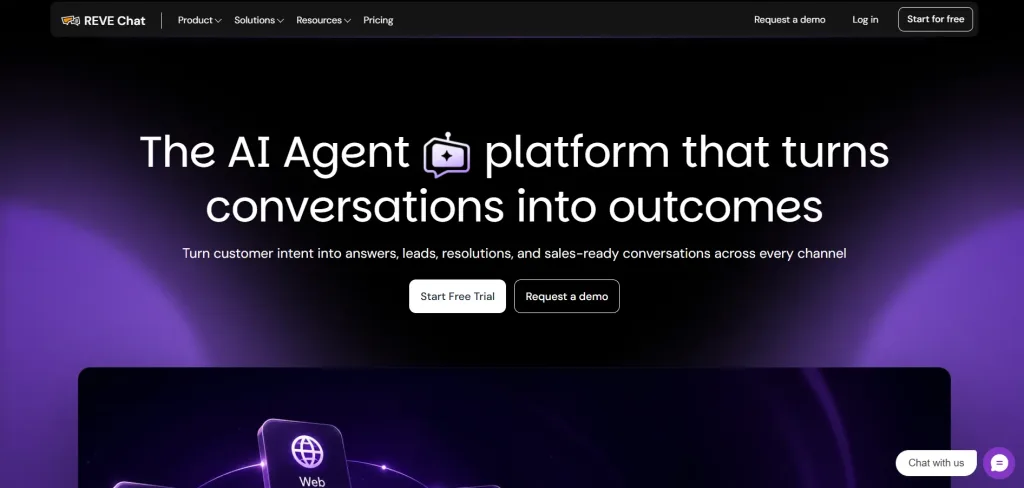
REVE Chat is often considered the best ecommerce AI agent for businesses that want to improve customer support, increase sales, and automate everyday tasks from one platform. Its Wize AI agent connects with your store data to answer questions, recommend products, provide order updates, and assist customers throughout their shopping journey.
Instead of relying on fixed replies, Wize AI understands customer requests and responds using real-time information from your ecommerce platform. This helps businesses reduce support workload, improve response times, and create better shopping experiences. For brands looking for the best ecommerce AI agent, REVE Chat offers a practical mix of sales support and customer service tools.
Key Features
- Wize AI agent for automated customer interactions
- AI shopping assistant for product guidance
- Product recommendation engine for personalized suggestions
- Order tracking automation with real time updates
- Cart abandonment recovery across multiple channels
- Post purchase support AI for returns and refunds
- Omnichannel inbox for unified conversations
- Brain AI trained on business data
- No code flow builder for automation
- Multilingual support for global customers
Pros
- Full omnichannel (website, WhatsApp, Instagram, Facebook + 40+ channels) with seamless continuity and proactive cart recovery/upsells.
- Strong autonomous actions.
- Built-in multilingual translation for global scaling.
- Hybrid AI + live chat automates 80-85% of queries
- Quick setup, fast training on your data, consistent brand voice
Cons
- Can feel feature-rich if you only want basic single-channel chat.
- Custom workflows need initial tweaking to get perfect.
Pricing
- AI Agent plans start at $59.99 per month.
- Get full access to AI agent features with a 14-day free trial.
2: Gorgias
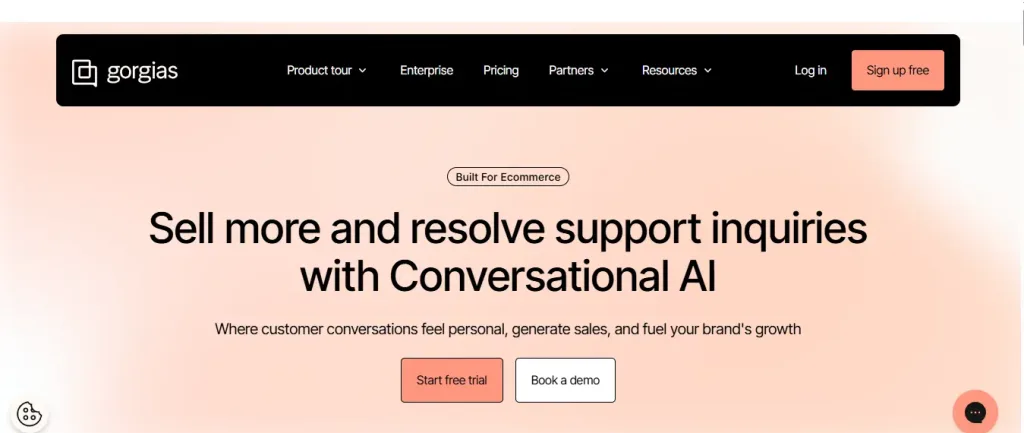
Gorgias is primarily a helpdesk and ticketing platform with strong AI automation layered on top, rather than a native proactive ecommerce AI agent.
It pulls in all your order and customer data right into tickets, letting the AI handle routine issues while spotting chances to sell more.
You manage everything from one inbox, with automations that resolve most common queries automatically.
The latest updates focus on proactive shopping help, like personalized recommendations and intent-based discounts during chats. Brands using it often see faster resolutions, lower costs, and extra sales from interactions that used to be pure support.
- Deep Shopify, Magento, and BigCommerce integrations
- Automates 60%+ of routine tickets
- Personalized responses and recommendations
- Omnichannel support across email, chat, SMS, social
- Revenue tracking from support interactions
Pros
- Deep Shopify/Magento/BigCommerce integration for order actions in tickets.
- Automates routine support and turns it into revenue.
- Clean interface with good macros.
- Omnichannel (email, chat, SMS, social).
Cons
- Expensive pricing hurts small stores.
- Limited support outside the Shopify ecosystem.
Pricing
- Starts at $10/month.
- AI resolutions are charged separately.
3: Siena AI

Siena AI is mainly a conversational support platform with generative AI, focused on empathetic, brand-consistent replies rather than full autonomous ecommerce selling.
It goes beyond basic answers to handle complex queries autonomously while turning support moments into sales wins through smart recommendations. You deploy it across channels without overhauling your setup, and it integrates smoothly with existing helpdesks.
Brands love how it cuts response times dramatically, resolves issues faster, and keeps customers happy with a consistent, caring tone. In fast-paced stores, this means handling growth without adding headcount.
- Autonomous handling of complex queries
- Generative product recommendations
- Omnichannel across chat, email, social
- Automated discount code generation
- Sentiment-aware, consistent tone
Pros
- Empathic tone improves CSAT.
- Automates complex queries well.
- Proactive sales during support.
- Solid chat/email/social coverage.
Cons
- Repetitive suggestions frustrate teams.
- Less flexible for heavy customization.
Pricing
- Starts around $750/month plus conversation fees.
4: Rep AI
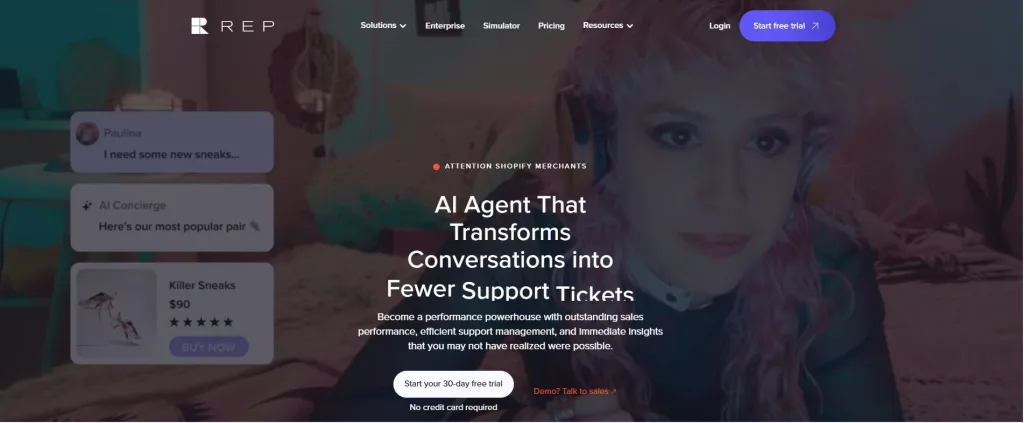
Rep AI functions primarily as a Shopify-specific sales concierge and chat agent, emphasizing proactive nudges over broad support automation.
It watches behavior in real time, triggers natural chats, and handles everything from product questions to support without scripts.
You get high automation rates for chats while boosting conversions through timely upsells and cart recovery. Many merchants find it turns passive browsing into active buying, with seamless handoffs to humans when needed.
It’s straightforward to set up and starts driving results quickly.
- Personalized shopping assistance
- Cart recovery and upsell nudges
- Handles 95%+ of support chats
- Behavioral triggers for timely engagement
- Seamless Shopify integration
Pros
- Proactive Shopify sales and cart recovery.
- Natural, on-brand conversations.
- Handles most support chats.
- Simple Shopify setup.
Cons
- Locked to Shopify only.
- Relies heavily on good product data.
Pricing
- Starts around $99/month.
5: Cognigy
Cognigy is an enterprise-grade conversational AI platform built for complex voice and digital flows, not specifically optimized as an e-commerce-first agent.
It comes with pre-built flows for retail scenarios, making rollout faster while allowing deep tweaks.
You benefit from reliable handovers, advanced analytics, and agents that adapt across digital and phone interactions.
Larger teams appreciate the scalability and how it maintains consistent experiences as volume grows. It handles personalized support around the clock effectively.
- 24/7 personalized support
- Voice and digital channel agents
- Pre-built retail use cases
- Agent-to-agent handovers
- Advanced analytics and insights
Pros
- Enterprise voice + digital scalability.
- Strong compliance and security.
- Pre-built retail flows.
- Deep integrations.
Cons
- Complex setup and learning curve.
- Too expensive for small/mid stores.
Pricing
- Custom pricing available for AI agents.
6: Fin AI

Fin AI is an advanced resolution-focused AI agent inside the Intercom ecosystem, designed to tackle difficult queries rather than lead proactive ecommerce selling. It pulls context from your systems to handle order changes, refunds, and recoveries end-to-end.
You set clear rules for tone and policies, ensuring reliable responses that improve over time. Stores dealing with complex order issues find it resolves far more autonomously than basic tools.
The focus on continuous learning keeps performance sharp as interactions pile up.
- End-to-end complex task handling
- Omnichannel chat, email, voice
- Real-time order updates and refunds
- Abandoned cart recovery
- Continuous improvement loop
Pros
- Strong multi-step query handling.
- Omnichannel with real-time updates.
- Improves over time.
- Good cart recovery.
Cons
- Needs a fresh knowledge base or answers go wrong.
- Per-resolution pricing adds up quickly.
Pricing
- Plans start at $39 per agent monthly plus AI resolution fees.
7: Triple Whale Moby Agents

Triple Whale Moby Agents are backend data and marketing intelligence agents, not customer-facing conversational tools for ecommerce.
It spots anomalies, forecasts trends, and suggests optimizations proactively without direct customer chats.
You ask natural questions and get actionable plans, often with visuals ready to share. Agencies and brands managing multiple channels use it to cut manual reporting and act faster on insights. It feels like adding expert analysts to your team.
- Acquisition, conversion, retention agents
- Real-time anomaly detection
- Creative and media buying optimization
- Forecasting and pacing tools
- Portfolio-wide insights for agencies
Pros
- Excellent data insights and anomalies.
- Forecasting and marketing optimization.
- Natural language data queries.
- Agency-friendly.
Cons
- No customer-facing chat or support.
- Needs full data setup to shine.
Pricing
- Custom pricing is available for AI agents
8: Shopify’s Built-in AI Tools (Shopify Magic & Sidekick)

Shopify Magic and Sidekick are merchant-side productivity tools embedded in the Shopify admin, not customer-facing AI agents for engagement or sales.
Sidekick acts as your always-available assistant, answering questions, automating workflows, and offering proactive suggestions based on your data.
You generate descriptions, edit images, set up discounts, or query performance in plain language.
Merchants on Shopify appreciate the zero-setup integration and how it speeds up daily operations. Recent updates make it even more proactive for growth ideas.
- AI-generated product descriptions and emails
- Image editing and theme suggestions
- Sidekick for task automation and insights
- Discount creation and data queries
- Natural language store management
Pros
- Free and native to Shopify.
- Fast content and image generation.
- Task automation in admin.
- Zero extra setup.
Cons
- No customer-facing support/sales.
- Lacks proactive or omnichannel features.
Pricing
- Included with Shopify plans
- Plans start at $39/month
9: Ada
Ada is a no-code automation platform focused on high-volume support deflection rather than proactive ecommerce sales leadership.
It quickly answers common questions about products, orders, and shipping while checking inventory or guiding sizes.
You integrate easily with platforms like Shopify or Salesforce, achieving high deflection rates with smooth escalations.
Teams handling lots of traffic rely on it for consistent service without extra complexity. It scales well as inquiries grow.
- Instant product, order, shipping answers
- Seamless integrations with Shopify, Salesforce
- Omnichannel chat, voice, email
- Inventory checks and size guides
- High automation rates with handoffs
Pros
- High-volume automation.
- Good multilingual and inventory checks.
- No-code flows.
- Shopify/Salesforce integrations.
Cons
- Opaque and high pricing at scale.
- Often requires heavy setup help.
Pricing
- Starts around $30,000/year
10: Decagon AI
Decagon AI builds enterprise-grade agentic experiences for large retail brands, emphasizing backend automation over lightweight, fast-deploy ecommerce chat.
It handles upsells, recommendations, and account tasks autonomously with strong analytics for refinement.
You deploy quickly, test thoroughly, and scale to high volumes reliably. Larger operations use it to turn support into a seamless, growth-oriented experience.
The focus on optimization keeps it improving with every interaction.
- Omnichannel chat, email, voice support
- Autonomous upsells and recommendations
- Account management automation
- Rapid deployment with testing
- Analytics for ongoing optimization
Pros
- Deep backend automation (refunds/orders).
- Context-aware conversations.
- Multimodal (text/image/video).
- Enterprise retail strength.
Cons
- Very high enterprise pricing.
- Too complex for smaller/quick setups.
Pricing
- Enterprise custom pricing
Benefits of Using AI Agents for Ecommerce
Adding an AI agent to your online store brings clear wins that show up fast in the numbers and in how things feel day to day. Here are the main ways you gain.
1. Higher Sales Without Extra Effort
Your agent spots chances to sell more during every chat. It suggests related items at the perfect moment, offers a small discount to close a hesitant buyer, or reminds someone about a forgotten cart.
Many stores see conversion rates jump 15-30% once the agent starts guiding shoppers gently toward checkout.
2. Round-the-Clock Customer Help
Shoppers browse and ask questions at any hour. Your agent answers instantly, no matter the time zone or the weekend.
Late-night visitors get the same friendly support as daytime ones. You stop losing sales just because no human is around to reply.
3. Happier Customers Who Return
Personal chats make people feel seen. The agent remembers past orders, uses their name, and solves problems quickly. Quick, accurate help builds trust. Satisfied buyers leave better reviews, tell friends, and come back to shop again.
4. Lower Costs and Less Work for Your Team
Routine questions about tracking, sizing, or returns eat up hours. The agent handles most of them on its own.
Your staff spends time on complex issues or creative work instead of repeating the same answers. Many businesses cut support costs by 40-60% while handling more volume.
5. Better Data for Smarter Decisions
Every conversation gives useful insights. You learn which products confuse people, what questions come up most, and where shoppers drop off.
The agent tracks all this cleanly so you can fix weak spots and stock what actually sells.
6. Easy Scaling as You Grow
A sudden traffic spike used to mean chaos or hiring rush. With an agent, you manage ten times the visitors without adding staff.
It grows with your store, keeping service steady even during big sales or holiday rushes.
Read Also: 10 Best Shopify Chatbot Apps
Ecommerce AI Agents vs Traditional Ecommerce Chatbots
While ecommerce AI agents and traditional ecommerce chatbots both can answer customer questions, they work in different ways and offer different levels of support. Let’s explore the differences between them.
| Feature | Ecommerce AI Agent | Traditional Chatbot |
|---|---|---|
| Understands customer context | Understands conversation history and customer intent | Limited understanding of context |
| Product recommendations | Recommends products based on customer behavior and preferences | Offers basic suggestions based on predefined rules |
| Order management support | Can check orders, update information, and assist customers | Usually provides limited order information |
| Cart abandonment recovery | Sends reminders and personalized messages to recover abandoned carts | Typically does not support cart recovery |
| Multi step problem solving | Handles complex customer issues through multiple actions | Struggles with complex requests |
| Personalized conversations | Adapts responses based on customer interactions | Uses fixed responses and scripts |
| Access to store data | Uses real time store, product, and customer information | Limited access to business data |
| Customer support after purchase | Provides Post-purchase support AI for updates and assistance | Usually limited to basic support responses |
| Automation capabilities | Supports Order tracking automation and other business tasks | Focuses mainly on answering questions |
| Sales assistance | Functions as an AI shopping assistant with a Product recommendation engine | Primarily handles simple customer inquiries |
Which Option Is Better for Growing Stores?
As an online store grows, customer expectations grow too. Shoppers want fast responses, accurate information, and a smooth buying experience.
The best ecommerce AI agents help businesses manage customer conversations, recommend products, and handle routine tasks automatically. Features like a product recommendation engine and cart abandonment recovery can help increase sales while reducing manual work.
When a Chatbot Is Enough
A traditional chatbot can still be useful for small stores that receive a limited number of customer enquiries. If customers mainly ask simple questions, a chatbot may be enough.
However, businesses looking to improve customer experience and automate more tasks often find that the best ecommerce AI agents offer greater value as their store grows.
Learn More: What is Omnichannel eCommerce? Retail Strategy & Trends
How Much Do Ecommerce AI Agents Cost?
The cost of an AI agent depends on the features, integrations, and level of automation you need. Most solutions fall into three main pricing categories.
1. Entry Level Solutions
Entry level plans are often designed for startups and small ecommerce businesses. They usually include basic automation, customer support features, and essential integrations.
These plans are a good starting point for businesses exploring AI agents for e commerce for the first time.
2. Mid Market Solutions
Mid market platforms include additional features such as omnichannel communication, advanced reporting, and cart abandonment recovery tools.
They are often a good choice for growing businesses that need better customer engagement and automation.
3. Enterprise Solutions
Enterprise solutions are built for larger retailers with higher support volumes and more complex requirements. These platforms often include custom integrations, advanced workflows, and dedicated support.
Pricing is usually based on business needs and usage.
What Return Can You Expect?
Many businesses invest in the best ecommerce AI agents because they help improve both customer service and sales performance.
Features like order tracking automation reduce repetitive support requests. A Product recommendation engine helps shoppers discover relevant products during conversations. Post-purchase support AI keeps customers informed after checkout and helps create a better customer experience.
The best ecommerce AI agents can also help recover abandoned carts, reduce support workload, and improve conversion rates. For growing ecommerce businesses, these benefits can create long-term value while helping teams serve more customers efficiently.
How to Choose the Right AI Agent for Your Ecommerce Store
Choosing an AI agent can feel like a big decision when options keep popping up. You want something that matches your store today and grows with you tomorrow.
Focus on what your business actually needs, and the right choice stands out clearly.
1. Match It to Your Store Size and Volume
Small shops or startups do great with tools that launch fast and handle a few hundred chats daily.
Mid-sized or busy stores need agents that stay stable during traffic spikes, like holiday rushes. Larger operations look for enterprise-grade options with high concurrency and strong security.
2. Check Platform and Channel Coverage
Your store runs on Shopify, WooCommerce, BigCommerce, or a custom setup, so pick an agent with tight, native connections there.
Customers message you on website chat, WhatsApp, Instagram DMs, Facebook, or email. The best tools unite all those channels in one dashboard so nothing slips away.
3. Look for True Autonomous Capabilities
Basic chatbots follow rigid scripts. Real ecommerce AI agents act independently: they check live inventory, apply personalized discounts, update order status, trigger reorders, or process simple returns without human input. This agentic behavior cuts manual work and lets the tool solve problems end-to-end.
4. Prioritize Proactive Sales Features
Top agents watch shopper behavior in real time. Does someone linger on a product page? It starts with a friendly chat. Cart about to be abandoned?
It offers a nudge or small incentive. Strong recommendation engines suggest items based on browsing history, cart contents, and past buys, lifting average order value without feeling salesy.
5. Demand Seamless Human Handoff and Advanced Tools
Complex queries happen. The agent should pass the full conversation context instantly to a live person.
Extra touches like co-browsing (guiding the shopper through pages together) or video chat turn tricky situations into quick wins. These keep satisfaction high when automation reaches its limit.
6. Evaluate Multilingual and Global Readiness
Selling internationally? Built-in real-time translation for dozens of languages removes barriers fast. You reach new markets without hiring local support or adding separate tools.
7. Assess Customization and Setup Ease
No-code flow builders let you drag and drop complex journeys such as returns, promotions, VIP handling, tailored exactly to your policies.
Webhooks and API access connect the agent to your CRM, ERP, or custom systems for deeper actions. Quick training on your FAQs and product data means accurate answers from day one.
8. Study Analytics and Revenue Tracking
Clear dashboards should show resolved tickets, recovered carts, generated upsells, and direct sales from conversations. You need hard numbers to prove the agent pays for itself and spot areas to improve.
9. Budget and Trial Reality Check
Pricing varies: per conversation, flat monthly, or tiered plans. Run real tests during a free trial with actual traffic scenarios. Measure response speed, resolution rate, and sales impact. Talk to similar stores if possible.
Conclusion
Ecommerce keeps moving faster every year. What works today might not cut it tomorrow as customers demand even quicker, more personal experiences. Adding a capable AI agent isn’t just nice to have, it’s how you stay ready for whatever comes next.
REVE Chat stands out with its full set of tools: real-time proactive triggers, global language support, deep customization, and direct ties to revenue growth.
You build a store that scales smoothly and keeps delighting shoppers no matter how big you get. Make the smart move for long-term success. Sign up for REVE Chat today and give your business the AI edge it deserves.
Frequently Asked Questions
Traditional chatbots stick to pre-written scripts and rules, often failing on anything unexpected. Ecommerce AI agents use advanced models to understand context, pull live store data, act autonomously, and hold natural conversations. You get real problem-solving and sales help instead of just basic replies.
Most stores notice changes in the first week, fewer abandoned carts, faster responses, and small sales lifts from recommendations. Bigger gains like 20-30% higher conversions or 50% less support volume usually show up within 30-60 days as the agent learns your products and customer patterns.
Good agents scale automatically to handle sudden rushes like Black Friday without slowing down or charging per extra conversation. You keep service smooth during peak times, capture more sales, and avoid hiring temporary staff.
Top agents follow strict standards like GDPR and PCI compliance, encrypt data, and never store sensitive payment details. You maintain customer trust while letting the agent access safe order info for tracking or recommendations.
Leading ecommerce AI agents let you train tone, style, and vocabulary to match your brand perfectly. You set friendly, professional, or casual voices, add specific phrases, and review responses, shoppers feel like they’re talking to your team, not a machine.
Build AI-powered support with Wize AI
Connect business knowledge, automate support conversations, and improve response quality without managing a complex AI stack.
Explore Wize AI Agent Rate the article

Mohaimin Talha
Lead Product Manager
Mohaimin Talha is a seasoned Product Manager, known for his ability to combine creativity with analytical thinking. His strategic vision and customer-centric approach make him a key driver of product success and business growth.
View all articles
Turn customer conversations into action with Wize AI
It helps businesses to engage with visitors, answer every question, recommend next steps, qualify leads, and support customers across every conversation.
Learn more