



Table of Content
The buyer journey and customer journey are both essential aspects of the marketing process. They are key tools for businesses to understand their customers better and achieve effectiveness with marketing strategies. Both concepts are also vital processes that companies use to attract and retain customers.
These two are obviously very different concepts but are sometimes confused with one another. Even many marketing experts are not able to understand the difference between the two.
So, any attempt to understand the buyer journey vs the customer journey needs to look at the broader picture to get clarity. The broader picture is that both concepts are essential for effective marketing. Without understanding them, a business might not be able to tailor their messaging and efforts to the specific needs of the customers.
More importantly, a business can map out these journeys to get a clear insight into customer behavior and create targeted campaigns. A good understanding of both journeys is also important to create experiences that will resonate with customers and eventually help drive sales.
In this blog, we will explore the buyer and customer journey in detail and will also see how they are invaluable aspects of marketing.
But first, let’s get started with understanding what exactly the buyer journey is.
What is the Buyer’s Journey?
The buyer’s journey is a marketing term that refers to the processes and steps that potential customers follow when considering and making a purchase decision. It outlines and includes the various actions and stages undertaken by potential customers before finalizing a purchase.
By understanding the buyer’s journey, a business can align its marketing and sales strategies to better engage with customers at each stage. Mapping this journey also helps businesses tailor their marketing efforts to meet the specific needs of customers at different stages.
When a business analyzes and maps out the buyer journey, it easily identifies potential gaps in its marketing and sales processes. This proves important in making data-driven decisions to optimize the strategies, boost conversion rates, and build long-term trust with customers.
What is the Customer’s Journey?
The customer’s journey is a marketing term that includes the entire experience a customer has with a brand. It encompasses every interaction of a customer, from the point of contact to ongoing engagement. A customer journey also involves every touchpoint a customer goes through with a company, including marketing, sales, support to post-purchase support.
For a business, it’s essential to understand the customer journey to create a seamless experience that builds satisfaction and boosts loyalty. This also helps in identifying pain points and enhancing the customer experience at each stage. Based on the understanding of the customer journey, a business can align its marketing strategies to deliver consistent and personalized experiences to the audience.
Stages of the Buyer’s Journey
The buyer’s journey commonly follows three stages that work as a framework for businesses to understand how potential customers make purchase decisions. By recognizing the needs of buyers at each stage, a business can tailor its marketing efforts and engage them better.
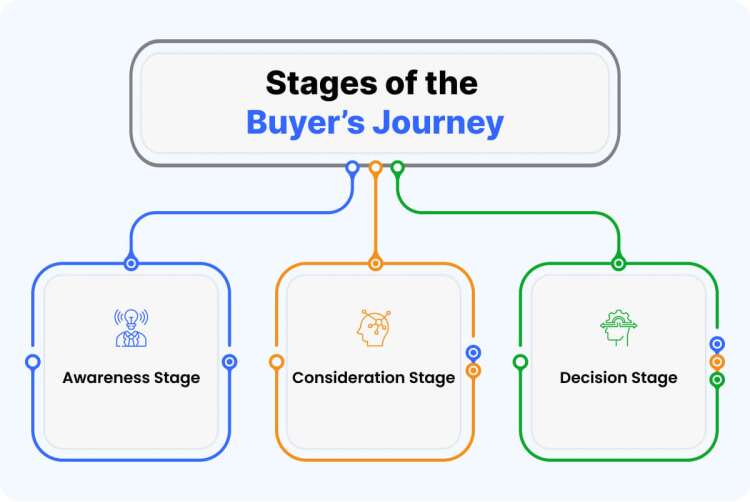
The 3 stages of the buyer’s journey include –
- Awareness Stage – In this stage, a potential buyer becomes aware of the need or problem. The buyer will then look for a solution and seek information that can help them solve the problem.
- Consideration Stage – In this stage, the potential buyer searches for different solutions and options that can help solve their problems. The buyer will compare features, benefits, and prices to determine the right fit for their needs. After all, a buyer journey starts with research as 80% of shoppers conduct online research before making a purchase.
- Decision Stage – In this stage, the potential buyer is ready to make a purchase decision after having compared and analyzed the options available to them. Before making a purchase, a buyer may request demos or additional information or may connect with sales reps for the purchase.
Stages of the Customer’s Journey
The stages of the customer journey include the entire experience – from initial contact to ongoing engagement – that a customer has with an organization. By understanding these stages, a business can better align its marketing and sales effort and enhance the experience at each stage.
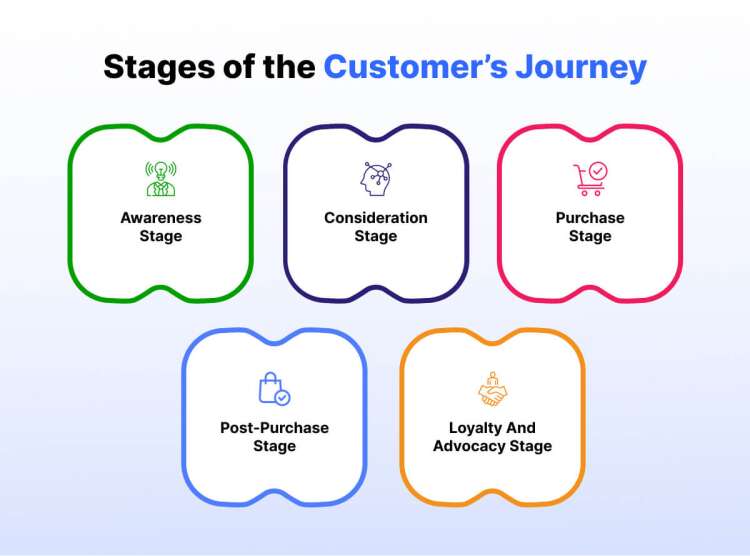
The 5 stages of the customer’s journey include –
- Awareness Stage – The customer journey starts with the awareness stage where a customer becomes aware of a product, service, or brand. For a business, the key focus at this stage is to catch the attention of the customer and make them aware of the brand and its offerings.
- Consideration Stage – In this stage, an aware customer evaluates different options available to them by assessing and comparing the features, prices, and benefits of the brand or product, or service. At this stage, a business should focus on providing the customer with detailed information so that the brand can stand out from competitors.
- Purchase Stage – The customer has selected a brand and is ready to make the purchase. At this stage, a business should focus on making the customer’s experience as smooth and hassle-free as it should be.
- Post-Purchase Stage – This stage starts the moment the customer has purchased a product. It can include onboarding, product set-up, product implementation, guidance, training, or any support that helps in the better utilization of the product or service. In this stage, the key for a business is to ensure positive experiences for customers.
- Loyalty and Advocacy Stage – When customers are happy with the experiences provided to them, they can become loyal to the brand. Loyal customers do repeat purchases and recommend the brand to others. At this stage, the key goal for a business is to nurture loyalty and advocacy.
What Businesses Should Do at Each Stage
To get the best results, businesses should treat each stage of the buyer and customer journey differently. Every stage has its own goal, owner, content type, and success metric.
1. Awareness Stage
At this stage, prospects realize they have a problem or need. They may not know your brand yet, and they may not be ready to buy.
Goal: Educate the audience and attract relevant traffic.
Best team owner: Marketing.
Useful content: Blog posts, guides, checklists, explainer videos, social media posts, industry reports.
Key metrics: Organic traffic, page views, time on page, newsletter signups, content downloads.
Example:
An e-commerce business may publish a blog titled “How to Reduce Cart Abandonment with Real-Time Customer Support.” This helps potential buyers understand their problem before introducing a solution like live chat or chatbot support.
2. Consideration Stage
At this stage, prospects understand their problem and compare possible solutions. They want proof, clarity, and confidence.
Goal: Help prospects evaluate solutions and shortlist your brand.
Best team owner: Marketing and sales.
Useful content: Comparison pages, product demos, case studies, ROI calculators, webinars, feature pages, customer reviews.
Key metrics: Demo requests, lead quality, webinar registrations, email engagement, return visits.
Example:
A SaaS buyer comparing customer engagement tools may look for live chat features, chatbot automation, omnichannel messaging, integrations, pricing, and customer support quality. A comparison guide or demo video can help move them closer to a decision.
3. Decision Stage
At this stage, prospects are ready to choose a vendor. They need reassurance before committing.
Goal: Remove objections and make the purchase process easy.
Best team owner: Sales.
Useful content: Pricing pages, free trials, product demos, testimonials, implementation plans, proposal documents, security information.
Key metrics: Conversion rate, trial-to-paid rate, sales cycle length, close rate.
Example:
If a prospect is unsure whether chatbot automation will work for their business, a live demo showing real customer conversations, routing rules, and handover to human agents can help them make the final decision.
4. Onboarding Stage
Once a customer purchases, the focus shifts from selling to helping them achieve value quickly.
Goal: Help customers get started successfully.
Best team owner: Customer success or support.
Useful content: Welcome emails, setup guides, onboarding calls, help center articles, in-app messages, chatbot guidance.
Key metrics: Time to first value, onboarding completion rate, first response time, early support tickets.
Example:
A new REVE Chat customer can be guided to install live chat, set up chatbot flows, connect communication channels, and train agents through a simple onboarding checklist.
5. Adoption and Engagement Stage
At this stage, customers begin using the product regularly. The goal is to help them build habits and discover more value.
Goal: Increase product usage and engagement.
Best team owner: Customer success, product, and support.
Useful content: Product tutorials, feature tips, use-case guides, webinars, milestone emails.
Key metrics: Active users, feature adoption, repeat logins, chatbot usage, number of conversations handled.
Example:
If a customer is using live chat but not chatbot automation, you can send tips on automating FAQs, qualifying leads, or routing conversations to the right department.
6. Retention, Loyalty, and Advocacy Stage
At this stage, satisfied customers may renew, upgrade, refer others, or leave positive reviews.
Goal: Build long-term loyalty and turn customers into advocates.
Best team owner: Customer success, support, and account management.
Useful content: Feedback surveys, loyalty offers, referral programs, review requests, success reports, renewal check-ins.
Key metrics: Retention rate, churn rate, customer lifetime value, NPS, CSAT, referrals, reviews.
Example:
After a customer successfully automates thousands of support conversations with a chatbot, you can ask for a review, invite them to a case study, or suggest additional features such as co-browsing or video chat.
Importance of the Buyer’s Journey For a Business
The buyer’s journey holds big significance for businesses as it provides insight into customers’ needs and preferences. When this insight is available, a business can take a data-driven approach to optimize the customer experience and guide marketing strategies.
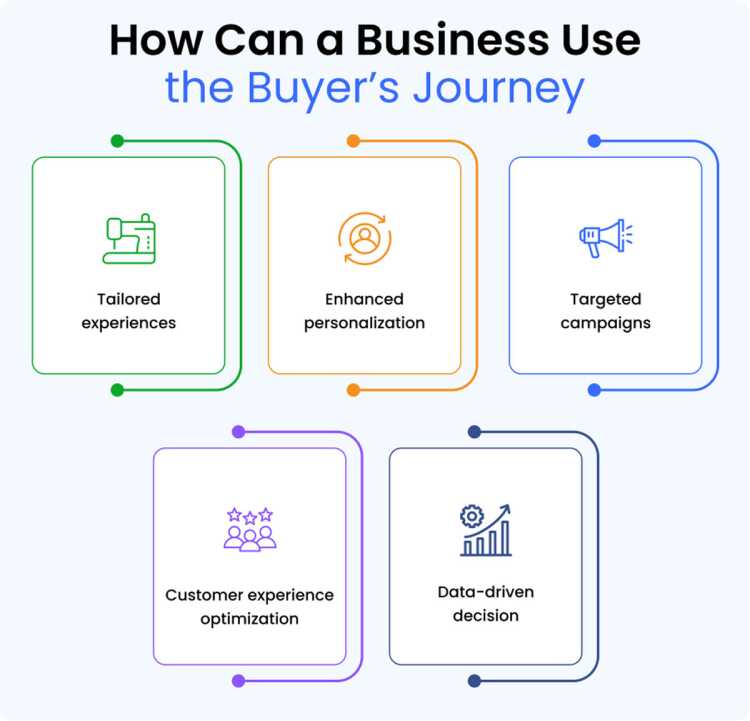
Some other importance of the buyer journey includes –
- Tailored experiences – The buyer’s journey helps businesses get an understanding of the pain points of their target audience, resulting in the creation and delivery of tailored experiences.
- Enhanced personalization – Based on the buyer journey information, a business can personalize its messaging and communication to better meet the needs of customers at each stage. After all, 91% of consumers would love to shop with brands that give relevant offers and recommendations.
- Targeted campaigns – When a business maps the buyer journey, it can effectively align its marketing and sales strategies which can help in creating targeted campaigns.
- Customer experience optimization – Mapping this journey can help businesses have a better knowledge of the touchpoints and interactions which can prove helpful in optimizing the customer experience at each stage.
- Data-driven decision – A buyer journey gives valuable data that can be used to analyze customer behavior and engagement metrics, resulting in optimized marketing and sales strategies.
Importance of the Customer’s Journey for a Business
The customer’s journey holds a big value for businesses as it helps them improve the customer experience and personalize interactions. When a business understands the customer journey, it’s better able to drive retention and build loyalty.
A business needs the customer’s journey for many reasons, including –
- A customer journey is a marketing tool to gain insights into the customer’s pain points and needs.
- Mapping the customer journey enables businesses to tailor their products and experiences, resulting in improved satisfaction.
- A business can optimize every touchpoint and interaction when it has an understanding of the customer journey which can lead to higher retention rates.
- A business can deliver personalized and relevant experiences only when it’s aware of the customer’s need at each stage of the journey.
- Precise targeting and messaging are not possible unless a business maps the customer journey and tailors the marketing strategies accordingly.
- By focusing on the customer journey, a business can easily nurture long-term relationships with customers and foster loyalty that often results in repeat business.
Mapping the Buyer and Customer Journey
Mapping the buyer and customer journey is key to success for a business as it gives a comprehensive understanding of the customers. By mapping the journey, a business can optimize its marketing and sales efforts and provide great experiences to customers at each stage.
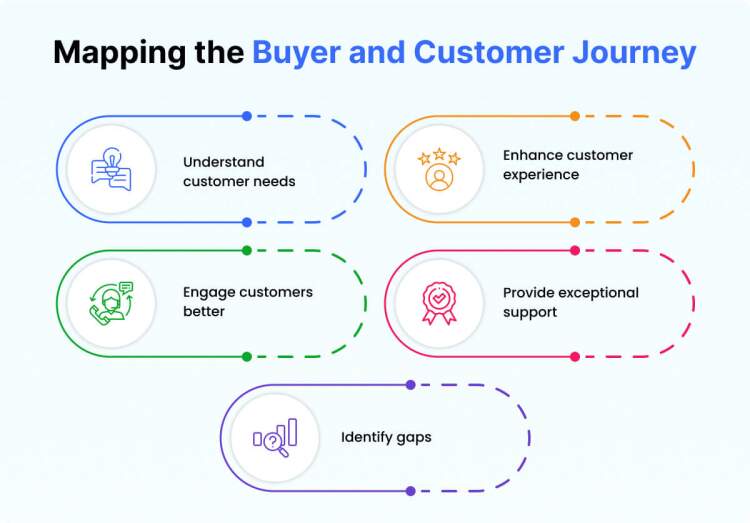
Here are some key reasons that highlight the importance of mapping the buyer and customer journey –
- Understand customer needs – A business that maps the buyer and customer journey gets insights into the needs and behaviors of potential customers. This understanding helps businesses tailor their marketing, sales, and customer support efforts and meet the needs of customers.
- Enhance customer experience – Mapping a buyer and customer journey is vital to identifying and improving touchpoints and interactions for the entire customer lifecycle journey. This enables businesses in delivering a seamless, and personalized experience across all channels.
- Engage customers better – The buyer and customer journey mapping is essential for effectively engaging customers at each stage of the journey by optimizing the sales and marketing efforts. When customers are engaged better, it always increases the chances of conversion and customer acquisition.
- Provide exceptional support – When a business maps the post-purchase stages, it’s able to identify opportunities for offering great support and provide proactive solutions to customer needs. This kind of support always forms the basis of long-term relationships and loyalty.
- Identify gaps – Journey mapping is very helpful in knowing the gaps or areas where the customer experience can be enhanced. When gaps the identified, a business can proactively address customer issues and take a lead in the market.
Key Similarities and Differences Between the Buyer and Customer Journey
While both the customer and buyer journey share a customer-centric focus, they differ in goals and audience. In the case of customer vs consumer, if the focus of the buyer journey is on the pre-purchase stages and conversion, for the customer journey it’s the entire customer lifecycle that matters.
Here are some of the key similarities and differences between the buyer and customer journey –
The Similarities
- Both have a major focus on the customer. The focus of both journeys is to understand the needs and preferences of customers to provide a better experience.
- Both journeys involve the mapping of various touchpoints to understand all the interactions an individual has with a brand.
- Both journeys aim to identify key moments of engagement and communication.
- Both journeys involve decision-making throughout the customer’s engagement with the brand at various stages.
The Differences
- The buyer journey focuses on the pre-purchase stages while the customer journey includes the entire lifecycle of a customer’s interactions with a brand.
- The buyer journey focuses on all potential customers who consider a purchase while the customer journey is concerned with all individuals who have interacted with a business.
- Driving conversion and acquiring new customers is the primary goal of the buyer journey whereas the customer journey is concerned with broader goals, including customer satisfaction and retention.
- Touchpoints in the buyer journey are more geared towards marketing while the customer journey includes a wider range of touchpoints for ensuring consistent experience.
| Point of comparison | Buyer journey | Customer journey |
|---|---|---|
| Main focus | Turning prospects into customers | Turning customers into loyal advocates |
| Timeline | Before purchase | After purchase and throughout the relationship |
| Typical stages | Awareness, consideration, decision | Onboarding, adoption, support, retention, loyalty, advocacy |
| Primary goal | Conversion and customer acquisition | Satisfaction, retention, repeat business, and advocacy |
| Main teams involved | Marketing and sales | Customer support, customer success, product, and account management |
| Key metrics | Website visits, leads, demo requests, conversion rate, sales cycle length | Onboarding completion, product usage, CSAT, NPS, churn rate, retention rate, customer lifetime value |
| Best content/assets | Blogs, comparison pages, case studies, demos, pricing pages | Onboarding guides, help center articles, live chat support, product tutorials, feedback surveys, loyalty programs |
In simple terms, the buyer journey helps people decide whether to choose your business, while the customer journey determines whether they stay with your business.
How to Optimize the Buyer and Customer Journey
How to Optimize the Buyer Journey
To optimize the buyer journey, focus on removing friction before the sale.
Awareness stage optimization
Create educational content around the problems your target audience faces. Focus on pain points rather than product promotion. Use blog posts, guides, videos, and checklists to help prospects clearly understand their challenges.
Consideration stage optimization
Help prospects compare solutions with confidence. Publish product comparisons, feature explainers, ROI calculators, demo videos, and case studies. Make it easy for visitors to understand why your solution is different.
Decision stage optimization
Reduce purchase anxiety. Offer free trials, demos, transparent pricing, customer testimonials, and clear implementation expectations. Make sure prospects know exactly what happens after they sign up.
How to Optimize the Customer Journey
To optimize the customer journey, focus on delivering value after the sale.
Onboarding optimization
Send a welcome email, provide a setup checklist, and offer immediate support. The faster customers reach their first success milestone, the more confident they become in their purchase.
Support optimization
Offer support across the channels customers prefer. Live chat, chatbots, email, voice, and self-service resources can work together to reduce wait time and improve satisfaction.
Retention optimization
Track customer behavior and identify signs of disengagement. If usage drops or support complaints increase, reach out proactively. Use customer feedback to improve both the product and the overall experience.
Advocacy optimization
Ask happy customers for reviews, referrals, testimonials, or case studies. Advocacy should feel natural and timely, not forced. The best moment to ask is after a customer has achieved a measurable result.
Buyer Journey and Customer Journey Examples
SaaS Example
A small business owner realizes that their support team is overwhelmed by repetitive customer questions. This is the awareness stage. They begin researching solutions such as live chat software, AI chatbots, and help desk tools. This is the consideration stage.
After comparing features, pricing, integrations, and reviews, they request a demo and choose a customer engagement platform. This is the decision stage.
Once they become a customer, the customer journey begins. They install live chat, create chatbot flows, train agents, monitor conversations, collect feedback, and eventually expand to more channels such as WhatsApp or voice support.
E-commerce Example
An online store notices that shoppers are leaving the checkout page without buying. The team searches for ways to reduce cart abandonment and improve customer support. They discover that real-time chat support can answer last-minute questions about shipping, returns, and payment.
After comparing tools, they choose a live chat and chatbot solution. Post-purchase, they use chatbots to answer order status questions, live chat to resolve complaints, and proactive messages to recommend products. Over time, customers receive faster support, return more often, and share positive experiences.
B2B Example
A B2B company wants to improve lead qualification and reduce manual sales workload. During the buyer journey, the team researches automation tools, compares vendors, attends demos, and evaluates ROI.
After purchase, the customer journey begins with implementation. The company sets up chatbot qualification questions, routes high-intent leads to sales reps, and uses live chat transcripts to understand buyer objections. The solution continues to support retention by improving response time, sales productivity, and customer satisfaction.
Where the Buyer Journey Meets the Customer Journey
The most critical point between the buyer journey and customer journey is the purchase-to-onboarding handoff. This is the moment when a prospect becomes a customer, and the promises made during sales must turn into real value.
For example, if your sales team promises fast setup, easy integration, or 24/7 support, the customer journey must immediately prove those claims. A poor handoff can create confusion, frustration, and buyer’s remorse. A smooth handoff, on the other hand, reassures customers that they made the right decision.
To make this transition seamless, businesses should:
- Share customer expectations from sales with the onboarding or support team.
- Send a welcome message immediately after purchase.
- Provide a clear next step, such as booking an onboarding call or setting up the product.
- Offer live chat or chatbot support during setup.
- Track early customer questions and turn them into better pre-purchase content.
- Follow up after the first few days to check whether the customer has reached their first success milestone.
This handoff is important because the buyer journey does not truly end at the purchase. It becomes the foundation for the customer journey. If the buying experience creates trust, the post-purchase experience must protect and strengthen that trust.
Common Mistakes to Avoid When Managing Buyer and Customer Journeys
Treating Both Journeys as the Same Thing
The buyer journey and customer journey are connected, but they have different goals. The buyer journey focuses on conversion, while the customer journey focuses on retention and loyalty.
Overpromising During Sales
If the sales message creates expectations that onboarding or support cannot meet, customers will quickly lose trust. Make sure marketing and sales promises match the actual customer experience.
Ignoring Post-Purchase Experience
Many businesses invest heavily in acquiring customers but neglect onboarding, support, and retention. This leads to churn and missed opportunities for repeat business.
Using the Same Content for Every Stage
A first-time visitor does not need the same content as a ready-to-buy prospect or an existing customer. Content should match the customer’s stage, intent, and level of awareness.
Not Using Support Insights in Marketing
Support teams hear customer questions every day. Those questions can reveal missing content, unclear product messaging, and weak points in the buyer journey.
Support Your Buyer and Customer Journey with REVE Tools
The buyer and customer journey is key to understanding the needs of customers and ensuring excellent experiences for them throughout the various stages. At REVE Chat, we understand that a business needs to map both journeys to get a knowledge of their customers and serve them better.
We have a range of customer engagement tools that can be used to measure the level of interactions that a customer has across touchpoints. Our AI-powered chatbots can prove very helpful in automating responses and ensuring quick replies to customer queries at any stage.
More so, we have video chat and co-browsing software that can help in offering visual engagement. These tools ensure help in the way customers expect.
Our live chat software can be paired with the chatbot to offer hybrid support. With this kind of support, a bot can handle routine queries while a human agent can handle complex situations.
Conclusion
For customers, experience matters more than anything else. If a business is able to provide great experiences, customers can become loyal to them. Offering this kind of experience is not possible unless a business understands and maps the buyer and customer journey.
At REVE Chat, we have high-quality customer support tools to engage and interact with customers at each stage of their journey.
You can sign up and check our tools and see how they fit into your business’ specific needs.
Frequently Asked Questions
No. The buyer journey focuses on the steps a prospect takes before making a purchase. The customer journey starts after purchase and includes onboarding, product usage, support, retention, loyalty, and advocacy.
The buyer journey usually ends when a prospect makes a purchase and becomes a customer. However, the quality of the buyer journey affects the customer journey because expectations created before purchase shape the customer’s post-purchase experience.
The customer journey is important because it affects satisfaction, retention, repeat purchases, referrals, and customer lifetime value. A customer may buy once because of good marketing, but they stay because of a good experience.
Marketing and sales usually own the buyer journey. Customer support, customer success, product, and account management usually own the customer journey. However, both journeys work best when all teams share insights.
Live chat helps prospects get instant answers while they are researching, comparing, or deciding. It can reduce hesitation, clarify pricing or features, and move high-intent visitors closer to conversion.
Chatbots can answer repetitive questions, guide customers through onboarding, collect information, route complex issues to human agents, and provide 24/7 support. This improves response time and reduces customer frustration.
Build AI-powered support with Wize AI
Connect business knowledge, automate support conversations, and improve response quality without managing a complex AI stack.
Explore Wize AI Agent Rate the article

Rasheek M. Rayat
Customer Success Manager
Rasheek M. Rayat is a dedicated Customer Success Manager at REVE Chat, where he leverages his expertise to empower businesses with innovative live chat and chatbot solutions. Passionate about enhancing customer experiences, he combines strategic insight with a customer-centric approach to drive satisfaction and growth.
View all articles