





Table of Content
A business becomes successful when it consistently delivers what its customer needs and wants. However, if a business does not care about meeting customer needs, it might fail to grow beyond a point.
Nokia is a good example to understand why customer needs analysis is important to stay competitive in the market and excel. The Finnish mobile maker was once the undisputed boss of the industry, enjoying dominance like never before. All this however could not last beyond a brief period starting in the late 90’s to early 2000s.
Its dominance started to lose grip over the market due to constantly changing consumer needs. Nokia could not foresee how users had started preferring smartphones more than the durable mobile phones it sold. Soon, competitors benefited from the gap in the market and took over, leaving Nokia to consign to a distant memory.
While there were other factors as well that contributed to the downfall of Nokia, its inability to adapt to the customer customer needs could well be the main point that started the slide.
This shows how a business must understand customer needs and deliver to those to stay relevant in the market. It’s equally important to know what customers want, why they want, and how to deliver what they need.
In this blog, we will explore customer need analysis in detail, understand what customer needs, why their needs are important, and how to assess those needs.
But before moving deeper, let’s first get started with understanding what exactly customer needs are….
What are Customer Needs?
As a business, you must understand why customers buy your products or services. Well, they may have some requirements, expectations, and desires to fulfill and that’s why they buy what they do. The purchases they make help solve a particular problem or purpose.

If customers did not have those desires and expectations, would your business exist, or any business exist? No. It’s the customer needs that drive businesses and that’s why you first have to identify those needs and then make products or services accordingly.
A business has to do customer needs analysis if it wants to meet and exceed expectations. Whether these needs are functional or aspirational, the focus should be on analyzing those needs and ensuring value specific to those needs.
Types of Customer Needs?
Customers have certain requirements and expectations that drive them to buy things. Their needs become the basis of purchase decisions. So, they buy a product or service to solve a specific problem. This shows how customer needs play a key role in what they want to buy and what not.
Here are some of the most common types of customer needs are –
- Price – Customers often expect a product or service to carry a specific price range. They have a budget in mind based on the unique value and quality of the product. In fact, customers are ready to pay even more if the overall experience exceeds their expectations with the product.
- Functionality – The product or service a customer buys should solve the specific problem it’s meant for. If it does, customers feel happy as the product or service will help effortlessly solve their problems. All this is only possible when the product has the intended functionalities and features expected by customers.
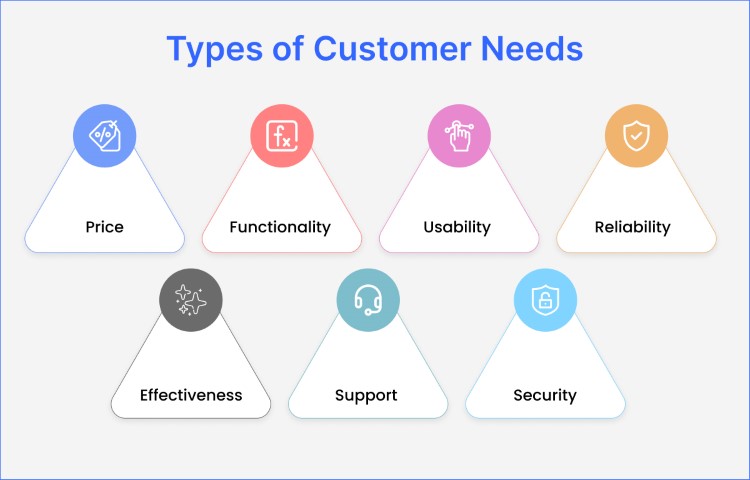
- Usability – Customers look to get a great experience with the use of the product. They want the product to be easy to use, smooth, and something that does not have complications. If a product helps them solve their problem easily, they will pay more to get it.
- Reliability – A good product is one that continues to perform well over time without any hiccups. Such products will be reliable and durable. If the product is not reliable, it might fail to meet the lofty expectations of customers.
- Effectiveness – A product or service must meet the promises it advertises. Customers feel happy when the product does its job effectively and helps solve the problem easily. If the product is not effective, it might cause lots of frustration for customers.
- Support – Poor customer service causes churn. If customer service is not good, a business might lose trust and goodwill as well. For customers, getting good customer service is one of the basic needs that must be met to keep them happy.
- Security – Risks to customers have grown in the digital world of transactions. Cases of theft of sensitive data and personal information are common now. Customers however expect a sense of security when they engage with a brand or buy a product or service.
Functional, Social, and Emotional Customer Needs
Customer needs such as price, usability, reliability, convenience, and support can also be grouped into three broader categories: functional, social, and emotional needs. Looking at needs this way helps businesses understand not only what customers want but also why they want it.
Functional Needs
Functional needs relate to the practical job a customer wants to accomplish.
A customer buying project management software, for example, may need to organize tasks, monitor deadlines, collaborate with team members, and generate reports. Similarly, someone contacting customer support may simply need an issue resolved quickly.
Price, functionality, usability, convenience, performance, security, and reliability frequently fall into this category.
Social Needs
Social needs relate to how a product, service, or brand affects the way customers interact with or are perceived by other people.
Customers may choose a particular product because it reflects their professional image, helps them fit into a community, improves collaboration, or gives them credibility within their organization.
Social needs can be less obvious than functional ones, but they can still strongly influence purchase and loyalty decisions.
Emotional Needs
Emotional needs relate to how customers want to feel throughout their experience with a business.
They may want to feel confident that they have made the right purchase, secure when sharing personal information, valued when speaking with customer service, or in control when using a product.
Empathy, reassurance, trust, personalization, transparency, and peace of mind are common examples of emotional customer needs.
Understanding all three categories prevents businesses from focusing only on product functionality while overlooking important factors that influence the complete customer experience.
Explicit vs. Latent Customer Needs
Businesses should also distinguish between explicit needs and latent needs.
Explicit needs are needs customers can clearly describe. For example, a customer might say, “I want customer support to respond within five minutes.”
Latent needs are harder to express because customers may not immediately recognize the underlying problem. A shopper who repeatedly abandons a checkout process may never say that the experience feels complicated. Behavioral data, session analysis, support conversations, and observation may be required to identify the actual friction.
This distinction matters because asking customers what they want will not always reveal the complete picture. Effective customer needs analysis combines what customers say with what customers do.
Importance of Customer Needs
Understanding and addressing customer needs is central to business growth and success. If a business is able to meet customer needs on a consistent basis, it will achieve higher levels of customer loyalty and trust. Plus, 66% of customers expect businesses to understand and meet their needs.
There is a huge importance in understanding customer needs and the reasons are below –
- Meeting customer needs is the only way to ensure an increased level of customer satisfaction. Such customers tend to make repeat purchases and also recommend products or services to friends and family.
- A business that meets customer needs on a consistent basis finds it easy to stand out in the market and carves a niche based on the value it provides. Such a business will go on to achieve a competitive advantage.
- Retaining customers becomes easy for a business that takes steps to understand and meet customer needs. The more customers a business retains, the more it indicates its commitment to delivering on customer needs.
- Innovation and product development are possible only when a business listens to customer feedback and analyzes their needs and preferences. Such a customer-centric approach is often key to creating improved products and services.
- Unless a business is aware of what customer needs, how it can know their preferences and behaviors? A lack of customer needs analysis could affect its marketing and pricing decisions in the long run.
- A business can devise and implement tailored marketing campaigns only when it’s aware of what customer needs and wants. Based on the need analysis, it can craft personalized messages that resonate well with the audience.
- Customers make repeat purchases when the products and services meet their needs and deliver on their expectations. Such customers become loyal and their loyalty leads to a steady stream of increased revenue for the business.
- A business that takes steps to meet customer needs can often adapt to the ever-changing market conditions and trends. They not only stay relevant for a long and also build a positive reputation on the back of meeting customer needs on a regular basis.
Methods of Identifying Customer Needs
Every business is unique in terms of how to identify and meet customer needs. While some take the conventional route to assess the needs of their customers, others might adopt a more modern approach to know what their customers want. In every case, however, there are plenty of methods to choose, including –
1. Surveys and questionnaires
Surveys and questionnaires have always been effective methods for getting insights into customer preferences, requirements, and pain points. They can provide valuable quantitative data and specific information from a group of respondents.
Pro Tips
- Design a survey with a set of questions focusing on uncovering customer needs
- Define your target audience, segment them, and choose the most appropriate channel for survey distribution
- Promote the survey and analyze the data to identify common trends and patterns
2. Interviews
Interviews are a qualitative research method that a business can use to gain deep insights into customer needs and preferences. Compared to surveys and questionnaires, interviews give a more in-depth idea of customer needs as they involve one-on-one conversations between customers and the business.
Pro Tips
- Have a clearly defined purpose for the interviews and develop a structured guide to achieve your goals
- Choose the participants who give a wide range of perspectives and reach out to them through the right channels
- Use open-ended questions so that respondents feel encouraged to share their thoughts freely
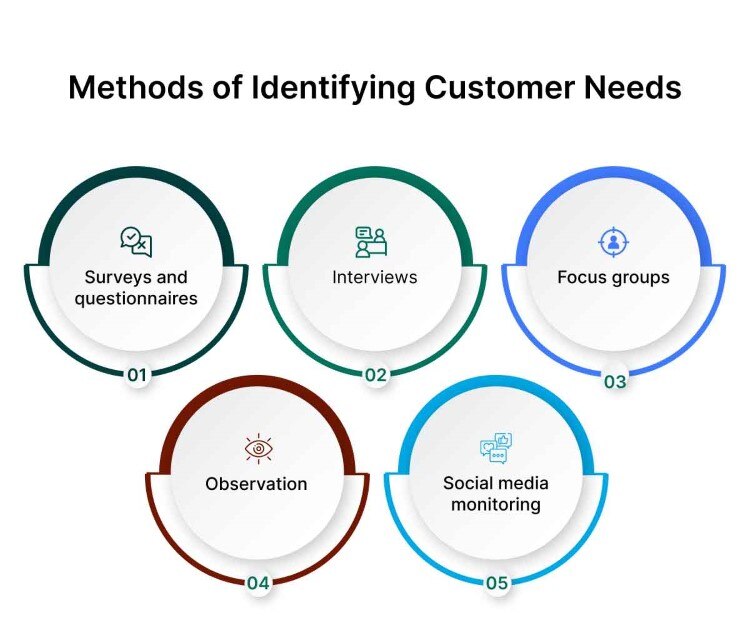
3. Focus groups
Focus groups are a very helpful method to explore customer needs in a dynamic and interactive setting. They are qualitative research methods wherein a small group of audience engages in a guided discussion. The purpose of focus groups is to capture customer interactions and experiences that are otherwise not possible with surveys and interviews.
Pro Tips
- Devise a detailed plan with clarity on the composition of the group the topics and the format of the discussion
- Select participants that represent diversity and appoint a skilled moderator to guide the session
- Let one-ended topics or questions be discussed and then you transcribe and analyze the data
4. Observation
Observation is a good method to understand customer needs and wants. Many companies use this research technique to watch and document the behaviors and reactions of their target audience. You can observe customers either physically or on the web to gain a deep insight into their comfort level with your products or service.
Pro Tips
- Observe customers in their natural setting be it retail stores or during product usage
- Carefully watch them and then document their behavior
- Leverage ethnographic research to understand how customers use your products and find areas for improvement
5. Social media monitoring
Social channels have become very helpful platforms to understand customer behaviors and interactions. You just need to monitor social media platforms and online forums where you can track discussions related to your products, services, or industry.
Pro Tips
- Devise a social media strategy and choose the channels where your target group hangs out the most
- Engage with customers and gather feedback
- Reply to their comments and messages to gain insights into their needs
Customer Needs Analysis Frameworks
Several frameworks can help businesses move from general customer feedback to a deeper understanding of customer motivation.
1. Jobs-to-be-Done
The Jobs-to-be-Done (JTBD) approach focuses on the progress a customer is trying to make rather than only on the product they are buying.
Instead of asking:
“Which features does the customer want?”
Ask:
“What job is the customer trying to accomplish?”
For example, someone purchasing live chat software may not simply need “live chat.” The actual job could be reducing customer waiting time, converting hesitant website visitors, handling more conversations without increasing headcount, or providing assistance outside regular business hours.
Thinking in terms of customer jobs helps reveal why customers choose one solution over another.
2. Means-End Analysis
Means-end analysis connects three elements:
Product attribute → Customer benefit → Personal value
Suppose a customer chooses a support solution with 24/7 availability.
The product attribute is continuous availability.
The benefit is receiving assistance whenever a problem occurs.
The underlying value may be confidence, convenience, or reduced business risk.
This approach is particularly useful when several customers request the same feature for different reasons.
3. Kano Model
The Kano Model can help businesses prioritize product and service improvements by separating customer expectations into different categories.
Basic needs are features customers expect automatically. Their presence may not delight customers, but their absence creates dissatisfaction.
Performance needs are areas where better performance generally creates greater satisfaction—for example, faster response times.
Delighter needs are unexpected features or experiences that can exceed expectations and differentiate a brand.
Using this model helps prevent businesses from treating every feature request as equally important.
Customer Needs Analysis Questions to Ask
The quality of your customer needs analysis depends heavily on the questions you ask. Instead of asking only whether customers are satisfied, use questions that reveal problems, motivations, priorities, alternatives, and expected outcomes.
- What are you ultimately trying to accomplish when using our product or service?
- What is the biggest challenge preventing you from achieving that goal?
- What part of the current experience requires the most effort?
- Which product or service feature is most important to you, and why?
- If you could improve one part of our product or service, what would you change?
- What alternatives did you consider before choosing us?
- What nearly stopped you from purchasing our product or service?
- What would you miss most if our product or service were no longer available?
- When you contact customer support, what does an ideal support experience look like?
- Which improvements would make you more likely to continue buying from or recommending our business?
Avoid relying exclusively on yes/no questions. Open-ended questions encourage customers to explain the reasoning behind their answers, which can help uncover needs that predefined survey options may miss.
Steps to Perform a Customer Needs Analysis
A customer needs analysis is key to getting insight into your customer’s challenges and pain points. It helps a business in devising data-driven strategies to improve customer experiences and grow the business over time. After all, customer-centric companies are 65% more profitable than others.
Here is a step-by-step guide on performing a customer needs analysis –
Step 1 – Define your target audience
Defining your target audience is the first step when a business wants to do customer need analysis. In this step, the purpose is to understand the ideal customers and know their motivations, behaviors, and preferences. Knowledge of the target audience will prove helpful in focusing the effort on a specific group and ensuring value to them at each step of the way.
Pro Tips
- Create a detailed description of your ideal customer
- Consider key factors like age, gender, income level, and location
- Tailor your efforts to the specific needs of the audience

Step 2 – Conduct market research
Once you have defined your target audience, the next step in need analysis is to gather more information about them. The more information you have about your customers, the better you can meet their needs.
To conduct market research, you can employ one of the various methods or, combine one or more for effective results. You can send surveys, arrange focus groups, or conduct interviews. Plus, there are plenty of online analytic tools that can be used to gather customer data.
Pro Tips
- Use a mix of qualitative and quantitative methods
- Get a 36o-degree view of customer needs and preferences
- Collect data about the market as well
Step 3 – Review existing customer data
Adopting a data-driven approach is essential to understanding customer needs and wants. For data, your business can rely as much on new customers as on existing ones. In fact, a detailed analysis of the sales data and customer interactions related to existing customers can help identify customer needs in a better way.
Pro Tips
- Leverage historical data
- Analyze all the customer feedback and support interactions to get a good knowledge of customer problems
- Go through all customer complaints and see patterns if any as it will help in the improvement of the product or service
Step 4 – Map your customer journey
Meeting customer needs is easier said than done. If it were easy, every business would have a long list of happy customers. After all, it takes effort and a detailed understanding of the different customer touchpoints and how they interact with your business at each of those touchpoints.
This is why we need to map the customer journey as it will give visual clarity on the entire process where customers engage with your products or services. The key to this mapping is to analyze all the steps your customers take to engage with the business and all the touchpoints they go through, right from being a prospect to becoming a loyal customer.
Pro Tips
- Mapping customer journeys is essential to streamline fragmented efforts in meeting customer needs
- You can identify all the friction points of the customer journey and know the opportunities to improve
Step 5 – Analyze industry trends and do competitor analysis
Staying informed about the latest industry trends is one of the key aspects of meeting customer needs. When a business analyzes industry trends, it takes proactive steps to keep up with the changes in market conditions and customer preferences.
Similarly, to effectively meet customer needs, you should consider analyzing your competitors. This will help a lot in understanding their weaknesses and strengths. Based on the industry trends and competitor analysis, you can gain knowledge of various types of customer needs and take steps to meet them.
Pro Tips
- Leverage competitor analysis to gain insights into what you’re doing right and where you are falling short
- Know what customers in your industry value and deliver as per their specific needs
- Anticipate changing customer needs and focus on staying one step ahead of your competitors
Step 6 – Develop solutions
What after you have gained a clear understanding of your customer needs? Well, the next step is to develop solutions to address those needs. After all, the needs analysis you have done will serve the ultimate purpose when you use the findings to serve your customers well.
So, you should consider product improvements like adding new features to make your customers happy. You may think of entirely new offerings as well. Make sure you develop solutions based on the identified needs.
Pro Tips
- Brainstorm solutions in line with the needs identified
- Ensure the solutions are aligned with customer needs
How to Analyze and Prioritize Customer Needs
Collecting customer feedback is only the beginning. Businesses also need a systematic way to convert large amounts of feedback into priorities.
1. Consolidate Customer Signals
Start by bringing relevant information together from surveys, interviews, reviews, support conversations, CRM data, website behavior, sales calls, social media, and product usage.
Looking at these sources together provides a more complete view than relying on one feedback channel.
2. Identify Recurring Themes
Group similar comments and behaviors into broader themes.
For example, individual comments such as “agents take too long to answer,” “I waited 20 minutes,” and “support wasn’t available at night” could form a broader theme of support availability and response speed.
The objective is to move from hundreds of individual comments to a manageable number of clearly defined customer needs.
3. Analyze Needs by Customer Segment
Not every need will be equally important to every customer.
Enterprise customers may prioritize security, integrations, reporting, and scalability, while small businesses may place greater importance on price and ease of implementation.
Segmenting findings by customer type, behavior, lifecycle stage, geography, industry, or value can prevent a highly vocal minority from being mistaken for the entire customer base.
4. Prioritize the Needs
Once needs have been identified, evaluate each one using factors such as:
Importance: How important is the need to customers?
Frequency: How frequently does the need appear across conversations and data?
Current satisfaction: How effectively does your existing product or service address it?
Business impact: Could solving the need improve conversion, retention, satisfaction, efficiency, or revenue?
Strategic fit: Does addressing the need align with your company’s product and business strategy?
A customer need that is highly important but poorly satisfied is usually a stronger opportunity than one that is frequently mentioned but has little impact on the customer’s overall experience.
5. Validate Before Acting
Before making a major investment, validate your conclusions with additional research or a smaller experiment.
You might interview another customer segment, test a prototype, run an A/B test, introduce a limited feature, or review additional behavioral data.
Validation reduces the risk of investing resources in a solution based on assumptions rather than genuine customer demand.
Best Practices to Meet Customer Needs
Meeting customer needs effectively is key to the growth of any business. If you consistently meet and exceed customer expectations, you will achieve happy customers who, in turn, can lead to operational success. However, there are some best practices you need to follow to meet customer needs.
Here are the best practices to meet customer needs –
- Make a priority of understanding your target audience, their needs, and preferences by developing detailed personas.
- Focus on promptly addressing customer queries, inquiries, and doubts, and let them have clear information about your products or services.
- Regularly encourage customers to share feedback and promptly act on their suggestions as this can help improve your products or services.
- Offer personalized services that fit the specific needs of individual customers and maintain the consistency of your offers.
- Address customer issues quickly and offer round-the-clock and accessible support.
- Add new features based on customer feedback and innovate as per market trends as adapting to changing customer preferences is vital to meeting their needs.
- Regularly train your employees so that they have the skills to meet customer service expectations and feel empowered to make the right decisions.
- Take steps to encourage customer retention and reward loyalty or repeat purchases.
Best Tools for Analyzing Customer Needs
Analyzing customer needs is a key part of an effective business strategy. A business that regularly assesses the needs of its customers can meet those needs successfully. The good thing is there are several tools and software available for analyzing customer needs.
Here are the tools to analyze customer needs –
1. Customer Relationship Management (CRM) Software
CRM tools are very useful for analyzing customer needs. A business can use them to manage customer data, track interactions across channels or touchpoints, and better understand customer behavior and preferences. More so, the use of customer relationship software is extensive for targeted marketing and personalized communication. Some of the examples of CRM tools include Salesforce and Zoho CRM.
2. Surveys and Feedback Tools
Surveys and feedback are very important for understanding and analyzing customer needs. You can use survey tools to collect feedback from customers and understand many things, including their satisfaction levels, and their preferences. These tools are vital for businesses that want to implement client feedback into different areas for improvement. Some of the examples of survey and feedback tools include SurveyMonkey and Google Forms.
3. Analytics Software
The use of analytics tools is widespread in evaluating customer-centric data and information for understanding customer behavior and preferences. These tools are invaluable in implementing effective marketing strategies aligned with the various stages of the customer journey. Some of the examples of analytics software include Google Analytics and Mixpanel.
4. Heatmap and Session Recording Tools
Visualizing heatmaps and recording user sessions is essential for analyzing and understanding how users engage with your website. These tools are helpful for a comprehensive analysis of user interactions. You can use these tools to identify areas where engagement happens the most or least. Some of the examples of these tools include Hotjar and Crazy Egg.
Examples of Customer Needs Analysis
Needs analysis is a key aspect of business strategy for making informed decisions and improving products or services. Top businesses across industry verticals routinely engage in needs analysis to better understand their customers and achieve higher levels of customer satisfaction.
Here are some examples of customer needs analysis –
1. Apple Inc.:

Apple is a great example of how to leverage the power of needs analysis and achieve innovation in products. The company conducts regular surveys, collects user feedback, and does usability testing to assess the needs of customers. More so, it keeps a close eye on forums and social platforms, and support interactions for identifying areas of improvement.
2. Airbnb

Airbnb is another example of how to take customer needs analysis seriously and ensure value to them at each stage of their journey. It relies on reviews and ratings of each customer visit to address issues related to user experiences with its properties.
3. Zappos

The online shoe and clothing retailer Zappos always stands out for its customer-centric philosophy. It puts high priority on customer feedback and reviews as it encourages customers to share their experience with the brand’s offers. It uses customer feedback to enhance its product offerings.
Turn Customer Needs Analysis Into Action
Customer needs analysis creates value only when insights lead to action.
Once the most important needs have been identified, assign them to the areas of the business that can address them.
A product-related need may influence the product roadmap. Repeated confusion around pricing may require changes to packaging or communication. Difficult onboarding may require improvements to educational content and customer success processes. Long support wait times could lead to better self-service, automation, workforce planning, or conversational AI.
Customer insights should therefore be shared across product, marketing, sales, customer service, and customer success teams rather than remaining inside a research report.
It is equally important to close the feedback loop. When customer feedback results in a meaningful improvement, communicate that change back to customers. This demonstrates that their input has been heard and gives the business another opportunity to validate whether the solution actually addressed the original need.
Finally, customer needs analysis should be an ongoing process rather than a one-time research project. Products change, competitors introduce new alternatives, technology evolves, and customer expectations shift. Regularly reviewing feedback and behavioral data helps businesses identify emerging needs before they become major experience gaps.
Customer Needs Analysis Example
Consider an ecommerce company receiving increasing complaints about customer support.
At first, the apparent customer need is simple: customers want faster responses.
However, the company analyzes live chat conversations, support tickets, customer surveys, and website behavior. It discovers that many repetitive questions concern order status, delivery times, return policies, product availability, and product recommendations.
The analysis reveals several underlying needs:
Customers want immediate answers to simple questions. They want support outside regular business hours. They expect consistent information across communication channels. And when an issue becomes complicated, they want to reach a human agent without repeating everything they have already explained.
Instead of treating “faster response” as a single issue, the business can develop several targeted solutions. Frequently asked questions can be handled through self-service or AI-powered assistance, conversations can be maintained across channels, and complex queries can be transferred to human agents with the conversation context preserved.
This is the real value of customer needs analysis: turning surface-level feedback into a clear understanding of the problem, prioritizing the underlying needs, and choosing solutions based on evidence rather than assumptions.
Final Thoughts
Customer needs analysis is important for a business to improve user experience and add value to each stage of the journey.
Without a better understanding of customer needs, it would not be possible to meet the specific needs which might increase customer churn over time.
With REVE Chat, you can sign up and find a variety of engagement tools and see how they can contribute to your need analysis endeavor.
Build AI-powered support with Wize AI
Connect business knowledge, automate support conversations, and improve response quality without managing a complex AI stack.
Explore Wize AI Agent Rate the article

Juwel Rana
Senior Content Writer
Juwel is a Sr. Content Writer at REVE Chat. He specializes in writing about customer service and customer engagement. He is passionate about helping businesses create a better customer experience.
He strongly believes that businesses will be able to understand their customers better and ultimately create more meaningful relationships with them.
View all articles