
Table of Content
AI SUMMARY
Quick Answer
Effective ecommerce customer retention strategies start with understanding why customers do not return. Improve product guidance, delivery updates, returns, complaint handling, and reordering before relying on discounts. Use timely reminders, relevant recommendations, loyalty rewards, and subscriptions where suitable. AI agents can support product and order queries through connected store data. Measure repeat purchases over consistent periods, compare test groups, and account for costs to identify improvements that support profitable retention.
A customer buys a bag of coffee, receives it on time, and enjoys it. Six weeks later, they order from another store. Nothing necessarily went wrong. Your store may simply have failed to make replenishment easy or give that customer a useful reason to return.
The problem is often not the first sale. Customers may leave because they had a poor delivery experience, could not get help when they needed it, or simply found another store they preferred.
Effective ecommerce customer retention strategies helps you focus on what happens after the first order. It gives customers reasons to return and makes buying from your store easier the next time.
In this blog, you will learn about the 15 practical ways to bring customers back for your ecomercce business. You will also learn ways to build better relationships and encourage repeat purchases without relying on guesswork.
What is Ecommerce Customer Retention?
Ecommerce customer retention is the practice of encouraging existing customers to buy from your online store again. Retention measures repeat purchases, while loyalty shows how much customers prefer and trust your brand.
A customer may buy from your store again because the product is useful, the price is right, or delivery is convenient. This does not always mean the customer is loyal to your brand.
Repeat purchases also depend on the type of product you sell. Customers buy everyday products more often, so a second purchase within the usual buying cycle shows retention. For furniture and other durable products, retention can mean buying accessories or returning for another product later.
Why Ecommerce Customer Retention Matters?
Getting a customer to place the first order is only the start. Retention focuses on what happens after that purchase and what makes customers come back. Acquisition and retention need different strategies.
Focus on the customer experience
Retention starts after the first purchase. Delivery, product quality, customer support, returns, and post purchase communication can all affect the next purchase.
Find problems early
Retention data can show where customers drop off. For example, if customers with late deliveries return less often, check the delivery process before spending more on promotions.
Improve post purchase support
The customer journey does not end after checkout. Easy order tracking and returns can improve the overall experience. Baymard’s 2024 benchmark reviewed 20 large ecommerce sites and 27 guidelines for these areas. Its findings can help ecommerce businesses review and improve these post-purchase journeys.
Measure the Next Purchase Consistently
Before you measure retention, set clear rules. Decide who counts as a customer, which orders count, and how long you will track each customer.
Remove test orders and decide how you will handle cancelled or refunded orders. Use the same rules when comparing different customer groups.
Second Purchase Rate
The second purchase rate tells you how many first-time customers buy again within a set period.
Formula:
Second purchase rate = Customers who make a second purchase within the period ÷ First-time customers × 100
For example, if 240 out of 1,000 customers place another order within 90 days, the second purchase rate is 24%.
Give each customer the full 90 days before comparing the results. Comparing customers who joined in January with customers who joined in September would give you an inaccurate result if the September group has only been tracked for two weeks.
Choose a time period that fits your products. A 90-day period may work for some stores, but it may not fit products that customers buy less often.
Cohort Retention
A cohort is simply a group of customers who started at the same time. You can group customers by the month of their first order.
Cohort retention shows how many customers from that group make another purchase during a later period. It helps you see how customer behavior changes over time.
Keep this separate from total repeat purchases. For example, a customer who bought again in February but did not buy in March counts as a February purchase, not a March purchase.
Repeat Customer Rate
Repeat customer rate can mean different things. Define it clearly before adding it to a report.
You may use it for customers who placed at least two orders during a specific period. You may also use it for customers who purchased during that period and had bought from you before.
Always state which definition you used, along with the time period and calculation.
Customer Retention and Churn
Customer retention rate shows how many existing customers remain active during a specific period.
Formula:
Retention rate = (Customers at the end − New customers) ÷ Customers at the start × 100
Churn shows how many customers stop buying. Set a clear period for inactivity before marking someone as inactive. A furniture customer may buy once a year, while a grocery customer may order every week.
Track Supporting Metrics
Track the time between the first and second order, purchase frequency, and revenue from each customer group. Include product costs, shipping costs, payment fees, and reward costs to understand the actual value of repeat purchases.
Average order value and customer satisfaction can help explain your results. They do not prove that retention has improved on their own.
For customer lifetime value, state clearly if the number comes from past purchases or a future estimate
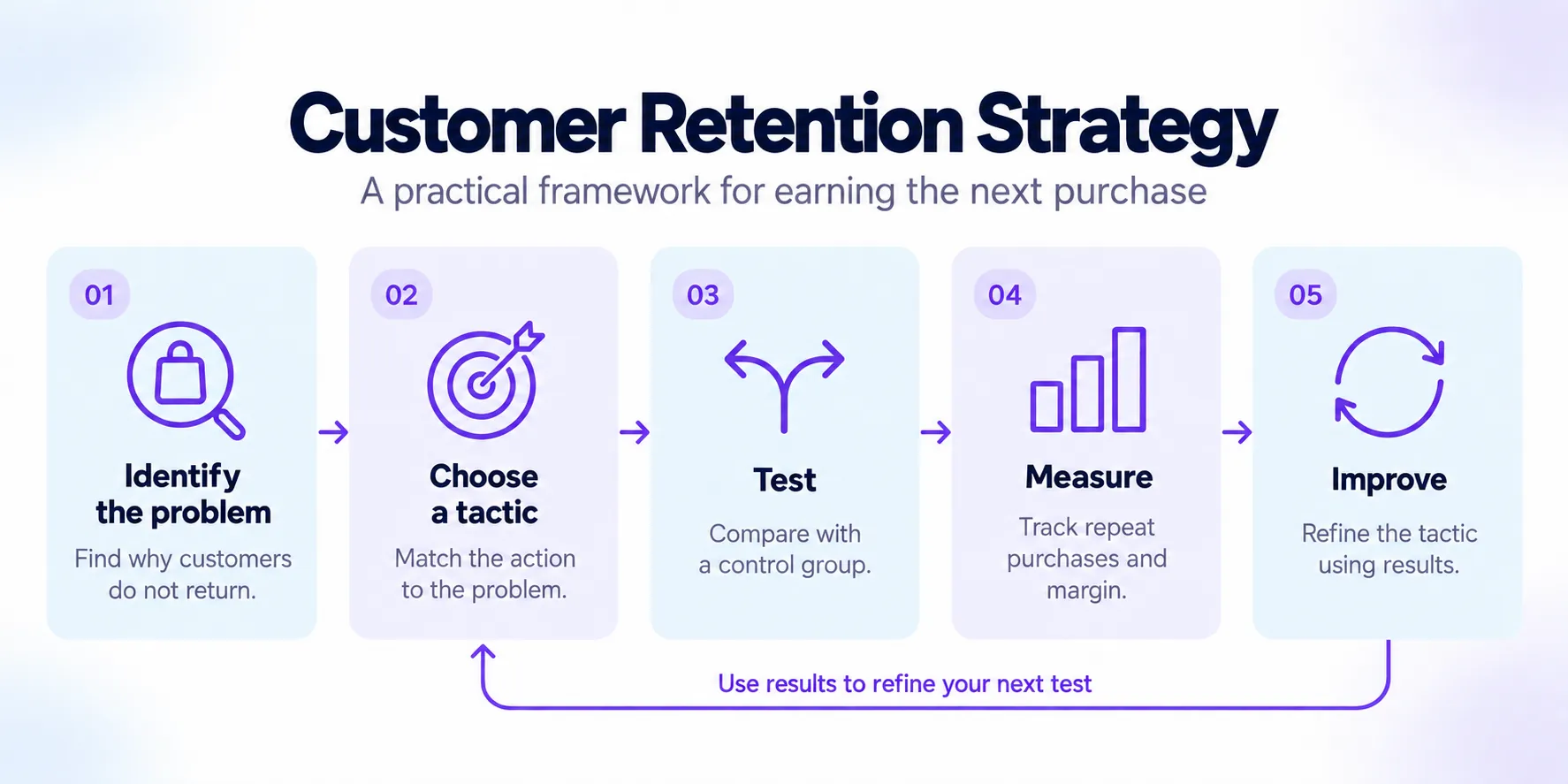
Choose a Strategy Based on the Problem
Before choosing a retention strategy, find out why customers do not return. Ask these four questions:
- Was the product and delivery experience good?
- Did customers get the help they needed?
- Do they have a reason to buy again?
- Is it easy to place another order?
Check order data, support questions, return reasons, and customer feedback. This helps you find the main problem and choose the right strategy.
| Problem | Strategy | What to Check |
|---|---|---|
| Customers do not understand the product well | Improve product information | Returns and repeat orders |
| Customers often ask about delivery | Improve order tracking | Delivery questions and repeat orders |
| Customers need help using the product | Add product guides | Support questions and repeat orders |
| Customers forget to reorder | Send reorder reminders | Repeat orders |
| Customers find it hard to order again | Make checkout easier | Completed orders |
| Customers stop buying after a complaint | Follow up and solve the issue | Resolved issues and repeat orders |
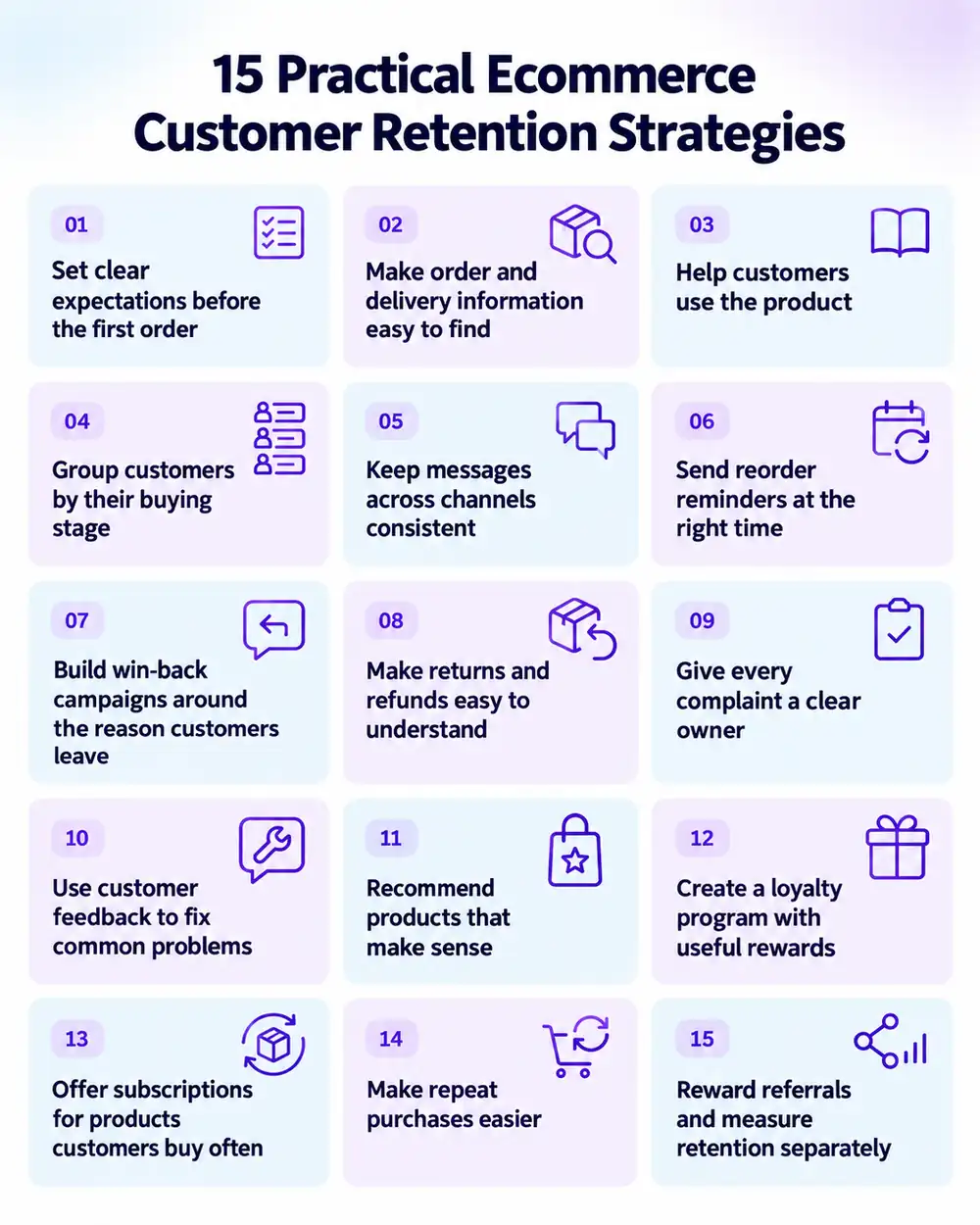
Top 15 Practical Ecommerce Customer Retention Strategies
Keeping customers coming back starts with a good experience after their first order. These simple strategies can help increase repeat purchases and keep customers interested in your store.
1. Set clear expectations before the first order
Give customers accurate information about size, materials, compatibility, delivery time, and return rules. Check support questions and return reasons to find areas that cause confusion.
For example, a clothing store may need better size charts if customers often return items because of poor fit. An electronics store may need clearer compatibility information.
Start with a product that gets frequent complaints or returns. Improve its information and compare the results with an earlier customer group. Track expectation-related returns along with the second purchase rate.
2. Make order and delivery information easy to find
Give customers a simple way to check their order status. Add a clear tracking link to the confirmation email or customer account.
Explain each order status and tell customers what to do when there is a delay. Show the latest tracking information and make it clear when a delivery date is only an estimate.
Check the tracking process on mobile. Make sure customers can find their order, understand split shipments, and contact support easily.
Track delivery-related questions and repeat questions about the same order. Also check if these customers return and buy again.
3. Help customers use the product
Give customers useful information after their order arrives. Focus on the first things they need to know.
A coffee buyer may need tips on grinding and storage. An appliance buyer may need setup instructions. Send information based on the product and delivery stage.
Keep these messages focused on helping customers rather than selling more products.
Track product related support questions and second purchases. If possible, compare customers who receive the guides with a similar group that does not.
4. Group customers by their buying stage
Start with a few useful groups, such as first-time buyers, repeat buyers, customers ready to reorder, and customers with unresolved issues.
Consider the product each customer bought too. A first-time camera buyer needs different information from a repeat coffee buyer.
Pause promotional messages when a customer has an open delivery, refund, or service issue. Record why customers enter and leave each group.
Compare repeat purchases and customer contribution across the groups. Avoid creating too many small groups that provide little useful data.
5. Keep messages across channels consistent
Review every message customers receive after an order. This includes order confirmations, delivery updates, product guides, review requests, reorder reminders, and win-back messages.
Give each message a clear purpose. An email and SMS may seem fine separately but can become too much when sent together.
Set a reasonable limit for promotional messages and avoid sending the same offer through several channels. Follow customer communication preferences.
Track repeat purchases, unsubscribes, complaints, and repeated campaigns. Set message timing based on how often customers normally buy.
6. Send reorder reminders at the right time
Find out how long customers usually wait before buying a product again. Consider different pack sizes and quantities when setting reminders.
For example, if coffee customers usually reorder after five weeks, test a reminder around that time. A customer who bought three bags may need a later reminder.
Do not send reminders if the customer has already reordered, the product is unavailable, or there is an unresolved issue.
Take customers directly to the right product and make it easy to change the quantity.
Track repeat purchases over a suitable period. This shows if the reminder creates an extra purchase or simply moves an expected order forward.
7. Build win-back campaigns around the reason customers leave
Set your inactive period based on how often customers normally buy. Then find out why they stopped buying.
Some customers may need a simple reminder. Others may have had a poor experience.
Test a product reminder, an update based on customer feedback, or a simple question about why they did not return. Use discounts only when they make financial sense.
A customer with a damaged order should receive help with that problem before getting a promotional offer.
Track how many inactive customers return, how much they spend after an offer, and if they buy again later. Stop contacting customers who opt out or show no interest.
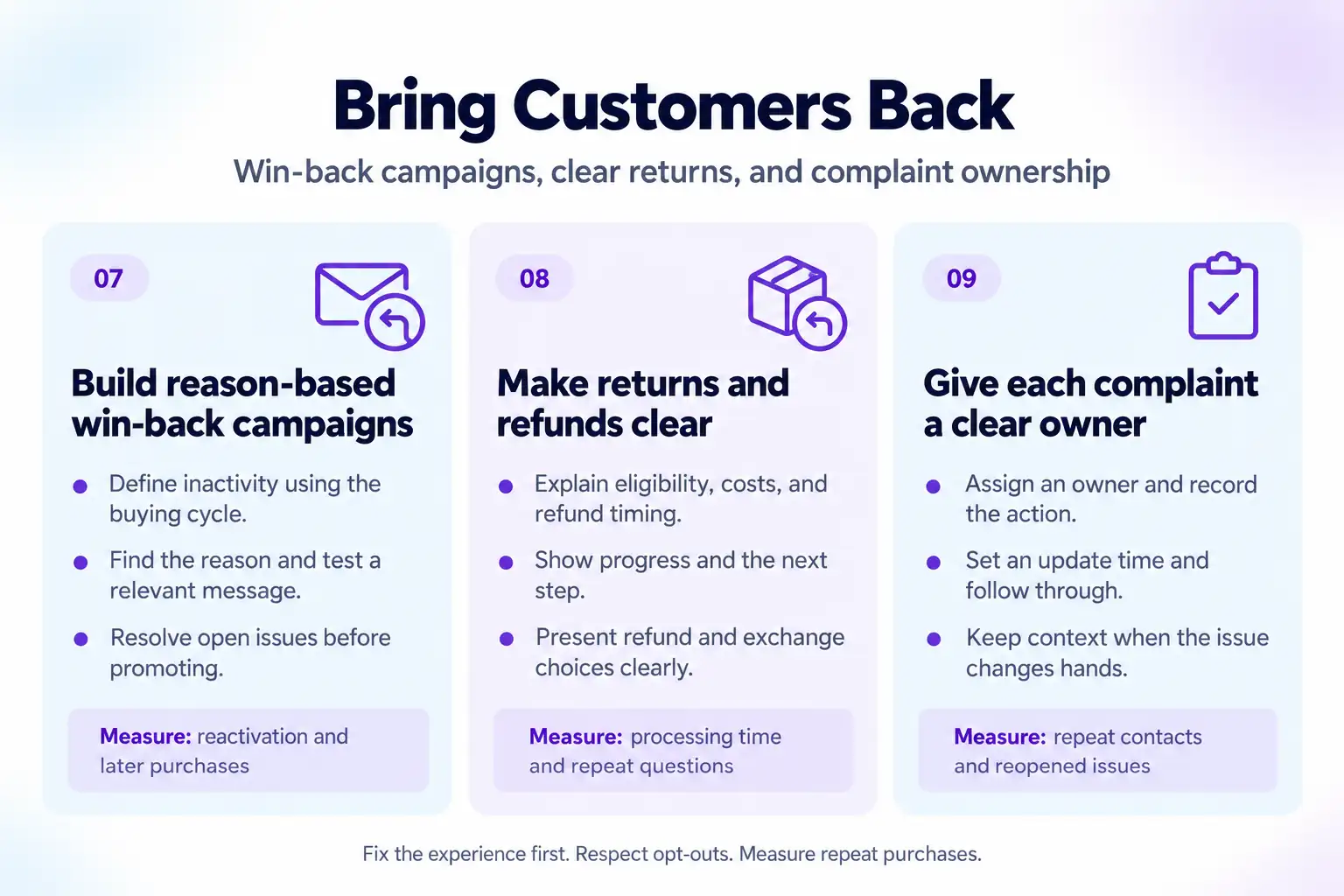
8. Make returns and refunds easy to understand
Clearly explain return eligibility, deadlines, costs, and refund times before customers start a return.
Once a return begins, show its progress and tell customers what they need to do next.
Check the full process from finding the return policy to receiving the refund. A clear policy is not enough if customers cannot see what is happening with their return.
Offer exchanges or store credit when suitable, but show all available choices clearly.
Track return processing time, repeated return questions, and later purchases. Review return reasons to find product quality or information problems.
9. Give every complaint a clear owner
When something goes wrong, assign someone to handle the issue. Record what happened, what action was taken, and when the customer should receive an update.
For example, if a customer receives a damaged product, confirm the solution and follow up after the replacement arrives.
Customers should not have to explain the same problem every time it moves to another team member.
Use compensation based on company policy and the situation. A discount should never replace a promised refund or replacement.
Track repeat contacts, reopened complaints, and later purchases. Keep in mind that customers who contact support may already have different buying habits.
10. Use customer feedback to fix common problems
Review support questions, returns, and customer reviews to find problems that keep coming up.
Focus on issues based on how often they happen, how much they affect customers, and how easily your team can fix them.
For example, if customers often ask if a charger works with a device, improve the compatibility information. If customers report damaged packaging, check the fulfillment process.
Give each improvement an owner and check the results after making the change.
Measure complaints against relevant orders or products sold. Total complaints can increase simply because sales increased.
11. Recommend products that make sense
Use a customer’s previous purchase to suggest products that fit their needs. Check availability, product variants, and compatibility first.
For example, someone who buys a coffee machine may need compatible filters. Someone who buys espresso beans may need a different recommendation.
If you do not know what the customer needs, ask a simple question instead of guessing.
Track purchases from recommendations, along with returns and customer contribution. When possible, compare these results with customers who did not receive the recommendation.
Do not recommend products that customers recently returned or products that do not fit their previous purchase.
12. Create a loyalty program with useful rewards
Choose rewards that customers can understand and use. Check how many purchases they need before earning the first reward.
A reward that takes years to earn may offer little motivation to an occasional buyer. Useful rewards may include shipping benefits, store credit, or early access.
Clearly explain how customers earn and use rewards. Include expiry dates and restrictions.
Calculate reward costs before launching the program. Some customers may have purchased again without the reward.
Track additional purchases and customer contribution. Do not assume the program caused higher sales just because members buy more.
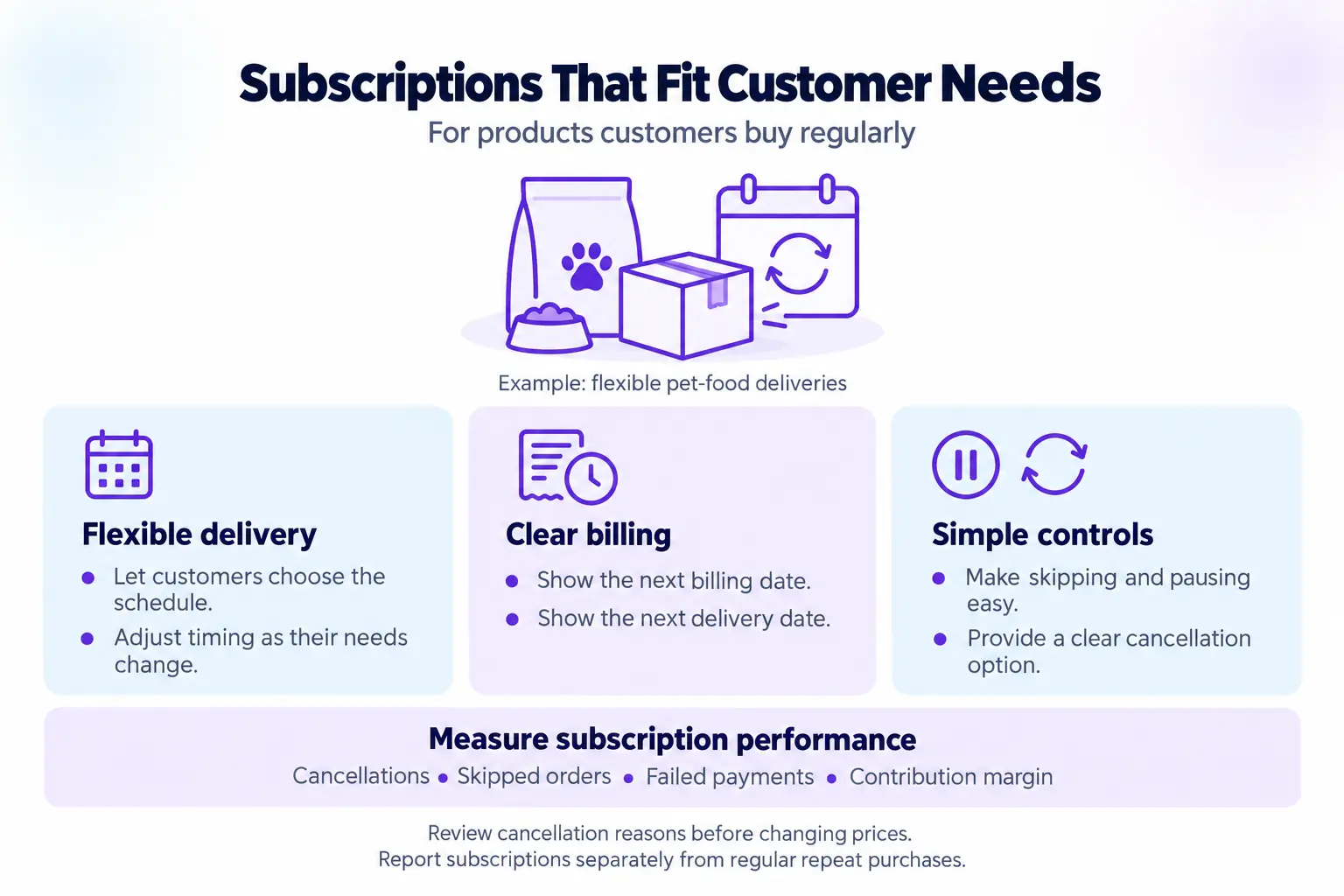
13. Offer subscriptions for products customers buy often
Subscriptions work well for products customers need regularly.
Let customers choose a suitable delivery schedule. Show the next billing and delivery dates clearly. Give them simple options to skip or pause an order.
For example, pet food needs can vary based on the pet and how much it eats. Customers should be able to change their delivery schedule when needed.
Track cancellations, skipped orders, failed payments, and customer contribution.
Review cancellation reasons before assuming that a lower price will solve the problem.
Keep subscription orders separate from regular repeat purchases when reporting retention because the two groups behave differently.
14. Make repeat purchases easier
Give returning customers an easy way to buy products they purchased before. Show the current price and availability. Let them change the quantity, variant, address, or delivery option.
Check the reorder process on mobile. A reorder button should take customers to the right product instead of the homepage.
If the original product is unavailable, explain why and suggest a suitable alternative.
Track completed reorders, checkout failures, and the time it takes to complete a purchase.
Make account features useful. Avoid extra sign in steps that make repeat purchases harder.
15. Reward referrals and measure retention separately
Give existing customers a clear reward when someone they refer completes a qualifying purchase. Explain the rules, reward timing, cancellations, and duplicate referrals before launching the program.
Choose a reward that fits your profit margin. A reward that works for an expensive product may cost too much for a low value order.
Referrals mainly bring in new customers, so measure their retention separately.
Check if customers who refer others return more often. Also check if referred customers make profitable second purchases.
Track both groups over the same period. Include rewards and refunds when calculating contribution.
Do not treat referral signups alone as proof that customer retention has improved.
How AI Agents can support retention
An AI Agent can help customers find products, check orders, and solve common issues. Its retention value comes from helping customers complete tasks and return to buy again.
Step 1: Understand the request
The agent identifies what the customer needs, such as finding a previous product or checking an order.
Step 2: Check customer and product data
With the right store connection, the agent can access approved product, catalog, order, and customer information.
Step 3: Verify the customer
The agent should verify the customer before showing private order information. Access should be limited to approved data and actions.
Step 4: Complete the task
For example, a customer wants to reorder coffee but cannot remember the variant. The agent can identify the previous product, check availability, and provide the correct purchase link. If it is unavailable, it can suggest an approved alternative.
Step 5: Transfer when needed
If the request requires an action the agent cannot safely complete, it should transfer the conversation to a human.
Step 6: Measure retention
Track task completion, repeat purchases, support contacts, and time between orders. Automation alone does not prove better retention.
A practical example of choosing the right intervention
Imagine a coffee store tracking 1,000 first-time customers for 90 days. During this time, 240 customers bought again. So, the second purchase rate was 24%.
The team found two problems. Some customers could not find delivery updates. Others forgot to buy coffee again. The store should fix these problems separately. It can test a reminder for customers who are ready to reorder.
The customers are split into two groups. One gets the reminder. The other gets the usual experience.
| Result | Reminder group | Control group |
|---|---|---|
| Customers | 500 | 500 |
| Repeat buyers | 140 | 120 |
| Repeat purchase rate | 28% | 24% |
The reminder group had a 4% point higher repeat purchase rate. It also had 20 more repeat buyers. The 16.7% increase is another way to describe the same result.
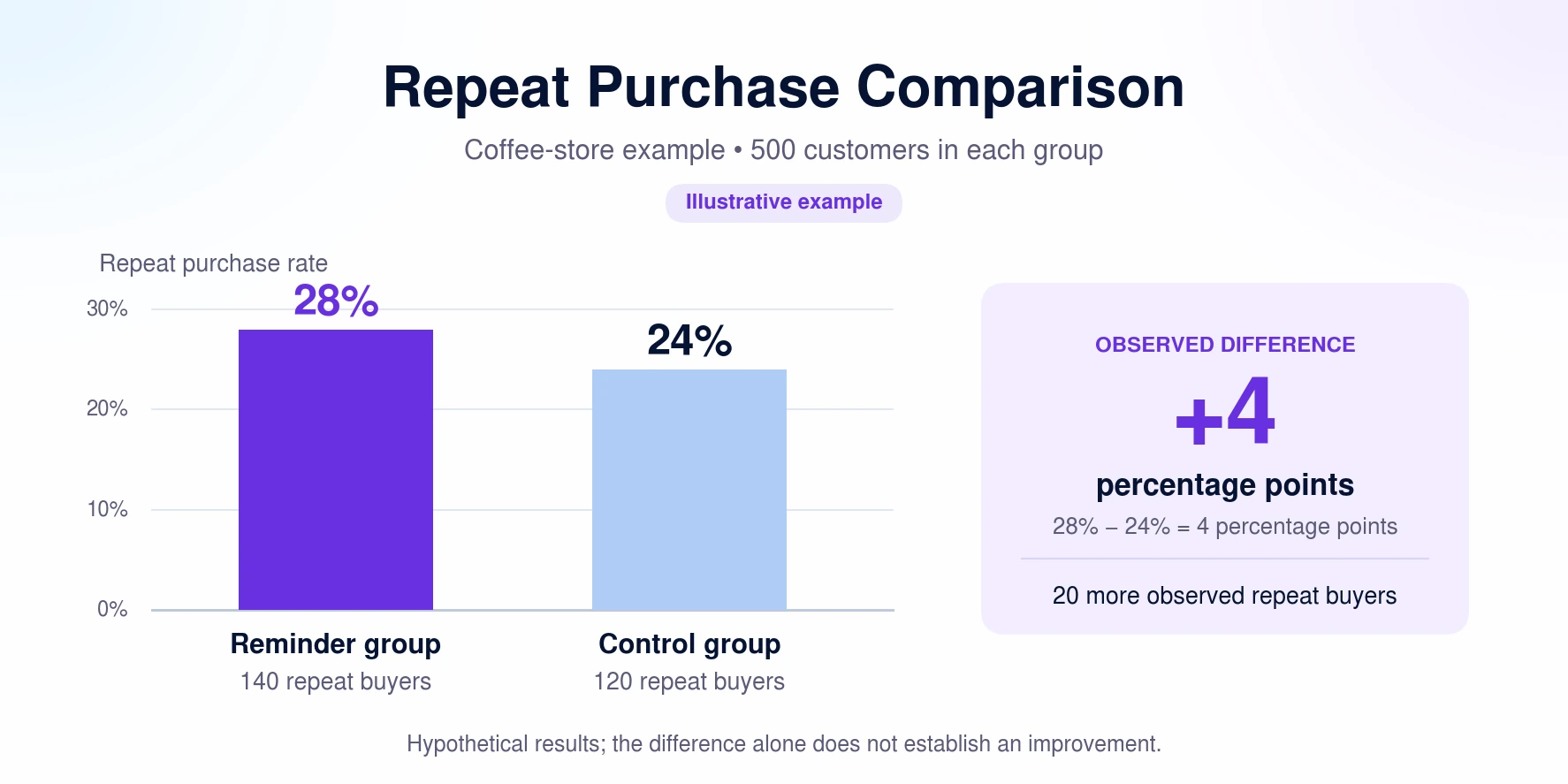
This example does not prove that the reminder caused the increase. A real test needs enough customers and enough time to measure the result.
Build a retention plan your team can execute
A simple plan helps your team focus on one problem at a time. Test the strategy, track the results, and make changes based on what you find.
Week 1: Establish the baseline and select a problem
Choose one product category and a relevant repeat purchase window. Review mature cohorts, recurring support issues, and return reasons. Write a specific hypothesis, such as testing whether a timely reminder improves second purchases among eligible consumable buyers.
Week 2: Prepare the intervention and measurement
Assign an owner, define eligibility, and document exclusions. Set the main outcome before launch. Record the customer experience, message timing, and any contribution or complaint limits that would prompt a change.
Week 3: Launch a controlled test
Where feasible, randomly assign eligible customers to treatment and control groups. Check whether messages, links, inventory information, and suppression rules work. Review early service problems without declaring a retention result prematurely.
Week 4: Review execution and continue observation
Assess whether the test ran as intended. A four-week setup plan does not imply that retention can be judged in four weeks. Continue until the chosen purchase window matures, then decide whether to expand, revise, or stop the intervention.
Mistakes that make retention results misleading
Avoid these common mistakes when measuring customer retention:
- Different follow up periods: Give customers the same amount of time to buy again before comparing results.
- Calling inactive customers lost: Consider the normal buying cycle. A customer who buys every six months may not be lost after two months.
- Looking only at campaign sales: Some customers may buy without the campaign. Use a control group when possible.
- Using rewards to fix problems: Fix product, delivery, and support problems first.
- Ignoring costs: Include discounts, rewards, and shipping costs when measuring results.
- Making several changes at once: Test one main change at a time. This helps you see what caused the result.
End Note
The best ecommerce customer retention strategies begin with a simple question: why do customers come back, and why do some stop buying? Find one problem, try one solution, and give it enough time to see what happens.
Small improvements can make it easier for customers to return. Better product information, clear delivery updates, helpful support, easy reordering, and timely reminders can all support repeat purchases.
If customers need help with products, orders, or common questions, REVE Chat’s Wize AI Agent and Live Chat can help at different points in the customer journey. Book a demo today!
Frequently Asked Questions
It depends on why customers do not buy again. Try reorder reminders for regular products. For other problems, improve product information, delivery updates, or complaint handling.
There is no single rate for every store. Compare customers using the same metric, product type, and time period. Your own past customer data can give you a useful benchmark.
Make buying again easier. Improve product guidance, delivery updates, support, checkout, and reorder reminders. Test discounts only when needed.
Referrals mainly help bring in new customers. However, referral rewards may encourage existing customers to buy again. Measure both results separately.
AI agents can help with product questions, recommendations, and order information. Track task completion, support contacts, and repeat purchases to see their effect.
Give customers enough time to buy again. The right period depends on the product. Set the test period before you start.
Build AI-powered support with Wize AI
Connect business knowledge, automate support conversations, and improve response quality without managing a complex AI stack.
Explore Wize AI Agent Rate the article

Tabassum Kabir
Sr. Content Writer
Tabassum Kabir is a Senior Content Writer with 5+ years of experience. She specializes in SaaS, AI, customer service, and ecommerce. She writes about technology, business, and digital trends. Her work is simple, clear, and useful. She aims to give readers information they can understand and use.
View all articles
Meet Wize AI
Let Wize AI answer customer questions and handle routine tasks, so your support team can focus on what matters.
Try Wize AI Today