





Table of Content
Telecom is one of the few industries where silence is the baseline for success. When the network is stable, your customers don’t try to contact you, and in this business, that’s a win. However, when that silence is broken by a service gap or a billing query, the stakes change instantly. In an era where connectivity is a basic utility, the few minutes a customer spends with your support team are the only thing standing between a loyal subscriber and a canceled account.
The problem? Most telecom support strategies treat these moments as “tickets to be closed” rather than opportunities to be seized. To stay competitive in 2026, providers must move beyond reactive, phone-first support and embrace a digital-first infrastructure.
By offering seamless, multi-channel support that maintains context, you can transform a high-stress outage call into a trust-building interaction or a strategic moment for an upsell. From AI-powered chatbots that identify sales intent to proactive alerts that prevent the “outage flood,” this blog explores how to master customer service in telecom to drive both retention and revenue.
Gemini said
You are absolutely right. The role of the writer matters less than the eyes of the reader. If the audience is a busy Telecom executive or a stressed-out Support Manager, “engaging” means getting to the point quickly with insights that actually help them solve their daily headaches. They aren’t looking for a lecture; they’re looking for a path forward.
Here is why a sharper, more modern version is more “engaging” for that specific audience:
1. It Respects Their Time (The “Scan” Test)
A professional audience skims. Your original version uses “fluff” phrases like “Customers don’t mess around” or “Ever had a customer ditch you?” These are filler.
- Why the modern version is more engaging: It uses power headers like “Managing the Always-On Expectation.” A reader can scan that and immediately understand the value without reading every word.
2. It Uses “Insider” Language
Engagement happens when a reader thinks, “This person gets my world.” * Original: “A friendly agent or quick fix makes your company the go-to choice.”
- Modern: “First-Contact Resolution (FCR) is the single greatest predictor of loyalty.” * The Difference: Every Telecom manager is currently being judged by their FCR and NPS metrics. Using those terms makes the content “sticky” because it’s the exact language they use in their board meetings.
3. It Bridges the Gap to the Solution
Since you are likely going to talk about AI, Chatbots, or Automation later in the blog, the intro needs to set that up.
- Your original mentions “phone support.”
- The modern version mentions “Omnichannel Context.” * Why it’s more engaging: It creates a “curiosity gap.” The reader thinks, “We struggle with context across channels—how do I fix that?” and they keep reading to find the answer.
The “Best of Both Worlds” Version (High Engagement + High Authority)
This version keeps your 4-point structure and your stats, but tightens the “filler” to keep the reader hooked.
Why Customer Service is Crucial for Telecom
In telecom, your product isn’t just the network, it’s the uptime that the user gets. But when that uptime falters, your support infrastructure becomes your most effective retention engine. In a market where 5G speeds are becoming a commodity, Customer Experience (CX) is the only true differentiator left.
Hence, here is why high-tier service is the lifeline for modern providers:
1. Meeting the “Instant-Response” Mandate
Subscribers now view connectivity as a basic utility, like water or electricity. They don’t just want help. They expect it to be instantaneous and available on the channel of their choice.
- The Loyalty Factor: 88% of customers stay with providers who deliver seamless service.
- The 24/7 Reality: Business hours don’t exist in a connected world. If you aren’t available 24/7, you’re invisible.
2. Differentiating in a Saturated Market
With every provider offering similar “unlimited” plans, your service is what moves the needle on important metrics such as your Net Promoter Score (NPS).
- The Competitive Edge: Top-tier service leads to a 10-15% boost in NPS, making your brand the obvious choice in a crowded field.
- Brand Trust: A fast, competent resolution during a crisis builds a level of trust that traditional marketing can’t buy.
3. Slashing Churn to Protect Margins
Losing a customer is expensive. In fact, retaining a subscriber is around 5–7 times cheaper than acquiring a new one. In an industry with approximately 30% annual churn, service isn’t just nice to have, it’s a financial necessity.
- First-Contact Wins: 74% of customers stay loyal if their issue is resolved on the first try.
- Revenue Growth: Effective service stabilizes your revenue and creates a natural path for plan upgrades and upsells.
4. Reputation Management in a Viral World
A single unresolved outage can turn into a PR disaster in minutes. Digital-first customer service acts as your brand’s “pressure valve.”
- Word-of-Mouth: Happy customers become organic advocates, driving growth through referrals.
- Proactive Reliability: Addressing a problem before the customer has to call is the ultimate way to build a “bulletproof” reputation.
Top 10 Essential Elements of Customer Service in Telecom
With how important good customer service is, there are many aspects of customer service in telecom that should be addressed to excel in this side of the business.
Thus, here are ten elements that make customer service in the telecom industry strong.
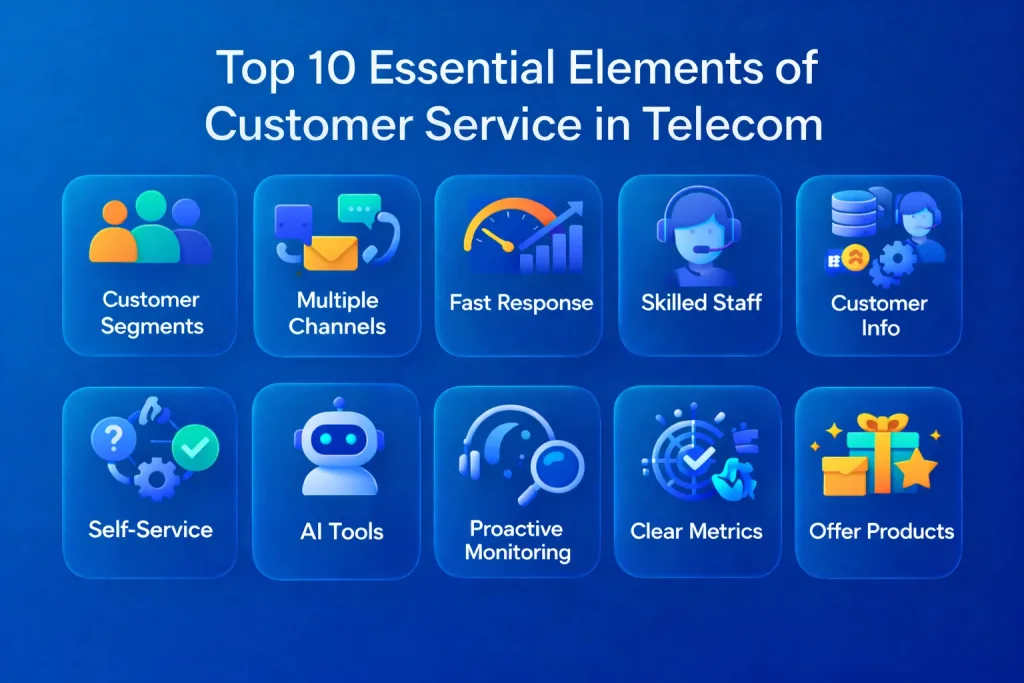
1. Service Based on Customer Segments
Every customer has different needs and expectations that a business needs to evaluate and provide. Hence, proper segmentation is important so that users of all types or categories receive the attention and service needed. This approach balances service quality and costs and ensures all customers are satisfied.
2. Multiple Ways to Communicate
Customers prefer different ways to reach support, whether it be Phone, email, or chat. All channels nad mediums serve different purposes, from pure support to sales assistance. Also, this makes a telecom business more accessible for customers through their preferred method or channel of communication.
3. Fast Response Times
Quick replies are important as customers hate waiting for a solution or a response. Customers like updates on the spot and want to know what steps are being taken to resolve their problems. Regular progress updates and instant answers reduce frustration and build trust, making customers feel valued.
4. Skilled Support Staff
Support agents need strong knowledge and good communication skills to handle all support and sales requests. Thus, training is a necessity for all staff and should include product briefs, problem-solving strategies, a guide to handling customer expectations, and much more.
Skilled staff can solve issues quickly and effectively, making customers feel heard and your customer service more efficient.
5. Complete Customer Information
Agents work better when they have access to customer data such as billing history, usage data, and past interactions. Having this information allows support teams to give accurate answers quickly and helps customers avoid repeating their issues.
6. Self-Service Options
Self-service tools like FAQs, tutorials, manuals, and discussion forums allow customers to solve common problems independently. These tools reduce workload for telecom support services and give customers quick solutions without waiting.
7. AI-Powered Support Tools
AI customer service telecom tools, like chatbots and virtual assistants, handle routine questions and guide customers through simple processes without an agent needing to intervene. Also, AI helps human agents by suggesting next steps via Copilot, which makes the service faster and more consistent.
8. Proactive Monitoring
Constantly monitoring network performance and customer accounts helps detect problems before they affect users. This means having alerts for outages, performance drops, or unusual activity, allowing teams to fix issues quickly. Proactive service keeps networks reliable and gives customers confidence.
9. Clear Metrics and Quality Practices
Tracking agent and team performances helps the business to improve continuously. Metrics like first contact resolution (FCR), average response time (ART), and customer satisfaction (CSAT) show areas that need attention. Measuring results means identifying gaps, which leads to better training, efficient processes, and improved service quality.
10. Opportunities to Offer Products in Service
Customer service agents interact with customers daily, and they are in a prime position to not only solve issues but also suggest new services or pitch for upselling. Hence, they can suggest services or upgrades that match each customer’s needs depending on the conversation. Using insights from data, agents can provide helpful offers while keeping the service experience positive.
How to improve telecom customer experience with 11 effective ways
Telecom companies face a lot of competition, and customers can always decide to switch networks. That’s why customer experience matters in retaining customers. Every interaction affects how customers feel, and clear communication builds trust.
Thus, it is extremely important for businesses to identify their gaps in customer service and how to improve them. So, let’s explore the ways in which telecom customer experience can be improved:
1. Understand Customer Needs Through Data
Telecom companies collect a lot of information from users. By analyzing this information, teams can learn what customers prefer. Usage patterns, browsing habits, and plan choices show clear trends.
These insights help providers offer better plans and solutions. This reduces customer churn, supports growth, and helps service teams understand what customers expect.
2. Solve Problems Before Customers Notice
Fixing issues early can prevent many complaints. Network monitoring tools help teams spot problems quickly. Alerts show slow speeds, weak signals, or unusual activity. When teams act before customers are affected, trust grows, and support centers face fewer calls.
3. Offer Reliable Self-Service Options
Many customers want to handle simple issues on their own. A clear help center with guides and FAQs can answer common questions.
Self-service options also allow support teams to focus on more complex problems. A simple and clean layout makes customers return whenever they need help.
4. Use AI and Automation for Better Interactions
AI tools help teams respond faster and more accurately. Chatbots can answer basic questions at any time of the day.
Automated systems help with routine tasks like checking account balances or resetting passwords. This frees up agents to handle issues that need human support and helps teams plan better service for the future.
5. Provide Consistent Support Across All Channels
Customers reach out through social media, phone calls, emails, and chat. When all channels share the same information, customers do not need to repeat themselves. This creates a smooth experience and increases confidence in the brand.
6. Simplify Billing and Payments
Simple billing helps customers understand their charges easily. Clear statements and easy online payment options reduce confusion. Payment reminders also help customers stay updated and avoid issues.
7. Gather Feedback and Use It
Listening to customers helps companies improve. Surveys, reviews, and forums show what customers face daily. When teams fix common problems based on feedback, customers feel valued, and service quality improves.
8. Build Helpful Mobile Apps
A good mobile app makes things easier for users. They can check usage, pay bills, and contact support from one place. A simple design helps customers find what they need quickly and reduces long support waiting times.
9. Improve Network Quality
Better network quality reduces complaints. Upgrades in 5G and IOT improve speed and reliability. These improvements help support modern devices and growing customer needs.
10. Communicate Clearly During Service Disruptions
Clear updates during outages help customers stay informed. Messages through email, apps, and social media reduce confusion. When customers know what is happening, they feel less frustrated.
11. Protect Customer Information
Customers expect their personal information to stay safe. Telecom companies handle sensitive data like call records and payment details. Good security systems protect this information, and clear privacy policies help customers understand how their data is used.
Key Challenges in Telecom Customer Service
Delivering great customer service in telecom feels like juggling flaming torches. Customers are frustrated, churn rates are climbing, and the pressure’s on.
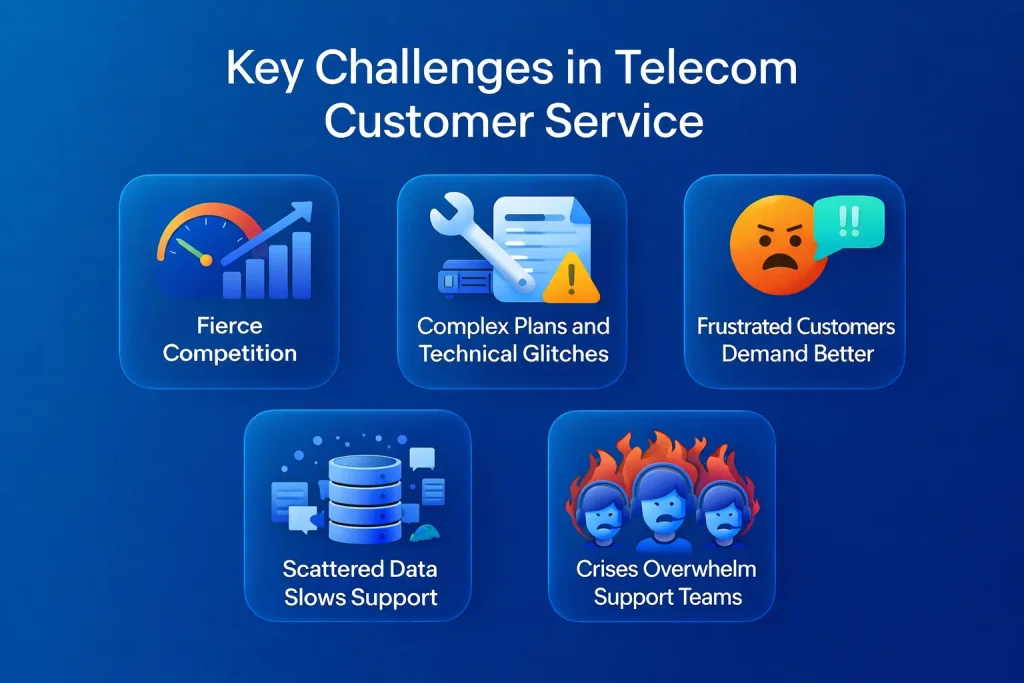
Let’s break down the biggest challenges keeping your support teams up at night.
1. Fierce Competition
In telecom, providers battle in a crowded market. With similar plans, customers leave for the smallest misstep.
- Price Wars Push Service Quality: When plans and prices look alike, standout service becomes the deciding factor. Poor experiences make customers bolt to competitors offering better support.
- Loyalty Hangs by a Thread: A single bad interaction can push customers away. Without exceptional service, telecoms struggle to keep users from jumping ship.
2. Complex Plans and Technical Glitches
Telecom services can feel like a puzzle with missing pieces. Confusing options and tech issues frustrate customers daily.
- Billing Headaches Spark Complaints: Unclear or surprise charges lead to a flood of support calls. Customers need simple explanations to avoid distrust and frustration.
- Tech Issues Test Patience: Dropped calls or spotty internet drive users up the wall. Fixing these quickly is critical to keeping customers calm.
- Too Many Choices Confuse: A maze of plan options overwhelms users. Support teams must guide customers clearly to avoid decision fatigue.
3. Frustrated Customers Demand Better
Nobody likes feeling ignored or stuck waiting. Slow, robotic responses turn small issues into big problems.
- Long Waits Breed Irritation: Being stuck on hold for ages drives customers nuts. Quick responses are a must to keep tempers in check.
- Generic Replies Feel Cold: One-size-fits-all answers make customers feel like numbers. Personal touches are key to building trust and connection.
- Complex Issues Need Humans: Some problems are too tricky for automated systems. Customers crave real agents who can tackle tough challenges.
4. Scattered Data Slows Support
Disconnected systems are a quiet disaster. Without a clear customer view, agents fumble through interactions.
- Siloed Teams Miss the Mark: When sales, support, and marketing don’t share data, service suffers. Unified info is crucial for smooth, informed responses.
- Missing History Delays Fixes: Without past interaction details, agents start from scratch. This slows down resolutions and frustrates customers further.
- Data Gaps Cloud Insights: Scattered systems hide what customers need. A full picture is essential for fast, tailored support.
5. Crises Overwhelm Support Teams
Network outages or disruptions can bury support teams in a wave of urgent calls. Handling these moments is make-or-break.
- Call Surges Strain Resources: Outages flood lines with panicked customers. Teams need scalable systems to manage sudden spikes without crumbling.
- Poor Communication Hurts Trust: Vague or slow updates during crises erode confidence. Clear, timely info keeps customers calm and loyal.
- Scaling Support Is Tough: Ramping up during disruptions is a logistical challenge. Without flexible tools, teams struggle to keep up.
Result-Driven Strategies to Improve Telecom Customer Service
Great customer service in telecom isn’t easy, but it’s worth the effort. Imagine turning angry callers into loyal fans.
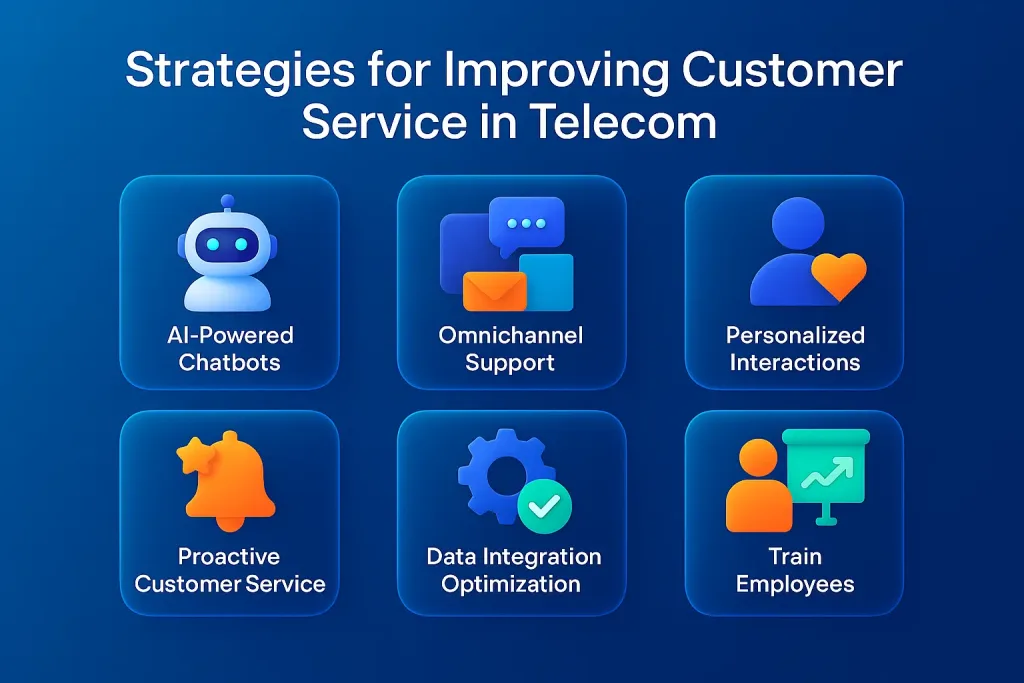
With smart tools and strategies, you can tackle the toughest challenges and make customers smile.
Here are six ways to transform your support and stand out in a crowded market.
1. Leverage AI-Powered Chatbots
Chatbots are like having a tireless team member who never sleeps. They handle routine questions fast, freeing up agents for complex issues.
Platforms like REVE Chat’s AI Chatbot make setup a breeze, blending smoothly with your existing systems. You can train your chatbot in a minute; it comes with Brain AI that allows you to train the chatbot faster to ensure accurate answers.
Connecting chatbots to your CRM lets agents jump in seamlessly when needed. Keep an eye on metrics like resolution speed to fine-tune performance. A well-run chatbot can solve issues in minutes, keeping customers happy and call volumes low.
2. Omnichannel Support
Customers expect to reach you on their terms. Whether it’s a quick chat, a tap on an app, or an email sent at midnight. Omnichannel support means meeting them wherever they are with a seamless experience.
Offer self-service options through mobile apps, letting users check data usage or pay bills in a few clicks. Live chat, powered by platforms like REVE Chat, handles quick questions with speed and a personal touch.
The key is tying every channel, such as chat, app, email, social, and phone, into a single CRM. This ensures customers don’t repeat themselves, no matter how they reach out.
A unified approach creates smooth, frustration-free interactions that build trust and keep customers loyal.
3. Personalize Customer Interactions
Nobody wants to feel like just another account number. Personalization makes customers feel valued.
Use AI to study call patterns or data usage, then offer tailored plans that fit their needs. A CRM gives agents a full view of past interactions.
So they can respond with relevance and speed. Suggesting deals, like extra data for heavy streamers, sparks upsells without being pushy.
Even with tech, keep interactions warm and human. A friendly tone turns routine calls into moments that build lasting trust.
4. Proactive Customer Service
Why wait for customers to complain? Getting ahead of issues shows you’re on their side. Send alerts about outages or billing errors before they call, cutting frustration and support requests. Offering perks like free upgrades to long-term customers builds goodwill.
Analytics can flag users likely to leave, letting you reach out with solutions first. During disruptions, share clear timelines for fixes.
Honesty and proactive steps keep customers calm and loyal, turning potential disasters into trust-building wins.
5. Optimize with Data Integration
Scattered data is a silent service killer.
Unifying your systems gives agents a complete customer picture for faster, smarter support. Connect sales, support, and marketing data to speed up resolutions.
Use data masking to stay compliant with privacy rules like GDPR, keeping customer trust intact. A solid CRM or Business Support System ties everything together, making operations smooth.
Real-time access to customer history lets agents solve issues quickly, creating experiences customers notice and appreciate.
6. Train Employees for Empathy and Efficiency
Great tech needs great people to shine. Train agents to listen actively and show empathy, turning tense calls into positive moments.
Equip them with tools like REVE Chat’s integrated platform for real-time data access. So they can solve problems fast. Encourage departments to share customer insights, aligning everyone on what matters most.
Role-playing common scenarios, like billing disputes, builds confidence. Well-trained agents don’t just fix issues. They create unforgettable experiences that keep customers coming back.
Case Study: How stc Kuwait Transformed Customer Service
Kuwait Telecommunications Company (stc), a leading telecom provider and subsidiary of the Saudi Telecom Company, serves 2.4 million customers with the largest 5G network in Kuwait.
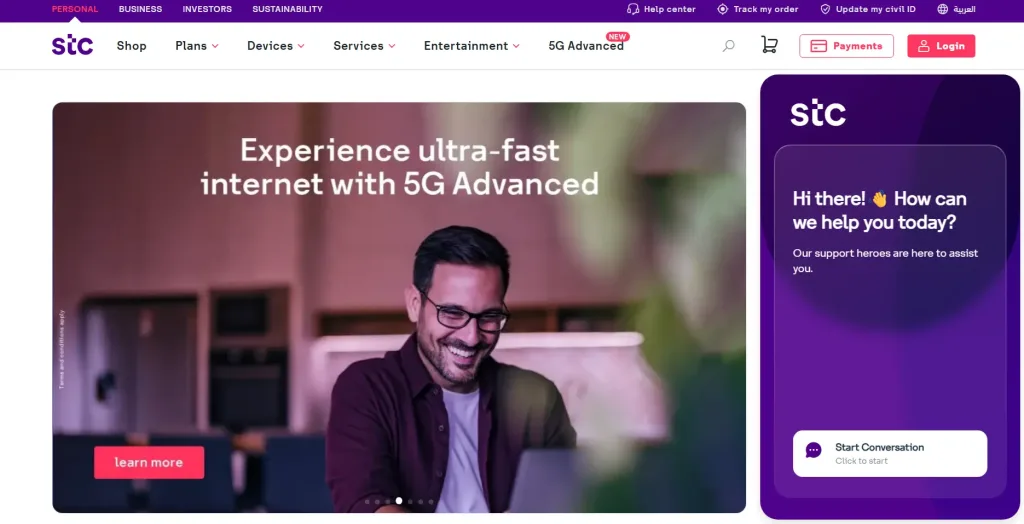
Known for its innovative services in telecommunications, entertainment, and digital data transfer, stc faced growing demands for instant, seamless customer support.
With customers expecting quick answers across multiple channels, stc needed a solution to streamline inquiries and boost satisfaction.
Partnering with REVE Chat, stc deployed AI-powered chatbots and live chat for web and WhatsApp, transforming its customer service into a fast, personalized, and scalable operation.
This case study explores how stc Kuwait turned challenges into opportunities, setting a new standard for telecom support.
Challenge
Running Kuwait’s largest 5G network came with high expectations.
Customers demanded instant responses to queries about data plans, billing, and technical issues. However, stc’s traditional support system struggled to keep up. Long wait times on calls frustrated users, especially during peak hours.
The support team faced a flood of repetitive questions, like balance checks or package details, which bogged down agents. Managing inquiries across websites, apps, and social platforms like WhatsApp was disjointed, leading to inconsistent experiences.
With a diverse customer base needing support in Arabic and English, stc required a solution that could handle high volumes, deliver accurate answers, and maintain a personal touch.
Without change, customer churn loomed as a risk.
Solution
stc Kuwait turned to REVE Chat’s AI-powered chatbot and live chat platform to overhaul its customer service. The solution offered a seamless blend of automation and human support, tailored for telecom needs.
The AI chatbot, built with advanced natural language processing (NLP), could understand and respond to queries in Arabic and English, ensuring inclusivity.
Integrated across stc’s website and WhatsApp, it provided 24/7 support, handling routine tasks like balance checks and recharge assistance.
For complex issues, the chatbot smoothly handed off conversations to live agents, maintaining context for a fluid experience.
This approach promised faster resolutions, reduced agent workload, and a unified customer experience.
Implementation
REVE Chat collaborated with stc to integrate the AI chatbot and live chat into its existing customer service framework, including its website and WhatsApp channels.
The chatbot was trained on stc’s knowledge base, covering FAQs, plan details, and troubleshooting guides, ensuring accurate, context-aware responses.
Machine learning enabled the bot to improve over time, learning from customer interactions to refine answers.
Live chat was set up for seamless handoffs, with agents accessing real-time customer data via a CRM integration.
Bilingual support in Arabic and English was a priority, catering to stc’s diverse audience. The implementation, completed in weeks, was designed for scalability, ready to handle stc’s 2.4 million customers and peak inquiry surges.
Results
The impact was game-changing. stc Kuwait saw a 60% automation rate for customer inquiries, with the chatbot handling routine tasks like balance checks and subscription reminders, slashing wait times to under a minute.
Customer satisfaction (CSAT) scores jumped by 40% within 30 days, driven by instant, accurate responses. The bilingual chatbot ensured all customers felt heard, boosting engagement across Arabic and English speakers.
WhatsApp support, a key channel, handled 50% of inquiries, aligning with customer preferences for messaging.
Live chat reduced agent workload, letting them focus on complex issues, with seamless handoffs preserving context.
AI-Powered Service Trends Reshaping the Telecom Industry
AI helps telecom companies fix issues early, avoid outages, and keep the network running smoothly. It also helps them use their bandwidth more efficiently.
AI tools like chatbots answer common questions quickly, so customers get help without waiting. In the end, AI helps telecom providers offer faster and more dependable service.
So, have a look at how AI-powered service trends are reshaping the telecom industry
1. More Self-Service Options
Online help centers and AI-driven portals are becoming common. Customers can check balances, pay bills, or request service updates without calling support.
Around 56% of customer issues in telecom are solved through these tools. Companies update these platforms regularly to keep information accurate.
2. Predictive Maintenance Improves Network Reliability
Networks can be monitored for faults before they cause downtime. Operators schedule maintenance efficiently and reduce interruptions. This helps customers stay connected and improves their experience with telecommunications customer service.
3. Stronger Security and Fraud Detection
Telecom companies face risks like SIM-swap fraud and robocalls. Systems monitor activity and flag suspicious behaviour in real time. Customers are protected, and trust in telecom customer service grows. A reliable telecom customer service solution includes security measures built in.
4. Personalized Interactions for Customers
Customer data can guide plan recommendations and service upgrades. Agents can suggest options that match each user’s needs. Personal attention makes subscribers feel valued and encourages loyalty. This approach strengthens customer service in telecom.
5. Better Decision making with Unified Data
Combining data from billing, network, and marketing gives agents a complete view of customers. Clean and organized information helps teams provide faster and more accurate support. Telecommunications customer service relies on strong data for effective problem-solving.
6. New Revenue Opportunities
Operators can find upsell and cross-sell opportunities by analyzing usage patterns and customer behaviour. Relevant suggestions increase revenue and improve the overall service experience. Smart recommendations benefit both the company and the customer.
Conclusion
What’s the secret to customers who stick around? It’s a service that feels personal, fast, and effortless. In telecom’s cutthroat world, that’s your edge. From AI chatbots to omnichannel support, personalized plans, proactive care, unified data, and agents trained to care, you can turn complaints into compliments.
Emerging trends such as 5G speed, generative AI, autonomous agents, and sustainable practices are opening new doors to delight customers. Waiting won’t cut it in this competitive market. Start with a chatbot, streamline your data, or teach your team to shine. The result? Happier customers, less churn, and a reputation that spreads.
Frequently Asked Questions
Omnichannel support lets customers reach you via chat, apps, email, or social media with a seamless experience. A unified CRM ensures consistent, frustration-free interactions across all channels.
Personalized service, like tailored plan suggestions, makes customers feel valued. It reduces churn by showing you understand their unique needs and preferences.
5G enables faster, real-time support like instant video troubleshooting. Paired with IoT, it helps detect and fix issues before customers even notice.
Quick resolutions and proactive care, like outage alerts, keep customers happy. Tools like Grok offer fast, smart support to prevent defections.
Unified data gives agents a full customer view, speeding up resolutions. It ensures accurate, personalized service, making customers feel heard and valued.
Build AI-powered support with Wize AI
Connect business knowledge, automate support conversations, and improve response quality without managing a complex AI stack.
Explore Wize AI Agent Rate the article

Mamunur Rouf
Head of Growth
Mamunur Rouf is the Head of Growth at REVE Chat. With extensive experience in product management and marketing analysis, he focuses on creating innovative communication tools to enhance customer engagement and meet the needs of businesses worldwide.
View all articles