





Table of Content
Airline customer service is tested at almost every stage of a journey. A passenger may need help comparing fares, completing a booking, changing a flight, finding a gate, tracking delayed baggage or arranging assistance during an unexpected disruption.
The quality of these interactions can shape how passengers remember the entire airline—not just the individual flight.
Today, excellent airline customer service goes beyond friendly cabin crews and comfortable seats. Passengers expect accurate information, convenient digital support, proactive updates and a smooth transition between automated and human assistance. When something goes wrong, they also expect the airline to take responsibility and provide a clear path to resolution.
In this article, we examine real examples of excellent customer service in the airline industry, the principles behind them and the practical steps airlines can take to improve the passenger experience.
What Makes Customer Service Excellent for the Airline Industry?
More than 66% of companies across industries now compete mainly on the basis of customer experience, and the airline industry is no different. Having said that, many elements obviously make up the crux of great customer service for the airline industry that can make or break the kind of experience fliers will have with an airline.
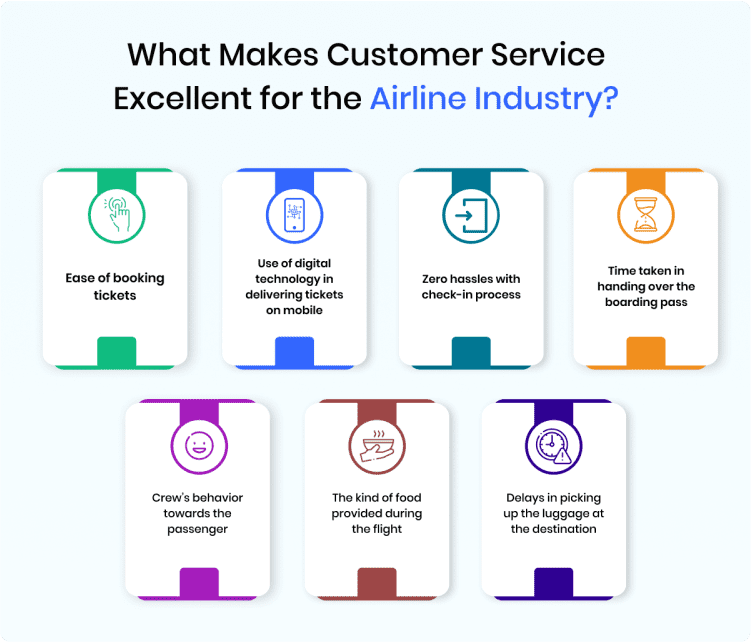
In general, excellent customer service in the airline industry constitutes these aspects, including –
- Ease of booking tickets – Customer experience starts with the ticket booking stage itself. And when a flyer finds it easy to reserve their seat on the flight, it should be considered good service.
- Use of digital technology in delivering tickets on mobile – Now that 84% of companies focus on the mobile customer experience, few airlines still play by the old rule and send the booked tickets by mail. Only some are using digital technology to deliver the tickets across channels, particularly on WhatsApp, and making things easier for customers.
- Hassles with the check-in process – No flier would wish to face hassles with the check-in process, but the reality is far from different. From calling passengers hours in advance to delaying the check-in process in the name of documentation, a lot can dilute the great experience flyers expect from an airline.
- Time taken in handing over the boarding pass – Yes, the more time an airline takes to hand over the boarding pass, the more likely it is to frustrate the fliers.
- Crew’s behavior towards the passenger – During a flight, a passenger may face various types of problems, be it related to seating arrangement or some request for food, etc. It’s ultimately the crew’s expertise and behavior in handling those matters that decide the level of customer experience for passengers.
- The kind of food provided during the flight – Food quality can also adversely impact the level and kind of in-flight customer service delivered to fliers.
- Delays in picking up the luggage at the destination– Ideally, a flyer should collect their luggage upon arrival within minutes so that they can make a breezy exit out of the airport. But not many airlines pay heed to this important aspect, and thus they compromise the customer experience big time.
Importance of Customer Service in the Airline Industry
Booking a flight and flying to some destination has always been seen as a privilege. It’s a kind of luxury that most of us secretly wish to afford on a regular basis. And those who do often develop a taste that gradually morphs into lofty expectations. Airlines must meet those high expectations in the form of excellent customer service to make the journey a truly once-in-a-lifetime experience for flyers.
Maybe this deeply ingrained need to feel special while flying has something to do with the great customer service that is always expected of the airline industry. But yes, delivering excellent customer service also has a huge role to play in the success of the aviation industry.
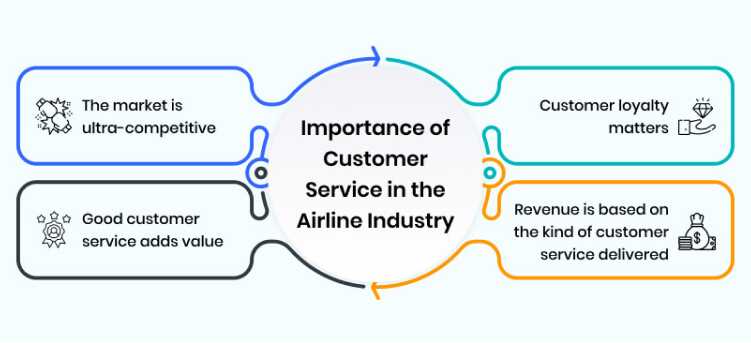
The role of customer service is indeed big for airlines for many reasons, including –
The market is ultra-competitive – Competition is immense in the airline industry, where new ventures hit the ground running regularly. Customer service emerges as the key differentiator between good and average companies in this cut-throat atmosphere.
Customer loyalty matters – When a flier gets a good experience at every stage of their journey with the airline, they feel happy, and it creates good word-of-mouth for the business. The flier then becomes a repeat customer, and this is how servicing could lead to building brand loyalty for the business.
Good customer service adds value – The scope of good customer service goes way beyond just guiding the passengers to their seats and providing them with the food on time. Fliers will feel great if the crew goes above the board in taking care of their in-transit needs and making their journey as comfortable as it can get.
Revenue is based on the kind of customer service delivered– When an airline delivers great customer service, the impact is often visible to the bottom line. It then gets repeat customers, which eventually adds to the revenue.
Examples of Excellent Airline Customer Service at a Glance
| Airline | Customer service example | Main lesson |
|---|---|---|
| United Airlines | Helped a passenger make an important connecting flight | Lead with empathy during exceptional circumstances |
| Alaska Airlines | Connected multiple customer communication channels | Make support accessible and consistent |
| British Airways | Made reading materials available across cabin classes | Create an inclusive passenger experience |
| TAP Air Portugal | Proactively contacted a customer facing a booking issue | Resolve problems before frustration increases |
| Qatar Airways | Created a more engaging experience for children | Design services for different passenger needs |
| Garuda Indonesia | Simplified part of the arrival process | Remove unnecessary travel friction |
| Cathay Pacific | Used conversational AI to support digital customers | Combine automation with accessible assistance |
These examples show that excellent service can take many forms. Sometimes it involves a major act of empathy. In other situations, it comes from making an everyday process faster, clearer or less stressful.
Some Examples of Excellent Customer Service in the Airline Industry
The airline industry is always synonymous with amazing customer service. Right from the early days, flying was considered a luxury purely for the kind of experiences made available to fliers. The trend of pampering the fliers is still in vogue, though cases of an extreme and innovative form of customer service are only a few and far between.
Some examples of excellent customer service in the airline industry include
1. United Airlines Holds Plane to Help a Passenger Say Goodbye to His Dying Mother
When we talk about customer service in the airline industry, nothing could beat the example of United Airlines. The airline not only redefined the meaning of customer service but also went way beyond what any other organization would do.
As was the case, one fine morning, a passenger named Kerry Drake got the information that her mother was seriously ill and probably facing her final hours. So, he caught the next flight from San Francisco to Lubbock, Texas, via Houston. However, when his first flight was delayed, he literally broke down in tears on the plane itself, knowing he would not make it in time to catch the connecting flight.
When the flight crew came to know about him and his condition, they spoke to the captain, who then spoke further to the concerned personnel of the next flight to delay the flight. And finally, the passenger was able to get on board and see his mother before she passed away.
2. Alaska Airlines Adopts Omnichannel Approach For Customer Communication
Flying with Alaska Airlines is nothing less than a treat, and flyers who have availed its services always swear by the creative ways it uses to boost in-flight customer experience. And if that was not enough, the airline is among the few in the industry to use omnichannel communication for customer communication.
So, what does it mean?
To understand the point well, you should know that whenever someone heads to the Alaska Airlines website, they find various ways to help. From an FAQ page to access a mobile app, and a direct line to the service team. On top of that, their website also has a Twitter account with a dedicated 24×7 team.
They don’t stop here – the airline has an open CSAT survey on the website. And they use multiple channels to ask for customer satisfaction surveys. All this makes communication absolutely seamless for customers as they can easily reach the service team from their channel of choice and get help as and when needed.
3. British Airways Rises Above Cabin Distinction and Provides Reading Materials to All
Treating every passenger equally is always the hallmark of quality customer service. However, in the airline industry where cabin barrier often defines the quality of service, British Airways is one company that rises above the class barrier and provides quality reading material to everyone on board.
While many airlines pamper their business-class flyers with tons of amenities and facilities, they often don’t maintain the same level of standards as the Economy class. This is where the step by British Airways to provide free reading material to all passengers makes a cut.

So, irrespective of the cabin of travel, any flyer can pick up newspapers and magazines near the boarding gate and get something to complement their journey. And by making available the materials at the gate, the airline leaves it up to the passengers to choose rather than distributing them, as it could be another hassle they avoid.
4. Portuguese National Airline, TAP, Reaches Out to a Customer Having Issues with Booking
Reaching out to an airline customer service agent via phone can be a painful experience. Sometimes it might take an eternity to have someone pick up your call and respond. But the case with the Portuguese National Airline, TAP, was different.
Once the support team of TAP airline did the unthinkable and went one step further, rather than waiting for the passenger to call, one agent took it upon himself to reach out to the troubled person and help him through the issue.
It all started when the person in question faced difficulty in booking a ticket as the website rejected three of his attempts while filling up the credit card details. Frustrated, he decided to seek help and then dialed up the service team and hoped for a long wait before getting a response.
To his surprise, the service team rep called back immediately on his phone and provided help as needed. This aptly shows how great examples of customer service in the airline industry do exist today as well.
5. Qatar Airways Creates a Fun and Engaging In-flight Environment for Kids
Flying with kids can be tough. And when it’s a long-haul flight, you can expect the plight to be even worse for parents. Not only parents, but kids can sometimes create problems for co-passengers as well. Cases are galore where some unruly youngsters and their antics made the entire journey bad for everyone.
Qatar Airways understands that risk, and maybe that’s why its customer service attempts on the long-route network consider kids and their needs as well. It knows how kids often feel bored on a long flight due to a lack of any activity beyond mobile entertainment. So, it decided to infuse some fun and engagement into the journey to keep children hooked and busy.
For kids, the airline has three special measures – first, it has a dedicated IEF channel with specifically selected videos; second, it hands out toy sets, books, and color pages; and third, it delivers a special lunch box to kids.
6. Garuda, the Flag Carrier of Indonesia, Takes Care of “Visa on Arrival” Needs in the Flight Itself
Many popular countries still require foreign tourists to get visas on arrival. While the intention is right, the process generally takes a lot of time, which somehow affects the otherwise good experiences passengers might have with the airline.

Garuda Airlines understood this problem, so it decided to offer immigration on-board services to its flights to Jakarta. Needless to say, this service has eased a lot of the burden on passengers who can now get help from immigration officers on board and save a great deal of time with the process.
7. Cathay Pacific is Using Conversational AI to Enhance the Digital Experience for Customers
AI-powered chatbots are now a key addition to many airlines to supplement customer engagement channels and ensure great service to flyers.
The example of Cathay Pacific, the Hong Kong Airline, shows how using chatbots to automate tasks could ensure value to not only customers but also save time for the support team.
According to the airline, more than half of its customer care chats are now handled by AI chatbots, which is quite impressive by any yardstick. The best part, the company is leveraging those conversations to boost the accuracy of AI chatbots so that it can deliver even better digital experiences to customers.
What Airlines Can Learn From These Customer Service Examples
1. Make communication proactive
Passengers should not have to repeatedly contact an airline to learn about a delay, gate change or baggage issue. Proactive notifications help passengers understand what has happened, what they should do next and when they can expect another update.
Airlines can send relevant information through mobile apps, SMS, WhatsApp, email and website messaging. However, these channels should remain connected so passengers do not receive conflicting information.
2. Empower frontline employees
Customer service often slows down when every request requires approval from another department. Frontline employees should have clear authority to solve common problems such as seat issues, meal concerns, minor compensation requests and certain rebooking situations.
Empowerment does not mean removing controls. It means giving employees defined options that allow them to act quickly while remaining within airline policy.
3. Support the people delivering the service
Passengers experience the airline through reservation agents, airport employees, cabin crews and support teams. When employees have the right training, information and internal support, they are better positioned to help passengers.
Airlines should also recognize employees who demonstrate empathy, creativity and sound judgment. Sharing positive service stories internally can show other employees what excellent service looks like in practice.
4. Design for stressful moments
The quality of airline service becomes especially important when a passenger is already under pressure. Delays, missed connections, visa concerns, medical needs and lost baggage can quickly turn an ordinary journey into a stressful experience.
Service processes should therefore be designed around the passenger’s emotional state as well as the operational issue. Clear language, realistic timelines and visible ownership can reduce uncertainty even when the problem cannot be resolved immediately.
5. Create small but memorable experiences
Excellent service does not always require an expensive upgrade or a major gesture. A thoughtful message, assistance with a child, recognition of a special occasion or a well-timed update can create a lasting impression.
These small moments make the airline feel more attentive and human.
6. Reward loyalty with meaningful value
Frequent-flyer programs are usually viewed as marketing tools, but they are also part of the customer experience. Passengers should be able to understand how rewards work, access their benefits easily and receive useful assistance when redemption problems occur.
Airlines can strengthen loyalty by combining points and status benefits with priority support, relevant offers and exclusive experiences.
Delivering Excellent Service Across the Passenger Journey
Customer service should not begin when a passenger contacts a support agent. It should be built into every stage of the airline journey.
1. Booking and trip planning
At the booking stage, passengers need transparent fares, understandable baggage policies and clear information about changes or cancellations. The website and mobile experience should make it easy to compare options without hiding important conditions.
Digital support should also be available when passengers have questions about routes, travel documents, accessibility or special services.
2. Before departure
After booking, airlines should provide timely reminders about check-in, baggage allowances, terminal information and documentation requirements.
When a schedule changes, passengers should receive a proactive notification along with practical options. Simply informing someone that a flight has changed is not enough. The communication should explain whether the passenger needs to take action and where help is available.
3. At the airport
Airport service should minimize queues, uncertainty and unnecessary movement between service desks. Employees should have access to the passenger’s relevant history so the customer does not have to explain the same issue multiple times.
Clear signs, digital queue information and accessible assistance are particularly important for elderly passengers, families, first-time travellers and passengers with disabilities.
4. During the flight
Cabin crews shape a major part of the passenger’s perception of the airline. Professional communication, attentiveness and fair treatment across cabin classes are therefore essential.
Crews should also be prepared to support passengers with dietary requirements, medical concerns, language barriers and accessibility needs.
5. During disruptions
Delays and cancellations are among the most important tests of airline customer service.
A strong disruption response should include:
- An early and honest explanation
- Consistent information across all channels
- Self-service rebooking where appropriate
- Fast access to a human agent for complex cases
- Clear information about accommodation, meals or compensation
- Regular updates, even when no final solution is available
Passengers are often more understanding of operational problems when the airline communicates clearly and demonstrates ownership.
6. After arrival
The customer journey does not end when the aircraft lands. Airlines should make baggage information easy to access and provide a clear reporting process when luggage is delayed or damaged.
After resolving a serious issue, the airline should follow up with the passenger rather than waiting for another complaint. A short, relevant feedback request can also help identify where the experience failed and whether the recovery was satisfactory.
How Airlines Can Handle Service Disruptions More Effectively
Service recovery is the process of restoring passenger trust after something goes wrong. In aviation, effective service recovery requires more than an apology.
1. Acknowledge the problem quickly
Passengers should not learn about major disruptions from airport displays, social media or other travellers before hearing from the airline. Even when complete information is not yet available, an early acknowledgement reduces confusion.
2. Give passengers clear options
Different passengers have different priorities. One person may prefer the next available flight, while another may want a refund or a later travel date.
Whenever possible, airlines should offer relevant options instead of directing every passenger into the same support queue.
3. Prioritize complex and vulnerable cases
Automated rebooking may work for a straightforward domestic journey. It may not work for a passenger with multiple connections, mobility requirements, an unaccompanied child or a time-sensitive medical situation.
Airlines should use intelligent routing to identify these cases and connect them with appropriately trained agents.
4. Maintain context during handover
Passengers become frustrated when they have to repeat their booking number, travel history and problem every time they change channels or agents.
Conversation history, booking context and previous actions should move with the passenger during every transfer.
5. Close the communication loop
A case should not be treated as resolved simply because a new ticket has been issued. Airlines should confirm that the passenger understands the solution and knows what to do next.
For significant disruptions, a post-resolution message can help rebuild confidence and show that the airline takes the experience seriously.
Accessibility and Inclusive Airline Customer Service
Excellent customer service should work for passengers with different physical, linguistic and digital needs.
Airlines can make service more inclusive by:
- Offering multilingual support across major service channels
- Making websites and mobile applications accessible
- Providing clear procedures for requesting mobility assistance
- Giving passengers multiple ways to communicate
- Training employees to support hidden and visible disabilities
- Avoiding complex language during urgent situations
- Allowing family members or authorized companions to assist when appropriate
Inclusive customer service is not an additional benefit. It is an essential part of delivering a safe and respectful travel experience.
How Technology Can Improve Airline Customer Service
Technology can make support faster and more convenient, but it should not remove the human element from sensitive or complex situations.
1. AI Agents
An AI Agent can answer common questions about baggage, check-in, flight policies, documentation and booking changes. It can also understand multiple needs within a single message and guide passengers towards the appropriate next step.
For example, a passenger may ask:
“Is my flight delayed, can I change my seat, and will I still make my connection?”
Instead of treating this as one general enquiry, an AI Agent can identify the different requests, retrieve the relevant information and determine whether human support is required.
2. Live chat
Live chat gives passengers immediate access to a human agent without requiring a phone call. It is particularly useful when a customer needs clarification, reassurance or assistance completing an online process.
3. Omnichannel support
Passengers may begin a conversation on a website, continue through WhatsApp and later contact the airline by another channel. An omnichannel support system brings these conversations together so agents can understand the complete situation.
4. Co-browsing
When a passenger is struggling with an online booking, refund form or account page, co-browsing allows an agent to guide them through the relevant webpage with permission.
This can reduce confusion without requiring the passenger to describe every screen or move to a separate screen-sharing application.
5. Voice and video assistance
Some travel situations require more direct communication. Voice or video support can help with complex bookings, documentation concerns, accessibility arrangements and high-value customer cases.
6. Human handover
Automation should recognize its limits. When a request involves an emergency, a complicated itinerary or a decision requiring human judgment, the conversation should move to an agent with the full context attached.
Airline Customer Service Metrics to Track
Airlines need to measure both operational efficiency and the quality of the passenger experience.
Important customer service metrics include:
1. First response time
This measures how quickly a passenger receives an initial response after requesting support.
2. First-contact resolution
This shows how often an issue is resolved without repeated calls, messages or transfers.
3. Customer satisfaction
A short survey after an interaction can help airlines understand whether passengers were satisfied with the support they received.
4. Customer effort score
This measures how easy or difficult it was for the passenger to resolve the issue. A resolution may be technically successful while still requiring too much effort.
5. Rebooking completion rate
Airlines should track how many affected passengers can successfully rebook through digital channels and how many need additional support.
6. Average resolution time
This measures how long it takes to fully resolve different types of cases, including refunds, baggage claims and booking changes.
7. Escalation and handover rate
This shows how often automated or frontline support needs to transfer a case to another team. Airlines should examine whether transfers happen for valid reasons or because employees lack the necessary authority or information.
8. Complaint recurrence
Repeated complaints about the same process may reveal a larger operational problem that cannot be solved through individual customer interactions alone.
9. Passenger sentiment
Feedback from surveys, conversations and online reviews can help airlines identify emerging concerns that traditional service metrics may miss.
Airlines Recognized for Customer Service
Independent recognition can add useful context to individual customer service stories.
In the 2026 Elliott Advocacy Readers’ Choice Awards, Delta Air Lines was named the domestic airline winner, while Lufthansa received recognition in the international airline category. The awards are based on companies nominated and voted for by readers.
Awards should not be treated as the only measure of service quality. However, including current passenger-voted recognition can help show which airlines are consistently earning customer confidence.
This section should be reviewed annually so that the examples remain current.
How REVE Chat Helps Airlines Deliver Connected Customer Service
REVE Chat helps airlines support passengers across digital touchpoints without separating automation from human assistance.
With Wize AI Agent, airlines can provide immediate answers to common questions, identify multiple passenger needs and automate routine support around the clock. When a request becomes complex, the conversation can be transferred to a human agent with the relevant context.
Live Chat allows passengers to speak directly with support teams from the airline’s website or application. The omnichannel inbox brings conversations from websites, messaging platforms and social channels into one place, helping agents manage the passenger journey more consistently.
For customers who need visual guidance, agents can use co-browsing to assist with booking pages, forms and online processes. Voice and video calling can support more sensitive or complicated situations without moving the passenger to a disconnected communication tool.
By combining AI Agents, Live Chat, omnichannel communication and real-time agent guidance, airlines can respond faster while preserving the human support passengers expect during important moments.
Leverage the AI Platform and Bolster Customer Service in the Airline Industry
Excellent customer service never happens by chance. It involves some planning and the willingness to go the extra mile so that passengers can feel great.
We, at REVE, understand how AI-powered chatbots could be pivotal in your company’s effort to boost customer service for flyers and deliver them the kind of experiences they covet.
With our platform, you can develop a bot in tune with the specific needs of your business and start adding value to each aspect of customer service.
You can find more engagement tools, such as video chat and co-browsing software, to complement your service effort.
What’s more, you can always use the chatbot in combination with our feature-rich live chat software and take a huge step toward offering 24×7 support to flyers.
Add Excellence to Your Airlines Customer Service and Keep Pace with Time
Customer service in the airline industry should always be excellent else flyers might feel less happy than they otherwise do while flying.
With the REVE platform, you can find a whole lot of AI-powered and advanced engagement tools that can contribute massively to your effort to deliver amazing services.
You can start free trial of our chatbot and even test out other tools and see how they could fit well into your company’s customer service needs.
Frequently Asked Questions
Airlines encourage loyalty through frequent flyer programs, offering rewards like miles, upgrades, priority boarding, and access to exclusive lounges. These rewards create a sense of value for customers, motivating them to choose the same airline repeatedly. Examples include Delta’s SkyMiles and Alaska Airlines’ Mileage Plan.
Yes, there are many heartwarming stories. For example, a Delta Airlines employee helped a passenger reunite with her mother during a terminal emergency, going beyond the normal call of duty to ensure she reached her mother in time. Such acts show empathy and commitment to passengers’ well-being.
Key principles include:
- Empathy: Understanding and addressing passengers’ emotional and practical needs.
- Clear communication: Keeping passengers informed, especially during delays.
- Personalization: Offering tailored services like preferred seating or food choices.
- Efficiency: Resolving issues promptly without adding stress to passengers.
Airlines such as Southwest Airlines, Virgin Australia, and Singapore Airlines are frequently recognized for their outstanding customer service. These airlines excel in creating positive, personalized experiences, as well as having friendly and professional staff.
Airlines handle exceptional situations with care and attention to passenger needs. For example, when an emergency arises, airlines like American Airlines provide immediate support, rebooking flights, offering hotel accommodations, or arranging transportation for affected passengers, ensuring they feel supported during challenging times.
Build AI-powered support with Wize AI
Connect business knowledge, automate support conversations, and improve response quality without managing a complex AI stack.
Explore Wize AI Agent Rate the article

Ehsanur Rahman
Head of Customer Communication
Ehsanur Rahman, the Head of Customer Communication at REVE Chat is dedicated to implementing advanced solutions that boost customer interactions and satisfaction. Ehsanur's passion for technology and customer service drives his commitment to delivering exceptional experiences.
View all articles