

Push Your Business Towards Success With Ecommerce Integrations
- December 7, 2025
- 13 mins read
- Listen
You started your store to sell great products, not to spend nights copy-pasting orders from Shopify to your 3PL, answering the same WhatsApp questions 47 times a day, or praying your inventory numbers are correct on the same planet as reality.
Yet here you are, drowning in apps that don’t talk to each other, customers ghosting at checkout, and a creeping feeling that your competitors are running circles around you.
Do you know the truth? The most successful stores aren’t smarter than you; they just mastered the best ecommerce integrations.
One unified stack can cut manual work by 60%, boost conversion rates by 25–40%, and deliver the instant, frictionless experience your customers now demand.
Keep reading for the definitive list of ecommerce integrations and the exact integration strategy top stores are using right now to dominate.
What is an Ecommerce Integration?
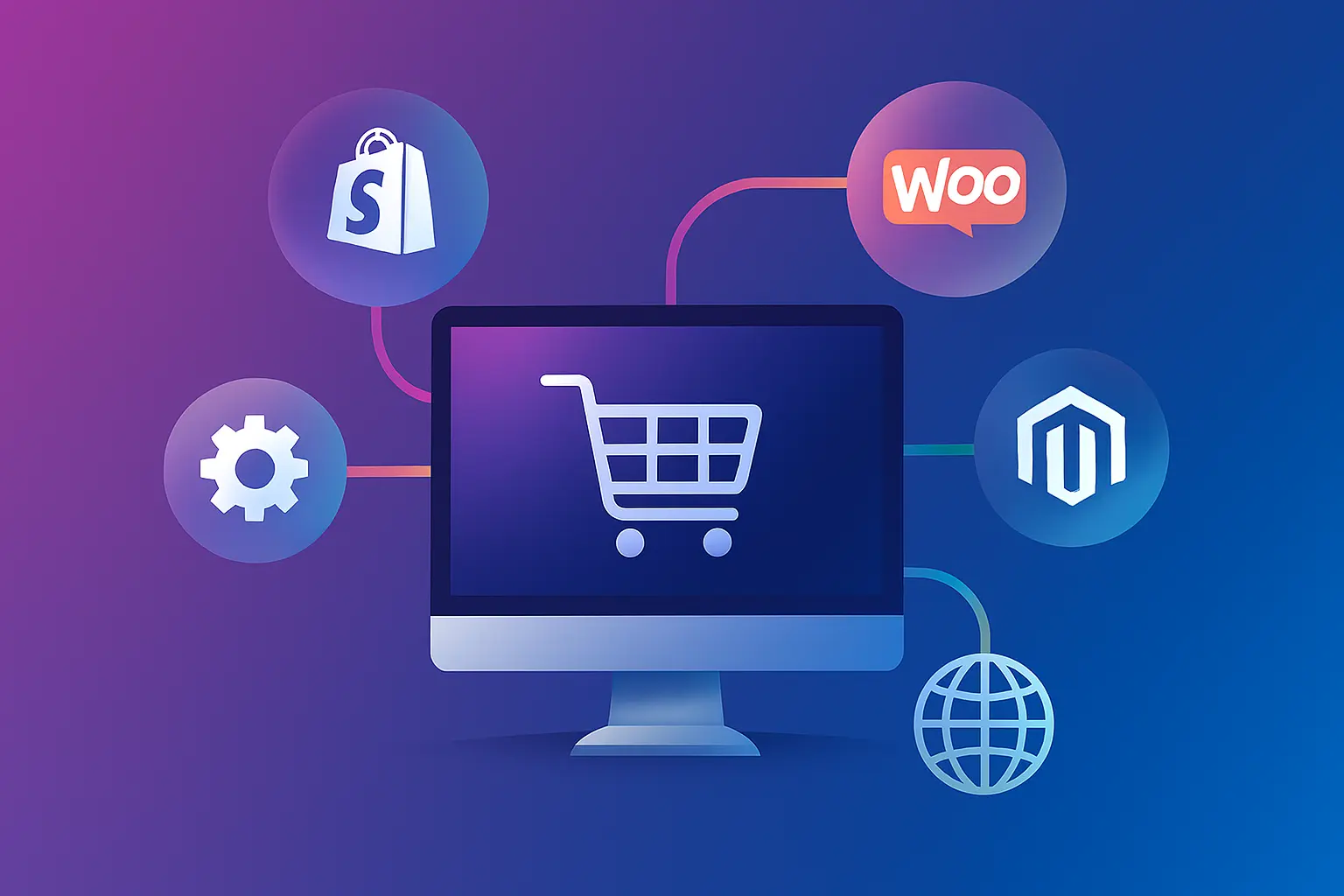
Ecommerce integration is the process of connecting your online store (Shopify, WooCommerce, BigCommerce, Magento, etc.) with third-party tools, systems, or marketplaces. So, they automatically exchange data, trigger actions, and share information in real time, which eliminates manual work and data silos.
It allows two or more platforms to “talk” to each other instantly. So when a customer places an order on your website, the inventory updates in your warehouse, the payment is recorded in your accounting software, a shipping label is created, an email/SMS is sent, and a support ticket is only raised if something goes wrong, all automatically.
Why Integrations Are Critical for Ecommerce Success
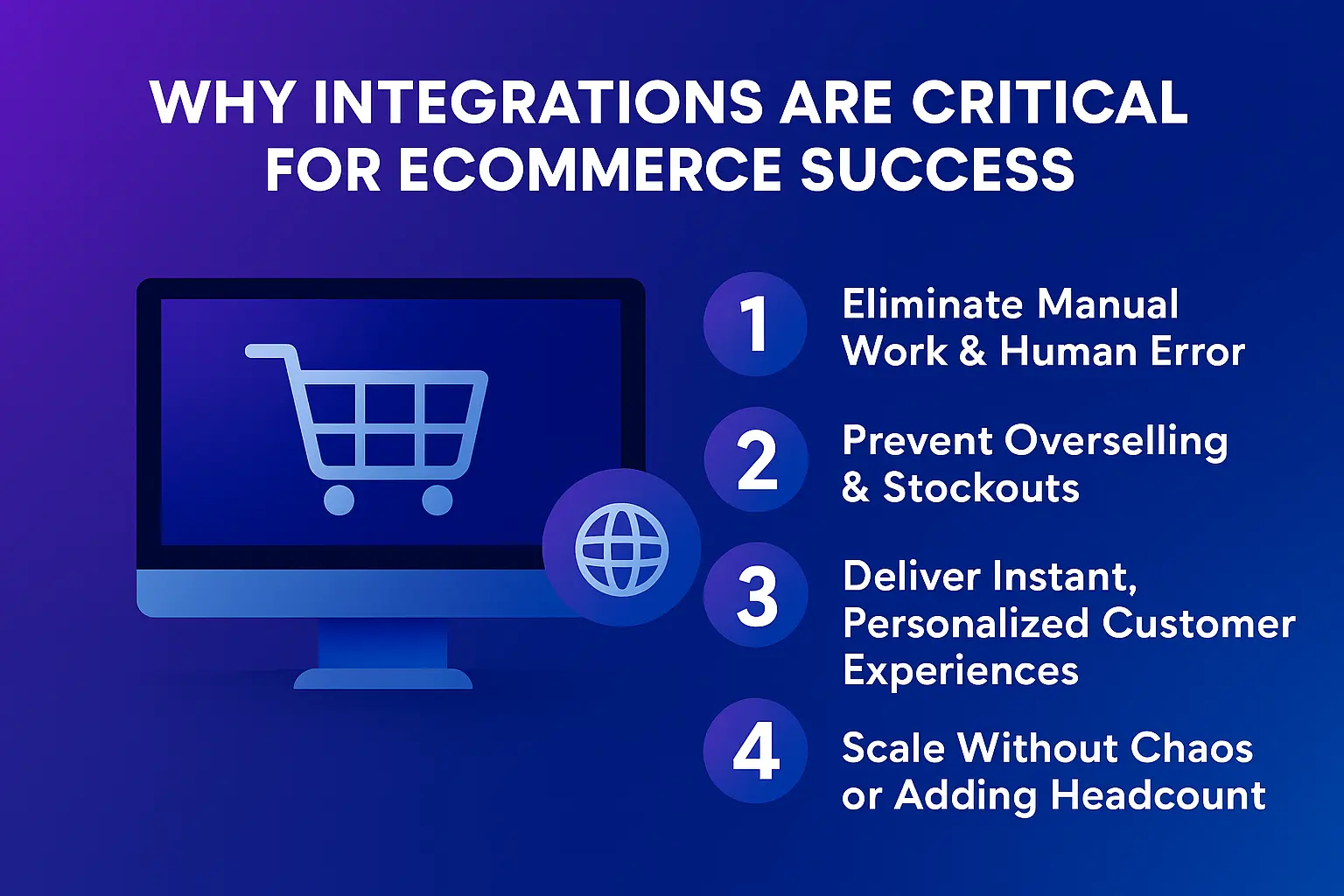
Here are the 4 most important reasons (backed by real data and proven ROI) why top-performing stores treat integrations as non-negotiable:
1. Eliminate Manual Work & Human Error
Without integrations, teams waste hours copy-pasting orders, updating inventory spreadsheets, and reconciling payments. Automated integrations instantly sync orders, stock levels, customer data, and financials across every tool.
As a result, a 50–70% reduction in operational busywork, near-zero data-entry mistakes, and your team focusing on growth instead of admin.
2. Prevent Overselling & Stockouts
Selling an item that’s out of stock costs the average store 5–15% of yearly revenue and destroys customer trust. Real-time inventory integrations (e.g., Shopify → warehouse → Amazon → Walmart) update stock levels across every channel the moment an order is placed.
This virtually eliminates overselling, reduces returns by 30%, and keeps your brand looking professional.
3. Deliver Instant, Personalized Customer Experiences
Today’s shoppers expect Amazon-level speed and relevance. Integrations let you combine behavioral data (browsing + purchase history) with instant support tools (chatbots, live chat, co-browsing) and marketing platforms.
The outcome: proactive messages, guided selling, abandoned-cart recovery, and support tickets resolved in seconds instead of days, directly translating to higher AOV and repeat purchases.
4. Scale Without Chaos or Adding Headcount
Growing from $1M to $10M in revenue with a disconnected tech stack forces you to hire entire departments just to keep the lights on.
A properly integrated stack (payments → inventory → shipping → marketing → support) lets the same small team handle 5–10× more orders with zero extra overhead.
7- and 8-figure brands consistently cite “smart integrations” as the #1 reason they scaled profitably instead of burning out.
The Ultimate List of Best Ecommerce Integrations
eCommerce sales are projected to exceed $7 trillion globally, and the right integrations aren’t just add-ons; they’re the engines driving efficiency, personalization, and revenue. Focus on tools that automate workflows, reduce errors by up to 70%, and boost conversions through unified customer data.
Whether you’re battling cart abandonment (still at 70% industry-wide) or scaling multi-channel sales, this list equips you with proven winners.
Each entry includes key features, ideal use cases, starting pricing, and compatibility for quick evaluation.
| Integration Category | Top Recommendation | Key Features | Best For | Pricing (Starting) | Compatibility |
| Payments | Stripe | 100+ global methods, AI fraud detection, local currencies, subscription billing | Multi-channel, international sellers | 2.9% + 30¢ per transaction | Shopify, WooCommerce, BigCommerce, Magento |
| Inventory Management | Cin7 | Real-time multi-warehouse syncing, low-stock alerts, bundle tracking, forecasting | Multi-location or high-SKU ops | $349/month | Shopify, WooCommerce, BigCommerce, Amazon |
| Customer Support & Engagement | REVE Chat | AI chatbots, live chat, ticketing, co-browsing, copilot for upsells, omnichannel | Reducing cart abandonment via proactive support | $99/month (custom plans) | Shopify, WooCommerce, BigCommerce, Magento |
| Shipping & Fulfillment | ShipStation | Automated labels, carrier comparison, order splitting, branded tracking | High-volume shippers expanding globally | $9/month | Shopify, WooCommerce, BigCommerce, eBay |
| Email Marketing & Automation | Klaviyo | Behavioral segmentation, SMS flows, real-time analytics, 250+ triggers | Data-driven personalization campaigns | Free up to 250 contacts | Shopify, WooCommerce, BigCommerce, Magento |
| CRM | HubSpot | Auto-invoicing, expense tracking, tax compliance, and bank reconciliation | Growing teams building loyalty | Free core; $20/month pro | Shopify, WooCommerce, BigCommerce |
| Accounting | QuickBooks Online | Auto-invoicing, expense tracking, tax compliance, bank reconciliation | SMBs streamlining financials | $30/month | All major platforms |
| Analytics & Reporting | Google Analytics 4 | Ecommerce event tracking, funnel analysis, predictive metrics | Data-informed optimization | Free | Universal |
| Multi-Channel Selling | Linnworks | Centralized order routing, SKU mapping, marketplace listings, returns | Omnichannel expansions (Amazon, Etsy, Walmart) | $79/month | Shopify, WooCommerce, BigCommerce, 100+ channels |
| Product Feed & Data Syndication | Productsup | Automated labels, carrier comparison, order splitting, and branded tracking | Global listings and SEO boosts | Custom (from $500/month) | All platforms |
The Most Important Ecommerce Integrations
Now let’s talk about the essential ecommerce integrations from our ultimate list. For every category, we’ll explore why it matters, key features of top tools, real-world benefits like boosted conversions or reduced errors, and seamless compatibility with platforms like Shopify, WooCommerce, and BigCommerce.
These aren’t just tech add-ons; they’re revenue multipliers that unify your operations and delight customers.
1. Payment Gateways
Payment gateways are the secure conduits that process transactions, reduce cart abandonment by 20-30% through one-click options, and support global currencies to expand your reach. With rising fraud threats and BNPL demand, the best gateways prioritize AI-driven security and seamless mobile experiences.
Stripe leads as the top choice, offering 100+ payment methods, subscription billing, and fraud detection that blocks 99% of suspicious activity. It integrates natively with major platforms, auto-syncs refunds to your CRM, and cuts processing fees via interchange-plus pricing (starting at 2.9% + 30¢). Merchants using Stripe report 15% higher conversions from localized checkouts.
For international sellers, it handles multi-currency conversions without eroding margins, while tools like Apple Pay and Google Pay speed up mobile purchases by 40%.
PayPal is a close second for trust-building, with 400M+ users and built-in buyer protection that boosts confidence in high-ticket items.
2. Inventory & Order Management
Inventory and order management tools prevent stockouts that cost ecommerce stores 5-15% of revenue annually, automating real-time syncing across warehouses and channels for 50% faster fulfillment.
AI forecasting is key, predicting demand with 90% accuracy to optimize cash flow. Cin7 excels here, providing multi-warehouse tracking, low-stock alerts, and bundle management that slashes overstock by 30%.
Starting at $349/month, it connects to Shopify, Amazon, and ERPs, auto-generating purchase orders and variant SKUs for complex catalogs. Users see 45% fulfillment speed-ups and zero oversells.
3. Customer Support & Engagement
Customer support integrations are a cornerstone for ecommerce success, directly combating the 70% cart abandonment rate driven by unanswered questions during the purchase journey.
When it comes to blending AI automation with human expertise, these tools enable proactive interventions that recover lost sales and foster loyalty.
Omnichannel solutions with features like co-browsing and AI copilots resolve up to 40% of issues instantly, cutting support costs while enhancing the full shopping experience from discovery to post-purchase.
REVE Chat stands out as an e-commerce-first engagement platform, deeply built to embed seamlessly into your store’s ecosystem. Its native Shopify integration pulls real-time data on catalogs, carts, and order history, allowing agents and bots to view and share products directly in chats without leaving the conversation.
Key ecommerce-specific capabilities include AI-driven product recommendations based on browsing patterns and purchase data, interactive carousels for catalog browsing, and full-journey support from personalized greetings to order tracking and upsell prompts.
This turns every interaction into a guided sales opportunity, boosting conversions by streamlining the path from query to checkout.
Starting at $99/month, it supports WhatsApp, Messenger, apps, and more for omnichannel reach, reducing ticket volume and enabling co-browsing for visual assistance on complex selections like high-ticket items.
4. Shipping & Fulfillment
Shipping and fulfillment integrations automate labels and tracking, reducing delivery times by 40% and returns by 25%, critical as 80% of customers expect 2-day shipping in 2025.
They negotiate carrier discounts (up to 90%) and handle multi-channel routing for global expansion. ShipStation dominates with automated printing, rate comparisons across 100+ carriers, and order splitting for bundles, starting at $9/month. It syncs with Shopify, eBay, and 3PLs, providing branded tracking pages that lift repeat purchases by 15%. High-volume sellers report 90% fewer errors.
ShipBob adds fulfillment-as-a-service, with 50+ global warehouses and AI-optimized routing that cuts costs by 30% for DTC brands. Custom pricing scales with volume, including returns automation.
Easyship shines for international ops, calculating duties and generating customs docs to avoid 20% of cross-border delays. These tools turn logistics from a headache into a competitive edge, enhancing CX and loyalty.
5. Email Marketing & Automation
Email marketing automation drives 30x ROI over one-off campaigns, recovering 20-40% of abandoned carts and personalizing flows based on behavior for 25% higher engagement in 2025.
With AI segmentation, it turns data into timely, relevant messages that nurture leads into repeat buyers.
Klaviyo is the ecommerce powerhouse, with 250+ triggers for email, behavioral flows, and product recommendations that boost AOV by 15%. Free up to 250 contacts ($20/month after), it integrates deeply with Shopify and Magento for real-time syncs. Merchants achieve 68% revenue from automations.
Brevo (formerly Sendinblue) suits budget-conscious teams, offering transactional emails and CRM ties for 40% open rate lifts. These platforms automate personalization at scale, slashing manual work while skyrocketing lifetime value.
6. CRM & Customer Data
CRM tools centralize customer profiles, enabling 360° views that personalize experiences and lift retention by 25-30%, vital as repeat buyers spend 67% more. AI lead scoring and journey mapping predict churn with 85% accuracy.
HubSpot’s free core CRM shines for growing teams, with lead pipelines, email tracking, and segmentation that syncs orders from WooCommerce for targeted nurturing. Pro plans at $20/month add deal forecasting; users report 28% faster sales cycles. It unifies data from ads to support, reducing silos.
Salesforce excels for enterprises, with customizable dashboards and multi-channel tracking that integrates loyalty programs, driving 15% AOV growth. These CRMs transform raw data into actionable loyalty strategies, fueling sustainable growth.
7. Analytics & Reporting
Analytics tools uncover insights from traffic to conversions, optimizing funnels to recover 10-20% lost revenue, and guiding decisions with predictive metrics. Real-time dashboards track KPIs like LTV and CAC for 30% better ROI.
Google Analytics 4 (GA4) is the free universal standard, with ecommerce event tracking, funnel visualization, and cross-device insights that pinpoint drop-offs.
It APIs into Shopify for AOV breakdowns; 90% of top stores use it for baseline performance. Enhances with BigQuery for custom queries.
Klaviyo Analytics (tied to email) adds revenue attribution, showing 40% uplift from campaigns via cohort analysis. Starts free, scales with contacts.
8. Multi-Channel & Marketplace Management
Multi-channel tools sync listings across Amazon, Etsy, and your site, preventing oversells and expanding reach to 2B+ shoppers, as 60% of omnichannel sales are expected in 2025. They automate repricing and feeds for 50% faster launches.
Linnworks centralizes orders from 100+ channels, with SKU mapping and returns automation that cuts errors by 90% ($79/month). Integrates with BigCommerce for real-time inventory; users gain 30% more listings without chaos.
ChannelEngine connects to 950+ marketplaces, optimizing feeds with AI for higher visibility and 20% sales growth. Pricing from $99/month, with bulk uploads.
Why Customer Engagement Integrations Are the #1 ROI Driver?
When you’re planning to scale your business, having a decent ROI is crucial for you. But, how to do that? Let’s take a look at the key factors that customer engagement integrations play a significant role in getting better ROI for your business.
Directly Tackle Cart Abandonment
Cart abandonment remains a $18B annual killer, but engagement tools like instant chatbots and co-browsing intervene at the exact moment of doubt, answering queries and guiding checkouts to recover 30% of lost sales.
REVE Chat’s AI-driven proactive messaging syncs with order data, offering personalized upsells during sessions. Merchants see 25% abandonment drops and 15% AOV lifts without extra ad spend.
This turns support into a profit center, with ROI compounding as recovered carts lead to higher LTV and word-of-mouth referrals.
Boost Retention and Loyalty
Engaged customers stick around, spending 67% more over time, and integrations foster this by delivering seamless omnichannel experiences that build trust and habit.
With 85% of loyal users in programs tied to engagement, tools like ticketing and copilots nurture post-purchase relationships, reducing churn by 25%.
It’s not just retention, it’s recurring revenue from delighted repeat buyers.
Enable AI-Powered Personalization
Generic interactions will flop; hyper-personalized ones via AI engagement will drive 50% faster content creation and 30% higher conversions through tailored recommendations. By unifying data from browsing to past orders, these tools segment and engage at scale, turning one-size-fits-all into “made for you.”
Slash Support Costs While Scaling Engagement
Traditional support eats 15-20% of budgets, but omnichannel integrations automate 50% of queries, freeing agents for high-value tasks and reporting 80% higher ROI from digital shifts. Customers engage 3x more with consistent experiences across chat, SMS, and social, cutting resolution times by 40%.
REVE Chat’s full suite, such as live chat, ticketing, and bots, handles spikes without added headcount, delivering 25% retention gains and operational savings that scale profitably for growing stores.
How to Choose the Right Integrations for Your Store
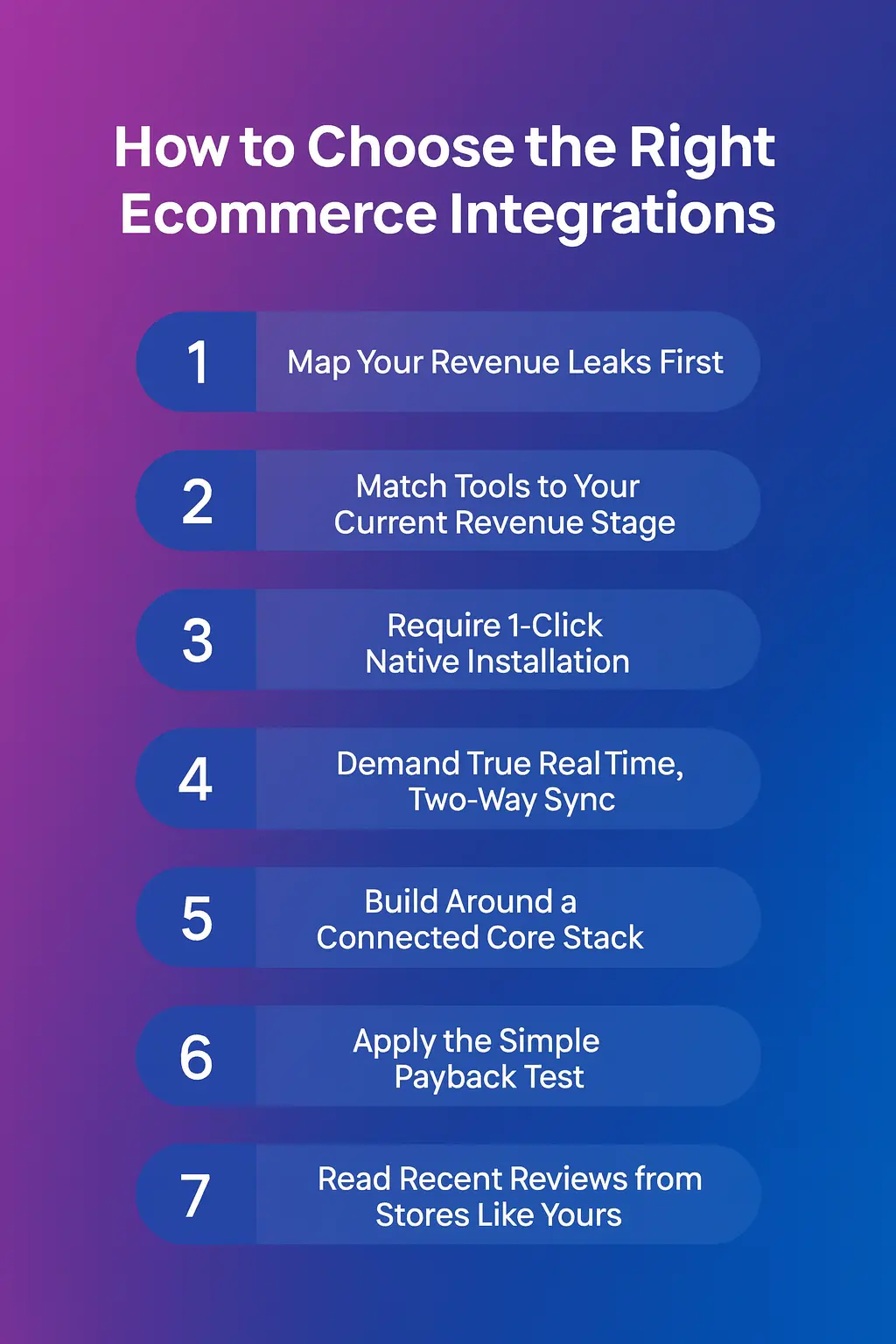
Are you getting overwhelmed with choosing the best integration for your ecommerce store, as there are tons of options available?
Let’s take a look at the crucial factors that you can look for to find the best integration solution for your business. Let’s dive deep in.
Map Your Revenue Leaks First
Check your analytics for the biggest money losers: abandoned carts, stockouts, slow fulfillment, or long support wait times. Fix the largest leak first; that single integration usually delivers the fastest visible results.
Match Tools to Your Current Revenue Stage
Early-stage stores stay lean with free or low-cost native apps. Mid-market brands add automation layers. Larger operations choose enterprise-grade platforms. Picking the wrong tier either wastes budget or limits growth.
Require 1-Click Native Installation
Only consider apps from the official Shopify App Store, BigCommerce Marketplace, WooCommerce Extensions, or Magento Marketplace that install in minutes with strong recent reviews.
Demand True Real-Time, Two-Way Sync
Look for webhooks and instant API connections, not scheduled CSV imports. A sale on any channel should immediately update inventory, fulfillment, and customer data across the rest of the system.
Build Around a Connected Core Stack
Most successful stores today run a tight core: platform → marketing automation → fulfillment → finance → customer engagement. Every new tool must connect natively to at least two of these pillars.
Apply the Simple Payback Test
Ask: “Will this save significant time or clearly add revenue within the first few months?” If the answer isn’t an obvious yes, skip it.
Read Recent Reviews from Stores Like Yours
Filter reviews on G2, Capterra, or the app stores by your niche and platform. Real user screenshots and workflow examples beat polished marketing copy every time.
Future-Proof with AI and Headless Compatibility
Choose tools already adding AI features (predictive analytics, smart chat, dynamic segmentation) and confirmed ready for composable/headless commerce. These will still be relevant years from now.
Conclusion
Building a world-class tech stack is only half the battle. The other half is choosing one integration that actively sells for you while you sleep.
REVE Chat excels here. It becomes your unfair advantage: deep catalog integration, real-time cart visibility, AI-driven product carousels, co-browsing, abandoned-cart recovery, and payment links shared directly in chat.
All features are designed from day one to shorten the path from “just looking” to “sold.” Stores using it don’t just improve support; they unlock a new growth channel that scales without extra ad spend or headcount.
Make 2026 the year your store stops leaking sales at checkout. Start with REVE Chat, sign up for your free trial, or schedule a personalized demo.
Frequently Asked Questions
Payments, email marketing, shipping/fulfillment, and customer engagement tools are the core four. They handle transactions, recover abandoned carts, automate logistics, and reduce friction at the point of purchase.
Successful stores typically run 5–10 well-chosen integrations. Beyond that, complexity often outweighs the benefits unless you’re enterprise-scale.
Yes. Choose multi-channel tools (e.g., inventory sync like Cin7, order routing like Linnworks, and universal shipping platforms) to keep everything in sync across marketplaces and your store.
With native apps and no custom development, a complete core stack can be fully live and tested in 1–3 weeks.
Customer engagement tools (live chat, chatbots, co-browsing) often show the quickest impact because they directly influence conversions and recover revenue that would otherwise be lost at checkout.