





Table of Content
It hit me the other week while I was making dinner. I said to my phone, “Hey, find me some decent noise-canceling headphones under 150 bucks that actually last more than six months, with prime shipping if possible.” No typing. No scrolling Amazon or Best Buy.
The agent just… went and did it. Pulled up options from three different places, pointed out which one had the freshest reviews for battery life, applied a promo I didn’t even know about, and asked if I wanted black or silver. I said silver, and that was it. The package shows up two days later. That little moment is agentic commerce work in real situations, not just tech demos.
It’s AI that doesn’t stop at suggesting, it shops, decides, pays, the whole thing.
I’ve been messing with these systems for months now as a shopper and watching how brands are reacting (or panicking). It’s changing shopping in ways that feel small at first but add up fast. Let me break down what this actually looks like today, no hype.
What Is Agentic Commerce?
Agentic commerce is the AI that shops for you independently. You give it information such as what you need, your budget, any must-haves, and the agent takes over the full process. It searches multiple sites, reads recent reviews, compares prices and shipping, spots deals or better options, weighs quality against cost, and completes the purchase (usually after one quick approval from you).
What sets it apart from past AI in shopping: regular tools only suggest or answer questions. Agents plan steps on their own, adapt if something changes (like stock running out), follow your instructions exactly (no overspending, prefer certain brands), and use tools such as APIs from shops and payment systems like Stripe or Shopify to complete purchases without human intervention.
This runs on newer models that can reason through multi-step tasks, plus open protocols letting any store talk to agents without custom code.
It’s not fully hands-off everywhere yet, most ask for your okay on checkout, but the agent does 90% of the work.
The Evolution: From AI in Retail to Agentic Commerce
Back then, AI mostly worked quietly. Amazon showed “customers also bought,” Netflix suggested shows, and stores predicted stock, so things didn’t sell out. For shoppers, it meant slightly better search results and emails with your name.
For stores, it cut waste and lifted sales a bit. No real conversation, just algorithms guessing from your clicks.
Chatbots and Basic Personalization (Mid-2020s)
Around 2022–2024, chat popped up everywhere. Site bots answered “what’s my delivery date?” or “does this run small?” Generative AI arrived, ChatGPT-style tools let you ask full questions: “best budget laptop for video editing.” You got detailed lists, pros/cons, even outfit ideas.
Huge step up from links. Still, you copied, clicked, and added to the cart yourself. AI talked smart, but didn’t finish anything.
Generative AI Opens the Door (2023–2025)
This is when things sped up. People started describing needs in normal words instead of keywords.
AI researched in real-time, pulled recent reviews, compared specs across sites. Tools like early Perplexity or ChatGPT plugins gave richer answers. Shoppers saved time hunting. Stores saw more traffic from conversational search.
The limit? AI stopped at “here are options.” You still did the buying.
The Agentic Shift (Late 2025–Early 2026)
Late 2025 marked the turning point. Open protocols enabled AI agents to securely connect with merchant systems, pulling live data and completing transactions.
Agents evolved from suggestions to action: they interpret natural-language requests, plan steps, search sources, filter options, present shortlists with reasoning, seek quick user approval, and execute buys.
Retailers adapted fast and made catalogs agent-readable with structured specs, live feeds, clear policies, and fast APIs.
In just over a year, commerce shifted from AI pointing at products to agents managing the full shopping process, with human oversight on final decisions.
The foundation is now solid, and the pace is accelerating.
How Agentic Commerce Works: Step-by-Step Process
Agentic commerce runs on AI agents that take your shopping request and handle most or all of it. The process breaks into clear steps, from you speaking up to the package arriving.
Behind it are open protocols like OpenAI/Stripe’s ACP (Agentic Commerce Protocol) or Google’s UCP (Universal Commerce Protocol) that let agents talk directly to stores, pull live data, and pay securely.
No more jumping between sites; the agent does the loop.
Step 1: You State Your Need (Intent Capture)
You describe what you want in a normal conversation, product type, budget range, key features, size, color, delivery timeline, or any preferences.
The agent processes your words right away, pulling in saved details if you allow it: shipping address, preferred payment method (stored as a secure token), past purchase history for context, like usual sizes or brands.
It identifies the main goal and any constraints, turning loose language into a structured shopping task.
Step 2: The Agent Plans and Researches (Autonomous Discovery)
The agent creates its own plan: decides which sites to check, what data points to compare, and in what order.
It connects to merchant systems through standardized protocols like ACP for direct checkout in ChatGPT, UCP for Google-integrated stores (like Walmart, Target, or Shopify-powered shops), or direct APIs from bigger retailers.
It pulls current information across multiple sources: live stock levels, exact prices including taxes and shipping, detailed product specs, recent customer reviews, return policies, and any active promotions or bundles.
If something changes during the process (stock drops, price jumps), the agent adjusts the plan automatically and keeps looking elsewhere.
Step 3: Evaluation and Shortlisting (Decision-Making)
The agent compares all the options against your original instructions.
It calculates the full landed cost (base price plus extras), reviews quality signals from the latest buyer feedback (looking at patterns in ratings, common complaints, or recent positives), checks delivery reliability, seller ratings, and any other rules you set.
It narrows down to the strongest 1–3 matches, ranking them by how well they fit your needs.
The agent prepares a short, clear summary for you, including key details like price breakdown, main features, and supporting info pulled directly from the merchant (images, specs, or review highlights)
Step 4: Your Quick Check and Approval (Human-in-the-Loop)
The agent shows you the top recommendation(s) in the chat interface, with transparent reasoning and all the relevant details side by side.
You review the options, make adjustments if needed (change color, raise budget, add an accessory, switch priority to faster delivery), or simply approve the choice.
For smaller or routine purchases, some setups allow auto-approval once you’ve set your comfort level.
Larger amounts or new sellers usually require your explicit confirmation before moving forward.
Step 5: Secure Execution and Follow-Up (Transaction + Tracking)
Once approved, the agent handles the purchase using a secure, tokenized payment method; it doesn’t require card details to be shared with the agent or passed around.
It completes checkout directly through the merchant’s system via the protocol in use (ACP for instant Stripe-powered buys, UCP for Google ecosystem stores).
After the order goes through, the agent sends you the confirmation details: receipt, order number, estimated delivery date, and a tracking link.
It continues monitoring the order status, notifying you of any updates (shipped, delayed, delivered) and stepping in for basic resolutions if something goes wrong, like suggesting a replacement if the item arrives damaged.
Learn More: Best Examples of AI in eCommerce & Use Cases
Benefits of Agentic Commerce for Consumers and Businesses
Agentic commerce changes shopping from a chore into something almost effortless. For everyday people, it means less time wasted and smarter buys that fit exactly what they want.
For businesses, it opens doors to more sales, deeper customer understanding, and ways to stand out without constant manual work, all while the agents quietly handle the details.
Benefits of Agentic Commerce for Consumers

1. Saves Serious Time Every Day
You say what you need once, and the agent does the searching, comparing, and buying.
No more opening ten tabs, reading endless reviews, or filling out forms. Tasks that took 15–30 minutes, like finding the right headphones or restocking basics, now wrap up in a couple of minutes of chat.
This adds up to hours saved weekly, especially for busy people handling groceries, gifts, or quick replacements.
2. Spots Deals and Savings Automatically
Agents check prices across many stores in seconds, grab coupons, bundles, or flash sales you wouldn’t find scrolling alone.
They figure the real total (with tax, shipping, and any fees) and pick the cheapest solid option that fits your rules.
Shoppers see 10–30% lower costs on average buys because the agent hunts hidden discounts and avoids overpriced spots.
3. Cuts Through Choice Overload
Shopping decisions pile up fast like reviews, specs, brands, colors, and it gets tiring.
The agent filters everything down to 1–3 strong picks with straightforward reasons why they match your needs and budget.
You skip the endless scrolling and just approve or tweak one clear summary. It makes routine or complex buys feel calm instead of stressful.
4. Better Personalization Over Time
Agents learn your sizes, preferred brands, colors, styles, or things like “always under $50 for gifts” from past chats and buys. They pull that context without you repeating it, suggesting things you’ll actually want or use.
It’s like a shopper who remembers you, no irrelevant junk, just spot-on matches that feel custom.
5. Auto-Reorder Essentials
For everyday stuff like coffee, ink, or household items, agents watch levels, reorder when needed, and stay within your budget limits.
You set preferences once (brand, price cap, delivery speed), and it runs quietly in the background.
No forgetting to restock or rushing last-minute, things just arrive when you need them.
6. Simplify Complex Shopping
Want a full outfit, travel gear, or coordinated home setup under a budget with fast delivery? The agent breaks it into steps, checks compatibility across sites, builds the cart, and handles details.
What used to mean multiple searches and tabs becomes one prompt and a quick review.
7. Stay in Control for Every Purchase
Agents always show reasoning (why this pick, these reviews, full cost), ask for approval on buys, and let you set strict limits (no auto-spend over X, skip certain sellers).
You can pause, change, or cancel easily at any point. It gives freedom from the work while you stay the final decision-maker.
Benefits of Agentic Commerce for Businesses
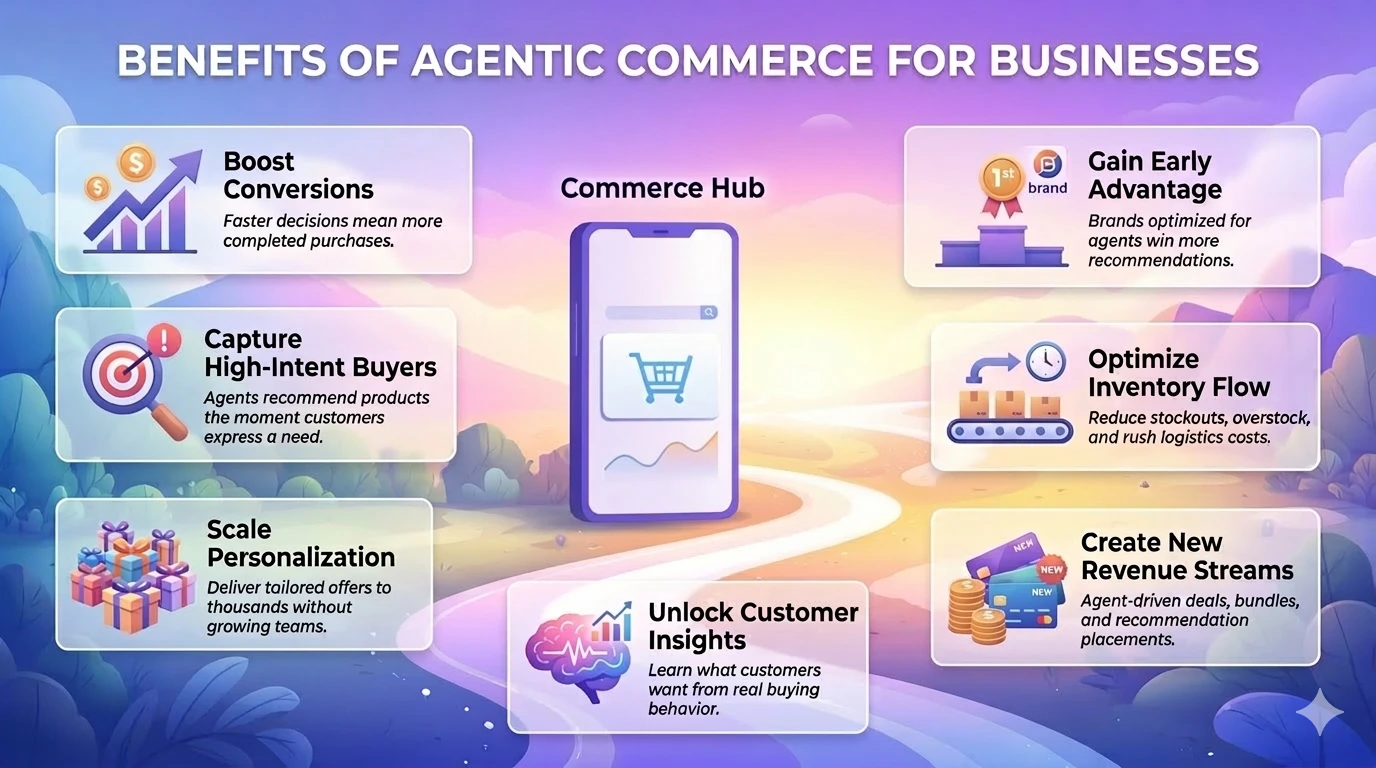
1. Lifts Conversion Rates and Closes More Sales
Agents cut out middle steps, such as shoppers getting fast, confident picks and seamless checkout without leaving the chat. People who reach approval are far more likely to finish buying, with fewer abandoned carts.
Early data shows 20–40% jumps in completed purchases for agent-ready stores, especially on quick or repeat items.
2. Capture Customers at the Moment of Intent
Agents catch needs the instant someone says them, no waiting for site visits or searches.
Brands with clear product data, good reviews, and competitive prices show up first in recommendations. This new moment of intent turns into sales before the shopper ever hits your homepage.
3. Personalizes at Scale Without Adding People
Agents deliver custom suggestions, bundles, or offers to thousands at once using real-time data and buyer history. No need for huge teams to do 1:1 service, the AI handles it.
This drives higher engagement, more repeat visits, and stronger loyalty over months.
4. Delivers Richer Insights from Real Behavior
Agents feed back signals: what got picked, why options were skipped, what prices won, or what features mattered most.
Stores learn customer wants, trends, and drop-off points faster than from surveys or analytics alone. This sharpens products, pricing, stock decisions, and marketing without guesswork.
5. Create New Revenue Opportunities
Businesses build agent-specific deals like exclusive bundles, dynamic prices, or perks agents favor.
Some tests paid visibility in recommendations or new monetization tied to agent flows. It adds revenue streams beyond traditional ads, SEO, or email campaigns.
6. Optimize Inventory and Reduces Waste
Agents check livestock and suggest backups when items run low, spreading demand better.
This cuts out-of-stocks, overstock piles, and expensive rush shipping. Stores move products more evenly, keep shelves right, and waste less.
7. Gain a Competitive Advantage Early
Retailers who fix catalogs for agents (structured details, fast APIs, rich reviews) win more spots in suggestions.
Early movers gain visibility and sales as adoption grows. It’s similar to early SEO wins; those investing now pull ahead while others catch up.
Real-World Agentic Commerce Examples
Agentic commerce is moving from ideas to everyday use. People already tell AI what they need and let it handle the rest, like searching, picking, and buying.
Brands and stores are building or joining systems so agents can find and sell their products easily. Here are real examples across consumer, retailer/brand, and B2B sides, based on what’s live or rolling out now.
1. Consumer Examples
These show how regular shoppers use agents for personal buys, often in chat apps without opening browsers or apps.
- ChatGPT Instant Checkout (OpenAI + Stripe) You ask ChatGPT for something like “best noise-canceling headphones under $150 with fast delivery.” The agent searches, compares options from connected stores, shows a top pick with reasons, and lets you buy right in the chat. It uses the Agentic Commerce Protocol (ACP) for secure payment, and it doesn’t require leaving the conversation. Live since late 2025, it works with Etsy and over a million Shopify merchants, handling real purchases daily.
- Perplexity Buy with Pro In Perplexity, you say, “Find me a waterproof hiking backpack under $100.” The agent researches across sites, filters by reviews and shipping, suggests matches, and completes checkout via PayPal or similar. It’s expanded to all users, connecting to thousands of merchants for direct in-chat buys.
- Google Gemini / AI Mode Shopping In Google search or Gemini, you ask “plan a weekend camping trip under $500 for two.” The agent pulls campsites, gear rentals, food supplies, checks availability, and books or buys pieces using the Universal Commerce Protocol (UCP). Backed by Walmart, Target, Shopify, and others, it allows shoppers complete transactions straight from results.
2. Retailer and Brand Examples
These are stores or brands making their products “agent-ready” or running their own agents to help shoppers.
- Shopify-Powered Merchants (e.g., Glossier, SKIMS, Vuori): Any Shopify store can plug into ACP or UCP so agents in ChatGPT, Perplexity, or Gemini find and sell their items. The agent pulls live stock, prices, and details, then checks out without sending the shopper to the site. Over a million merchants are onboarding, and brands see sales from AI chats without extra marketing.
- Lowe’s Mylow AI Adviser: On Lowe’s site or app, Mylow acts as a home improvement agent. You describe a project (“build a simple deck under $2,000”), and it guides with plans, product picks, checks stock, and adds to cart or buys. Built with OpenAI tech, it handles DIY questions end-to-end.
- Instacart Personalized AI Cart Builder: The agent takes prompts like “weekly groceries for a family of four under $150” or recipe ideas. It suggests items, builds the cart, compares options, and completes the order. It uses natural language to personalize and shop for you.
3. B2B Examples
In business buying, agents automate procurement, supply chains, and routine orders, saving time on repetitive or complex tasks.
- B2B Procurement Agents (e.g., via ChatGPT or Gemini): A company buyer says, “find industrial bearings supplier with same-day Midwest shipping.” The agent searches vendors, checks prices/terms, negotiates basics, and places orders within rules. Tools like Perplexity or enterprise setups handle this for routine buys.
- Autonomous Supply Chain Replenishment: In logistics or manufacturing, agents monitor inventory and auto-order supplies (shipping materials, parts) when low. They compare vendors, pick the best price/delivery, and execute under set budgets, no manual POs for low-value items. Seen in facilities management for office supplies or healthcare for consumables.
- Agent-to-Agent Negotiation in B2B: Buyer agents talk to seller agents for volume deals, contract renewals, or tail-spend items. They handle RFQs, pricing adjustments, and approvals autonomously, escalating only big issues.
Learn More: Best Ecommerce Chatbots to Enhance Your Store
How Businesses Can Prepare for Agentic Commerce?
Agentic commerce is here in early 2026, with agents in ChatGPT, Perplexity, Google Gemini, and similar tools already handling real buys for people. Businesses that wait risk getting skipped when agents pick winners.
The good news: you don’t need a full overhaul right away. Start with the basics that make your products easy to find, trust, and buy.
Focus on clean data, fast connections, and small tests, things you can do now without huge spending.
1. Audit and Clean Up Your Product Data
You should look hard at what agents see: prices, stock, sizes, colors, descriptions, reviews, and shipping rules.
Many catalogs have inconsistencies, such as old prices in one place, new in another, or details buried in images/PDFs.
Fix it: create one single source of truth (like a central PIM system) so everything stays accurate and up-to-date.
Agents trust consistent info; messy data gets ignored or ranked low.
2. Make Product Info Machine-Readable and Structured
Agents read structured data best. So use schema.org markup (JSON-LD) on pages for products, prices, availability, reviews, and policies.
Add rich details: sustainability tags, compatibility, real measurements, and fresh customer photos.
Write descriptions in natural language people (and agents) use, not just keyword-stuffed SEO text.
This helps agents parse and recommend to you accurately, like when someone asks for a “waterproof jacket under $100 with good reviews.”
3. Build Fast, Reliable APIs for Agents
Agents need quick access to live data: stock checks, price updates, shipping options.
Set up REST APIs or integrate with protocols like OpenAI/Stripe’s ACP (for ChatGPT Instant Checkout) or Google’s UCP (for Gemini/Search buys).
ACP lets agents create carts, update shipping, and pay securely via tokenized Stripe. Many Shopify/Etsy stores are already plugging in.
UCP covers discovery to fulfillment for bigger players like Walmart or Target.
4. Optimize for Delivery, Returns, and Policies
Agents check these early. Slow shipping or strict returns can kill a recommendation.
Make terms clear and machine-readable: delivery windows, fees, cutoffs, location limits, easy returns.
Standardize across channels so agents compare you fairly.
Good policies build trust; agents favor reliable sellers to avoid bad experiences.
5. Set Up Secure Payment and Checkout Flows
Use delegated tokens (like Stripe’s in ACP) so agents pay without seeing full card details, it keeps things safe.
Test agent checkouts: ensure carts create fast, updates work (add variant, change address), and orders confirm smoothly.
Maintain control as the merchant of record for fraud checks and data visibility.
6. Test with Pilots and Learn Fast
Pick one category or product line, then start with low-risk items like accessories or consumables.
Integrate with one protocol (ACP if on Shopify/Stripe, UCP for broader reach).
Monitor: Which agents recommend you? What gets bought? Adjust data or pricing based on signals.
Early tests show quick wins in visibility and sales as adoption grows.
7. Build Trust Signals Beyond Your Site
Agents cross-check info, good reviews on third-party sites, consistent pricing elsewhere, and strong seller ratings.
Encourage fresh, verified feedback and monitor sentiment.
Some brands build “trust footprints” by sharing data openly so agents verify easily.
8. Think About Your Own Agents or Partnerships
For bigger operations, explore building internal agents (e.g., for inventory or B2B procurement) using tools like Vertex AI or Salesforce Agentforce. Partner with platforms (Shopify, commercetools) that handle agent readiness.
This keeps you in control while agents handle routine tasks.
Top Use Cases for Agentic Commerce
Agentic commerce is picking up speed, with AI agents handling more of the shopping work, it’s from simple reorders to full decision-making.
These top use cases show where it’s making the biggest difference right now for consumers, retailers, and businesses.
They’re based on what’s live or scaling fast: tools like ChatGPT Instant Checkout, Perplexity Buy, Google Gemini shopping flows, and B2B pilots.
1. Routine Replenishment and Auto-Ordering (Consumer & Retail)
Agents watch your habits or inventory levels and reorder everyday items automatically like groceries, household essentials, printer ink, or office supplies, within your budget and preferences.
You set rules once (price cap, brand, delivery window), and the agent handles restocking without reminders.
This saves time on boring repeats and keeps things in stock; retailers see steady, predictable sales from loyal users.
2. Personalized Shopping Concierge for Complex Needs (Consumer)
You describe a goal in plain words like “plan a weekend camping trip for two under $500” or “build a work-from-home setup under $800,” and the agent researches, compares options across sites, checks compatibility, builds a cart, and buys after your quick yes.
It factors in reviews, delivery, bundles, and your past likes.
Great for gifts, travel gear, outfits, or home projects where manual hunting takes hours.
3. In-Situ Discovery and Purchase in AI Tools (Consumer & Retail)
Shoppers stay inside ChatGPT, Perplexity, Google Gemini, or similar, ask for products, get recommendations, and complete checkout without tabs or site switches.
Agents use protocols like ACP (OpenAI/Stripe) or UCP (Google) for secure, direct buys.
Brands plugged in (Shopify stores, Etsy, Walmart) get sales from high-intent moments before shoppers hit search engines.
4. Hyper-Personalized Recommendations and Cart Building (Retail & Consumer)
Agents learn your style, sizes, budget, and ethics (eco-friendly, specific brands) over time, then curate full carts or outfits proactively.
They suggest based on real-time context like weather, events, or past buys and handle tweaks.
Retailers boost conversions as agents push ready-to-buy bundles with higher average order value.
5. Dynamic Pricing and Offer Optimization (Retail & B2B)
Agents adjust prices or promotions in real time based on demand, competitor moves, inventory, or shopper signals. This means flash deals agents spot and grab; in B2B, agents negotiate basics or find the best supplier terms.
Businesses maximize revenue while staying competitive; shoppers get better deals without hunting.
6. B2B Procurement and Supply Chain Automation (B2B)
Agents handle sourcing, quoting, replenishment, or approvals for routine business buys like parts, materials, or office goods.
They compare vendors, check specs/sustainability/contract terms, place orders within rules, or escalate big decisions.
This cuts manual work in procurement, speeds workflows, and reduces errors; Gartner sees 90% of B2B spend agent-mediated by 2028.
7. Post-Purchase and Support Automation (Retail & Consumer)
Agents track orders, send updates, handle simple issues (delays, returns, wrong items), or reorder if needed.
They resolve Tier-1 questions, issue refunds, or update records autonomously. Customers get faster help; retailers lower support costs and keep satisfaction high.
8. Autonomous Inventory and Operations Management (Retail & B2B)
Agents monitor stock, predict needs, trigger reorders from suppliers, or reroute shipments to avoid shortages.
They optimize shelf restocking; in B2B, they coordinate supply chains. This reduces waste, out-of-stocks, and rush fees while keeping everything flowing smoothly.
These use cases are where agentic commerce delivers real value today, mostly in routine tasks, complex planning, and behind-the-scenes efficiency.
Learn More: E-commerce Chatbot Use Cases & Examples
Conclusion
Agentic commerce isn’t waiting for some distant breakthrough; it’s unfolding right now in the chats and apps people open every day. What started as helpful recommendations has quietly turned into agents that search, decide, and buy on our behalf, using protocols like ACP and UCP to make it secure and smooth.
The real value shows up in saved time, smarter deals, less stress for shoppers, and higher conversions, plus richer insights for businesses.
If you’re reading this as a shopper, try delegating one small purchase this week; you’ll feel the difference. If you’re in retail or business, audit your product data today; the agents are already shopping. The ones they choose first will shape the next era of commerce.
For businesses, that is where a tool like REVE Chat can come in. With agentic commerce being one of the core focuses of REVE Chat, we offer the best agentic features a business may need. To find out how REVE can benefit your business, request a free demo and get started with the future of ecommerce.
Frequently Asked Questions
Traditional e-commerce requires you to browse, search, compare, and check out yourself on websites or apps. Agentic commerce lets AI agents do most of that work autonomously, you just state your need, and the agent researches, decides, and buys for you with your approval.
AI in commerce started with recommendations, chatbots, and personalized suggestions based on your past behavior.
It evolved into agentic systems when AI gained the ability to plan steps, use tools, make decisions, and take actions like completing purchases independently.
Artificial intelligence in retail powers everything from inventory forecasting and personalized recommendations to chat support and dynamic pricing.
It goes further by enabling autonomous agents that act as personal shoppers, handling full purchase journeys on behalf of customers.
Yes, when using trusted platforms like ChatGPT, Perplexity, or Google Gemini with secure protocols (ACP, UCP, tokenized payments).
Agents only act within your set rules, require approval for purchases, and never store or share full card details. It keeps risks low if you stick to reputable tools.
Retailers should clean up product data, add structured markup (schema.org), build fast APIs, and integrate with protocols like ACP or UCP for seamless agent access.
They should also test agent checkouts, keep policies clear and machine-readable, and monitor how agents recommend their products to stay visible and competitive.
Build AI-powered support with Wize AI
Connect business knowledge, automate support conversations, and improve response quality without managing a complex AI stack.
Explore Wize AI Agent Rate the article

Nur-Nabi Siddique
CTO
Nur-Nabi Siddique is the CTO at REVE Chat. He is renowned for his deep proficiency in the Spring Framework, NLP, AI and Agentic Development. He brings a wealth of knowledge and a forward-thinking approach to technological innovation.
View all articles