



What is a Customer Health Score & How to Calculate it?
- March 5, 2026
- 21 mins read
- Listen

A business should routinely check whether its customers are healthy or at risk. If customers are healthy, they are going to stick, make repeat purchases, and contribute to the business revenue. And if they are not, the chances of churn will be higher. And we know most businesses fear churn.
And if customers are not healthy, who knows they might wake up someday and decide to leave, leaving you rattled. You’d surely want to avoid that situation. The key is to know the reasons and actions that may cause the churn.
This is where a customer health score metric comes into the picture.
Tracking this metric can help you –
- Understand the level of customer happiness with your product or service
- Analyze the health score of your business at a particular point in time
- Identify customers who are at risk of churning or disengaging
In this blog, we will explore a customer health score in detail, understand its importance for companies, see some examples, and also look at the tips to increase it.
Before moving further, let’s first get started with the definition.
What is a Customer Health Score?
Customer health score is a powerful metric to measure the risk levels of a customer churn. It is a good indicator of whether a customer is planning to stay or leave. This metric also indicates how robust a relationship the business has with its customers.

The customer health score is a very useful metric for customer service teams and account managers to know whether a customer is at a high or low risk of churn. By tracking this metric, a business can understand ideal candidates for upselling and adjust its sales and marketing efforts accordingly.
The earlier customer success teams measure this score, the more proactive steps they can take to minimize the dangers of churn.
Why is a Customer Health Score Important?
A business should consistently track the customer health score. Doing this can help it identify customers who are likely to go away or stay. When this metric is not measured regularly, a business fails to know how healthily it’s managing customer relationships and ensuring success.
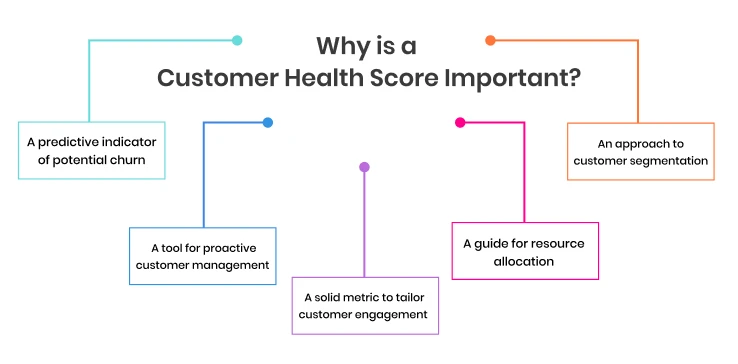
A customer health score is important for various reasons, including –
- To understand customers’ loyalty or churn potential
- To gauge customer engagement with product/service
- To identify happy and unhappy customers
- To know whether customers need immediate support for their issues
- To know whether you can offer your customers additional services or upgrades.
- To allocate the resources judiciously
- To categorize customers into different groups
- To offer personalized experiences based on the needs of each segment
Key Customer Health Score Metrics
There is no specific formula to calculate a customer health score. Businesses that look to calculate it often rely on various metrics, specific to the nature of their industry and the unique customer needs. However, there are some key metrics that you need to measure customer health, and these are –
1. Product Usage Metrics
Product/service usage gives a healthy peek into user interaction or engagement with your product or service. It helps you understand the various degrees of adoption by users. This metric can suggest how much users are benefiting from your product. To track this metric, you will need information on –
- Login history
- Total time spent in the app
- Engagement with new product features
- Utilization of licensed services
When evaluating product usage, you can consider various aspects, including –
- The average duration a user engages with your product or service
- The variety of features a user utilizes
- The level of reliance on specific features of your product
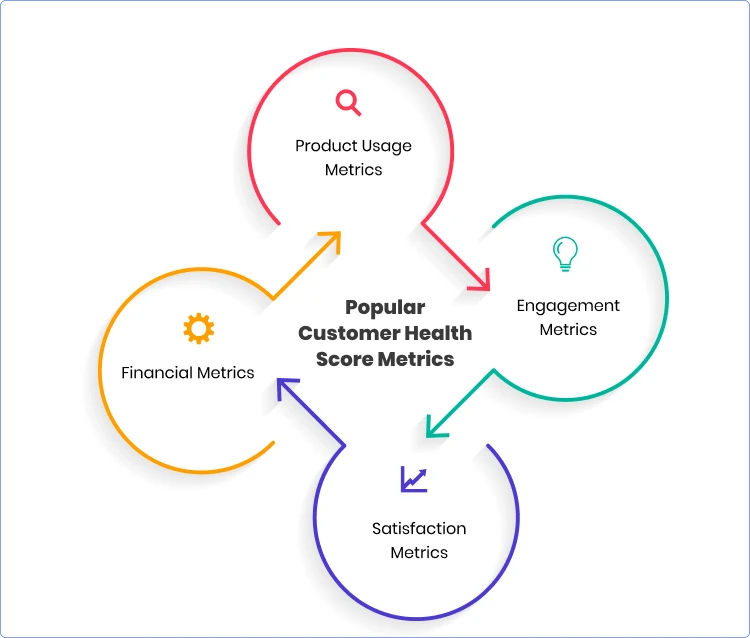
2. Engagement Metrics
Engaged customers spend 67% more on average than new ones. This shows why customer engagement level is an excellent indicator of someone’s probability of sticking or leaving. You can track different engagement metrics to understand a customer health score, including –
- Customer satisfaction (CSAT): It’s a commonly used metric that will indicate how satisfied customers are with your products or services. You can measure it through customer feedback and express it as a percentage, ranging from 100% to 0%.
- Net promoter score (NPS): This metric can help you gauge customer loyalty, satisfaction, and enthusiasm with your company. You can calculate it by asking customers one question: “On a scale from 0 to 10, how likely are you to recommend our product/company to others?” Based on responses, you can segment customers into detractors (1-6), passives (7-8), and promoters (9-10).
- Customer lifetime value (CLV): This metric will help you assess the total net profit you can expect to generate from a customer throughout their entire stay. To calculate this metric, you will use parameters like the customer’s initial purchase, repeat purchases, and average stay with your company.
3. Retention and Churn Rates
Retention and churn rates are good indicators of customer health. These metrics provide information on the chances of a customer’s leaving or staying. Both measure different customer data points.
- Churn Rate – It’s the percentage of customers that leave within a specific time frame.
- Retention Rate – It’s the percentage of customers that stay with you.
4. Financial Metrics
A business’ financial health improves when customers stay for a longer duration and purchase more. Such behavior is often reflected in the overall performance of the business. That’s why financial metrics provide a solid measure of the customer health score.
- Renewal Rate – It measures the ratio of customers who opt/choose to renew and extend their contracts at the end of a subscription period.
- Revenue Growth – It’s a key metric to measure a percentage increase from a starting point. To calculate it, one has to divide the rate of increase in total revenue by total revenue in the previous year.
How to Build a Customer Health Scorecard
A customer health scorecard is a structured framework that helps your team track the right customer signals, assign weight to each signal, and turn the final score into action. Instead of looking at product usage, support tickets, renewals, or satisfaction scores separately, a scorecard brings all those signals into one view.
Before creating a customer health scorecard, answer these questions:
- What does a “healthy customer” mean for your business?
- Which customer behaviors are linked to renewal, repeat purchase, or expansion?
- Which behaviors usually happen before churn?
- How often should the score be updated — daily, weekly, or monthly?
- Should each metric have the same weight, or should some metrics matter more?
A simple customer health scorecard can include the following categories:
| Scorecard Category | Example Metrics | Why It Matters |
|---|---|---|
| Product usage | Login frequency, feature adoption, session duration | Shows whether the customer is actively using your product |
| Support activity | Number of tickets, ticket severity, resolution time | Reveals friction, confusion, or dissatisfaction |
| Customer feedback | CSAT, NPS, CES, reviews, survey responses | Captures customer sentiment and loyalty |
| Engagement | Email responses, webinar attendance, chat interactions, meeting participation | Shows how connected the customer is with your brand |
| Financial/account health | Renewal date, payment history, plan upgrades, contract value | Helps identify revenue risk or expansion potential |
| Relationship quality | Responsiveness, stakeholder involvement, CSM notes | Adds human context behind the numbers |
The best customer health scorecards are simple enough to use regularly but detailed enough to predict risk. Avoid tracking too many metrics at once. Start with 4–6 high-impact signals, review the results, and refine the scorecard as you learn which signals are most closely connected to churn, retention, or upsell opportunities.
How Many Metrics Should You Include in a Customer Health Score?
A common mistake is adding too many metrics to the health score. When every metric matters, no metric truly matters.
A practical customer health score should usually include 5 to 7 core factors. This keeps the score focused and easier for your team to understand. Each factor should be important enough that a major change in that area can affect the overall score.
For example, if you use a 100-point customer health score, you might distribute the score like this:
| Metric | Weight |
|---|---|
| Product usage | 30 points |
| Feature adoption | 20 points |
| Support experience | 15 points |
| Customer feedback | 15 points |
| Account/payment health | 10 points |
| Engagement with your team | 10 points |
| Total | 100 points |
This makes the score easier to interpret. If a customer has strong product usage but poor support experience and low engagement, the score will reflect both the positive and negative signals.
The exact weighting should depend on your business model. For example, a SaaS company may give more weight to product usage and feature adoption, while a service-based business may give more weight to relationship quality and customer feedback.
How to Calculate Customer Health Score?
The calculation will depend on the type of metrics you use and the type of business you operate. The key is to include both positive and negative indicators as it will give a detailed insight into the health of your customer.
Follow these steps to calculate a customer health score specific to your business –
1. Determine What to Measure
You will need some key indicators to determine the health of a customer. You also need to determine what to measure as it will be unique to your business or product. You can track or measure many things, including –
- How frequently does the customer use a key feature of your product
- How often do they engage with the app, or log into the account
- How many support tickets do they have
No matter what you decide to track, it should suggest the chances of your customers to upgrade or disengage. You can then use it as a factor for your customer health score formula.
2. Define What Your Score Will Represent
The score you get will indicate something about your customer’s health. It can indicate positively or negatively. Whatever it does will help you redefine your customer effort and customer success strategy. The information you seek or use can be key to monitoring the relevant behavior metrics and accurately measuring customer health at any specific point in time.
3. Establish Score Distribution
Make a list of all actions you want to consider for calculating the health score of your customer. There will be positive and negative actions – include both in the formula.
While grouping actions, remember two things –
- Add the positive actions to your score
- Subtract the negative ones
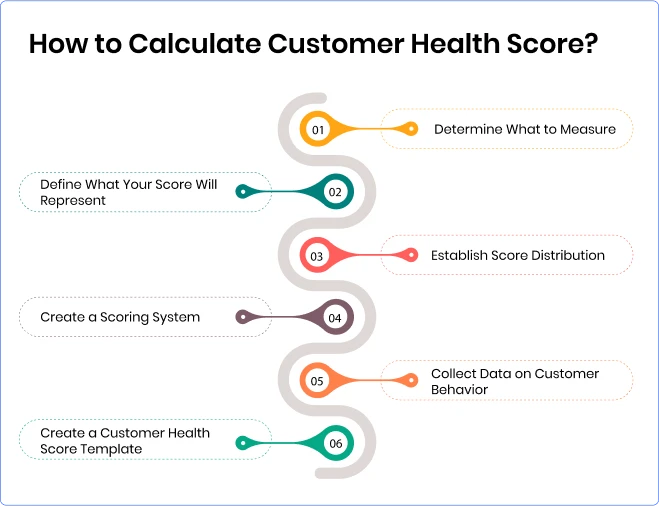
4. Create a Scoring System
Each customer action will have varying degrees of impact on the health score. For this reason, you must assign a score to each action. This will help determine the impact of each action on a customer’s health. While assigning weight, you may also analyze the actions of happy and risky customers, and adjust your score accordingly.
After that, create a scoring system that will give an overall idea of the health of your customer. In the scoring system, show value-addition actions on the positive side and others on the negative side.
5. Collect Data on Customer Behavior
The more customer data you have, the better insights you will gain on the health of your customers. That’s why you need to collect data on consumer behavior and habits to get an accurate picture of customer health. The data you have can help you put customers in different number ranges and set benchmarks.
6. Calculate the Health Score
Now you can use the assigned impact scores and calculate the total health score. Before calculating the score, you also need to tally the total action value for each customer.
Use the below formula –
Customer Health Score (CHS) = Sum of positive action values – Sum of negative action values)
Let’s suppose you have six positive actions and 3 negative actions. Now let us assign the value 5 to a positive action and value 2 to a negative action. ( Note: you can assign any value )
In that case, the CHS would look like that –
CHS = 5×6 – 2×3
CHS = 30 – 6
CHS= 24
Create Different Health Scores for Different Customer Segments
Not all customers should be measured the same way. A new customer in onboarding does not behave like a long-term customer approaching renewal. An enterprise customer may need high-touch engagement, while an SMB customer may rely more on self-service resources.
That is why businesses should create different health score models for different customer segments.
You can segment customer health scores by:
- Customer lifecycle stage
- Company size
- Subscription plan
- Industry
- Product edition
- Revenue value
- Support model
- Customer maturity
- Region or market
Example: Onboarding Customer Health Score
For a new customer, the health score should focus on early adoption and setup progress.
Useful metrics may include:
- Account setup completed
- First login completed
- Key feature used for the first time
- Training session attended
- Onboarding checklist completed
- First support issue resolved
- Time to first value
Example: Renewal Customer Health Score
For a customer close to renewal, the health score should focus on value, satisfaction, and relationship strength.
Useful metrics may include:
- Product usage trend
- Feature adoption depth
- Number of active users
- Support ticket trend
- NPS or CSAT score
- Payment history
- Executive stakeholder engagement
- Renewal conversation status
Segmented scoring gives you a more accurate picture of customer health because it measures customers against the right expectations.
What to Do After Calculating Customer Health Score
A customer health score is only valuable when it leads to action. Once you classify customers as healthy, neutral, or at risk, your team should have a clear playbook for each group.
Healthy Customers
Healthy customers are engaged, satisfied, and likely to continue using your product or service.
Actions to take:
- Ask for testimonials or reviews
- Offer advanced product education
- Introduce premium features
- Identify upsell or cross-sell opportunities
- Invite them to webinars or customer communities
- Turn them into brand advocates
Neutral Customers
Neutral customers are not in immediate danger, but they may not be getting full value from your product.
Actions to take:
- Share helpful product tips
- Recommend underused features
- Send educational content
- Offer a check-in call
- Ask for feedback
- Monitor changes in usage or sentiment
At-Risk Customers
At-risk customers show signs of dissatisfaction, low engagement, poor adoption, or possible churn.
Actions to take:
- Reach out proactively
- Review support history
- Identify unresolved issues
- Offer live chat or video support
- Schedule a success call
- Provide personalized onboarding or training
- Escalate major issues internally
- Track whether the score improves after intervention
With REVE Chat, businesses can use live chat, AI chatbot, co-browsing, ticketing, and omnichannel messaging to respond faster, support customers proactively, and improve the engagement signals that influence customer health.
Read More: Customer Stickiness Definition, Importance & Benefits
How to Improve Customer Health Score?
Engaged and satisfied customers are always the foundation of growth for any business. This is why improving the health of customer relationships directly impacts the customer health score.
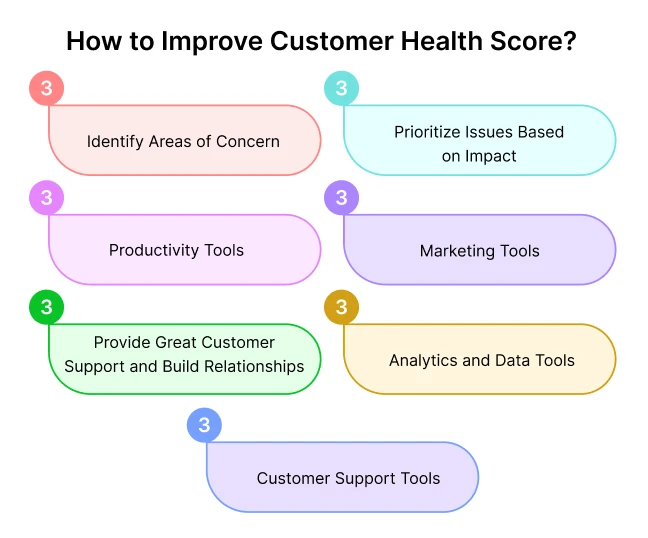
Here are different ways to improve the customer health score –
1. Identify Areas of Concern
A business needs to identify the areas of concern that may be causing customer dissatisfaction.
There are two ways to achieve that –
- Reviewing customer data and feedback
- Evaluating support interactions
Identifying weak areas can be a good point for enhancing customer satisfaction and happiness.
2. Prioritize Issues based on Impact
Some issues may be critical and can impact the health of your customer more. If they are not addressed on time, they might push customers toward churn.
You need to remember two things –
- Some issues may not cause an immediate impact but might have a negative effect in the long run
- Prioritize the most critical issues based on the level of impact they have on the customer
3. Focus on Enhancing Product Adoption by Customers
When customers are happy, they are more likely to optimize your product or service’s features fully. You can trust such customers to stick for longer based on the extent of product adoption. That’s why you should always focus on encouraging customers to maximize the value of your offering. You also need to gauge their responses to your messages and communications. That can also be a good signal of their immediate trust in your brand.
4. Engage More with Customers
Engaged customers tend to be more trustful and less fidgety. The more engaged they are, the better relationships they form with the business. Such customers are also more receptive to price fluctuations in products or services. On the other hand, 66% of consumers will abandon a brand if not engaged through personalized experiences.
Here are some key steps to engage more with customers –
- Foster engagement through proactive and personalized communications with the customer
- Make sure you collect regular feedback
- Attend to their queries promptly
- Take steps to meet their needs
5. Provide Great Customer Support and Build Relationships
Customers feel happy and valued when a business provides great support to them. Addressing their issues promptly and always guiding them through their problems is key to avoiding churn. You can win customers for life if you focus on building long-term relationships and align your business goals with theirs.
Make sure you –
- Always focus on meeting customer’s expectations
- Always focus on improving their experience with your brand
6. Talk to customers
Is your customer health score low despite all your good efforts to build customer relationships and offering value? Not sure why? Well, you can speak to customers and get a better understanding of the issue troubling customers. You can think of sending out satisfaction surveys, but that won’t help beyond a point.
Talking to customers means –
- Reach out to customers directly
- Ask them about the issues they are facing
- You can also ask why they are not scoring highly on various survey parameters you have set
- You may also ask them about the steps and actions they expect of you
7. Identify Patterns
Do you think your customers’ behavior is changing towards your products or services but not sure how to find out about that? Consider analyzing all the customer data and insights you have gathered. The analysis can suggest why some features are not getting the kind of traction you expected and so on. The more you dig deep into the data, the more you can find some patterns behind the customer’s unhappiness, resulting in a low customer health score.
Quantitative vs Qualitative Customer Health Score Factors
A strong customer health score should include both quantitative and qualitative data. Quantitative data tells you what happened, while qualitative data helps explain why it happened.
Quantitative Factors
Quantitative factors are measurable and easy to track through your product, CRM, billing system, helpdesk, or analytics tools.
Examples include:
- Login frequency
- Feature usage
- Time spent in the app
- Number of support tickets
- Ticket resolution time
- Renewal date
- Payment history
- Product adoption rate
- NPS, CSAT, or CES score
- Number of active users in the account
These signals are useful because they show actual customer behavior. For example, if a customer suddenly stops logging in or stops using a key feature, that can be an early warning sign of churn.
Qualitative Factors
Qualitative factors are more subjective, but they add important context that numbers alone may miss.
Examples include:
- Relationship quality with the customer
- Responsiveness to emails or calls
- Customer sentiment during support conversations
- CSM or support team notes
- Perceived ROI
- Internal champion strength
- Competitor mentions
- Unresolved feature requests
- Customer maturity or product fit
For example, a customer may have high product usage but still be unhappy because they need a feature your product does not currently offer. If you only look at usage data, the customer may appear healthy. But if you combine usage data with support conversations and CSM feedback, you may discover a hidden churn risk.
That is why the most reliable customer health scores combine both types of signals.
Customer Health Score Examples
Interpreting behavioral data and health scores is vital to gaining deep insights about customers. It helps us reach a meaningful conclusion about what customers like and what not. Some businesses are very good at turning the health score data into a decision-making tool.
Here are a few customer health score examples for you –
1. Percentage Scale
This scale is very simple to use and most businesses can adopt it for calculating their customer health scores. Whatever maximum value is assigned for a health score, the customer score can be divided by that value to get a percentage. Using this scale, a percentage score for each action can be calculated which eventually can help you exceed customer expectations.
2. Colour-Coding Scale
This scoring system may not be as precise as the percentage one, but it nonetheless is easy to use. Its working resembles that of a traffic light where the “red color” and “green color” have different meanings. Here too, the health score is assigned three values in color red, yellow, or green for easy understanding of their satisfaction level with the business.
3. Grading-Based Scale
As the name suggests, this scoring system assigns grades from F to A to a range of health scores. Excellent scores are rated A while poor ones are graded F, and the rating follows a top-down approach with the inferior ratings appearing higher and vice versa. The grading system makes it an easy method to understand the health score quickly.
Common Challenges in Measuring Customer Health Score
Customer health scoring is powerful, but it is not always easy to get right. Here are some common challenges businesses face.
1. Choosing the Wrong Metrics
Not every metric predicts customer success. For example, a high number of logins may look positive, but if the customer is logging in repeatedly because they cannot complete a task, the signal may be misleading.
Choose metrics that are clearly connected to retention, satisfaction, product value, or revenue growth.
2. Giving Equal Weight to Unequal Signals
Some signals matter more than others. A missed payment or sudden drop in product usage may be more serious than a missed newsletter open.
Assign weights based on business impact. If a metric is strongly linked to churn or renewal, it should carry more weight.
3. Limited or Scattered Data
Customer data often lives across multiple systems: CRM, helpdesk, billing tools, chat platforms, survey tools, and product analytics. When this data is disconnected, the health score may be incomplete.
To solve this, businesses should centralize customer data and connect support, engagement, and account information wherever possible.
4. Lack of Clear Benchmarks
A score is only useful when your team knows what it means. Without benchmarks, it is hard to decide whether a score of 60 is acceptable, risky, or critical.
Define clear ranges such as:
- 80–100 = Healthy
- 50–79 = Needs attention
- 0–49 = At risk
These ranges can be adjusted as your team gathers more historical data.
5. Treating the Score as Static
Customer health changes over time. A customer may be healthy today but at risk next month if product usage drops or support issues increase.
Review and update health scores regularly. Your scoring model should evolve as your product, customer base, and business goals change.
Future of Customer Health Scoring: AI and Proactive Engagement
Customer health scoring is becoming more intelligent with the help of AI, automation, and real-time customer engagement tools. Instead of only reviewing scores manually, businesses can now detect risk patterns earlier and respond faster.
AI can help businesses:
- Analyze large volumes of customer interactions
- Detect changes in sentiment
- Identify churn patterns
- Recommend next-best actions
- Predict which customers are likely to renew or leave
- Personalize support based on customer behavior
For example, if a customer has low product usage, multiple unresolved tickets, and negative chat sentiment, AI can help flag that account as high risk. Your team can then take proactive action before the customer decides to leave.
This is where tools like live chat, AI chatbots, co-browsing, and omnichannel support become important. They help businesses engage customers at the right moment, resolve problems faster, and collect the data needed to maintain an accurate customer health score.
Boost Customer Engagement and Achieve a Better Health Score with REVE
Engaged customers stay for longer, spend more, and have a higher CLV. Keeping this in mind, your business should focus more on engaging with customers more frequently and effectively.
At REVE, we bring you a wide range of engagement and support tools that you can use and serve your customers better.
You can use our AI-powered chatbot to increase the response rate and automate tasks across sales, marketing, and support.
You can also provide better visual support to customers by using our tools such as video chat software and co-browsing software.
Plus, we have advanced live chat software that you can add to the bot and elevate the level of customer support.
Final Thoughts
A business that strives for customer happiness enjoys better retention rates and lower churn. When customers are happy, they don’t feel the need to switch to competitors.
At REVE, we understand the significance of keeping customers engaged and serving them the best you possibly can.
That’s why our tools can be a great value addition to your customer engagement strategy. You can sign up and check the features of our products.
Frequently Asked Questions
A good customer health score depends on your scoring model. If you use a 100-point scale, a score above 80 usually indicates a healthy customer. A score between 50 and 79 may need attention, while a score below 50 may indicate churn risk.
Customer health scores should be updated regularly. For SaaS and subscription businesses, weekly or real-time updates are ideal. For businesses with longer sales or service cycles, monthly updates may be enough.
Customer success, support, sales, marketing, and account management teams can all use customer health scores. The score helps teams prioritize customers, identify risks, find upsell opportunities, and improve customer experience.
Yes, a customer health score can help predict churn when it includes the right signals, such as declining product usage, poor feedback, unresolved support issues, low engagement, and negative account activity. However, it should be combined with human judgment and customer conversations.
NPS measures how likely a customer is to recommend your business. Customer health score is broader. It combines multiple signals such as product usage, support activity, engagement, satisfaction, payment history, and renewal likelihood.