




Table of Content
If you’re an entrepreneur, you already know how vital marketing is to running a successful business. Without marketing, your business cannot achieve the kind of customer engagement it should, nor can it effectively communicate its offers to the target audience.
However, you are also aware that marketing involves a lot of effort, and most of its tasks are manual and repetitive. From sending individual emails to manually tracking leads, managing customer data, and analyzing campaign results, the list of tasks is long and never-ending. If you decide to do all marketing tasks manually, it might hamper your team’s overall productivity.
Needless to say, you’d ideally want to avoid all the manual effort and time spent on marketing. But the question is, can you? If yes, then how?
Yes, marketing automation tools can help your business streamline workflows and automate most tasks, resulting in improved efficiency. These tools can help you automate repetitive tasks and make marketing more profitable for your business. More importantly, these tools can improve productivity by approximately 20%.
In this blog, we will explore marketing automation tools in detail, understand their benefits and features, and know how they can add great value to your business.
But first, let’s get started with understanding what exactly marketing automation tools are…
What are Marketing Automation Tools?
Marketing automation tools are software platforms that can automate various marketing tasks, processes, and workflows. These tools have advanced features for streamlining and optimizing marketing by automating repetitive tasks. Using these tools or systems, you can automate time-consuming tasks so that your marketing team can focus on other important activities and stay more efficient and productive.
In addition, using an automation tool can empower your business to optimize various marketing activities and gain insights into the team’s performance. From nurturing leads to tracking customer interactions, these tools can add value to marketing on different levels and ensure better results with marketing efforts.
A marketing automation tool typically offers a variety of features and capabilities, including Email Marketing Automation, Lead Management, Campaign Management, Personalization, Segmentation, Social Media Management Analytics, and Reporting. More so, they can be integrated with other third-party tools to boost your marketing inputs and results.
Why Should Your Business Use a Marketing Automation Tool?
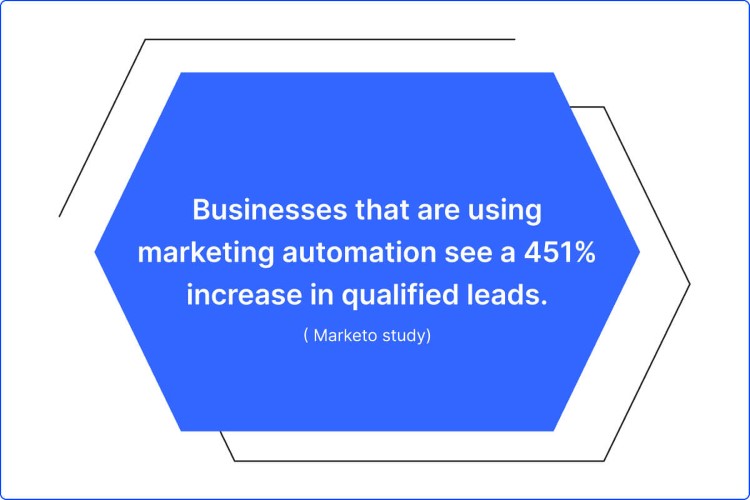
Marketing automation tools are vital to streamlining your marketing processes and workflows. They have a key role to play in delivering personalized experiences and gaining valuable customer insights. More importantly, more than 6 out of ten companies outperform competitors with the help of marketing automation.
Here are the main reasons your business should get an automation tool for marketing:
- Time and Resource Efficiency – These tools can automate many repetitive and manual tasks of marketing, therefore leading to improved productivity and efficiency.
- Improved Conversion Rates – Automation software can streamline lead management processes that can help you effectively move leads through the sales funnel and improve conversion rates.
- Personalized Marketing – Automation software can enable you to offer targeted content to your audience based on their demographics and customer journey. With personalized marketing, there will always be enhanced customer engagement.
- Multi-Channel Marketing – The use of an automation tool for marketing facilitates marketing across multiple channels so that you can reach customers across touchpoints and maximize the impact.
- Data-Driven Decisions – When a business employs automation tools for marketing tasks, it gets tons of valuable data and insight, which helps it track and analyze customer engagement and make informed data-driven decisions.
- Unified View of Customer Information – Marketing automation tools’ integration capabilities with other tools and systems ensure seamless data flow across different tools. It results in a unified view of customer information that proves beneficial in devising personalized campaigns.
Different Types of Marketing Automation Tools
For marketing, there are several types of automation tools available that a business can choose based on its specific needs. These tools can fit with the complexity of marketing operations on any scale, so a business of any size can find the right match for tasks.
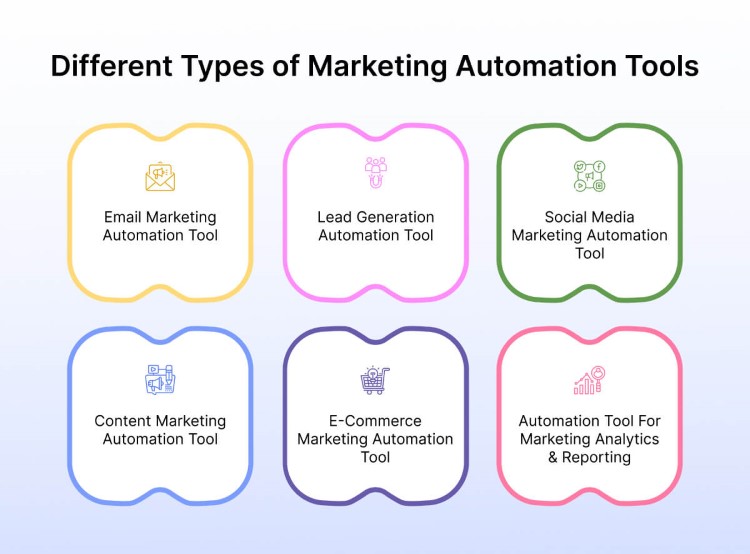
Here are those tools –
- Email Marketing Automation Tool – These tools are used for automating email marketing campaigns. A business can create, schedule, and send personalized emails by using these tools.
- Lead Generation Automation Tool – These tools are mostly used for capturing leads from landing pages, pop-ups, and forms. They also have features for lead nurturing and automated follow-ups.
- Social Media Marketing Automation Tool – These tools not only help automate various social media marketing activities but also offer features for tracking and monitoring social engagement. Your business can schedule, publish, and analyze social posts using these tools.
- Content Marketing Automation Tool – These tools enable managing and automating content creation, publishing, and distribution. Using them, a business can plan content, and workflow management, along with optimizing content and getting analytics.
- E-commerce Marketing Automation Tool – E-commerce enterprises can automate marketing activities using these tools. Some of the key features include product recommendations, personalized offers, and post-purchase follow-ups.
- Automation Tool for Marketing Analytics & Reporting – Businesses can use these tools to gain insights into customer behavior, campaign effectiveness, and marketing ROI. They enable data tracking, reporting, and analytics.
- Local Marketing Automation Tool – This type of tool can help with marketing efforts at the local level and has features such as Local Campaign Management, Localized Content Creation, targeted Local advertising, local SEO, and listing management.
Key Features of a Marketing Automation Tool
Automation tools are growing in prominence for automating and optimizing marketing efforts on any scale. These tools come packed with a range of features and functionalities that enable seamless automation of various tasks.
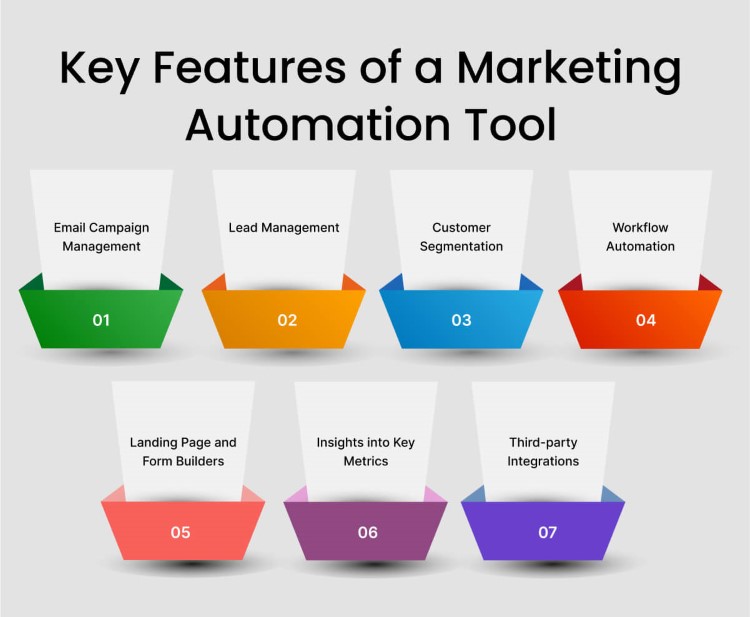
Some of the key features include –
- Email Campaign Management – These tools enable email campaign automation and management and have features like templates, A/B testing, performance tracking, etc.
- Lead Management – Automation tools have features for lead management so that a business can capture and manage leads. Key features for lead nurturing include triggered emails, automated workflows, and drip campaigns.
- Customer Segmentation – Top automation tools help businesses segment the audience based on demographics, browsing history, and behavior.
- Workflow Automation – A business can use the features of automation tools to automate marketing tasks, workflows, and processes. Features like task assignment, and workflow builders ensure streamlining of marketing operations.
- Landing Page and Form Builders – Top marketing automation tools often come with features for creating and optimizing landing pages and forms.
- Insights into Key Metrics – These tools offer features for tracking and measuring the performance of marketing campaigns. Its features enable insight into key metrics such as conversion rates, click-through rates, and open rates.
- Third-party Integrations – Most marketing automation tools can be integrated with third-party tools or software such as CMSs, CRMs, applicant tracking systems, etc. to enable seamless data synchronization across systems and platforms.
How to Choose the Best Marketing Automation Tool for Your Business?
It’s important to choose the marketing automation software that best fits your business needs and also contributes to maximizing your marketing efforts. If you’re able to find the right match, it will help achieve your marketing goals efficiently.
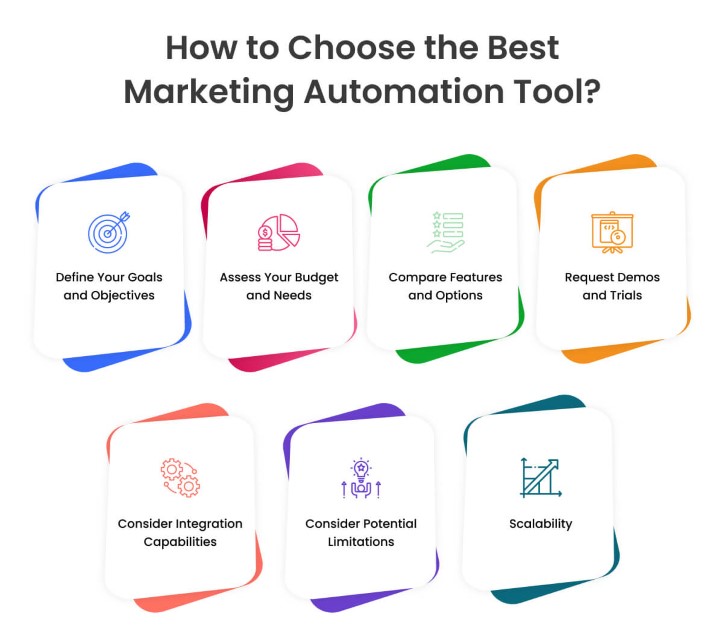
Here are the tips to choose the best tool for marketing automation –
- Define Your Goals and Objectives – Finding the best automation software for marketing is not possible unless you clearly define your marketing goals and objectives. Once you know what you want to achieve with the tool, you will be able to find the ideal tool easily.
- Assess Your Budget and Needs – Before choosing the right marketing automation software, you should not only consider the upfront cost but also ongoing fees such as subscription changes. It’s equally important to prioritize the features that align with your marketing goals and business needs.
- Compare Features and Options – Make sure you compare the features, pricing plans, ease of use, and other key aspects of the automation tool before choosing it for your business. You should also check the customer reviews and customer support for the software.
- Request Demos and Trials – Requesting a demo or a trial of the software will help you explore and understand the user interface, usability, and intuitiveness of the software. This step will also give you the choice to ask questions and clarify any doubts regarding the product.
- Consider Integration Capabilities – Check how well the marketing tool integrates with other tools such as CMS, CRM, analytics platforms, etc.
- Consider Potential Limitations – Make sure you are aware of the potential limitations that come with the software, such as the number of emails allowed per month, total contacts allowed, or number of actions allowed in a month with a specific activity.
- Scalability – Check whether the software you choose can accommodate your future business needs.
Quick Comparison: Best Marketing Automation Tools by Use Case
| Tool | Best For | Starting Price | Key Strength |
|---|---|---|---|
| REVE Chat | Conversational omnichannel marketing and lead engagement | Free tools; paid plans vary | AI Agent, Live chat, chatbot, WhatsApp campaigns |
| Adobe Marketo Engage | Enterprise B2B lead management | Custom | Lead scoring, ABM, scalability |
| Salesforce Account Engagement | B2B sales-marketing alignment | Custom | CRM integration, lead nurturing |
| ActiveCampaign | SMB email, CRM, and customer journeys | Starts around $19/month | Affordable automation and CRM |
| Klaviyo | Ecommerce email and SMS automation | Free for small lists; paid scales by contacts | Purchase-based segmentation |
| Customer.io | SaaS lifecycle messaging | Starts around $100/month | Behavior-triggered campaigns |
| Zapier | Connecting marketing apps | Free; paid plans start around $29.99/month | No-code app automation |
| Brevo | Budget-friendly email and SMS | Free plan available | Email, SMS, transactional campaigns |
| HubSpot | All-in-one marketing, sales, and CRM automation | Plan-based | CRM, workflows, reporting |
How to Choose the Right Marketing Automation Tool by Business Size
For small businesses, the best marketing automation software should be easy to set up, affordable, and practical for a small team. Look for drag-and-drop workflow builders, ready-made email templates, simple segmentation, CRM integration, and transparent pricing. Tools like ActiveCampaign, Brevo, Constant Contact, and SendPulse are often suitable for teams that want to automate email campaigns, lead capture, follow-ups, and basic customer journeys without heavy technical setup.
For growing mid-sized businesses, prioritize scalability. At this stage, your marketing automation tool should support multi-step customer journeys, stronger reporting, deeper CRM integration, lead scoring, campaign attribution, and sales handoff workflows. HubSpot, Zoho, Customer.io, and GetResponse can work well for teams that need more control over segmentation, personalization, and lifecycle marketing.
For enterprises, basic automation is not enough. Larger companies should look for advanced features such as account-based marketing, predictive lead scoring, role-based access, approval workflows, compliance controls, data synchronization, multi-channel orchestration, and enterprise-grade analytics. Adobe Marketo Engage, Oracle Eloqua, Salesforce Marketing Cloud Account Engagement, Braze, and Insider One are better suited for complex, high-volume marketing operations.
Pros and Cons of Marketing Automation Tools
Marketing automation tools can save time, improve personalization, and help teams scale campaigns. However, the wrong platform can also become expensive, complex, or underused.
Pros
- Saves time by automating repetitive tasks such as follow-ups, lead nurturing, and campaign scheduling.
- Improves personalization through segmentation, behavior-based triggers, and dynamic messaging.
- Helps align sales and marketing by scoring leads and passing qualified prospects to sales teams.
- Provides better reporting on campaign performance, conversions, and customer engagement.
- Supports multi-channel campaigns across email, SMS, chat, WhatsApp, social media, and web.
Cons
- Pricing can increase quickly as your contact list grows.
- Advanced workflows may require training or technical support.
- Poor data quality can reduce the accuracy of segmentation and lead scoring.
- Some tools are too feature-heavy for small teams.
- Implementation can fail if goals, ownership, and workflows are not defined before setup.
Marketing Automation Implementation Checklist
Before choosing a marketing automation platform, use this checklist:
- Define your main goal: lead generation, nurturing, customer retention, ecommerce revenue, or sales alignment.
- List the channels you need: email, SMS, WhatsApp, live chat, website, social media, push notifications, or ads.
- Check whether the tool integrates with your CRM, ecommerce platform, analytics tools, and customer support software.
- Review pricing based on contacts, users, emails, workflows, and automation limits.
- Test the workflow builder with a real campaign before buying.
- Confirm whether the platform supports lead scoring, segmentation, reporting, and A/B testing.
- Clean your contact data before migration.
- Train your team before launching complex automations.
- Start with one or two high-impact workflows, then expand gradually.
Best Marketing Automation Workflows to Start With
If you are new to marketing automation, start with workflows that directly impact leads, revenue, or customer engagement.
Welcome sequence: Send new subscribers a series of emails introducing your brand, best resources, offers, and next steps.
Lead nurturing workflow: Automatically send educational content based on a lead’s interests, page visits, or form submissions.
Abandoned cart recovery: Remind ecommerce shoppers to complete their purchase through email, SMS, WhatsApp, or web push.
Re-engagement campaign: Identify inactive users and send personalized offers, product updates, or helpful content to bring them back.
Sales handoff workflow: Score leads based on behavior and profile fit, then notify your sales team when a lead is ready for outreach.
Customer onboarding sequence: Guide new users through product setup, tutorials, support resources, and upgrade opportunities.
Automate Various Tasks Across Marketing With REVE Chat
In the digital and data-driven age, automation is key to success in marketing. A business that is able to automate repetitive tasks can optimize marketing efforts and drive growth.
We, at REVE Chat, are familiar with the rising automation trends that are happening around the marketing landscape, and so we strive to contribute to them. We have a variety of engagement and support tools and software that can add value to your marketing and sales efforts.
Our AI-powered chatbot can automate most of your tasks and save time and resources with your effort. You can also leverage our video chat software and co-browsing software for visual engagement.
Similarly, the live chat software we offer can be paired with the bot to offer hybrid support and ensure value through engagement.
Final Thoughts
Automation is now integral to various aspects of running a successful enterprise, and marketing is no exception. With strategic marketing automation, a business can strengthen customer communication and also economize on resources.
With REVE Chat, you stand to benefit a lot as we have a variety of tools for engagement and support. Some of these tools could also help automate various marketing activities.
You can sign up with us and check how our tools can add value to your business’s marketing efforts.
Frequently Asked Questions
ActiveCampaign, Brevo, Constant Contact, SendPulse, and GetResponse are good options for small businesses because they offer email automation, templates, segmentation, and affordable entry-level plans.
HubSpot, Adobe Marketo Engage, Salesforce Marketing Cloud Account Engagement, and Oracle Eloqua are strong B2B options because they support lead scoring, CRM integration, account-based marketing, and sales handoff workflows.
Klaviyo, Drip, Omnisend, and GetResponse are strong ecommerce choices because they support abandoned cart campaigns, product recommendations, purchase-based segmentation, and revenue tracking.
No. Modern marketing automation includes email, SMS, WhatsApp, live chat, chatbots, web push, landing pages, CRM workflows, analytics, and customer journey automation.
Build AI-powered support with Wize AI
Connect business knowledge, automate support conversations, and improve response quality without managing a complex AI stack.
Explore Wize AI Agent Rate the article

Rahat Hassan
Product Marketing Manager
Rahat Hassan is a strategic Product Marketing Manager at REVE Chat specializing in customer experience & communication. He is passionate about creating compelling content for diverse audiences. Beyond work, he enjoys reading articles and watching videos on trending technological shifts in the IT industry.
View all articles