


Table of Content
AI SUMMARY
Quick Answer
‘Front’ is a popular customer communication platform, but it may not fit teams that need broader AI automation, built in live engagement tools, industry specific workflows, or simpler pricing. This guide compares seven Front alternatives: REVE Chat, Zendesk, Intercom, Crisp, Help Scout, LiveAgent, and Tidio.
This guide evaluates each platform based on ease of use, AI capabilities, omnichannel support, integrations, specialized features, and pricing. The comparison helps businesses identify which alternative best matches their customer support, sales, and engagement needs.
Front is a customer communication platform centralizing emails, chats, and social media messages into a shared inbox. This enables teams to collaborate and respond to customers more efficiently. It is a platform that is designed to manage complex B2B operations through its AI-driven Autopilot and shared inboxes.
While being widely used by support and sales teams, Front may not be the right fit for every business. Some teams need stronger AI automation, simpler pricing, built-in live engagement tools, or industry-specific capabilities that Front does not fully prioritize.
This discussion will look into why businesses might need Front alternatives and will rank the 7 best alternatives to Front.
Why Do Businesses Need Front Alternatives
Let’s look at the reasons why businesses need to look for alternatives to Front:
1. Absence of Native High-Touch Visual Tools
Front does not natively provide advanced collaborative features such as co-browsing or integrated audio-video calls directly within the chat. Businesses that need to provide real-time technical guidance by viewing a customer’s screen or conducting face-to-face consultations to close complex sales may find this a critical missing component.
2. Need for Pre-Configured Industry Workflows
Front’s AI Agent, Autopilot, can handle business operations, but businesses must create their own workflows from scratch by defining the rules, steps, and data the AI should follow. Organizations in banking, telecom, and insurance may prefer alternatives with ready-made industry workflows.
3. Separate AI Tools Across the Customer Lifecycle
Front offers a capable AI Agent through Autopilot, while Copilot supports human agents with tasks such as drafting and summarizing responses. However, these capabilities operate as separate tools, and businesses usually look for one single AI solution that can move smoothly between sales, support, and ecommerce tasks within the same conversation may prefer a more unified alternative.
4. Unpredictable Scaling Costs and Add-on Complexity
Front utilizes a seat-based pricing model where many of its most powerful capabilities are not included in the base price. Features like Autopilot, Copilot, and Smart QA are charged as separate add-ons. This can lead to unpredictable monthly bills for businesses as their conversation volume grows or as they attempt to modernize their support with AI.
Ranking at a Glance
| Platform Names | Pricing | Feature Value |
|---|---|---|
| REVE Chat | Free Plan Available. Starting Price: $14.99 | Wize AI Agent, built-in co-browsing, audio and video calls, live chat, industry-specific AI Agents, WhatsApp campaigns, and real-time visitor monitoring |
| Zendesk | Starts at $19/agent/month | AI that learns from past resolutions, advanced AI reasoning, a large app marketplace, and role-based AI assistance |
| Intercom | From $0.99 per Fin outcome $19 per seat/month | Unified customer service agent, Fin AI Agent, structured workflows, pay-per-resolution pricing, and ecommerce shopping support |
| Crisp | Free Plan Available. Crisp and Hugo Membership costs $45/month/workspcace | Flat-rate pricing, co-browsing, audio and video calls, AI integrations through MCP, and unlimited conversations |
| Help Scout | The Free plan includes 5 users, 1 Inbox, and 1 Docs site. Paid Pricing Starts at $25per user/month | Beacon support widget, proactive in-app messages, customer-focused support, and a free plan |
| LiveAgent | Starts at $10/month | Built-in call center, agent gamification, smart ticket prioritization, and collision detection |
| Tidio | Free Plan Available. Pricing starts at $24.17/month | Quick Lyro AI setup, Shopify order management, live typing preview, visual workflow builder, and video calls in the chat widget |
How We Evaluated the Alternative Platforms
Here are the evaluation criteria based on which the alternative platforms have been ranked and considered:
1. Ease of Use
This point measures how easily and quickly the team can implement the tool and begin resolving customer queries without exclusive technical training or complete system migration.
2. Feature Versatility & Specialized High-Touch Tools
This evaluates the versatility of the communication toolkit, looking for features that allow for more than just simple text chat, such as co-browsing and audio-video call options.
3. AI Automation Proficiency & Context Awareness
This measures how effectively the platform’s AI can handle multi-step workflows and also remember conversation history. This is the assessment of whether the AI merely assists or acts as an autonomous agent capable of resolving tickets end-to-end.
4. Industry-Specific Customization
This looks at whether the platform provides purpose-built AI agents or workflows designed for specific sectors.
5. Integration Depth & Scalability
This point assesses the platform’s ability to serve as a central operating center by seamlessly integrating with third-party tools such as CRM and e-commerce platforms. The point of scalability assesses the tool’s ability to handle growing ticket volumes as well.
6. Omnichannel Breadth
This evaluates the variety of communication channels unified into a single dashboard. The alternative should be able to manage more than just email and live chat; it should integrate WhatsApp, Facebook Messenger, Instagram, SMS, and even Voice. The goal of this point is to ensure agents do not lose context when the customer switches channels.
7. Pricing Model Transparency
Prioritizes platforms that offer clear, predictable billing structures. This includes outcome-based pricing, or simple seat-based models without hidden setup fees.
Best 7 Front Alternatives
Here are the 7 best Front alternatives, their features, and why they should be chosen over Front:
1. REVE Chat
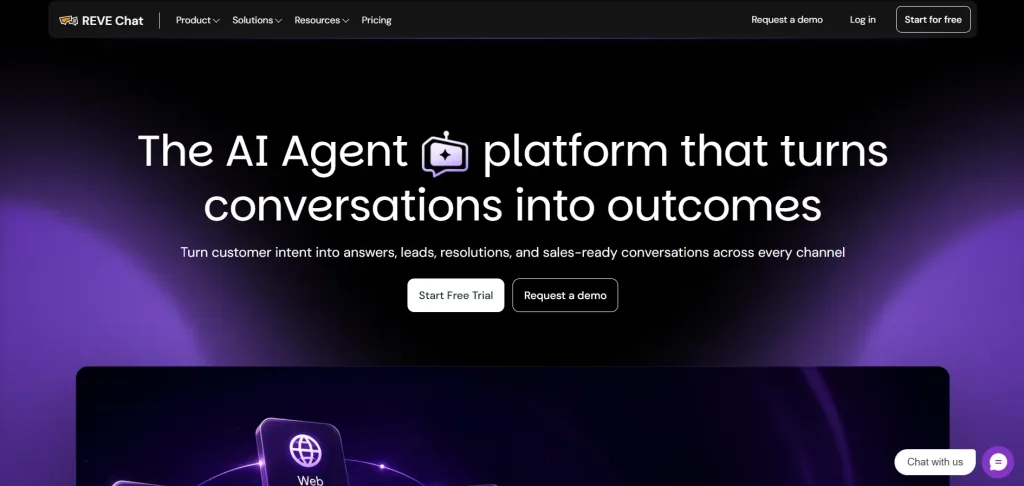
REVE Chat is a comprehensive AI-driven customer engagement platform. It features the Wize AI Agent, which automates complex service journeys using real-time business data. Its live chat solution enables instant connections and proactive engagement, while the omnichannel dashboard unifies conversations across social media and email. Wize AI Agent can also be configured with industry-specific logic and workflows, helping businesses automate specialized customer journeys without building every process from scratch.
Key Features
- Wize AI Agents that understand customer intent and can take real-time action using connected business data
- Modern, intuitive live chat allowing businesses to connect with customers instantly, including proactive chat and real-time visitor monitoring
- Native co-browsing that allows agents to view a customer’s screen in real-time to guide them through their website journey
- Integrated audio-video calls allow agents to initiate high-resolution face-to-face consultation calls
- Omnichannel smart inbox gathers conversations from website chat, WhatsApp, Facebook Messenger, Instagram, and email into a single, unified dashboard
- The drag-and-drop interface of the visual flow builder allows businesses to build sophisticated chatbot automation and workflows without writing any code
- Businesses can launch personalized messaging campaigns across WhatsApp, SMS, and Web Push notifications to engage prospects and drive conversions
Why Switch to REVE Chat
Businesses should switch to REVE Chat when they want AI automation to play a larger role for customer support and engagement. Wize AI Agent can be trained with industry-specific logic and workflows, being able to help businesses automate specialized customer journeys without building every process from scratch. It also works alongside live chat, omnichannel communication, and human teams.
REVE Chat further strengthens this experience with proactive engagement and features such as co-browsing, audio, and video calls. These provide additional ways for teams to assist customers, but the core advantage over Front is the combination of specialized AI automation with a broader customer engagement platform.
Pricing
REVE Chat’s pricing spans from $14.99 to $291.99 per month across plans. This pricing ensures scalability through transparent pay-for-value billing. Businesses can adjust seats and AI conversation sliders as they grow, enabling predictable budget expansion alongside rising conversation volumes, avoiding hidden per-ticket fees.
2. Zendesk
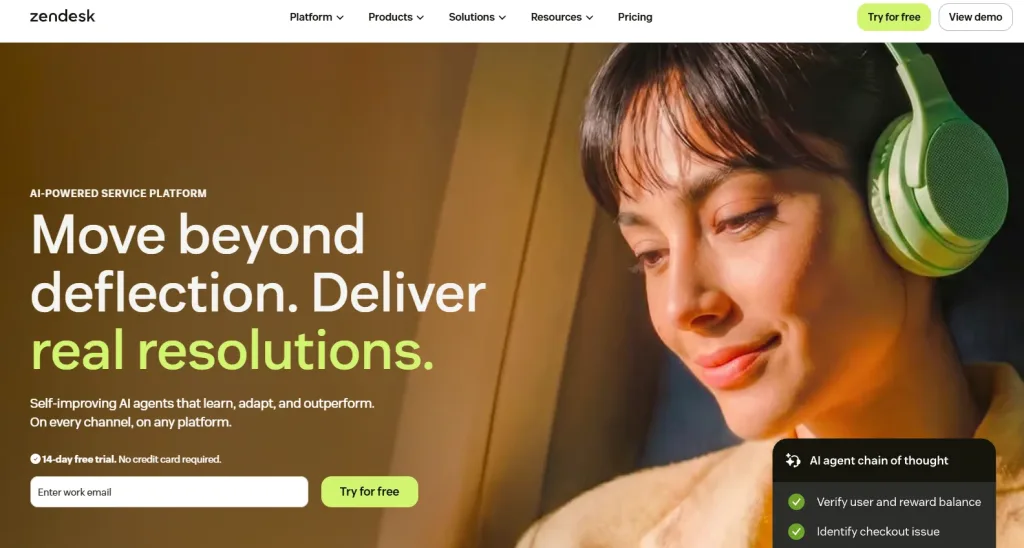
Zendesk is an AI-first service platform designed to move beyond deflection and deliver real resolutions. Its Resolution Platform utilizes autonomous AI Agents that learn via the Resolution Learning Loop. It unifies support and sales into a single omnichannel workspace with advanced proactive AI assistance.
Key Features
- AI Agents powered by a Resolution Learning Loop
- Omnichannel inbox that unifies inquiries from various channels
- A Copilot suggesting replies, summarizing long threads, and recommending the next actions based on the context of the conversation
- Agentic AI reasoning that can execute actions across connected business systems to reach a resolution
- Offers an extensive ecosystem
Why Switch to Zendesk
Businesses should switch to Zendesk for its scalability and self-improving AI ecosystem. While Front manages B2B complexity, Zendesk’s Resolution Learning Loop continuously improves the quality of automation based on every historical outcome. With a massive marketplace of 1,800+ apps, it serves as a more comprehensive Resolution Platform.
Moreover, Zendesk’s Agentic AI reasons through multi-step problems dynamically, adapting far beyond rigid scripts.
Pricing
Zendesk scales from startups to enterprises by offering tiered seat-based plans starting at $19 per agent monthly, spanning to $115 per agent per month. This is a structured pricing model combined with outcome-based AI pricing and modular add-ons. This allows businesses to expand their toolkit and manage rising conversation volumes predictably without immediate headcount increases
3. Intercom
Intercom is a helpdesk platform specifically engineered for AI functionality. At its core is Fin, a unified Customer Agent that seamlessly transitions between sales, support, and e-commerce roles. The system features natively integrated AI, outcome-based pricing, and self-improving insights for the entire customer lifecycle
Key Features
- Featuring Fin AI Agent that handles customer journeys
- Combines natural language instructions with fixed rules to handle complex queries
- Omnichannel AI Helpdesk that gathers conversations from different channels
- Includes an AI engine that automatically scores and organizes conversations
Why Switch to Intercom
Businesses should switch to Intercom for a unified AI experience and results-based billing. Intercom’s Fin acts as a single customer agent that seamlessly transitions between sales, support, and e-commerce roles without visible handoffs. This eliminates fragmentation between automation and assistance tools, making Intercom a stronger choice for businesses that want a more unified AI-led customer service experience and a pricing model tied directly to resolved conversations.
Pricing
Intercom scales through a pay-for-value model spanning from $19 per seat to $132 per seat monthly, along with $0.99 per Fin AI outcome. This outcome-based structure allows businesses to manage seasonal spikes without increasing human headcount. Costs align directly with results, ensuring value compounds as automation handles more complex inquiries.
4. Crisp
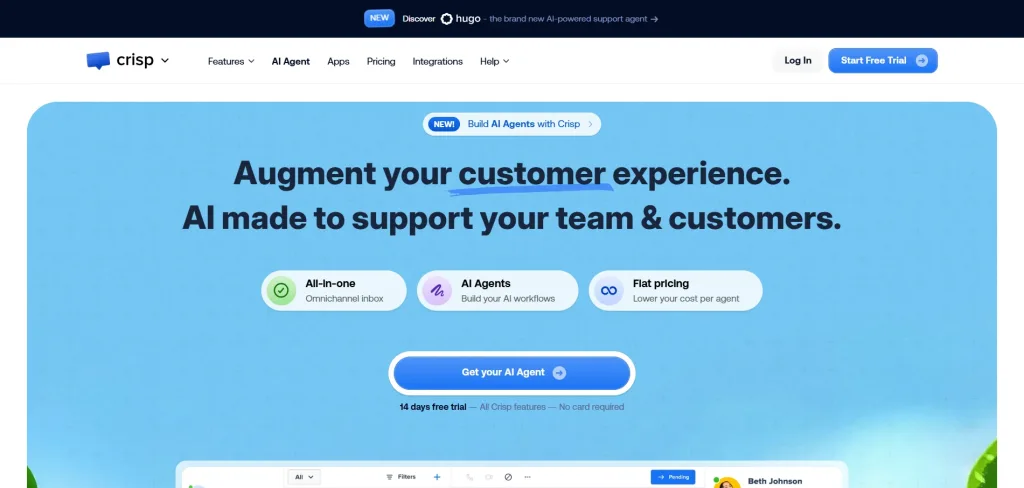
Crisp is an AI-first customer support suite offering a flat-rate workspace pricing model that ensures predictable costs. Its flagship features include the Hugo AI agent, which autonomously resolves up to 60% of tickets, and specialized tools like MagicBrowse for co-browsing. It unifies over 10 communication channels.
Key Features
- Omnichannel shared inbox that centralizes communication from channels
- Hugo AI Agent designed to resolve conversations and support tickets end-to-end
- Magic Browse that gives agents a live view of the customer’s screen to guide them through a website in real-time
- Integrated video and audio Chat for one-click audio or video calls within the chat widget
- Built-in CRM support for lead and customer data synchronization
Why Switch to Crisp
Businesses should switch to Crisp for predictable costs and superior visual engagement. Crisp uses flat-rate workspace pricing with included AI credits. Businesses also gain native high-touch tools that Front lacks, including MagicBrowse (co-browsing) and integrated video chat. Hugo AI autonomously resolves 60% of support tickets, ensuring scalability without unpredictable monthly bills.
Pricing
Crisp’s flat-rate workspace pricing, ranging from $45 to $295 monthly, ensures high scalability by decoupling costs from conversation volume. This allows businesses to manage thousands of interactions without increasing bills. Integrated fair use AI credits further support sustainable growth by preventing unpredictable per-resolution expenses.
5. Help Scout
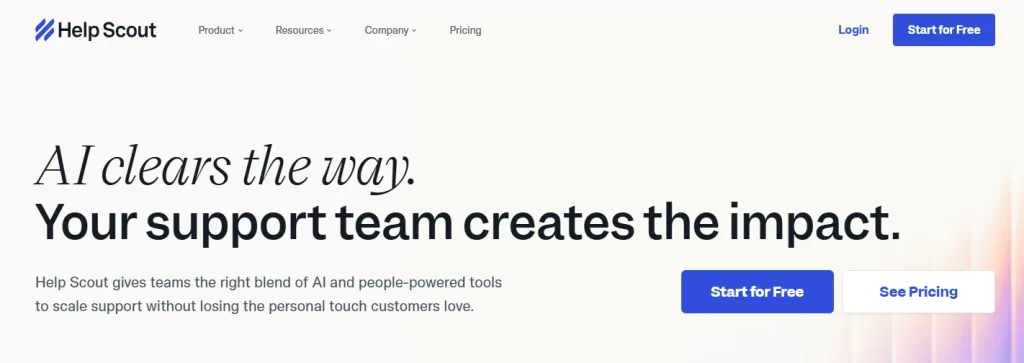
Help Scout prioritizes human-centric support with an intuitive platform designed to upgrade team members to power users within a day. Key capabilities include AI Answers, boasting a 73% resolution rate, and the Beacon embeddable support hub.
Key Features
- AI Answers that uses your knowledge base and web sources to answer common customer questions.
- Beacon, a support widget that combines help articles, live chat, and contact forms.
- Omnichannel shared inbox brings messaging channels into one inbox.
- Proactive messages that send targeted messages to selected customers or visitors.
- Docs knowledge base letting teams create branded help centers without coding.
- Docs reports showing visitor activity, search trends, and gaps in help content.
Why Switch to Help Scout
Businesses should switch to Help Scout for human-centric support and specialized compliance. Help Scout’s intuitive interface helps agents become confident, highly capable users within a very short time. Its Beacon support hub brings help articles, live chat, and contact options together in one place, while proactive messaging allows businesses to engage customers before they ask for help.
Pricing
Help Scout’s pricing ranges from $25 to $75 per user each month, making costs easy to estimate as your team grows. Higher plans include more inboxes, knowledge bases, and advanced features. AI Answers costs $0.75 per resolved conversation, helping teams handle more customer questions without immediately adding more agents.
6. LiveAgent
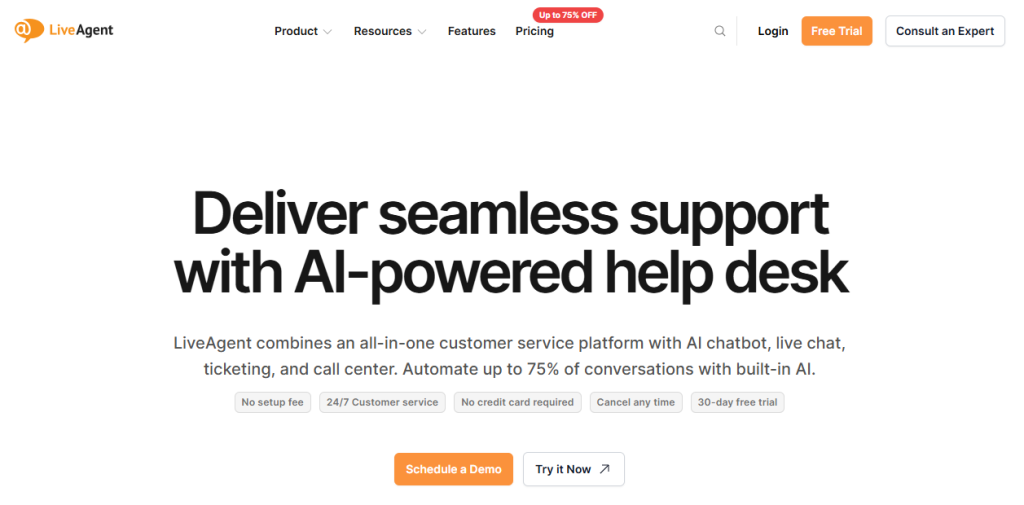
LiveAgent is a feature-rich omnichannel help desk providing over 175 tools, including a native built-in call center. Starting at $15 per agent, it offers exceptional value with native gamification and a “To Solve” priority algorithm. It centralizes communication across email, chat, phone, and social media.
Key Features
- A fully native telephony system to manage calls and call recordings for further training
- Omnichannel universal inbox centralizes communications from a variety of channels
- Includes native gamification and agent motivation features such as rewards and badges
- The To-Solve algorithm identifies urgent unresolved tickets and alerts agents based on deadlines.
- AI support suite that includes AI Autoresponder and AI Human Handover
Why Switch to LiveAgent
Businesses should switch to LiveAgent for a comprehensive, all-in-one feature set at a lower cost than Front’s. LiveAgent includes a native built-in call center; Boasting 175+ features, it offers superior value. Unique tools like the To Solve algorithm and 12-level gamification boost agent productivity, making LiveAgent a strong alternative to Front.
Pricing
LiveAgent’s pricing ranges from $10 to $46 per agent each month with discounts. Teams can add more users as their support needs grow, while higher-tier plans include advanced features such as a built-in call center. AI automation also helps manage sudden increases in customer conversations without immediately hiring more agents.
7. Tidio
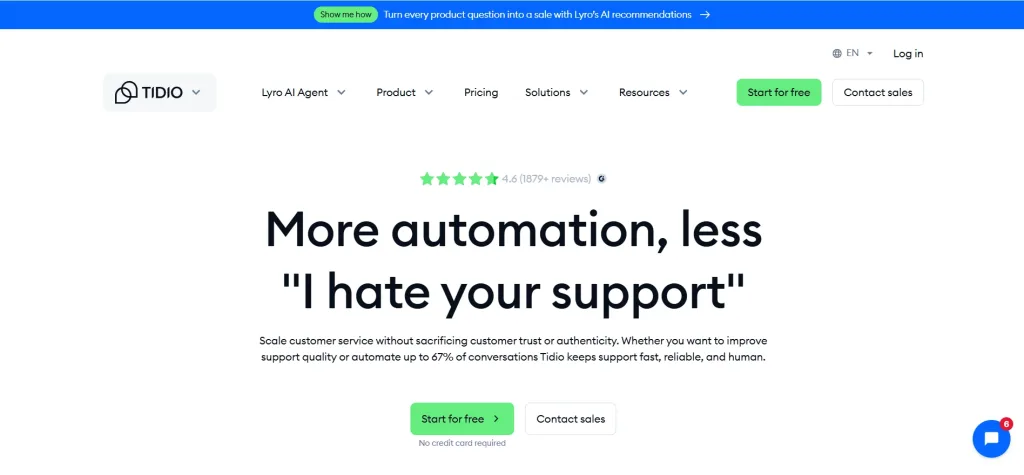
Tidio is an automation-focused support platform built for human and AI alignment. It features the Lyro AI Agent, which automates up to 67% of support inquiries using existing knowledge. Tidio offers live chat, visual flows, and native Shopify actions, enabling retailers to manage orders and engage visitors instantly
Key Features
- Lyro AI Agent answers customer questions using your existing support content.
- Shopify order management lets agents handle actions such as cancellations, refunds, and shipping address changes.
- Live typing preview shows agents what visitors are typing before they send the message.
- Visual flow builder provides drag-and-drop automation with ecommerce templates for tasks such as cart recovery and proactive engagement.
Why Switch to Tidio
Businesses should switch to Tidio for its retail speed and rapid deployment. It goes live in just five minutes, offering immediate automation through the Lyro AI agent. Tidio provides native Shopify actions, allowing agents to manage orders and preview carts directly within the chat window. Moreover, features like live typing preview further slash response times for better experiences; all this makes Tidio a strong Front alternative.
Pricing
Tidio’s plans start at $24.17 per month when billed annually. Businesses can choose bundled plans or purchase products such as Lyro AI separately. Conversation limits can be increased as usage grows, while the Plus plan offers custom user seats and discounted pricing for high-volume teams.
Most Important Factors When Choosing a Front Alternative
The following points are critical factors to consider while choosing an alternative to Front:
1. AI Automation and Capabilities
Advanced AI should move beyond simple FAQ deflection and manage complex, multi-step customer operations. Consider and evaluate how well the platform can automate customer conversations, follow workflows, collect information, and assist human agents. The best option should reduce manual work without making the customer experience feel disconnected.
2. Omnichannel Communication
A comprehensive solution must unify all communication channels, including email, live chat, SMS, WhatsApp, social media, and voice, into a single, coordinated workspace. This factor is vital for maintaining conversation continuity, ensuring that agents do not lose context if a customer switches platforms mid-interaction.
3. Availability of Native High-Touch Visual Tools
Native collaborative tools are essential for businesses that provide technical guidance and close high-value sales. Co-browsing capabilities allow agents to view a customer’s screen and guide them through website journeys in real-time. Moreover, integrated audio and video calls directly within the chat widget enable instant face-to-face consultations, reducing the need for external meeting software and speeding up resolution times.
4. Team Collaboration and Inbox Management
Your chosen platform should prioritize collaborative shared inboxes, which also include features like internal comments and shared drafts, where coworkers can mention each other to resolve issues without the customer seeing the internal discussion. Advanced routing rules and load balancing are also critical to ensure that incoming inquiries are automatically distributed to the right personnel or departments based on priority and availability.
5. Integration Depth and Marketplace Scalability
The platform should serve as a central operations center for your business’ entire tech system. Check whether the platform connects with your CRM, ecommerce system, help desk, and other business tools. It should also allow you to customize workflows, automation rules, and customer journeys according to your needs.
6. Outcome-Based and Transparent Pricing Models
Transparent billing is a key factor; look for models that clearly define costs for seats and AI conversations with no hidden per-ticket charges, setup fees, or platform fees. This allows you to scale your support operations predictably based on delivered results
Conclusion
The best Front alternative depends on your team’s priorities, customer channels, automation needs, and budget. Zendesk and Intercom are strong options for advanced service operations, while Crisp, Help Scout, LiveAgent, and Tidio serve different needs around simplicity, ticketing, ecommerce, and team collaboration.
REVE Chat is a comprehensive alternative for businesses seeking a more complete customer engagement platform. It combines Wize AI Agent, live chat, omnichannel messaging, co-browsing, audio and video calls, campaigns, and proactive engagement tools.
Start a free trial or book a demo to see how REVE Chat can support your customer journey.
Frequently Asked Questions
Businesses may look for Front alternatives when they need more specialized AI automation, broader customer engagement tools, or additional communication features beyond shared inbox management.
Consider AI and automation capabilities, supported communication channels, shared inbox and collaboration features, and how well the platform can scale with your customer service needs.
Front is strong for shared inbox collaboration. However, alternatives may be a better fit for businesses that need broader AI automation, live engagement, ecommerce support, or industry-specific workflows.
Businesses should compare scalability, automation, supported channels, integrations, pricing, and whether the platform can handle increasing conversation volumes without adding unnecessary complexity.
Build AI-powered support with Wize AI
Connect business knowledge, automate support conversations, and improve response quality without managing a complex AI stack.
Explore Wize AI Agent Rate the article

Mohaimin Talha
Lead Product Manager
Mohaimin Talha is a seasoned Product Manager, known for his ability to combine creativity with analytical thinking. His strategic vision and customer-centric approach make him a key driver of product success and business growth.
View all articles
Turn your customer conversations into action with Wize AI
It helps businesses to engage with visitors, answer every question, recommend next steps, qualify leads, and support customers across every conversation.
Learn more