

Table of Content
AI SUMMARY
Quick Answer
AI voice agents help ecommerce businesses answer product questions, track orders, manage return requests, and support sales through spoken conversations. Their effectiveness depends on reliable integrations, customer verification, clear permissions, and human handover. This blog explores practical use cases, platform selection, outbound calling considerations, and performance metrics, helping businesses evaluate whether voice automation resolves customer needs and delivers measurable value.
A customer calls because an order has not arrived. Another wants to exchange a shirt. Someone else is ready to buy but needs to check whether a product is available.
Each conversation needs a clear answer. Some also require access to an order record, a delivery update, or permission to make a change.
The AI voice agents for ecommerce can help with these requests through spoken conversations. Connected to the right systems, it can retrieve information, explain store policies, complete permitted tasks, and transfer calls when someone needs human assistance.
Its usefulness depends on what it can access and do. Answering a delivery question is different from changing a delivery address. One requires reliable information. The other also requires verification, permission, and confirmation that the change succeeded.
In this blog, you will learn where voice agents can help ecommerce businesses, what their limits are, and how to evaluate their performance.
What Is an AI Voice Agent for Ecommerce?
An AI voice agent for ecommerce is software that understands spoken requests and responds using business information. It can support conversations over the phone or through other voice interfaces. This article focuses on customer phone calls.
Some systems convert speech into text, process the request, and generate a spoken reply. Others process speech directly. Both approaches can support conversations and calls to connected business tools.
For example, a customer might ask, “Where is my order?”
After completing the store’s verification process, the agent can retrieve the order record and explain the latest available delivery information.
Depending on the setup, it may connect with:
- Order systems for purchases, cancellations, and returns.
- Product catalogues and inventory systems for specifications and stock.
- CRM systems for customer records and previous interactions.
- Payment providers for transaction and refund updates.
- Delivery platforms for shipment information.
These connections require suitable access and permissions. A platform integration does not automatically make every action available.
For a broader view of how businesses use these connections, explore these real examples of AI in ecommerce.
How AI Voice Agents Help With Ecommerce Customer Calls
The best starting point is usually a frequent request with a clear answer or a well-defined process.
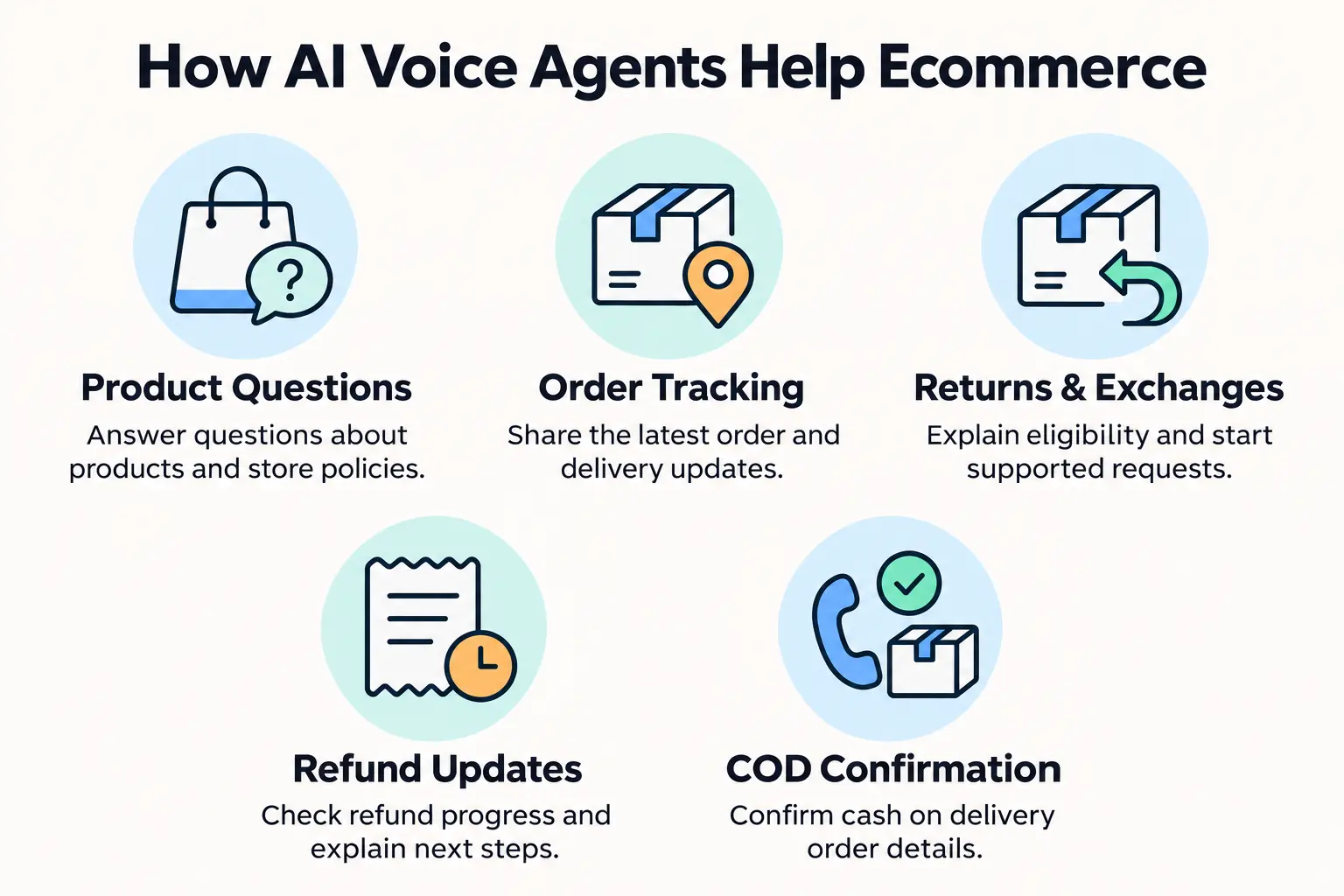
Answering Store and Product Questions
Customers call about delivery charges, payment methods, opening hours, product specifications, and return conditions. A voice agent can answer using approved store information. For a Bangladesh store, a caller might ask whether an order above ৳2,000 qualifies for free delivery.
The response should reflect any conditions, such as delivery location or excluded products. Product questions require the same care. If a caller asks whether a shoe comes in black and size 39, the agent should check the relevant variant. It should ask for clarification when the product name is unclear rather than guess.
Checking Order Status and Delivery Updates
An order update often involves several details: whether payment was received, whether the parcel has shipped, and when it is expected to arrive.
A connected voice agent can retrieve the available records and explain them in plain language.
Illustrative conversation, after customer verification:
Customer: My order was supposed to arrive today. Where is it?
AI agent: The latest carrier update shows your parcel at the local delivery hub. The current estimated delivery date is tomorrow.
Customer: Is that guaranteed?
AI agent: That is the carrier’s current estimate. I can record your concern for the support team if you need further help.
The distinction matters. The agent can report an estimate, but it cannot guarantee delivery or make an outdated carrier record more accurate.
Starting Return and Exchange Requests
Returns involve eligibility, product condition, dates, and the customer’s reason for returning an item.
A voice agent can collect these details, explain the applicable process, and create a request when the connected system permits it.
Before submission, it should confirm the item, quantity, and requested outcome. An exchange may also depend on replacement stock.
Store policies must account for applicable consumer rights. A request outside the automated process should go for review when necessary. It should not be rejected simply because the system cannot handle it.
Explaining Refund Status
Customers want to know both whether a refund has been issued and when they will receive the money.
These are different stages.
A voice agent can check whether a refund is awaiting approval, has been processed by the merchant, or has another recorded status. It can then explain the payment provider’s available processing guidance.
It should avoid promising an exact arrival date unless the connected provider supplies a reliable commitment. If a refund is overdue or disputed, the customer should have a clear route to the appropriate team.
Handling Address and Delivery Changes
A caller may want to correct an address or request another delivery date.
Whether the agent can complete that change depends on the order’s fulfilment stage, the carrier’s rules, and the available integration.
Before submitting a change, it should verify the caller and read back the important details. After submission, it should check the result.
“Your request has been submitted” and “Your delivery date has changed” describe different outcomes. The response must match what the system confirms.
Confirming Cash on Delivery Orders
For stores offering cash on delivery, outbound calls can help confirm whether customers still want their orders.
The agent can confirm the items, quantities, total amount, and delivery details, then record the response.
This may help identify unwanted orders before dispatch. It does not prove that an order is genuine or guarantee that the customer will accept the parcel.
How an AI Voice Agent Handles an Order Call
A useful voice workflow needs to manage the steps around the conversation as carefully as the conversation itself.
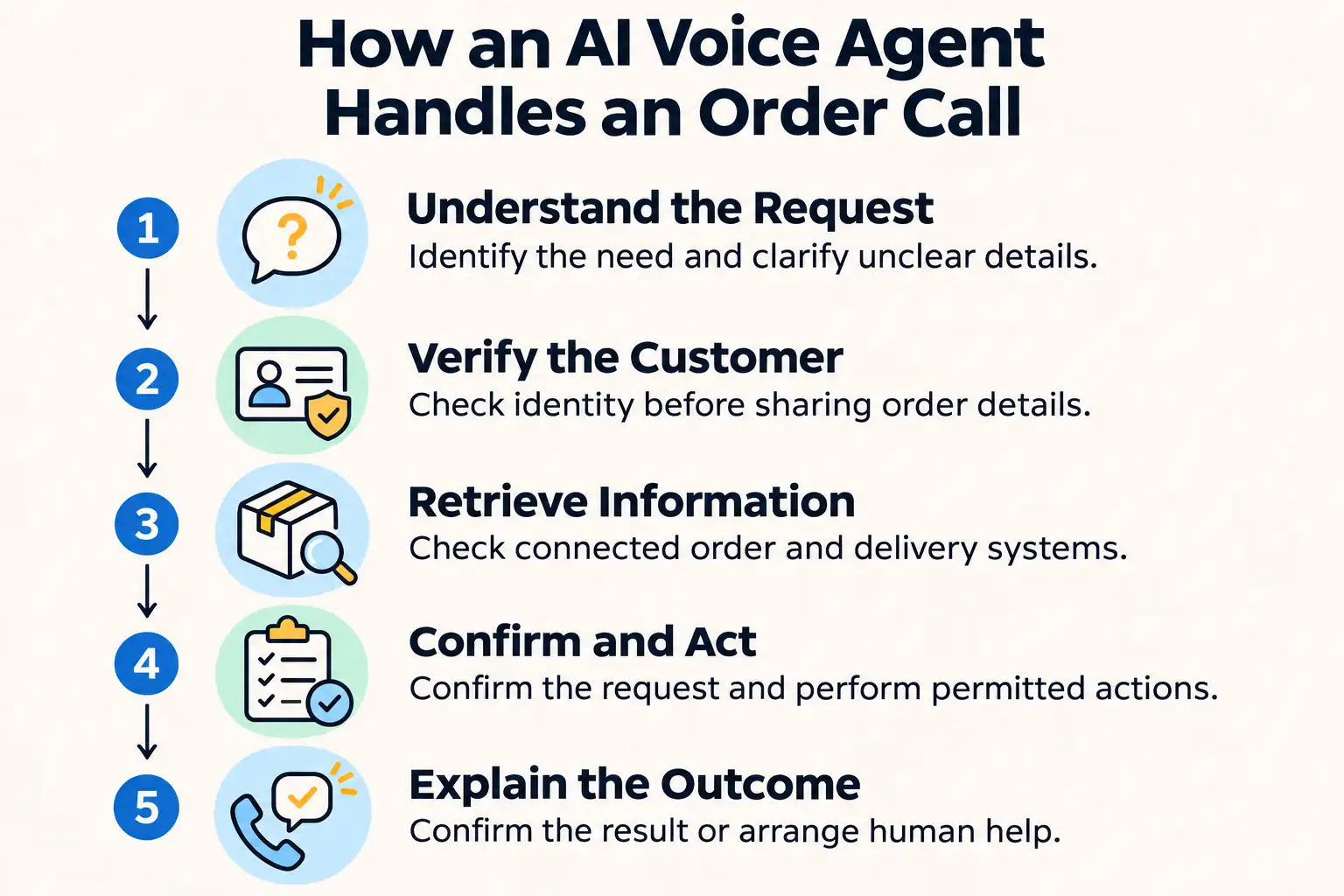
1. Understand the Request
The agent identifies what the customer needs and asks questions where necessary.
“I need to change my order” could mean changing an address, replacing an item, or cancelling the purchase. These requests require different actions.
2. Verify Access to the Order
The verification process should match the sensitivity of the information or action. An order number helps locate a record. It should not automatically be treated as proof of identity. Address changes and access to personal details may require stronger checks.
3. Retrieve the Relevant Information
The agent checks the connected systems for the information needed to answer the request. If a connection fails or a record is unavailable, it should explain the limitation. It should not fill the gap with an assumed answer.
4. Confirm and Submit Any Action
For a return, cancellation, or delivery change, the agent checks eligibility and confirms the customer’s intention. The connected system should enforce permissions and business rules. Spoken instructions alone should not bypass them.
5. Explain the Outcome
The customer should know what happened, what remains pending, and what to expect next.
If the request needs human help, the transfer should include relevant context where the system supports it. Outside support hours, the agent should offer an available alternative, such as a callback request or ticket.
For more detail on connected tools and permissions, see how to use an AI agent for ecommerce customer support.
How AI Voice Agents Can Support Ecommerce Sales
Voice assistance can help when a shopper needs an answer before deciding to buy. Its role is to resolve the question and make the next step easier.
Helping With Abandoned Carts
A shopper might leave checkout because of uncertainty about sizing, delivery costs, payment options, or returns.
Where contact is permitted, a voice agent can ask whether assistance is needed. It can answer questions and, when configured to do so, arrange for a checkout link to be sent through an appropriate channel.
A phone number collected during checkout does not automatically establish permission for a marketing call.
Abandoned cart calls can form part of wider ecommerce marketing automation strategies, alongside email reminders and other permitted communications.
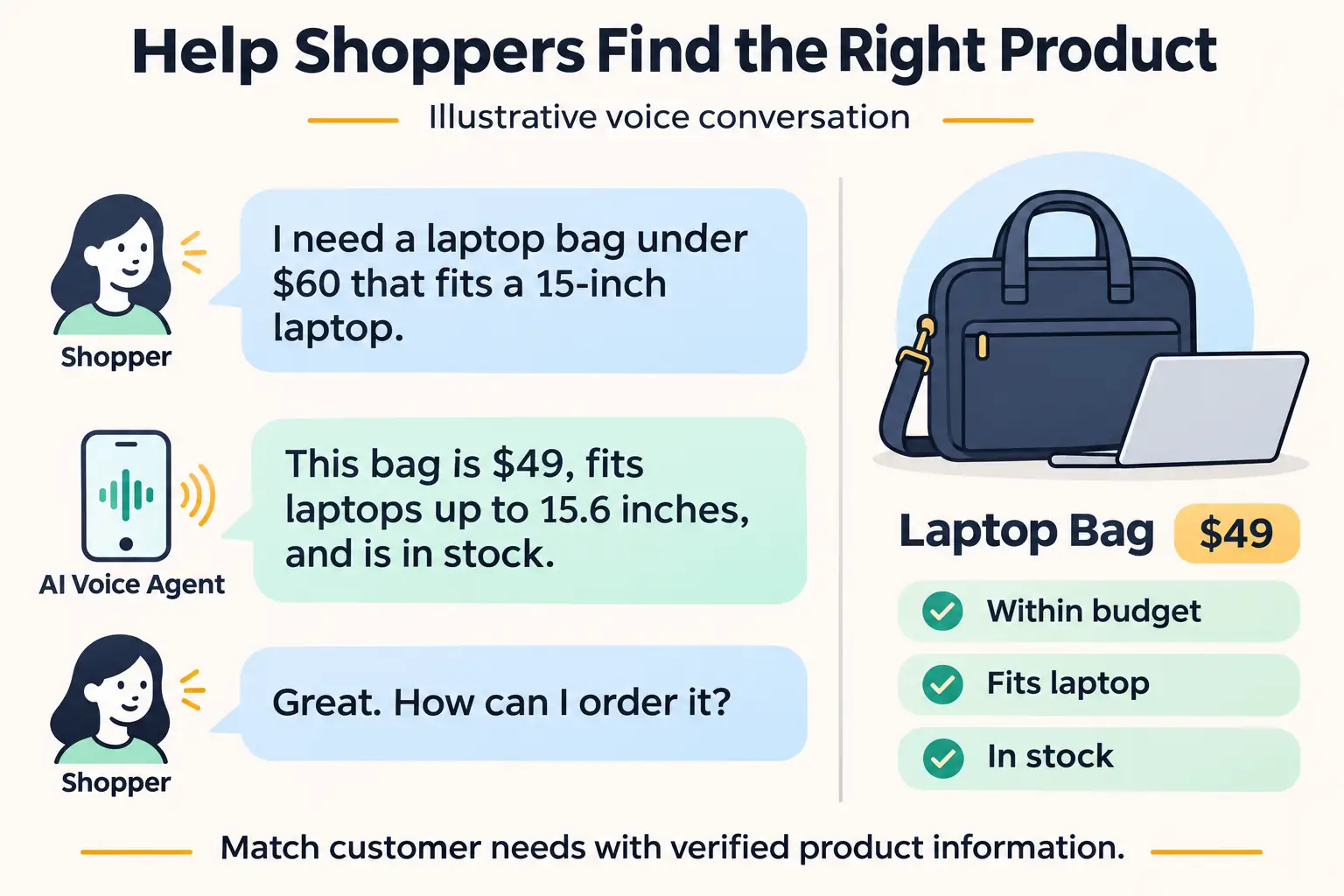
Recommending Suitable Products
A customer may describe a need instead of naming a product. For example, someone looking for an office bag might specify a budget, laptop size, and preferred material.
The agent can use those requirements to search the catalogue and explain suitable options. Recommendations should reflect verified specifications, current prices, and available stock. If the catalogue does not confirm that a bag is waterproof, the agent should not make that claim.
Following Up on Requested Information
Some shoppers ask for a callback after checking a measurement, discussing a purchase, or waiting for stock. A configured voice agent can follow up at the agreed time and continue from the available conversation record. These calls should have a clear purpose. Repeated calls without useful information can damage the customer relationship.
What Businesses Should Check Before Making Outbound Calls
Order confirmations, delivery updates, feedback requests, and sales calls may be subject to different requirements. Before launching a campaign, establish who can be contacted, why the call is permitted, and how customers can decline further calls.
Review applicable consent requirements, calling hours, contact preferences, retry limits, caller identification, and recording notices.
Requirements vary by market and call type. For example, the US Federal Communications Commission’s ruling on AI generated voices confirms that these voices fall within existing restrictions on artificial or prerecorded voice calls.
Identify the business clearly and explain the purpose of the call. Introducing the assistant as automated also helps customers understand whom they are speaking with.
Supporting Customers After a Purchase
Some of the most valuable conversations happen after delivery.
Damaged or Missing Items
A voice agent can collect the order details, identify the affected item, and record what happened. When evidence is needed, it can explain how the customer should submit photographs through an approved channel. It should not claim to assess damage from a phone conversation alone.
Inspection, disputed facts, and exceptions should go to the appropriate team.
Product Use and Care
Customers may need setup instructions, care guidance, or help finding a manual. The agent can answer from approved product documentation. Where the instructions are unclear or the issue involves safety, it should direct the customer to qualified assistance.
Feedback After Delivery
A short call can ask whether the order arrived in good condition and whether anything needs attention.
Feedback should lead to action when a customer reports a problem. Recording dissatisfaction without offering help adds little value.
These conversations can support ecommerce customer retention strategies when they are useful, appropriately timed, and respectful of contact preferences.
What Makes an AI Voice Agent Different From a Traditional IVR System?
Traditional interactive voice response systems use recorded messages and numbered menus to direct callers.
For example, a caller may hear:
“Press 1 for order information. Press 2 for returns. Press 3 to speak with an agent.”
This system can handle basic call routing. However, customers may need to move through several menu options before reaching the right department.
An AI voice agent offers a different experience.
| Traditional IVR | AI Voice Agent |
|---|---|
| Uses recorded menu options | Understands natural speech |
| Follows fixed call paths | Responds to customer intent |
| Offers limited interaction | Supports follow up questions |
| Routes calls to departments | Can retrieve information and perform approved tasks |
| Depends on menu selection | Can manage a natural conversation |
For example, a customer can say, “I want to check my order and change the delivery address.”
A traditional IVR may require the customer to select separate menu options. An AI voice agent can identify both requests and handle them through the supported workflows.
The difference between a conversational tool and an action-based system also matters here. Businesses can understand this distinction through the comparison of AI agents and chatbots.
Handling Several Requests in One Conversation
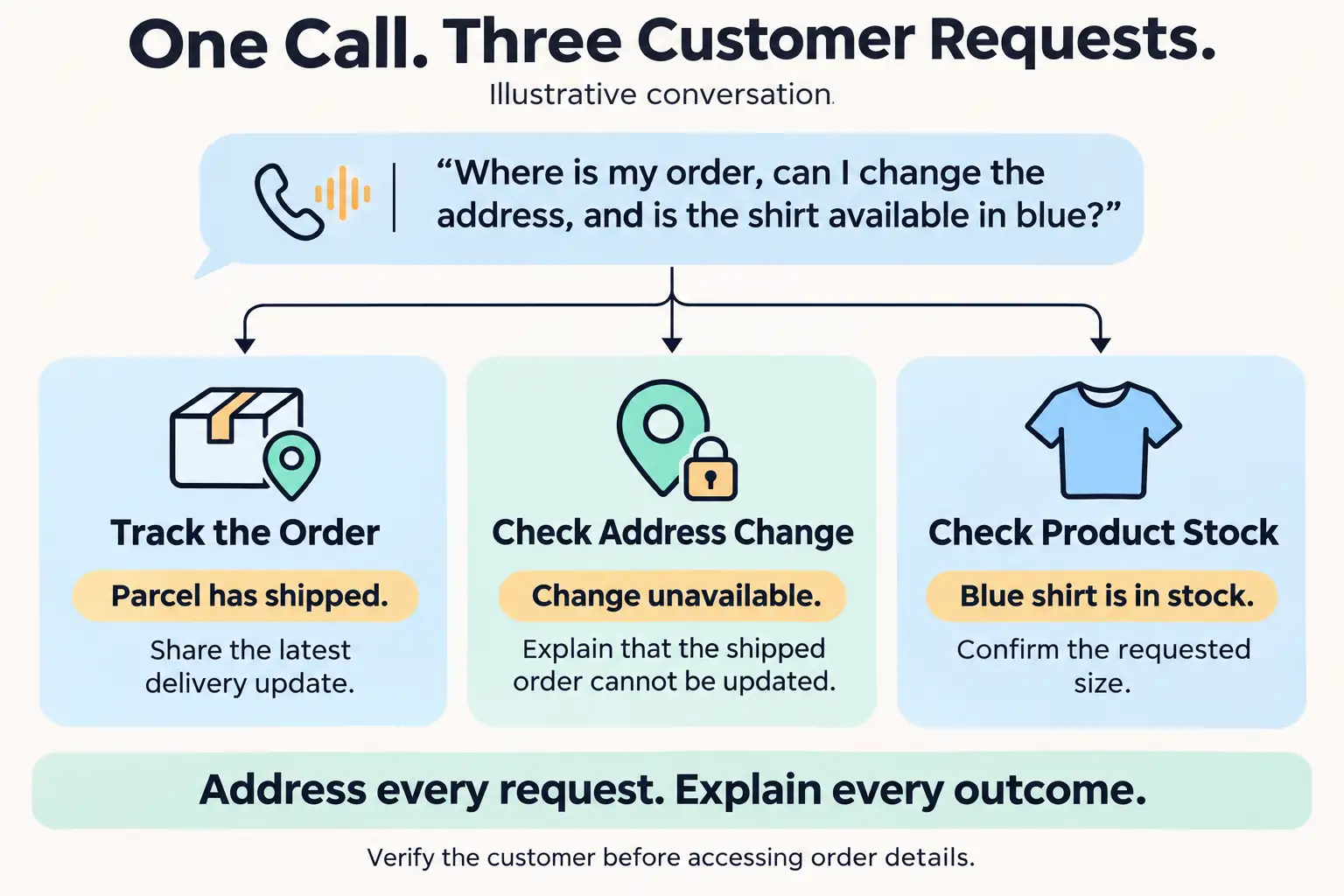
Customers often combine questions.
Consider this illustrative request:
“Where is my order? Can I change the address, and do you have the same shirt in blue?”
The agent needs to keep track of three separate needs.
It should verify access to the order, retrieve the shipment status, and check whether an address change is still allowed. It can then look up the blue shirt in the catalogue.
If the parcel has already shipped and changes are blocked, the agent should explain that limit while still answering the product question.
Before ending the call, it should summarise the outcome of each request. Understanding several questions is useful only if none are lost along the way.
What to Look for When Choosing a Platform
Ask providers to demonstrate your actual customer scenarios.
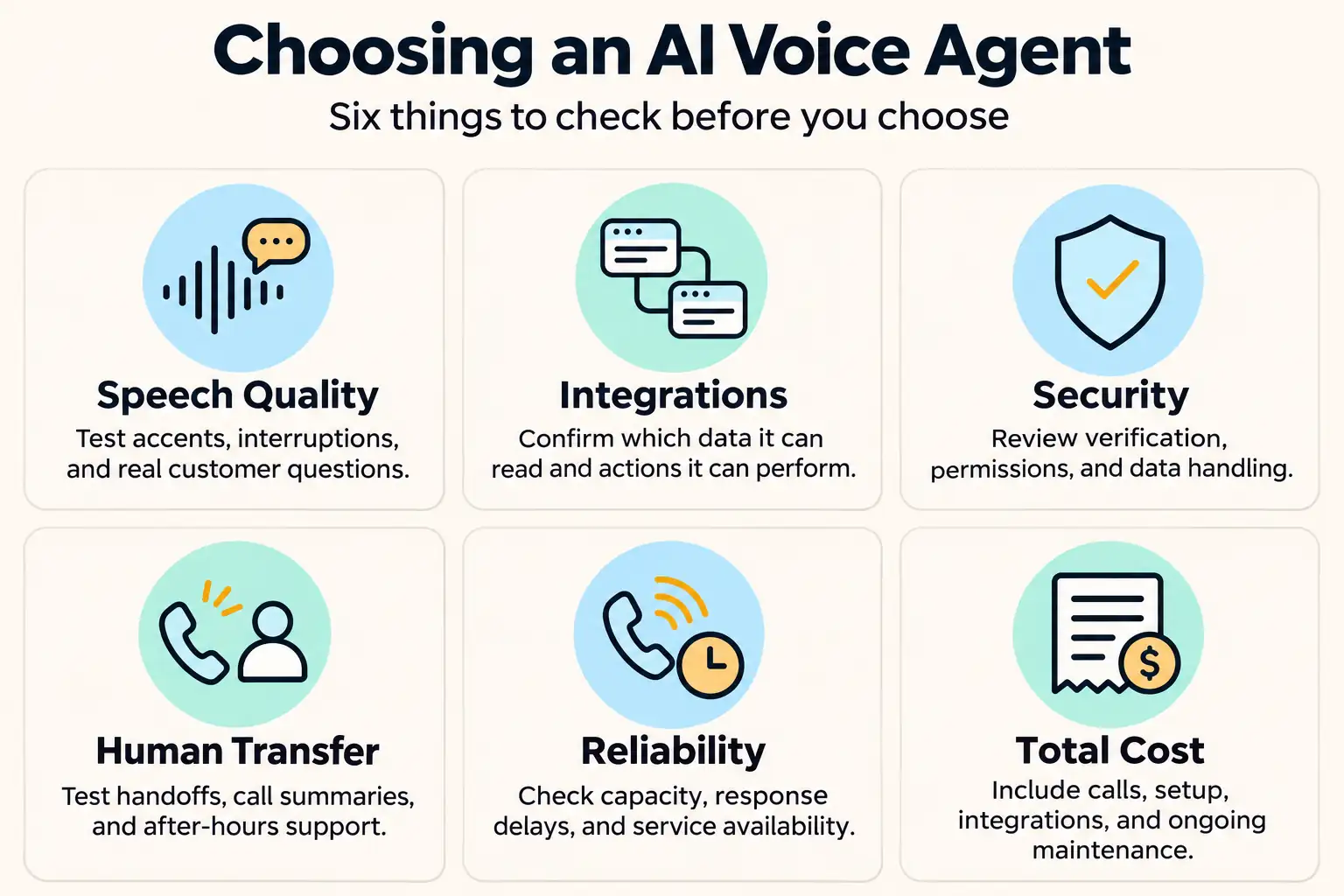
Speech Quality and Conversation Flow
Test accents, background noise, pauses, interruptions, and corrections. Include product names, addresses, and order numbers. These details can be harder to recognise than ordinary conversation.
For multilingual support, test complete calls in each required language, including any language switching your customers commonly use.
Integration Depth
Confirm which information the agent can read and which actions it can perform.Ask whether a return can be created, whether an address can be changed, and how failed requests are handled.
For Shopify, access depends on permissions and applicable protected customer data requirements. Installation alone does not establish access to every customer field or order action.
Security and Verification
Review identity checks, access controls, recording retention, sensitive data handling, and logs of changes made through connected tools.
The agent should receive only the access required for its assigned work.
Human Transfer and Availability
Test whether the call reaches the right queue and whether the receiving agent gets a useful summary. Also check what happens when nobody is available. Automated service around the clock does not mean human support is available at every hour.
Capacity, Reliability, and Cost
Check supported phone numbers, countries, simultaneous call limits, response delays, and service availability. Compare the full cost, including telephony, usage, integrations, setup, and ongoing maintenance.
When Should a Call Go to a Human?
Transfer should be available when the customer asks for it.
Other reasons include repeated misunderstanding, failed verification, unavailable systems, disputed payments, policy exceptions, and requests requiring investigation or approval.
The agent should explain why further help is needed and what will happen next.
A transfer is not necessarily a failure. Passing a sensitive or complex request to the right person can be the correct outcome.
What Ecommerce Businesses Can Learn From Voice Conversations
Calls can reveal information missing from product pages and problems in store operations.
Repeated sizing questions may suggest an unclear size chart. Refund enquiries may expose confusing status messages. Delivery complaints may point to a carrier issue in a particular area.
Finding these patterns requires analysis. Staff can review call records, or suitable reporting tools can group topics for further investigation.
Check a sample of automated classifications before relying on them. A customer asking about a return policy has not necessarily requested a return.
Access to recordings and transcripts should be limited, with retention and use consistent with applicable requirements and the business’s stated policies.
How to Measure Performance
Call volume shows activity. It does not establish whether customers received useful help.
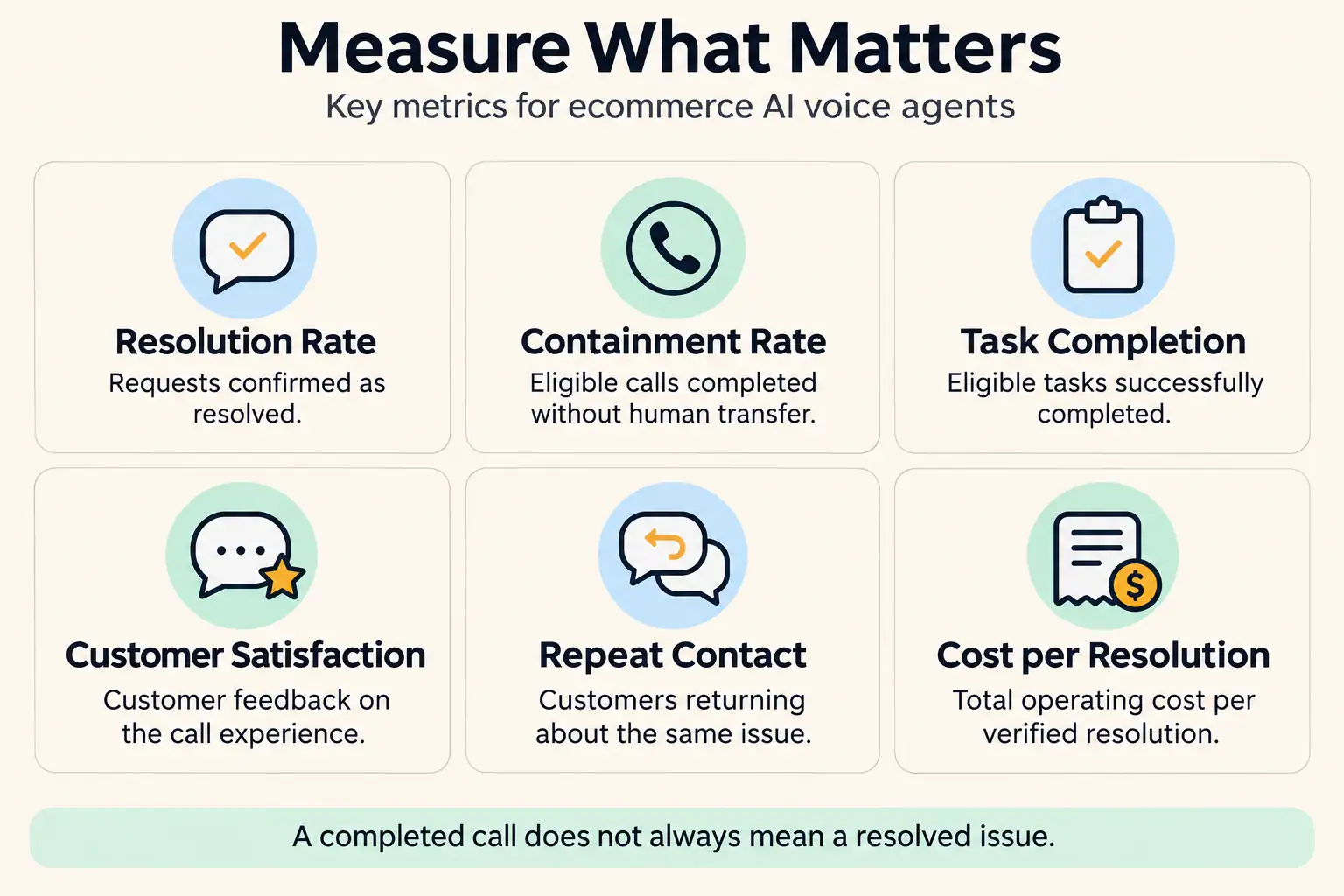
Verified Resolution Rate
Measure the share of assessed requests confirmed as resolved. State how resolution is checked, such as through record reviews, customer feedback, or a defined period for monitoring repeat contact.
Containment Rate
Measure the share of eligible calls completed without human transfer. Report this separately from resolution. A customer may end a call without getting an answer.
Task Completion Rate
Divide successfully completed eligible tasks by eligible tasks attempted. A submitted request should count as complete only when it reaches the outcome you have defined.
Customer Satisfaction and Repeat Contact
Collect feedback and report how many customers responded. Track customers contacting the store again about the same issue within a stated period. Repeated calls may reveal incomplete answers.
Errors and Response Delays
Review incorrect answers, failed actions, missed requests, and long pauses. Use these findings to improve the knowledge base, integrations, and call flow.
Sales and Cost
For sales calls, define the attribution period and account for cancellations and returns. Revenue following a call does not prove the call caused the purchase. Where practical, compare results with a similar group that did not receive calls.
Track total operating cost alongside verified outcomes to understand whether the service is worthwhile.
Explore AI Voice Support With REVE Chat
Start with the calls your team receives most often and the actions customers need.
REVE Chat’s voice offering is worth evaluating through those real scenarios. Ask to see how it retrieves information, handles an unclear request, confirms a permitted action, and passes a conversation to your team.
For ecommerce workflows, confirm the required store connections and voice capabilities before deciding what to automate.
Explore REVE Chat AI Voice Bot and book a demonstration based on your customer calls.
Frequently Asked Questions
Yes, when it has authorised access to the relevant order and delivery systems. It can report the latest available information after appropriate verification.
It can explain policies, check eligibility, collect details, and submit supported requests. Refund updates and refund issuance are separate capabilities. Approval may still require a person.
Some providers support Shopify connections. Confirm the available permissions, customer data access, supported actions, and any additional setup.
Many platforms support simultaneous calls. Capacity depends on the provider, telephony setup, account limits, and connected systems.
Yes, subject to service availability. Requests requiring staff may need to wait for a callback or ticket response.
Build AI-powered support with Wize AI
Connect business knowledge, automate support conversations, and improve response quality without managing a complex AI stack.
Explore Wize AI Agent Rate the article

Tabassum Kabir
Sr. Content Writer
Tabassum Kabir is a Senior Content Writer with 5+ years of experience. She specializes in SaaS, AI, customer service, and ecommerce. She writes about technology, business, and digital trends. Her work is simple, clear, and useful. She aims to give readers information they can understand and use.
View all articles
Handle More Customer Calls With REVE Chat’s AI Voice Bot
Answer questions, automate routine tasks, and connect customers with your team when they need help.
Try Our Voice Bot Today