




Table of Content
AI SUMMARY
Quick Answer
Live chat helps businesses provide quick and convenient customer support while visitors are on their websites. It can improve customer satisfaction, support sales, generate leads, reduce support workload, and provide useful customer insights. This blog covers 15 key live chat benefits, its limitations, ways to improve results, important metrics to track, and how REVE Chat helps businesses manage customer conversations. It also explains how to combine live chat, automation, and AI for better customer support.
A customer visiting your website may have a simple question about a product, price, delivery time, booking, or service. If they cannot find the answer quickly, they may leave the website and look somewhere else.
Live chat gives customers a direct way to ask questions while they are still on your website. For businesses, it can support faster customer service, better conversations, lead generation, sales, and more efficient support operations.
The live chat benefits depend on how it is used. A chat box alone will not improve customer service. Businesses need the right people, processes, response times, and tools behind it.
Here are 15 benefits of live chat for businesses and customers, along with the situations where each benefit matters most.
What Is Live Chat?
Live chat is a communication channel that lets customers or website visitors send messages to a business in real time. A conversation can involve a human agent, an automated system, or both.
With live chat, customers do not have to leave a message and wait for a later response. They can communicate through text while continuing to browse the website, without having to make a phone call.
Live chat can be reactive, where a customer starts the conversation, or proactive, where a business invites a visitor to chat based on their activity.
Modern live chat systems can also connect conversations with customer information, chat history, routing, automation, analytics, and other support tools.
KEY TAKEAWAY
Live Chat Benefits at a Glance
Live chat helps businesses answer questions quickly, improve customer support, generate leads, and support sales. With the right setup, it makes communication easier for both customers and support teams.
Top 15 Live Chat Benefits: You Must Know
The main benefits of live chat include faster responses, more convenient support, personalized conversations, higher customer satisfaction, better conversion opportunities, improved agent productivity, lower support workload, lead generation, and useful customer insights.
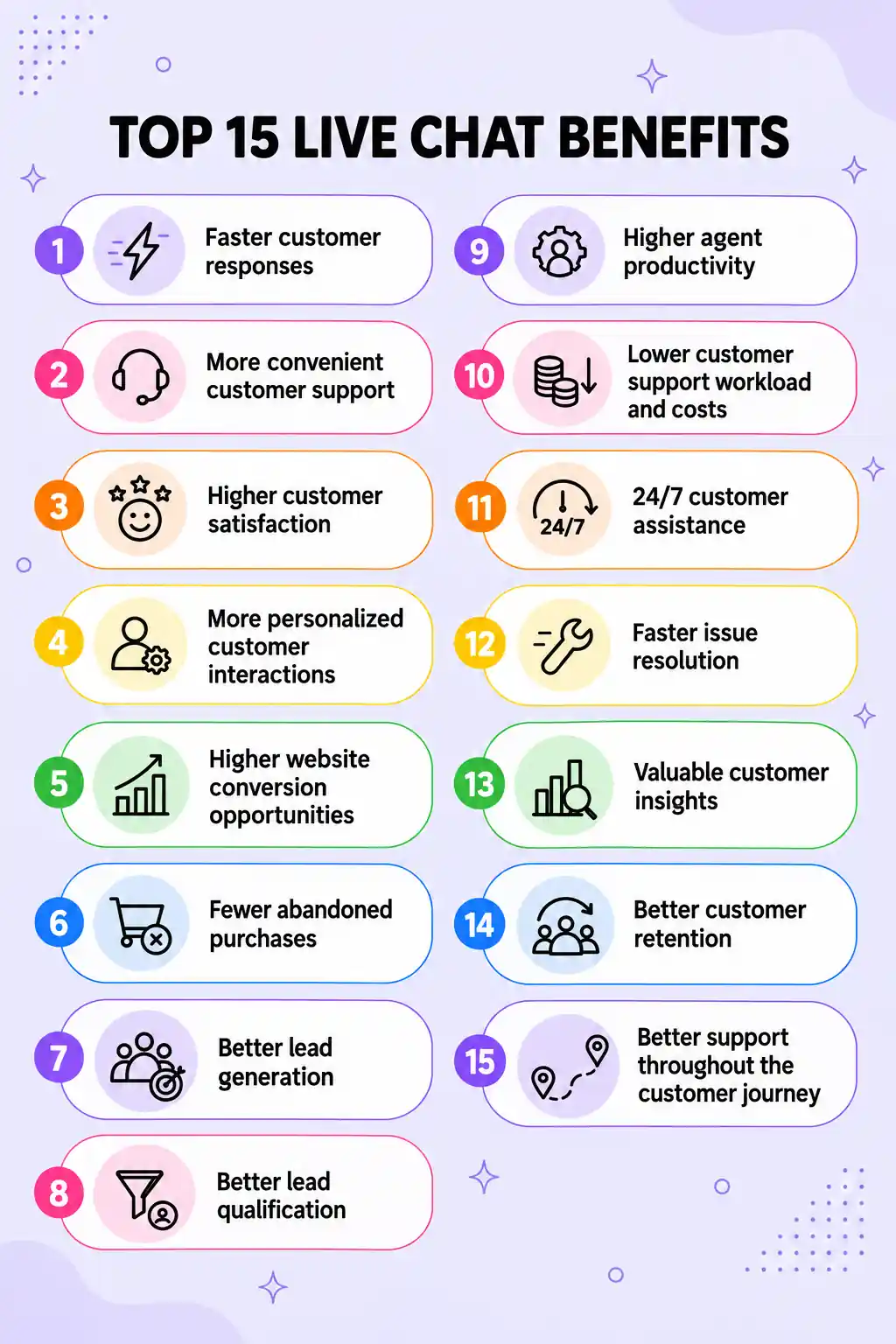
The following 15 live chat benefits explain how these outcomes happen in practice.
1. Faster Customer Responses
One of the clearest benefits of live chat is speed.
Customers can ask a question and receive an answer during the same website visit. They do not have to search for an email address, submit a support form, or wait for a callback.
Speed matters when a customer needs a simple answer. A visitor comparing two products may only need to know which one includes a particular feature. Someone checking out may want to confirm shipping information. A SaaS buyer may need clarification about a plan.
LiveChat’s customer service data, last updated in 2024, reported an average first response time of 35 seconds across its dataset of businesses. This is a benchmark from LiveChat’s own data, not a universal response time that every business should expect.
The real goal is to set a response time that matches your customers’ needs and your team’s capacity.
2. More Convenient Customer Support
Customers do not always want to make a phone call or write an email for a small question.
Live chat gives them another option. They can type their question, continue browsing, share information, and ask follow-up questions in the same conversation.
This can reduce the effort involved in getting help.
For example, a customer looking at a pair of shoes may want to ask about sizing. A customer buying software may want to confirm whether a particular integration is available. A visitor booking a service may want to know what is included.
Instead of leaving the website to find an answer, they can ask while they are already on the relevant page.
Convenience does not mean live chat should replace every other support channel. Some customers still prefer phone, email, or messaging apps. Offering several appropriate channels gives customers more control over how they communicate.
3. Higher Customer Satisfaction
Fast support can contribute to a better customer experience, especially when customers can get a useful answer without repeating their problem several times.
Research published in the Journal of Business Research in 2025 examined online chat interactions across six experiments. The researchers found that online dialogical interactions can increase customer satisfaction, with the effect depending on factors such as the customer’s motivation and the type of interaction.
LiveChat’s own 2024 data reported an average customer satisfaction score of 64.2% across rated chats in its dataset. Because this comes from one provider’s customer base, it should be treated as a benchmark rather than a universal industry average.
This also shows why simply installing live chat is not enough. A customer who receives a fast but incomplete answer may still leave unhappy.
Good live chat depends on speed, accuracy, tone, context, and resolution.
4. More Personalized Customer Interactions
A live chat conversation can be more personal than a generic help page because customers can explain their specific situation.
An agent can ask follow-up questions and adjust the response based on what the customer says.
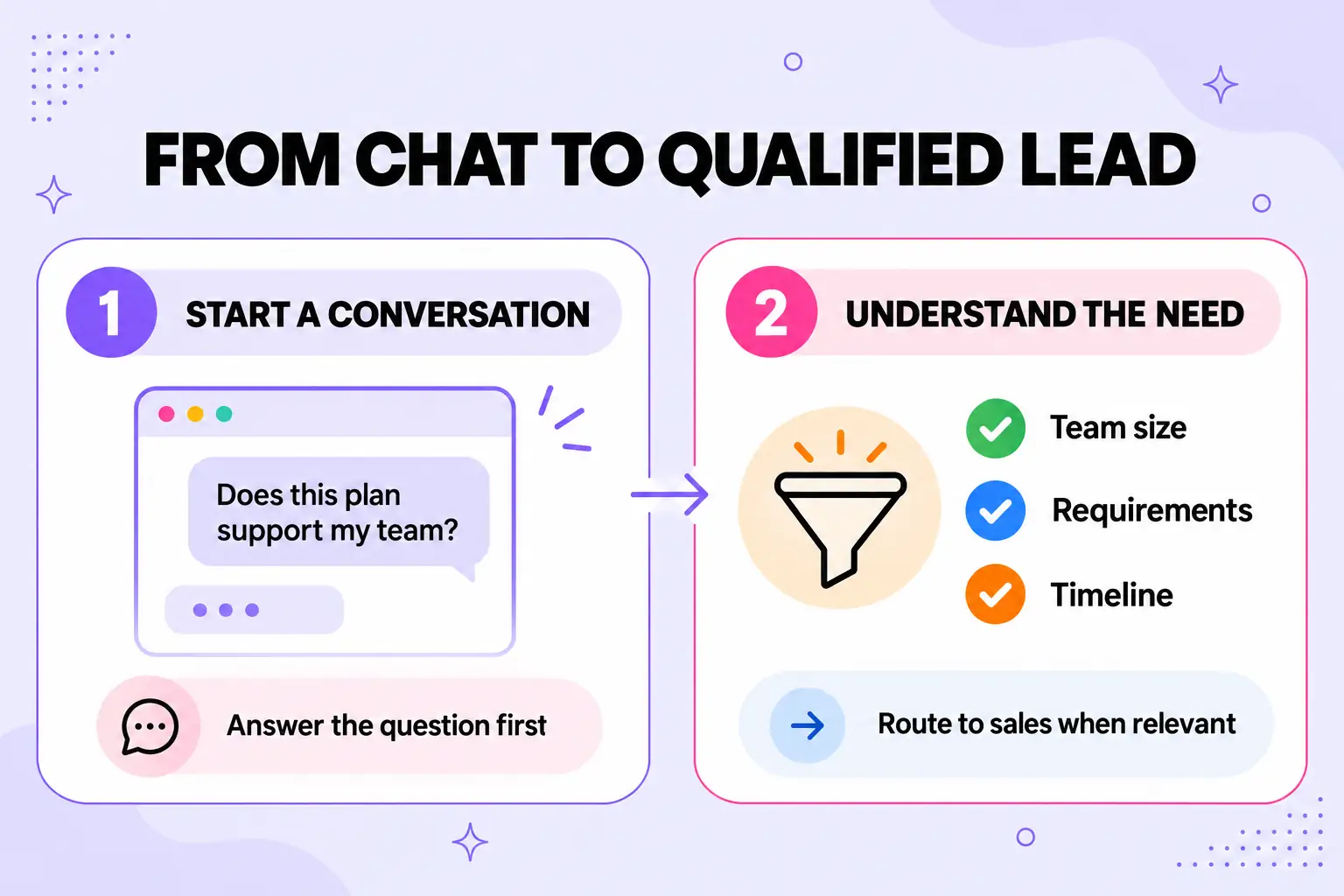
For example, instead of sending every visitor to the same pricing page, an agent can ask about the customer’s team size and explain which plan fits their requirements.
Context can make these conversations even more useful. Information such as previous conversations, the page a visitor is viewing, and relevant customer details can help an agent understand the situation before responding.
This reduces the need for customers to explain the same information repeatedly.
5. Higher Website Conversion Opportunities
Live chat can help remove questions that stop visitors from taking the next step.
Imagine a visitor who is interested in a software product but cannot tell which plan includes a feature they need. They may leave the website to look for the answer elsewhere.
With live chat, the business has an opportunity to answer that question while the visitor is still considering the purchase.
The same applies to ecommerce, travel, education, financial services, real estate, and professional services.
So, the fact is live chat does not automatically increase conversions. The result depends on factors such as product fit, pricing, website quality, response time, agent knowledge, and the quality of the conversation.
Live chat creates an opportunity to remove purchase friction. It does not guarantee a sale.
6. Fewer Abandoned Purchases
Customers often hesitate during checkout because they have unanswered questions.
They may want to know:
- When will my order arrive?
- What is the return policy?
- Are there additional delivery charges?
- Is this product compatible with my device?
- Can I change my order later?
- Which payment methods are available?
A live chat agent can answer these questions while the customer is still on the checkout or product page.
Proactive chat can also be used when a visitor spends a long time on a product or pricing page. Research published by Zendesk has discussed proactive chat as a way to engage visitors who may need help before they leave, while also warning that proactive chat can increase support workload.
The lesson is simple: proactive messages should be used at useful moments rather than shown to every visitor.
7. Better Lead Generation
Live chat can work as a sales channel as well as a support channel.
A visitor who opens a conversation may already have an interest in your product or service. The conversation can help the business understand what they need and collect relevant information.
For example, a software company can ask about:
- Company size
- Current tools
- Main requirements
- Number of users
- Expected timeline
A service business may ask about the type of service required, location, budget range, and preferred appointment time.
This allows sales teams to identify potential opportunities earlier.
The key is to keep the conversation useful. Asking for too much information before helping the visitor can make the experience feel like a form rather than a conversation.
8. Better Lead Qualification
Generating a lead is only the first step. Businesses also need to understand which leads require immediate attention.
Live chat can help qualify visitors based on the information they provide.
A visitor asking about enterprise pricing, integrations, security requirements, or a large deployment may need to speak with a sales representative.
Another visitor may only need a basic product answer and can continue without sales involvement.
Routing conversations based on intent can help send the right conversations to the right team.
This is especially useful for businesses with separate sales, support, billing, and technical teams.
9. Higher Agent Productivity
Live chat can help support agents handle several conversations instead of relying entirely on one conversation at a time.
Tools such as saved replies, conversation history, routing, internal notes, knowledge bases, and AI assistance can reduce repetitive work.
LiveChat’s 2024 customer service report recorded an average of 84.1 chats handled per agent per day across its dataset. Again, this is a benchmark from its own data and should not be treated as a target for every support team.
Agent productivity should be measured alongside customer outcomes.
Handling a large number of conversations is not useful if customers receive incomplete answers or need to contact support again.
A better approach is to look at productivity together with resolution rate, customer satisfaction, response time, and workload.
10. Lower Customer Support Workload and Costs
Live chat can reduce support workload when it is properly organized.
An agent may handle several simple conversations, while automation can answer routine questions or collect information before a human agent joins.
Routing can send a billing question directly to the billing team. A technical question can go to technical support. A sales question can reach a sales representative.
This can reduce unnecessary transfers and repeated explanations.
However, live chat does not automatically reduce costs. Poor staffing, slow responses, complicated workflows, and high conversation volumes can create additional work.
The financial benefit comes from using the channel efficiently, not from having a chat button on the website.
11. 24/7 Customer Assistance
Customers may visit a website outside normal business hours.
A business that only provides human live chat during office hours cannot provide continuous human support. However, automation and AI can handle suitable questions when agents are unavailable.
For example, an automated system can help with common questions about pricing, product information, business hours, order status, or basic policies.
More complex conversations can be transferred to a human when an agent becomes available.
This creates an important distinction between 24/7 automated assistance and 24/7 human support. Businesses should be clear about which one they provide.
12. Faster Issue Resolution
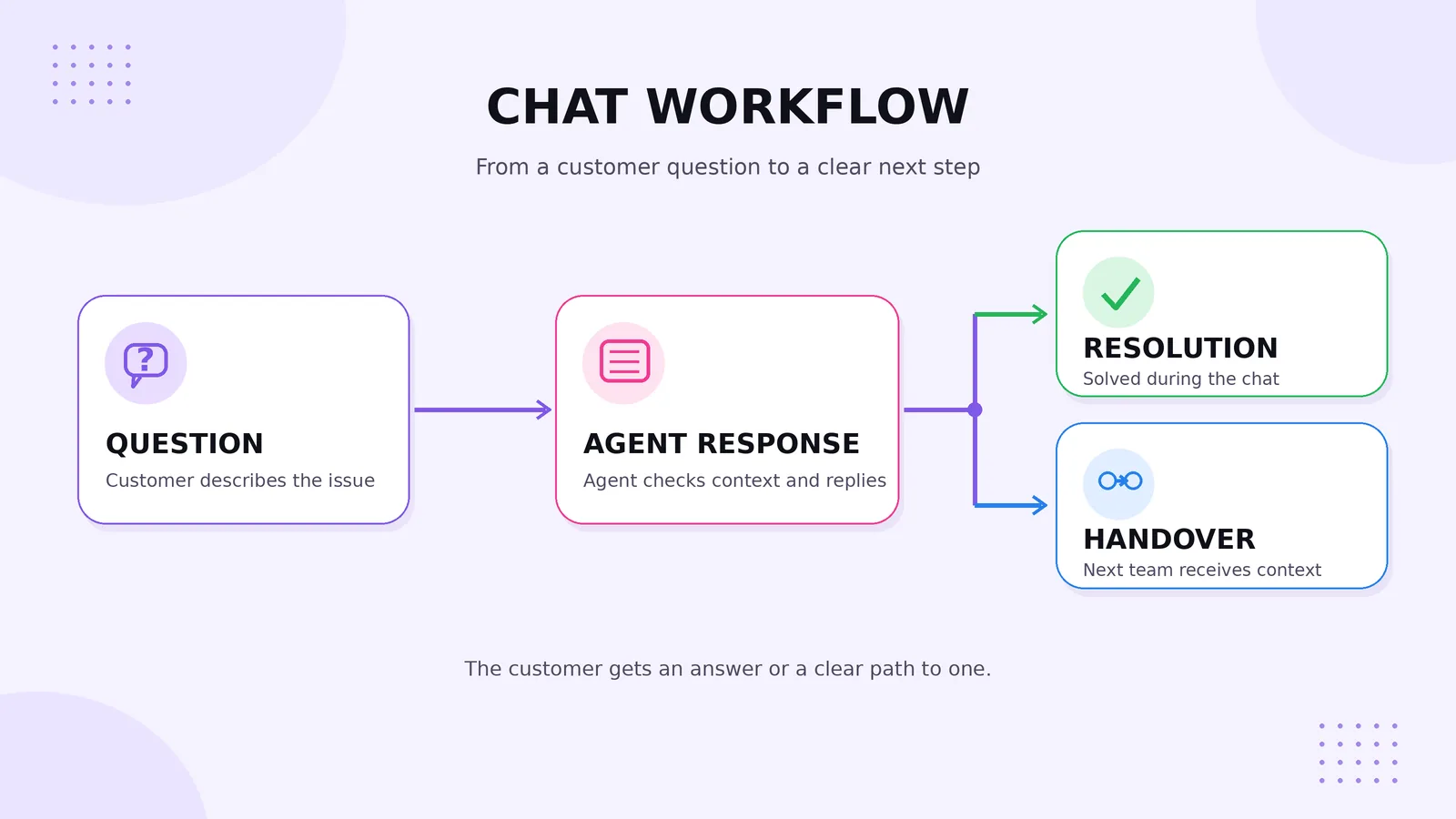
A live conversation can help agents understand and resolve some problems during the same interaction.
Customers can explain the problem, answer follow up questions, share screenshots or links, and receive instructions without waiting for several rounds of email.
For more complicated issues, live chat can also become the starting point for a ticket or another support process.
The quality of the resolution depends on the agent’s access to the right information.
If agents cannot access customer details, previous conversations, product information, or relevant internal resources, the customer may still need to repeat the issue.
That is why chat history and access to relevant information matter as much as the chat channel itself.
13. Valuable Customer Insights
Customer conversations can reveal problems that website analytics alone may not show.
If customers repeatedly ask:
“Where can I find the pricing?”
the pricing page may need to be clearer.
If customers regularly ask whether a product works with a particular tool, that information may need to be added to the product page.
If customers repeatedly ask about delivery times, the shipping information may not be visible enough.
Chat conversations can therefore become a source of customer research.
Support teams can review conversations to identify common questions, objections, product issues, and gaps in website content.
These insights can then inform changes to the website, product, sales process, and support documentation.
14. Better Customer Retention
Good support does not end when a customer completes a purchase.
Existing customers may need help with setup, billing, account questions, troubleshooting, upgrades, or product usage.
Live chat gives them a convenient way to get that help.
When customers can resolve problems without unnecessary effort, the business has a better chance of maintaining a positive relationship.
However, retention depends on the whole customer experience. Live chat cannot compensate for a poor product, repeated service failures, or unresolved problems.
Its role is to make support easier when customers need it.
15. Better Support Throughout the Customer Journey
Live chat can support customers at several stages rather than being limited to technical support.
A visitor may use it to:
- Learn about a product
- Compare plans
- Ask about pricing
- Book an appointment
- Complete a purchase
- Check an order
- Solve a technical problem
- Request a refund
- Understand a policy
- Upgrade a service
This makes live chat useful across sales, onboarding, support, and retention.
The exact role depends on the business. A SaaS company may use chat heavily for product questions and onboarding, while an ecommerce company may focus on product selection, delivery, and returns.
Live Chat Benefits by Business Type
According to business type, live chat benefits change.
| Business type | Common live chat uses |
|---|---|
| Ecommerce | Product questions, delivery, returns, checkout support |
| SaaS | Product questions, sales, onboarding, technical support |
| Education | Course questions, enrollment, admissions |
| Financial services | General service questions and account guidance |
| Healthcare | Appointment and general service information |
| Travel | Booking, availability, itinerary questions |
| Real estate | Property inquiries and lead qualification |
| Professional services | Consultation requests and lead generation |
The best use of live chat depends on where customers need help most.
What Are the Disadvantages of Live Chat?
Live chat can improve support, but businesses should understand its limits before adding it to every customer interaction.
- Needs enough staff: Agents must be available to respond on time.
- Slow replies can frustrate: Long waits may lead to a poor customer experience.
- Some issues need other channels: Complex problems may require calls, tickets, or specialist support.
- Too much automation hurts: Customers need an easy way to reach a human.
- Proactive chat can annoy: Poorly timed messages may interrupt visitors.
- Requires data protection: Chat records and customer data need proper security controls.
When Should a Business Use Live Chat?
Live chat can be particularly useful when customers frequently ask questions before buying or need help while using a website.
Consider adding live chat if:
- Visitors frequently ask the same questions
- Your website generates sales leads
- Customers need help choosing products or plans
- Checkout questions are causing hesitation
- Support receives many simple requests
- Customers need help with onboarding
- Your team works across different departments
- You want to offer automated assistance outside business hours
Before launching it, decide who will answer conversations, what response time customers should expect, which questions can be automated, and when conversations should be transferred to another team.
Live Chat vs Chatbots: Top 6 Differences
Live chat connects customers with human agents, while chatbots handle routine questions through automated responses.
| Area of Difference | Live Chat | Chatbot |
|---|---|---|
| Who responds | Human support agent | Automated bot |
| Response time | Depends on agent availability | Provides instant responses |
| Best for | Complex or sensitive questions | Simple and routine questions |
| Conversation style | Human-led and flexible | Predefined or automated |
| Availability | Usually during support hours | Can work 24/7 |
| Main purpose | Personal support and problem-solving | Automating common customer requests |
How to Get More From Live Chat
Adding live chat is just the beginning. To get better results:
- Set clear expectations: Tell customers when agents are available.
- Train your team: Give agents product knowledge and clear escalation rules.
- Use chat history: Help agents understand previous conversations quickly.
- Route chats: Send each request to the right team.
- Automate simple tasks: Handle routine questions while keeping human support available.
- Review chats: Find common questions and unresolved issues.
- Track performance: Monitor response time, resolution, satisfaction, and chat volume.
How Do You Measure the Live Chat Benefits?
The right metrics depend on your goal.
| Metrics | What it tells you |
|---|---|
| First response time | How quickly customers receive an initial response |
| Resolution time | How long it takes to solve an issue |
| First contact resolution | How often an issue is resolved in the first conversation |
| Customer satisfaction | How customers rate the interaction |
| Chat abandonment rate | How often visitors leave before receiving help |
| Chat to lead rate | How often conversations produce leads |
| Conversion rate | Whether chat assisted purchases or signups |
| Transfer rate | How often conversations move to another agent or team |
| Recontact rate | How often customers return about the same issue |
| Agent workload | How much conversation volume each agent handles |
Looking at one metric alone can give a misleading picture.
For example, a team may reduce first response time while resolution quality falls. Another team may handle fewer conversations but solve more issues during the first interaction.
Measure speed, quality, customer satisfaction, and business outcomes together.
How REVE Chat Supports Live Customer Conversations
REVE Chat Live Chat combines human conversations with tools for managing customer conversations and support tasks.
Depending on setup, its live chat tools include an omnichannel inbox, customer details, chat history, visitor activity, smart routing, ticket creation, appointment scheduling, and reports.
Separately, AI Copilot for Live Chat can assist human agents with knowledge-based answers and suggested replies. Other available Copilot capabilities include conversation summaries, translation, and sentiment analysis, according to REVE Chat’s feature documentation.
For automated conversations, Wize AI Agent can use approved business information, follow configured workflows, collect relevant details, and hand conversations to human agents when needed. These AI features depend on the product setup; they are not inherent benefits of a human live chat channel.
Live Chat in Practice: Commercial Bank of Kuwait
Commercial Bank of Kuwait uses REVE Chat’s live chat, forms, saved replies, and internal notes to handle questions about cards, loans, and account access.
Agents can answer common questions faster and pass complex cases to another team with the conversation context intact.
End Note
Finally, live chat gives customers a quick way to get help while they are browsing a website. They can ask questions, solve issues, or get guidance without leaving the page. For businesses, these conversations can help with sales, customer support, and understanding what customers need.
But simply adding live chat does not guarantee results. The live chat benefits come from quick replies, helpful agents, proper routing, useful automation, and timely follow-up. A poor chat experience can leave customers frustrated instead of helping them.
Businesses can get more from live chat by combining human support with automation and AI. Start by finding common customer questions, choosing the right support setup, and tracking results to see what actually helps customers.
Frequently Asked Questions
Yes, live chat is often better than calling for quick, real-time support. It allows multitasking, shorter wait times, and instant access without hold music.
Live chat is used to provide instant customer support, answer questions, guide users, and improve engagement directly on a website or app.
People prefer live chat because it’s fast, convenient, and provides immediate responses without the need for phone calls or emails.
To make live chat effective, ensure quick response times, train agents for personalized interactions, integrate automation for common queries, and provide 24/7 availability.
Yes, live chat is reliable as it provides real-time communication, is secure, and offers consistent support, making it an essential tool for businesses.
Yes, a Live Chat agent is a real support representative trained to handle customer queries professionally through a secure chat platform.
Live chat can support sales by answering questions that may prevent a visitor from purchasing. It does not guarantee higher sales because conversion also depends on factors such as pricing, product quality, website experience, and the quality of the conversation.
Yes, live chat can be useful for customer service when customers need quick answers or help while using a website. Its effectiveness depends on response time, agent knowledge, routing, automation, and the ability to resolve issues.
Build AI-powered support with Wize AI
Connect business knowledge, automate support conversations, and improve response quality without managing a complex AI stack.
Explore Wize AI Agent Rate the article

Khalid Hassan Emran
Sr. Technical Content Writer
Khalid Hassan Emran is a Senior Technical Content Writer with more than 5 years of experience in technical documentation, content marketing, and blog writing. He specializes in simplifying complex technical concepts into clear, engaging content. In addition, he is an AI Agent Specialist and SEO Expert, helping businesses improve their digital presence through AI-driven solutions and search-optimized content strategies.
View all articles
Improve Customer Support With Live Chat
Help customers get quick answers while they browse your website. REVE Chat Live Chat helps your team manage chats, solve customer issues, and generate more leads.
Try Live Chat Today