





Table of Content
Whether you’re a small startup or an established brand, understanding and harnessing the power of marketing communication tools can make all the difference in your growth and profitability.
In this blog post, we’ll embark on an exciting journey through the diverse landscape of marketing communication tools, uncovering their potential to amplify your brand, engage your audience, and skyrocket your success.
So, fasten your seatbelts and get ready to unlock the secrets of these game-changing omnichannel marketing support tools!
What is Marketing Communication?
Marketing communication refers to the strategies and tactics used by companies to convey their messages and promote their products or services to target audiences. It is a subset of marketing that focuses on the communication aspect, aiming to create awareness, generate interest, and ultimately persuade customers to take a desired action.
It involves using various channels and mediums to deliver a consistent and persuasive message to the target audience. These channels can include advertising, public relations, sales promotions, direct marketing, personal selling, digital marketing, social media, content marketing, and more.
The primary goals of marketing communication are:
- Building Brand Awareness: It helps in creating and increasing brand recognition by exposing the target audience to the brand name, logo, tagline, and other visual or auditory elements associated with the brand.
- Informing and Educating: It provides information about the features, benefits, and unique selling propositions of a product or service, helping potential customers understand why they should choose it over competitors.
- Creating Desire and Generating Interest: It aims to generate interest and desire in the minds of consumers, making them want to explore the product or service further.
- Encouraging Action and Purchase: The ultimate objective of marketing communication is to motivate consumers to take a specific action, such as making a purchase, signing up for a newsletter, requesting a demo, or visiting a physical store.
- Building and Maintaining Customer Relationships: It plays a crucial role in nurturing relationships with existing customers by providing relevant information, offering special promotions or loyalty programs, and addressing customer concerns or feedback.
To achieve these goals, marketing communication strategies typically involve market research, target audience segmentation, message development, creative design, media planning, and campaign execution.
The key is to ensure consistent messaging across different channels and touchpoints, creating a cohesive brand image and delivering a compelling experience to the target audience.
What Are Marketing Communication Tools?
Marketing communication tools are the channels, platforms, technologies, and methods businesses use to deliver messages to their target audiences and manage interactions throughout the customer journey.
They can range from traditional methods such as advertising, public relations, and trade shows to digital solutions such as email marketing platforms, live chat, CRM systems, marketing automation, messaging apps, social media, and AI-powered conversational tools.
The right combination of tools helps a business communicate the right message through the right channel at the right moment. Instead of treating every channel separately, modern businesses increasingly connect their communication tools so customer data, conversations, campaigns, and follow-ups can work together.
For example, a potential customer might discover a company through a search engine, read a blog post, interact with an AI chatbot, subscribe to an email campaign, ask a question through WhatsApp, and finally speak with a sales representative. Each interaction is different, but together they form one marketing communication journey.
How to Choose the Right Marketing Communication Tools
There is no single marketing communication tool that works best for every business. The right choice depends on your audience, goals, communication channels, available resources, and existing technology stack.
Before investing in a new tool, consider the following factors.
1. Define your marketing objective
Start with the result you want to achieve. For example, your priority might be:
- Increasing brand awareness
- Generating qualified leads
- Improving website conversions
- Nurturing prospects
- Increasing repeat purchases
- Engaging existing customers
- Collecting customer feedback
Different objectives require different communication tools. Paid advertising may be useful for awareness, while live chat can help convert visitors who are already evaluating your product.
2. Understand where your audience communicates
Choose channels based on customer behavior rather than simply adopting every available platform.
A B2B organization may rely heavily on email, LinkedIn, webinars, and live chat, while an ecommerce company may prioritize Instagram, WhatsApp, website chat, email automation, and remarketing.
3. Check integration capabilities
Marketing communication becomes more effective when tools can exchange information.
For example, connecting your customer communication platform with a CRM can help teams retain customer context, while connecting website conversations with marketing automation can enable relevant follow-up campaigns.
Look for integrations, APIs, and workflow capabilities that reduce disconnected customer data and repetitive manual work.
4. Evaluate automation and AI capabilities
Automation can reduce repetitive marketing tasks such as lead qualification, campaign delivery, follow-up messages, conversation routing, and frequently asked questions.
AI-powered tools can go further by understanding customer intent, personalizing interactions, recommending relevant information, and supporting customers conversationally.
The objective should not be to automate every interaction. Instead, businesses should automate predictable tasks while making it easy to transfer conversations to human teams when more expertise or judgment is required.
5. Consider scalability
A tool that works for a small marketing team may become difficult to manage as the audience, number of channels, customer conversations, or campaign volume grows.
Consider whether the solution can support additional users, communication channels, automation workflows, integrations, and customer data as your business expands.
6. Look at reporting and measurement
Marketing communication tools should help you understand what happens after a message reaches your audience.
Depending on the channel, useful metrics may include:
- Engagement rate
- Click-through rate
- Lead generation
- Conversion rate
- Response rate
- Customer acquisition cost
- Customer satisfaction
- Revenue attribution
- Return on investment
These insights help marketers identify which channels deserve more investment and which campaigns need improvement.
Purpose of Marketing Communication
The purpose of marketing communication is to promote a company’s products, services, or brand to its target audience. It involves the strategic use of various communication channels and tactics to convey messages and influence customer behavior.
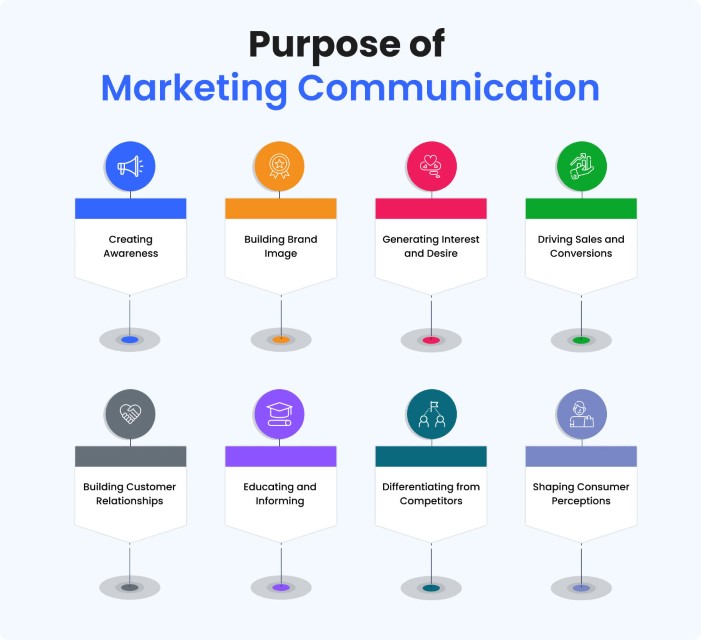
Here are some specific purposes of marketing communication:
- Creating Awareness: It helps create awareness about a company, its products, or services among potential customers. By effectively communicating the value proposition and unique selling points, it aims to capture the attention of the target audience and make them aware of what the company has to offer.
- Building Brand Image: It plays a vital role in shaping and maintaining a company’s brand image. It helps establish a positive perception of the brand in the minds of consumers by consistently delivering relevant messages, values, and experiences that align with the brand’s positioning.
- Generating Interest and Desire: It aims to generate interest and desire for the company’s offerings. Through persuasive messaging, storytelling, and highlighting the benefits and features of the products or services, it seeks to influence consumer perceptions and create a desire for the offerings.
- Driving Sales and Conversions: Ultimately, marketing communication aims to drive sales and conversions. By effectively communicating the value proposition, addressing customer needs, and providing compelling reasons to purchase, it encourages consumers to take action and make a purchase.
- Building Customer Relationships: It helps build and nurture relationships with customers. Through personalized and targeted communication, such as email marketing, social media interactions, or customer support, it aims to engage customers, establish loyalty, and encourage repeat business.
- Educating and Informing: It is also responsible for educating customers about the company’s products, services, and benefits. It provides information on how the offerings can solve customer problems or fulfill their needs, helping them make informed purchasing decisions.
- Differentiating from Competitors: In a competitive market, marketing communication helps differentiate a company from its competitors. By highlighting unique features, quality, value, or customer benefits, it aims to position the company’s offerings as superior to others in the market.
- Shaping Consumer Perceptions: Through consistent and strategic messaging, marketing communication seeks to shape consumer perceptions about the company and its offerings. It aims to create positive associations, establish credibility, and influence how customers perceive the brand compared to its competitors.
Why Are Marketing Communications Tools Vital?
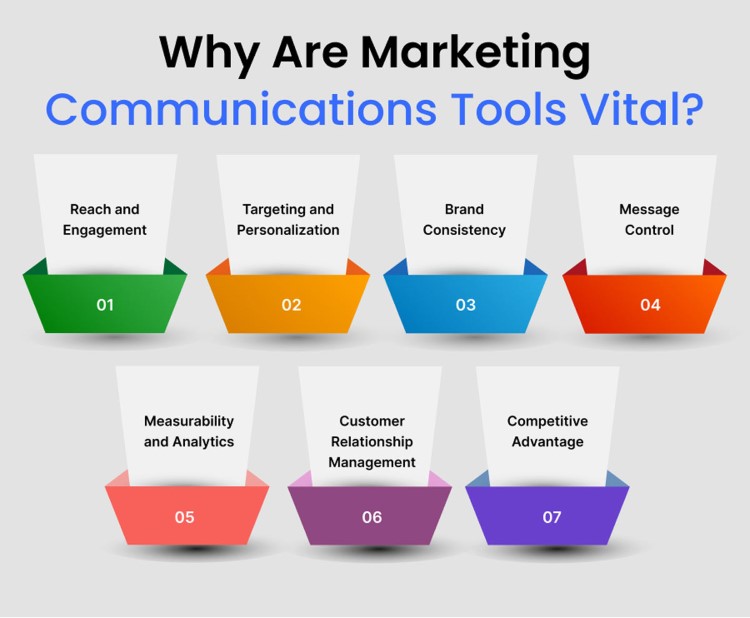
Marketing communications tools are vital for several reasons:
- Reach and Engagement: It enables businesses to reach and engage with their target audience effectively. Whether it’s through traditional channels like television, radio, or print media, or digital platforms like social media, websites, email marketing, or content marketing. These tools provide a means to connect with customers on a large scale and capture their attention.
- Targeting and Personalization: It allows businesses to target specific segments of their audience based on demographics, interests, behavior, or other criteria. This targeting helps deliver personalized messages and offers that resonate with individual customers, increasing the likelihood of engagement and conversion.
- Brand Consistency: It plays a crucial role in maintaining brand consistency across various channels. By using consistent visual elements, messaging, and tone of voice, businesses can reinforce their brand identity and create a cohesive brand experience for customers, regardless of the communication platform.
- Message Control: With marketing communication tools, businesses have control over the messages they convey to their audience. They can carefully craft their marketing messages to highlight their unique selling propositions, address customer pain points, and effectively communicate the benefits of their products or services.
- Measurability and Analytics: Many marketing communication tools offer measurement and analytics capabilities. This allows businesses to track the performance of their marketing campaigns, gather data on customer responses and behaviors, and gain insights into the effectiveness of their communication strategies. These insights can inform future marketing decisions and help optimize campaigns for better results.
- Customer Relationship Management: It often integrates with customer relationship management (CRM) systems, allowing businesses to manage and track customer interactions and nurture relationships effectively. They can use these tools to automate workflows, personalize customer interactions, and provide timely and relevant information to customers at different stages of their journey.
- Competitive Advantage: Utilizing effective marketing communication tools can provide a competitive advantage in the market. Businesses that leverage the right tools and channels to reach their target audience with compelling messages can differentiate themselves from competitors and attract and retain customers more effectively.
13 Marketing Communication Tools

1. Advertising
It is a paid form of marketing communication that aims to promote a product, service, or brand through various media channels such as television, radio, print, outdoor billboards, online banners, and social media.
Key Points:
- Broad reach and exposure to a large audience.
- Allows businesses to create visually appealing and persuasive messages.
- Can target specific demographics or consumer segments.
- Enhances brand awareness and visibility.
- Requires a budget allocation for media placement and creative development.
2. Sales Promotion
It involves short-term incentives and tactics to stimulate immediate purchases or encourage customer loyalty. Examples include discounts, coupons, contests, giveaways, loyalty programs, and point-of-sale displays.
Key Points:
- Aimed at boosting sales and generating immediate customer response.
- Encourages customers to take action by offering incentives or added value.
- Creates a sense of urgency or exclusivity.
- Supports product launches, clearance sales, or seasonal promotions.
- Limited duration and often used in conjunction with advertising.
3. Direct Marketing
It involves communicating with customers directly, often on a one-to-one basis, to promote products or services. It includes direct mail, telemarketing, catalog distribution, and targeted digital marketing efforts.
Key Points:
- Targets specific individuals or segments with personalized messages.
- Allows for direct response and immediate feedback.
- Can be highly targeted and cost-effective.
- Enables tracking and measurement of campaign performance.
- Requires careful management of customer data and privacy considerations.
4. Email Campaigns
Email campaigns involve sending targeted promotional messages or newsletters directly to individuals’ email addresses.
It is a form of direct marketing using the email channel.
Key Points:
- A cost-effective and efficient way to reach a large audience.
- Enables personalization and segmentation based on customer data.
- Can be automated for timed or triggered messages.
- Supports lead generation, customer retention, and sales conversion.
- Requires compliance with email marketing regulations and opt-in permissions.
5. Newsletter
Newsletters are regular publications distributed to subscribers, typically via email, providing updates, information, and engaging content related to a company, its products, or its industry.
Key Points:
- Builds relationships with customers and stakeholders.
- Provides valuable content, insights, and industry news.
- Keeps subscribers informed and engaged.
- Strengthens brand authority and loyalty.
- Supports lead nurturing and customer retention efforts.
6. Personal Selling
It involves one-on-one interactions between sales representatives and potential customers. It is a face-to-face or virtual communication method used to educate, persuade, and close sales.
Key Points:
- Enables personalized communication and relationship building.
- Tailors message specific customer needs and objections.
- Facilitates immediate feedback and clarification.
- Often used in high-value or complex sales situations.
- Requires trained sales professionals and ongoing training.
7. Public Relations
It focuses on managing a company’s reputation and maintaining positive relationships with the public, media, and other stakeholders. It involves activities such as press releases, media relations, events, crisis management, and community engagement.
Key Points:
- Enhances brand reputation and credibility.
- Generates positive media coverage and publicity.
- Manages company image and perceptions.
- Builds relationships with media and influencers.
- Plays a role in crisis communication and damage control.
8. Social Media
Social media platforms such as Facebook, Instagram, Twitter, LinkedIn, and YouTube provide avenues for businesses to engage with their target audience, share content, and promote their products or services.
Key Points:
- Enables direct communication and engagement with customers.
- Supports building brand awareness and loyalty.
- Allows for targeted advertising and audience segmentation.
- Facilitates viral marketing and word-of-mouth promotion.
- Requires consistent content creation and active community management.
9. Catalogs
These are printed or digital publications that showcase a company’s products or services in a visually appealing and organized format. They provide detailed product information and can be distributed through mail, in-store displays, or online platforms.
Key Points:
- Showcases a wide range of products or services.
- Enables customers to browse and compare offerings.
- Can be used for direct sales or lead generation.
- Supports cross-selling and upselling opportunities.
- Requires effective design and compelling product presentation.
10. Trade Shows
These are events where companies from a specific industry showcase their products, services, and innovations to industry professionals and potential customers.
Key Points:
- Offers opportunities for face-to-face interactions with prospects.
- Showcases products in a physical, experiential environment.
- Builds brand visibility and industry presence.
- Facilitates networking and partnership opportunities.
- Requires careful planning, booth design, and staffing.
11. Webinars
These are online seminars or presentations that allow businesses to educate, inform, or train their target audience through live or recorded sessions.
Key Points:
- Enables remote audience engagement and participation.
- Provides educational or thought leadership content.
- Can be used for product demonstrations or training.
- Generates leads through registration and follow-up.
- Requires quality content, interactive features, and promotion.
12. Mobile Apps
Mobile apps are software applications specifically designed for use on mobile devices such as smartphones or tablets. They provide functionality, information, or entertainment and can be used by businesses to engage and serve customers.
Key Points:
- Offers convenience and accessibility for users.
- Supports personalized experiences and targeted messaging.
- Facilitates mobile commerce and in-app purchases.
- Enhances brand loyalty and customer retention.
- Requires development, maintenance, and regular updates.
13. Sponsorship
It involves supporting events, organizations, or initiatives financially or through other resources in exchange for brand visibility and association.
Key Points:
- Enhances brand exposure and reaches target audiences.
- Builds positive brand associations and goodwill.
- Supports corporate social responsibility efforts.
- Provides opportunities for activation and engagement.
- Requires careful selection of sponsorships aligned with the target market and brand values.
Additional Marketing Communication Tools for Modern Businesses
Traditional communication methods remain important, but digital customer journeys have introduced several other tools businesses should consider.
14. Live Chat and Conversational Marketing
Live chat transforms a website from a one-way information channel into a real-time communication channel.
Instead of expecting visitors to fill out a form and wait for a response, businesses can answer questions while customers are actively researching products or making purchasing decisions.
Marketing teams can use live chat to:
- Engage high-intent website visitors
- Answer product or pricing questions
- Recommend relevant products or services
- Capture leads conversationally
- Schedule demos or appointments
- Reduce abandonment at important conversion points
Live chat can become even more effective when combined with chatbots or AI agents. Routine questions can be handled automatically while complex or high-value conversations are transferred to human teams.
This combination creates a conversational marketing experience in which prospects can move from discovery to assistance without leaving the website.
15. AI Chatbots and AI Agents
AI-powered conversational tools are becoming an important part of modern marketing communication because they allow businesses to interact with customers at scale while maintaining two-way communication.
Unlike traditional campaigns that primarily broadcast messages, AI chatbots and AI agents allow customers to ask questions and receive immediate responses.
They can support marketing activities such as:
- Answering product questions
- Qualifying potential leads
- Recommending relevant products
- Helping visitors find information
- Collecting lead information
- Guiding users toward appropriate pages or resources
- Supporting campaign traffic outside normal business hours
- Transferring qualified opportunities to sales representatives
The biggest advantage is availability. Marketing campaigns can generate interest at any hour, while conversational AI provides an immediate next step for people who want additional information.
For the best customer experience, businesses should combine automation with clear human handover options so customers can reach an employee whenever the conversation requires personal assistance.
16. SMS and Messaging Apps
SMS and messaging apps provide businesses with a direct way to communicate with customers through channels they already use every day.
These channels can be particularly effective for timely and action-oriented communication such as:
- Promotional offers
- Product announcements
- Event reminders
- Appointment reminders
- Back-in-stock notifications
- Order-related updates
- Personalized recommendations
- Limited-time campaigns
WhatsApp has also become an important business communication channel, allowing companies to combine campaign messages with two-way customer conversations.
A customer who receives a campaign message may immediately have a product, delivery, or pricing question. Connecting campaigns with conversational support makes it possible to continue the interaction instead of treating campaign delivery and customer communication as separate experiences.
17. Marketing Automation Platforms
Marketing automation platforms help businesses manage repetitive communication activities based on customer data, actions, and predefined triggers.
Instead of manually sending every campaign, marketers can create automated sequences that respond to specific customer behaviors.
Common examples include:
- Welcome email sequences
- Lead nurturing campaigns
- Abandoned-cart reminders
- Re-engagement campaigns
- Event follow-ups
- Product recommendations
- Customer onboarding communication
Automation becomes particularly powerful when it connects multiple stages of the customer journey.
For example, a visitor might download a resource, enter a nurturing sequence, return to the website, start a live chat conversation, and later receive a relevant follow-up based on their interests.
The goal is not simply to send more messages. Effective marketing automation delivers relevant communication based on where a customer is in their journey.
18. Customer Relationship Management (CRM) Software
CRM software acts as a central system for managing information about prospects and customers.
Marketing teams can use CRM data to understand previous interactions, segment audiences, coordinate follow-ups, and deliver more personalized communication.
A CRM can store information such as:
- Contact details
- Lead source
- Previous interactions
- Sales activity
- Customer preferences
- Purchase history
- Communication history
Connecting a CRM with other marketing communication tools can provide valuable context.
For example, if a prospect who previously requested a product demo starts another conversation, the sales or support team can use historical information to provide a more relevant response rather than beginning the relationship from scratch.
CRM therefore plays an important role in connecting marketing communication with sales and customer relationship management.
19. Content Marketing
Content marketing communicates with audiences by providing useful information instead of relying only on direct promotional messages.
Blog posts, guides, videos, case studies, reports, ebooks, infographics, and educational resources can help potential customers understand a problem and evaluate possible solutions.
Content marketing can support different stages of the buying journey.
At the awareness stage, educational content can introduce a problem or opportunity. During consideration, comparison guides, webinars, case studies, and product-focused resources can help prospects evaluate alternatives. Later, onboarding and educational content can help existing customers gain more value from their purchase.
Strong content also gives marketers material that can be distributed through email, social media, search engines, newsletters, sales conversations, and other communication channels.
For this reason, content marketing often works as the foundation connecting several marketing communication tools.
20. SEO Tools and Organic Search
Search engine optimization helps businesses communicate with people who are actively searching for information, products, or solutions.
SEO tools help marketers identify search demand, optimize website content, monitor rankings, identify technical issues, and evaluate organic performance.
Typical applications include:
- Keyword research
- Competitor research
- Content optimization
- Technical SEO analysis
- Backlink analysis
- Search performance monitoring
SEO differs from many outbound marketing methods because communication begins with existing customer intent.
Someone searching for “best customer support software,” for example, is already communicating a need through their search query. Effective SEO helps the business provide an appropriate answer at that moment.
SEO and content marketing therefore work especially well together: SEO identifies what audiences are searching for, while content provides the information that satisfies that demand.
21. Video Marketing
Video allows businesses to communicate complex ideas visually and can be used throughout the customer journey.
Common marketing videos include:
- Product demonstrations
- Explainer videos
- Customer testimonials
- Educational videos
- Webinars
- Tutorials
- Short-form social videos
- Behind-the-scenes content
Short-form videos can help businesses attract attention through social media, while longer product demonstrations and webinars can help potential customers evaluate a solution.
Video also makes it easier to repurpose communication. A webinar, for example, can later become short social clips, educational videos, blog content, and email campaign material.
The most appropriate format depends on the audience and the stage of the buying journey rather than the popularity of a particular video platform.
22. Influencer and Creator Marketing
Influencer marketing allows businesses to communicate with an audience through creators or industry figures who have already developed credibility within a particular community.
Rather than relying entirely on the brand’s own communication channels, companies can collaborate with relevant creators for:
- Product demonstrations
- Reviews
- Sponsored content
- Tutorials
- Events
- Social media campaigns
- Affiliate partnerships
Audience relevance is more important than follower count. A smaller creator with a highly relevant audience may generate more meaningful engagement than a larger account whose followers have little connection to the product.
Businesses should therefore evaluate audience fit, credibility, engagement quality, brand alignment, and measurable campaign outcomes when selecting influencer partners.
23. Customer Reviews and Reputation Management
Customer reviews have become an important form of marketing communication because prospective customers frequently want to understand other customers’ experiences before making a decision.
Businesses can encourage customers to leave reviews and actively manage responses across relevant review platforms.
Review management can help organizations:
- Build credibility
- Identify customer concerns
- Highlight positive experiences
- Respond to negative feedback
- Understand recurring customer expectations
Reviews are also two-way communication. Responding professionally demonstrates that the business listens to its customers rather than simply collecting ratings.
Review and reputation management tools can simplify this process by helping teams monitor feedback from multiple sources.
24. Customer Surveys and Feedback Tools
Marketing communication should not only involve sending messages to customers. Businesses also need ways to listen.
Surveys and feedback tools allow companies to collect direct insights about customer needs, preferences, expectations, and experiences.
Businesses can use surveys for:
- Product research
- Campaign feedback
- Customer satisfaction measurement
- Website experience research
- Market research
- Post-purchase feedback
The insights gathered can then improve messaging, product positioning, audience segmentation, and future campaigns.
This creates a feedback loop in which customer communication informs future marketing communication rather than marketing decisions being based entirely on assumptions.
Internal vs. External Marketing Communication Tools
Marketing communication tools can also be divided into internal and external categories.
External marketing communication tools connect a business with prospects and customers. Examples include advertising, email, social media, live chat, messaging apps, webinars, and public relations.
Internal communication tools help marketing, sales, service, and other teams coordinate the interactions customers eventually experience.
CRM platforms, internal messaging systems, collaboration tools, customer communication platforms, and shared knowledge systems can therefore indirectly influence marketing communication.
The distinction is important because great customer communication often depends on strong internal coordination.
For example, if marketing launches a new campaign but customer-facing teams do not have information about the offer, customers may receive inconsistent answers. Connected internal and external communication helps maintain a consistent brand experience.
How to Build an Integrated Marketing Communication Stack
Rather than selecting communication tools independently, businesses should think about how each tool contributes to the overall customer journey.
A simple marketing communication stack can be organized around four stages:
1. Awareness
Use communication channels that help potential customers discover your brand.
Examples include:
Advertising → SEO → Social Media → Content Marketing → PR → Influencer Marketing
2. Consideration
Give prospects opportunities to learn, ask questions, and evaluate your offering.
Examples include:
Website Content → Video → Webinars → Live Chat → AI Chatbots → Email
3. Conversion
Remove uncertainty and make it easier for customers to take action.
Examples include:
Live Chat → Messaging Apps → CRM → Sales Communication → Marketing Automation
4. Retention and Advocacy
Continue communicating after the initial conversion.
Examples include:
Email → Messaging → Customer Support → Surveys → Reviews → Loyalty Campaigns
The individual tools matter, but the connections between them matter just as much.
A customer should be able to move between channels without encountering completely disconnected experiences. Integrating customer communication, CRM, automation, analytics, and marketing channels helps businesses create more consistent interactions across the journey.
The Role of AI in Modern Marketing Communication
AI is changing marketing communication from a largely campaign-driven process into a more responsive and conversational experience.
Traditional marketing often follows a predefined sequence: create a message, choose an audience, select a channel, launch the campaign, and analyze the response.
AI adds another layer by helping businesses react to individual customer needs during the interaction itself.
AI-powered marketing communication tools can assist with:
- Audience segmentation
- Content personalization
- Conversation automation
- Lead qualification
- Product recommendations
- Customer intent detection
- Campaign optimization
- Conversation routing
- Analytics and insight generation
Conversational AI is particularly important because it turns marketing from one-way communication into an ongoing dialogue.
Platforms such as REVE Chat combine customer communication channels with tools such as live chat, chatbots, AI-powered assistance, and omnichannel engagement, enabling businesses to connect automated and human conversations across the customer journey.
AI should ultimately make marketing communication more relevant and efficient—not simply generate more messages. Businesses that combine automation, customer context, connected channels, and human assistance can create communication experiences that are both scalable and personal.
Summary
By leveraging the right mix of marketing tools, with AI chatbots you can build brand awareness, foster customer loyalty, offer great customer service and drive tangible results. So, embrace the power of these tools, experiment with creativity, and unleash the full potential of your marketing campaigns.
Get ready to elevate your brand to new heights and leave a lasting impact in the minds of your audience. The world is waiting for your message – go forth and conquer!
Frequently Asked Questions
AI-driven tools offer automation so that businesses can automate many of their internal operations, personalization, and data analysis. Chatbots for instant customer service and automated email responses enhance overall customer engagement and conversion rates.
While choosing the right marketing tools for your business, you need to keep in mind some of the key considerations like target audience preferences, your business objectives, budget and scalability, integration with existing tools, analytics, and performance tracking features.
Omnichannel marketing ensures a seamless customer experience across multiple communication touchpoints (email, social media, website, in-store, live chat etc), increasing customer satisfaction and brand loyalty.
Since all communication touchpoints are connected, customers can easily continue their interactions without repeating themselves. Meanwhile, customer service representatives can manage all conversations from a single platform.
To measure the effectiveness of marketing communication tools some key metrics include engagement rates, conversion rates, customer feedback, customer satisfaction scores and Return on Investment (ROI).
Some of the upcoming trends in marketing communication tools include: AI-powered personalization, video-based marketing, voice search, conversational marketing, and automated predictive analytics.
A marketing channel is the medium through which communication reaches an audience, such as email, social media, search, or WhatsApp. A marketing communication tool is the technology or method used to manage communication through those channels.
For example, email is a channel, while an email automation platform is a tool used to manage email communication.
No. Businesses should select tools based on their audience, objectives, customer journey, budget, team resources, and technology requirements.
Using a smaller number of well-integrated tools is often more manageable than maintaining a large collection of disconnected platforms.
AI-powered marketing communication tools use artificial intelligence to automate or improve activities such as customer conversations, personalization, lead qualification, content recommendations, segmentation, analytics, and campaign optimization.
Examples include AI agents, intelligent chatbots, AI-assisted CRM systems, recommendation engines, and AI-enabled marketing automation platforms.
Integration allows customer information and activities to move between platforms.
For example, data captured through a website conversation can be added to a CRM, trigger a marketing workflow, and give sales teams context for their next interaction.
This reduces fragmented customer experiences and makes communication easier to coordinate across marketing, sales, and service teams.
Build AI-powered support with Wize AI
Connect business knowledge, automate support conversations, and improve response quality without managing a complex AI stack.
Explore Wize AI Agent Rate the article

Juwel Rana
Senior Content Writer
Juwel is a Sr. Content Writer at REVE Chat. He specializes in writing about customer service and customer engagement. He is passionate about helping businesses create a better customer experience.
He strongly believes that businesses will be able to understand their customers better and ultimately create more meaningful relationships with them.
View all articles