



REVE Chat v6.3.0: Introducing AI Conversations, New Pricing Model & Flexible Add-ons
- September 9, 2026
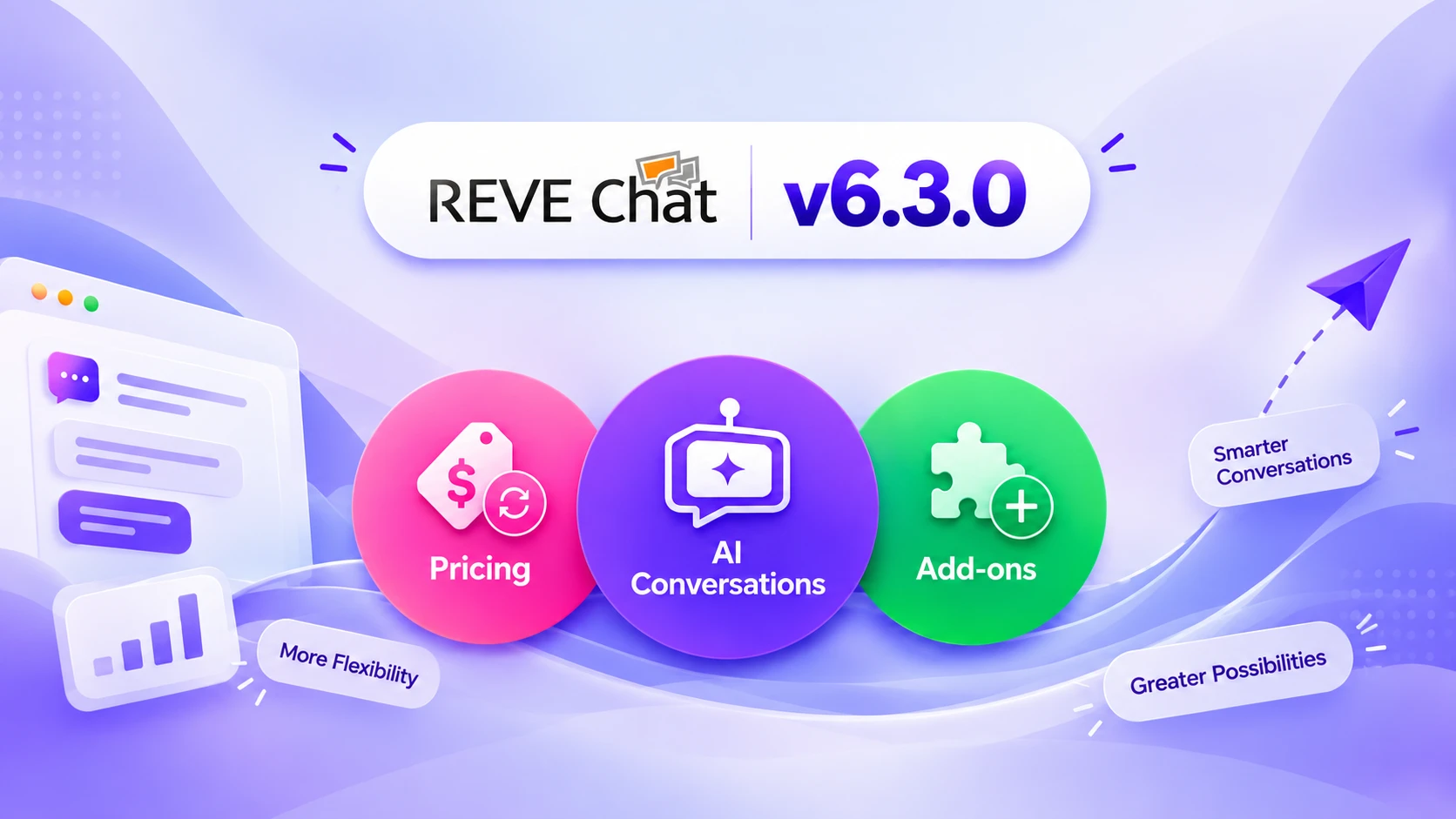
REVE Chat 6.3.0 is live now! 🥳
Now we are introducing a new pricing structure built around AI Conversations, along with unlimited AI Agents, flexible additional capacity, and separate add-ons for the capabilities businesses need.
Customer conversations are rarely predictable.
Some end after a single question. Others continue through multiple messages, knowledge lookups, business actions, follow-ups, and human handovers. Pricing AI around individual tokens or replies can therefore make it difficult to understand how much a real customer interaction will cost.
We are changing that.
We are also removing the previous AI Credit model and session caps, making it easier to connect what you pay for with the customer conversations your AI Agent is actually handling. The new model is designed around a clear customer-level usage unit rather than tokens, individual model calls, or individual messages.
What’s New at a Glance
| Change | What it means for customers |
|---|---|
| Session caps removed | Customer engagement is no longer planned around a fixed number of platform sessions |
| AI Credits removed | AI Agent usage is no longer presented as a credit balance based on underlying AI consumption |
| AI Conversations introduced | AI Agent usage is measured through qualifying customer conversations within a fixed 24-hour window |
| Unlimited Conversion ( with in 24h ) | Within this 24-hour window, no matter how many messages are exchanged between the AI Agent and the customer, they are counted as a s1 AI Conversation |
| Unlimited AI Agents | Replace limited AI Agent , Now Every paid package can support unlimited AI Agents |
| New plan allowances | Each plan includes a monthly AI Conversation allowance free of cost |
| Additional AI Conversation capacity | Businesses can add more capacity when their expected AI usage grows |
| Copilot pricing separated | Copilot is available as a monthly per-seat add-on |
| Clear media limits | Image and inbound voice-message usage now follow defined per-conversation limits |
The result is a pricing model that is easier to connect to real customer activity and easier to plan as AI usage grows.
1. A Simpler Pricing Model Built Around Customer Conversations
Under the previous model, Wize AI usage was represented through AI Credits.
Credit consumption could vary depending on factors such as the number of AI responses, the amount of text being processed, knowledge retrieval, conversation length, and other AI activity.
The new approach moves away from that.
REVE Chat now uses AI Conversations as the customer-facing usage unit for autonomous Wize AI Agent activity across eligible live-chat and messaging interactions. Copilot is handled separately by seat, while Knowledge Base training follows package-level entitlements rather than consuming AI Credits.
This makes the commercial model much closer to how businesses already think about customer support and engagement: in conversations rather than tokens.
2. Session Caps Have Been Removed
Session limits can become difficult to manage as customer traffic grows.
A business might have thousands of website or messaging interactions while only a portion of them actually require AI assistance. Using sessions as a core package restriction can therefore make usage planning harder than it needs to be.
With the new structure, AI usage is controlled through AI Conversation capacity instead.
Every package also supports unlimited AI Agents, so businesses are not required to restrict the number of AI Agents they create simply to stay inside an agent limit. They can build different AI Agents for different teams, workflows, channels, or use cases while managing actual autonomous AI usage through their available AI Conversations.
For example, a business could operate separate AI Agents for sales, support, and ecommerce use cases. If those Agents participate in the same eligible customer conversation window, creating or involving multiple AI Agents does not automatically multiply the AI Conversation count.
3. Introducing AI Conversations
An AI Conversation is one billable unit of Wize AI Agent handling within a fixed 24-hour live-chat or messaging window.
There are two important moments to understand.
The first accepted inbound visitor message starts the 24-hour window.
However, that does not automatically make the conversation billable.
The AI Conversation is counted when the AI Agent begins handling a substantive customer request during that window.
This distinction is important because simply opening the widget or saying “Hi” does not necessarily consume an AI Conversation.
If a visitor sends only a greeting, emoji, or generic small talk and leaves without asking for meaningful assistance, the interaction remains non-billable. If the visitor then asks a genuine question and the AI Agent starts helping, that same window becomes one AI Conversation.
A Simple Example
Suppose a customer sends: Monday, 10:00 AM: “Hi.”
The 24-hour window starts, but no AI Conversation has been charged yet.
At 10:03 AM, the same customer asks: “Where is my order?”
The AI Agent begins working on the request. The interaction now becomes one AI Conversation.
Later that afternoon, the customer asks to change the delivery date. At 9:59 AM the following day, they return with another question.
It is still the same AI Conversation because everything is happening inside the original fixed 24-hour window.
If the customer returns after that window has expired and the AI Agent starts handling another substantive request, a new AI Conversation can then be counted.
| Time | Customer journey | Usage status |
|---|---|---|
| Monday 10:00 | Visitor says 'Hi'. | Window starts; 0 AI Conversations |
| Monday 10:03 | Visitor asks for order status. | Conversation 1 becomes billable; expiry remains Tuesday 10:00 |
| Monday 16:00 | Visitor asks to change the delivery date. | Still 1 |
| Tuesday 09:59 | Visitor reconnects before expiry. | Still 1 |
| Tuesday 10:05 | A new window starts and AI handles a substantive request. | 2 AI Conversations in total |
One AI Conversation Can Include Much More Than One Message
AI Conversations are not charged per message.
Within an active qualifying window, a customer can exchange multiple text messages with the AI Agent without each message becoming another usage unit.
Normal Knowledge Base retrieval, tool usage, API orchestration, reconnects, technical sessions, and AI-to-human collaboration can also remain inside the same AI Conversation.
This is one of the biggest differences from the previous AI Credit approach.
A longer conversation does not automatically become more expensive simply because the customer asks several follow-up questions or because the AI Agent needs to retrieve information from the Knowledge Base or use a connected tool.
What matters is the qualifying AI-handled conversation window.
Human Handover Does Not Start Another AI Charge
AI automation and human support often need to work together.
If the AI Agent helps a customer and then transfers the conversation to a human agent, the original AI Conversation remains counted once. Messages handled only by the human agent do not create additional AI Conversation usage.
Even if the human continues working on the conversation after the original 24-hour AI window expires, time passing alone does not create another AI Conversation.
| Scenario | Usage | Reason |
|---|---|---|
| AI helps, then hands over inside the 24-hour window | 1 AI Conversation | The prior AI handling remains charged once. Human-only messages create no additional AI charge. |
| The human continues the same chat beyond 24 hours | Still 1 overall | Time passing during human handling does not create another AI Conversation. |
| The human closes after expiry; the visitor returns and AI handles a new request | Can become Conversation 2 | A new AI activation after the prior window can create the next charge. |
| The human returns the chat to AI inside the original window | Still 1 | Reuse the existing AI Conversation. |
| Technical reconnect or close/reopen occurs inside the window | Still 1 | Operational state changes do not multiply usage. |
A new charge can occur only when AI is activated again after the previous window has expired and begins handling another substantive customer request.
This allows businesses to combine AI automation with human judgment without treating every handover as another AI usage event.
4. AI Credits Are Being Replaced
With this release, AI Credits are removed from package allowances, add-ons, and customer-facing balances.
Instead of estimating usage from credits, tokens, or individual AI replies, businesses can plan around the number of customer conversations they expect Wize AI Agent to handle.
This provides a clearer relationship between customer activity and AI usage.
Knowledge Base training is also separated from the old AI Credit model and is governed by package-level document entitlements. Exact Knowledge Base limits should be checked against the current pricing documentation for the applicable package.
How the New REVE Chat Pricing Structure Works
The new commercial structure separates the main components of a REVE Chat subscription more clearly.
Customers choose a base package, add any required human seats, receive a monthly allowance of AI Conversations, and can purchase additional AI Conversation capacity when needed. Copilot is priced separately as a per-seat add-on.
The current AI Conversation allowances defined in the September 2026 pricing model are:
| Plan | AI Conversion | USD / month | BDT / month | INR / month |
|---|---|---|---|---|
| Free | 10 | $0 | ৳0 | ₹0 |
| Starter | 50 – 500 | $14.99 | ৳914.39 | ₹809.46 |
| Growth | 250 – 10,000 | $59.99 | ৳3,659.39 | ₹3,239.46 |
| Enterprise | 1,000- 1,50,000 | $291.99 | ৳17,811.39 | ₹15,767.46 |
The Free Trial includes 50 AI Conversations. Every package supports unlimited AI Agents.
For additional usage, one AI Conversation is priced at $0.25 USD, ৳30 BDT, or ₹25 INR under the current model.
| Currency | Additional AI Conversation |
|---|---|
| USD | $0.25 each |
| BDT | ৳30 each |
| INR | ₹25 each |
For the latest base-package prices, seat pricing, regional billing details, taxes, and current commercial terms, customers should refer to the official REVE Chat pricing guide rather than relying on this release announcement.
Introducing Flexible Add-ons
Not every business uses AI at the same volume.
Some teams have consistent monthly demand. Others experience seasonal peaks, campaigns, or short periods where AI conversations increase significantly.
The new add-on model provides more flexibility for these situations.
Businesses can purchase recurring additional AI Conversation capacity for ongoing monthly requirements. Where offered, non-expiring AI Conversation packs can also provide additional capacity that remains available until it is consumed.
Monthly plan-included capacity is used first, followed by capacity from AI Conversation add-ons. Monthly included and recurring allowances reset with the billing cycle, while non-expiring purchased capacity remains available until consumed where that option is offered.
Copilot Is Now a Separate Seat Add-on
Copilot is also separated from AI Conversation usage.
Instead of drawing from an AI Credit balance, Copilot is purchased for the agents who need it as a monthly seat add-on.
The current listed Copilot price is $9 USD, ৳900 BDT, or ₹700 INR per assigned seat per month. Copilot seats cannot exceed the total number of account seats.
| Currency | Price per Agent/seat |
|---|---|
| USD | $9 monthly |
| BDT | ৳900 monthly |
| INR | ₹700 monthly |
This lets businesses separate autonomous AI Agent capacity from the AI assistance used by their human support team.
What Happens If Your AI Conversation Balance Reaches Zero?
The new pricing model does not automatically create postpaid AI overage.
If an AI Conversation has already been charged, that active conversation can continue within its original 24-hour window even if the workspace balance reaches zero.
However, if a new conversation requires AI assistance, or an existing window has expired and a new qualifying AI interaction would need to begin, the AI Agent will not start a new billable conversation while the balance is zero.
Instead, the conversation remains in or moves to Unassigned, where a human agent can handle it without consuming an AI Conversation.
After additional capacity is purchased, eligible Unassigned conversations can be transferred back to an AI Agent. The transfer itself does not create the charge. Billing begins only when AI starts handling the substantive request.
This gives businesses clearer control over additional AI spend instead of creating unexpected automatic overage.
Image and Voice Message Usage
The new AI Conversation structure also includes more extended support for image and voice messages, making customer interactions more flexible and natural.
Image messages: Customers can share images during an AI Conversation, and the AI Agent can process and respond to supported image-based queries. Other supported interactions can continue throughout the conversation.
Voice messages: Customers can send voice messages, which are processed through speech-to-text so the AI Agent can understand the request and respond in text. Customers can also continue the conversation using text whenever needed.
Ticket handling and live AI Voice calls are managed separately and are not included as part of this AI Conversation pricing structure.
What Existing REVE Chat Customers Should Know
Existing customers using the previous AI Credit model should expect the way AI Agent usage is represented and purchased to change.
However, migration details should not be assumed.
The current release documentation does not define a universal rule for legacy AI Credit balances, grandfathered pricing, proration, custom commercial arrangements, or migration treatment. These situations are specifically identified as requiring account-level commercial confirmation.
If your account currently has AI Credits, custom pricing, or existing purchased capacity, contact your REVE Chat account representative or support team to confirm how the new pricing structure applies to your subscription.
Why We Made These Changes
AI pricing should be understandable without requiring customers to estimate tokens, model operations, or the cost of every individual response.
The AI Conversation model shifts pricing toward a unit businesses already understand: a customer conversation.
A single qualifying AI Conversation can include multiple messages, Knowledge Base retrieval, connected actions, reconnects, and collaboration between AI and human agents within the eligible window. At the same time, unlimited AI Agents give businesses more flexibility to design their automation around their actual operations rather than around an artificial Agent limit.
The goal is a pricing experience that is easier to forecast, easier to explain internally, and more adaptable as AI-powered customer support grows.
Learn More About the New REVE Chat Pricing
The new pricing structure changes how AI Agent usage, additional capacity, and Copilot are packaged across REVE Chat.
For complete plan pricing, current regional rates, package entitlements, and add-on availability, visit the REVE Chat Pricing Guide.
You can also explore the latest REVE Chat Product Updates or contact the REVE Chat team if you need help estimating the right AI Conversation capacity for your business.
