




Table of Content
Under the pressure of handling many functions, enterprises don’t have time to do everything manually. Traditional automation covers routine repetitive tasks, but it breaks down when tasks require judgment, context, and multiple steps.
AI agents can fill this gap by understanding goals, using business data, connecting to tools, and taking action across workflows. Effective AI solutions for enterprise also need to ensure security, governance, reliable integrations, human oversight, and scalability.
In this article, we rank 9 leading enterprise AI agents and platforms based on their agent capabilities, integrations, security and governance, scalability, ease of implementation, and overall business value.
Enterprise AI Agents: What Is It?
An enterprise AI agent is not like a basic AI assistant that mainly responds to prompts. It can work with company data and use connected tools. It can also execute multi-step workflows and take actions with limited human involvement.
Typical capabilities include:
- Understanding user intent and business context
- Retrieving information from enterprise knowledge sources
- Connecting with CRMs, help desks, databases, and other business tools
- Completing multi-step tasks and workflows
- Maintaining context across interactions
- Escalating to humans or requesting approval when necessary
What makes these agents enterprise-ready is not limited to their AI capability. They also need strong security, governance, access controls, integrations, scalability, monitoring, and auditability so businesses can use them safely across real operations.
How Do Enterprise AI Agents Work?
AI Agents for enterprises are goal-driven software systems that combine advanced language models with secure tool integrations to perform complex business processes autonomously. Autonomous enterprise AI Agents navigate multi-step workflows using a structured, lifecycle-based methodology:
1. Receive a goal or trigger
The process begins with an initiation signal, such as a direct customer request via chat or email, an employee instruction, or an event trigger like an abandoned shopping cart or a webhook request. The trigger can also be a pre-configured schedule or an automated system signal from connected applications
2. Understand context
Once triggered, the agent uses Natural Language Processing (NLP) to translate raw, unstructured input into a structured intent while identifying key details. Instead of handling each message separately, the agent uses shared business context to understand the conversation as a whole.
3. Reason and plan
Based on the user’s intent and context, the agent reasons and defines what steps must be taken to achieve the defined goal, planning the logical sequences of tasks.
During this phase, the agent evaluates whether there are any missing details using information gap detection before deciding on the next best action.
4. Access knowledge and tools
To execute its plan, the agent connects directly to the enterprise ecosystem:
Knowledge Retrieval: The agent searches structured and unstructured company knowledge bases like PDFs, wikis, and FAQs, using Agentic RAG to retrieve contextually precise answers.
Tool Integrations: It securely connects external systems, including CRMs, ticketing helpdesks, e-commerce platforms, and databases.
5. Take action
Once the agent has the information it needs, it carries out the required task using predefined business rules and safety controls. This helps it complete actions reliably instead of depending only on AI-generated responses.
For example, the agent may:
- Process a refund
- Create a support ticket
- Book a meeting
- Update a customer or database record
These controls help ensure the agent follows the right steps and only performs actions it is allowed to take.
6. Continue, Escalate, or Complete
After executing an action, the agent evaluates the outcome and chooses 3 alternatives:
Continue: If the task is not finished, the agent moves to the next step. It can also ask follow-up questions when it needs more information.
Escalate: If the issue is too complex, falls outside the agent’s limits, or requires human judgment, it transfers the conversation to the right team member.
Complete: Once the task is finished and no further help is needed, the agent closes the interaction and records the outcome.
How We Ranked the Platforms
We ranked the best enterprise AI Agents based on some criteria:
1. Agent Capabilities
AI agents should go beyond just answering questions and contribute with reasoning, and should have the ability to take actions and manage workflows with autonomy.
2. Enterprise Integrations
The AI agent should be able to connect with CRMs, help desks, ecommerce platforms, databases, communication tools, and other business systems.
3. Security and Governance
Features like access controls, permissions, audit logs, monitoring, and support for enterprise compliance requirements are evaluated.
4. Omnichannel/Multichannel Capabilities
Whether the agent can maintain context of conversations when they move between different channels has been considered.
5. Human Oversight and Handover
The evaluation considers how well each agent can involve human teams, hand over conversations with relevant context, and request approval for sensitive or complex actions.
6. Scalability and Deployment Flexibility
Whether the solutions or platforms can scale with growing usage, support multiple agents, maintain context through different departments, and support larger enterprise deployments has been evaluated.
7. Ease of Implementation
The agents should be easy to build, configure, test, and launch using no-code tools, templates, workflow builders, and ready integrations.
9 Best Enterprise AI Agents: Quick Comparison
| Tools | Pricing | Best For |
|---|---|---|
| REVE Chat | Growth ($59.99/mo) and Enterprise ($291.99/mo) | Conversational commerce, lead qualification, multi-intent handling, omnichannel customer journeys, customer support automation, workflow execution |
| Yellow.ai | Free tier includes 500 resolutions/month, then $0.99/resolution | Multi-agent orchestration, voice AI, multimodal interactions, automated agent testing |
| Kore.ai | Starts at $50/month for Essential, and $150/month for Advanced | Regulated enterprise workflows, multi-agent orchestration, enterprise search, proactive outreach |
| Sierra.ai | Custom | Long-running customer journeys, persistent memory, agent creation, customer insight discovery |
| Intercom Fin | $0.99/outcome; 50 outcomes/month minimum | Unified customer interactions, action-taking workflows, automated evaluation, support operations |
| Zendesk AI Agents | Costs $1.50 per committed automated resolution or $2.00 pay-as-you-go | Omnichannel resolution, intelligent ticket routing, human handoff, email automation |
| Rasa | Developer Edition is Free. Enterprise pricing is custom | Controlled enterprise automation, private deployment, complex conversations, voice AI |
| Stack AI | Free plan is $0/month (500 runs/month), and Enterprise is custom | No-code agent building, document automation, governed workflows, multi-agent orchestration |
| Lindy.ai | Plus is $29.99/user/month; Pro is $99.99; Max is $199.99; Enterprise is Custom | Workplace automation, recurring tasks, role-based AI agents, app integrations |
9 Best Enterprise AI Agents and Platforms in 2026
Here we discuss the features and capabilities of the 9 best enterprise AI Agents and agent platforms in 2026.
1. REVE Chat
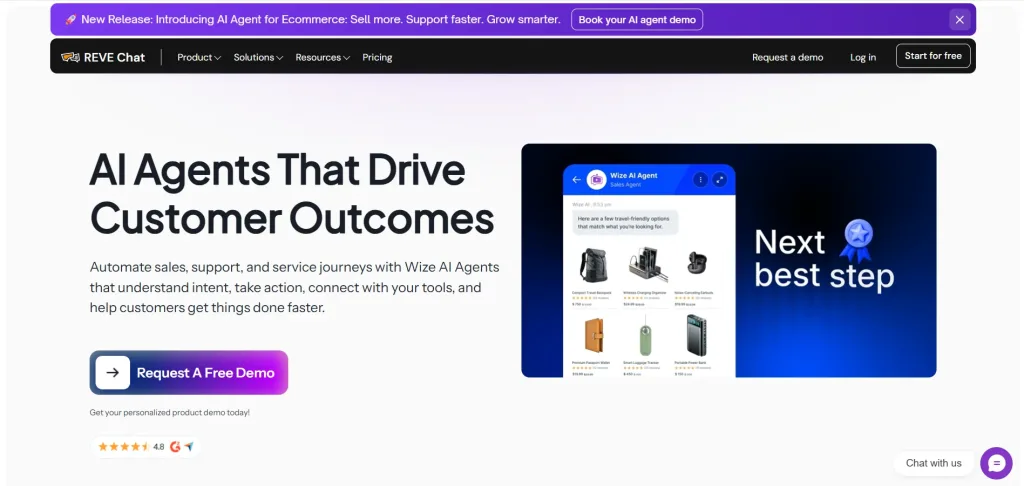
REVE Chat is an omnichannel customer engagement platform designed to help businesses manage customer conversations across multiple digital channels from one place.
The platform includes live chat for real-time customer interactions. It has an omnichannel inbox that brings conversations from different channels into a unified workspace for support and engagement teams. The platform also includes ticketing and WhatsApp campaigns.
The autonomous conversational agent Wize AI is built into the environment of the REVE Chat platform. It is able to understand customer intent, use business data, run workflows, support conversational commerce, and hand conversations to human teams when needed.
Key Features:
- Multi-intent detection handles multiple customer needs within the same conversation.
- Remembers previous customer statements within the ongoing conversation
- Captures buying signals by identifying visitors inquiring about pricing, plans, or product demos
- Flags urgent issues like customer complaints for fast attention
- Helps in product discovery by guiding online shoppers based on preference
- Autonomously places, modifies, cancels, or tracks customer orders
- Smart Escalation transfers complex queries to humans with full interaction context
- Connects with online stores to retrieve real-time product details
Pricing
- Growth $59.99/mo
- Enterprise $291.99/mo
Why Choose REVE Chat’s Wize AI Agent
As an enterprise business, you should choose REVE Chat’s Wize AI Agent if you need customer-facing automation across ecommerce, sales, and support.
With REVE Chat’s Wize AI Agentic platform, businesses can build custom agents around their own workflows, website content, databases, and connected tools.
Wize can integrate with APIs, Google Sheets, Shopify, and product catalogs to retrieve live information and complete supported actions. It also includes behavior controls and human handover options. This makes it suitable for businesses that want automation without losing oversight.
2. Yellow.ai
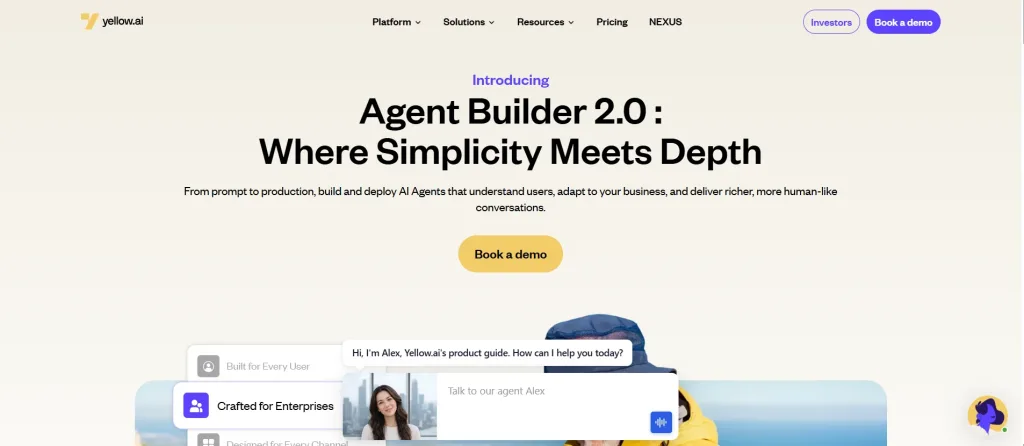
Yellow.ai is an enterprise agentic AI platform with a visual workspace, automated testing tools, and advanced voice capabilities. Super Agent is at the center of this system, acting as the main decision-making AI agent.
While the Yellow.ai platform manages security, integrations, and channel connections, the Super Agent analyzes customer requests, identifies multiple intents, assigning tasks to specialized Domain Agents while keeping the conversation context intact.
Key Features:
- Super Agent decision hub orchestration
- Nexus Vox Engine voice AI
- Multi-modal intent recognition
- Automatic Agentic Testing
Pricing
- Free tier includes 500 resolutions/month, then $0.99/resolution
Why Choose Yellow.ai
If your enterprise needs strong voice AI, multilingual support, and multi-agent automation, go for Yellow.ai. Its Super Agent can coordinate multiple specialized agents together while keeping conversation context intact.
Along with automated testing, helping businesses check agents before launch, it also supports text, voice, and other input types. It is particularly suitable for large enterprises that need scalable customer automation across many languages and channels.
3. Kore.ai
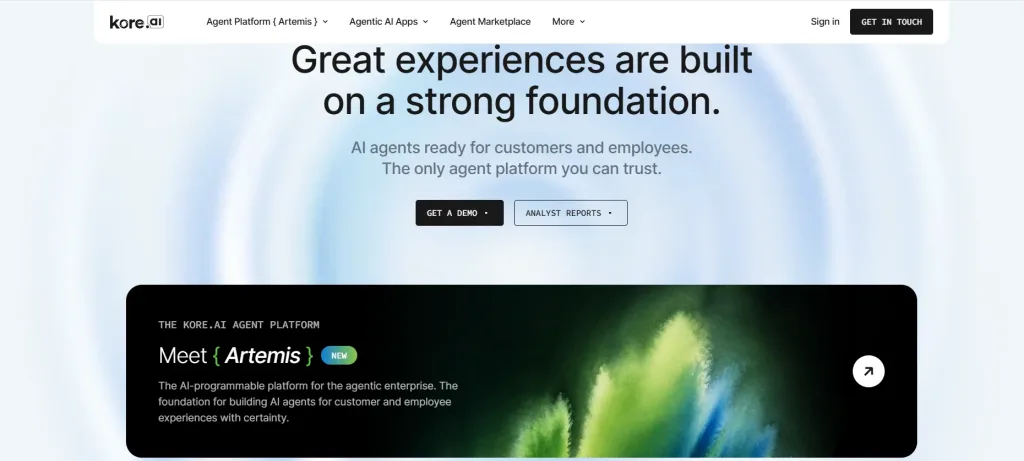
The enterprise AI suite Kore.ai offers pre-built industry applications, admin controls, and enterprise search capabilities for customer and employee support. Its AI Agent platform Artemis powers this suite.
The AI Agents of Kore.ai are goal-focused agents built on Artemis. It is able to handle complex customer service requests, access enterprise knowledge, and manage multi-turn conversations across voice and text.
Key Features:
- Artemis multi-agent orchestration coordinates agents in parallel
- Ready-to-deploy applications
- Proactive outbound campaigns
- Agentic RAG and enterprise search retrieve contextually precise answers
Pricing
- Starts at $50/month for Essential
- $150/month for Advanced
Why Choose Kore.ai
If your enterprise needs advanced automation with strong controls for complex or regulated environments, go for Kore.ai. It supports multi-agent coordination, enterprise search, industry-specific applications, and thousands of ready-made API actions.
Kore also handles proactive customer outreach and automated quality monitoring. This makes it a strong option for large organizations in sectors such as banking, healthcare, IT, and customer service.
4. Sierra.ai
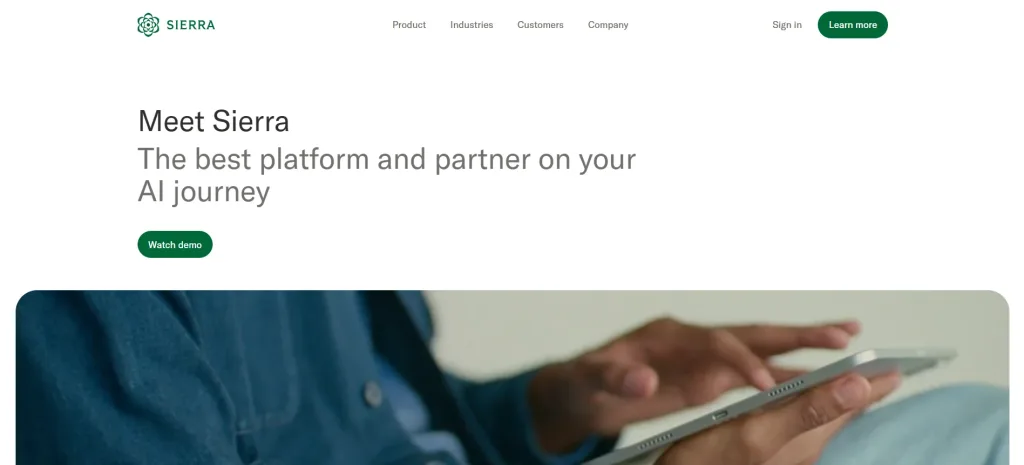
Sierra is a conversational AI platform built for large brands, with tools for testing, monitoring, and reporting. Businesses use the platform to deploy the Sierra Agent, which acts as the customer-facing AI agent.
While the platform provides the management environment through tools such as Agent Studio, the Sierra Agent handles the actual customer interaction. It follows goal-based workflows, using stored customer context, and managing complex processes that continue over days or weeks.
Key Features:
- Horizon agents execute goal-driven playbooks to manage processes
- Context engine and persistent memory
- Ghostwriter, an autonomous agent that builds other agents
- Explorer, uncovers hidden trends and customer behavior patterns
Pricing
- Custom
Why Choose Sierra.ai
If your business wants advanced AI agents for long and complex customer journeys, go for Sierra.ai. The agents of this platform can manage processes continuing through days or weeks while maintaining customer context and history.
Sierra also uses multiple AI models and control layers to improve reliability. Its outcome-based pricing can, though custom, appeal to enterprises that prefer paying for completed results rather than general usage.
5. Intercom Fin

As another AI-focused customer service platform, Intercom combines inboxes, ticketing, and proactive messaging tools for support teams. Intercom’s AI Agent Fin is within this environment.
While Intercom provides the helpdesk, management tools, and agent support features, Fin handles customer conversations directly able to qualify leads, support purchases, answer service questions, and complete multi-step tasks by working with connected third-party systems.
Key Features:
- A single all-in-one customer agent
- Procedures execute multi-step tasks in systems of record
- Eval, context-driven conversation delivery
- Operator, the operations Agent
Pricing
- $0.99/outcome; 50 outcomes/month minimum
Why Choose Intercom’s Fin AI
Choose Intercom’s Fin if your enterprise needs that one AI agent that can work across support, sales, and ecommerce conversations. It can answer questions, qualify leads, complete supported actions, and work with tools such as Stripe and Shopify.
Its controlled procedures help businesses define and manage how the agent performs actions, while built-in testing helps teams check agent quality before changes go live.
6. Zendesk AI Agents
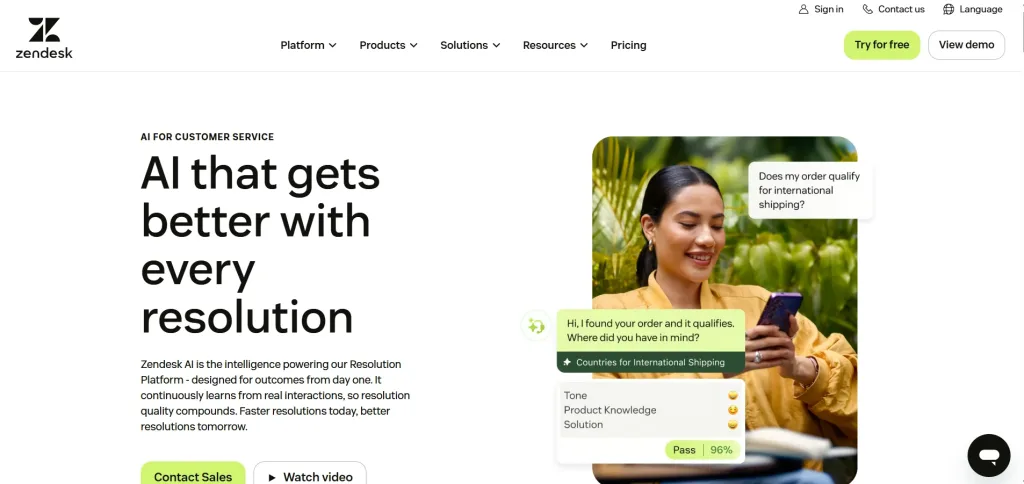
The Zendesk platform is a customer service and ticketing suite designed to manage customer conversations across multiple channels. Zendesk AI Agents are built into this platform, acting as autonomous customer-facing agents.
While Zendesk provides the main workspace for ticketing, reporting, and human support teams, the AI Agents handle customer requests directly. They use company knowledge and defined procedures to resolve issues across messaging, email, and voice with limited human involvement.
Key Features:
- Omnichannel autonomous resolution
- Grounding in unified knowledge
- Escalation with context preservation
- Built-in quality assurance
Pricing
- Costs $1.50 per committed automated resolution
- $2.00 pay-as-you-go
Why Choose Zendesk AI Agents
Zendesk’s AI Agents are for when customer service automation is your main priority, especially if the business already uses Zendesk’s customer service platform.
These AI Agents can handle multi-step customer requests across messaging, email, and voice, then transfer conversations to human agents when needed. They also ensure workflow actions, conversation quality checks, and continuous improvement based on previous resolutions.
7. Rasa
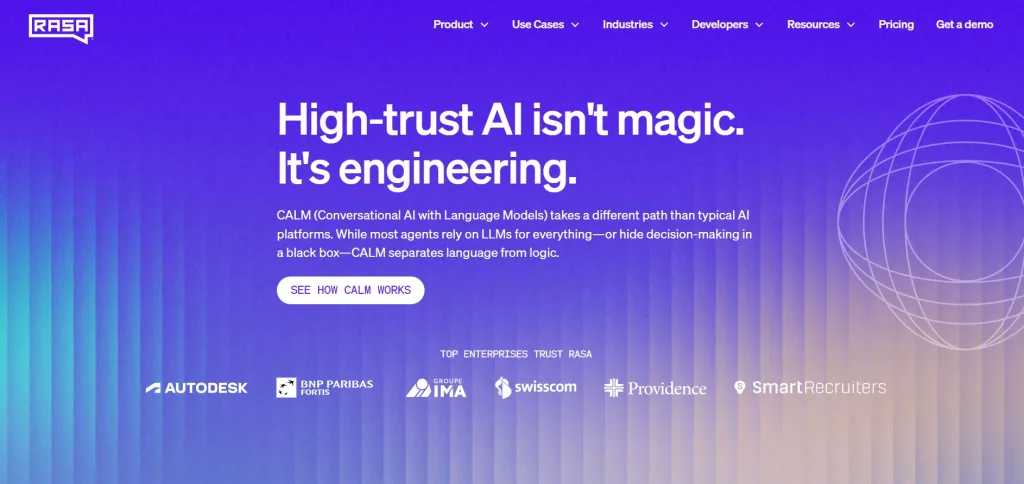
The Rasa Platform is a conversational AI environment made up of Rasa Pro, its developer framework, and Rasa Studio, its no-code design tool. This platform is used for building Rasa AI Agents powered by its CALM architecture.
The platform manages deployment, hosting, and security, and the AI agents handle live conversations. They use language models to understand what users mean while following structured business flows to complete tasks more reliably.
Key Features:
- CALM Dialogue Management separates language understanding from action execution
- Built-in conversation repair
- Deployment flexibility & data sovereignty
- Multi-agent orchestration
Pricing
- Developer Edition is Free
- Enterprise pricing is custom
Why Choose Rasa
Rasa is a good choice if your enterprise needs greater control over data, infrastructure, and AI behavior. Rasa’s support for private cloud, on-premises, and highly restricted deployment environments makes it useful for regulated industries.
Rasa helps businesses keep important actions more predictable by combining AI-based conversation understanding with controlled business workflows. It is also well suited for complex, multi-turn conversations and enterprise voice assistants.
8. Stack AI
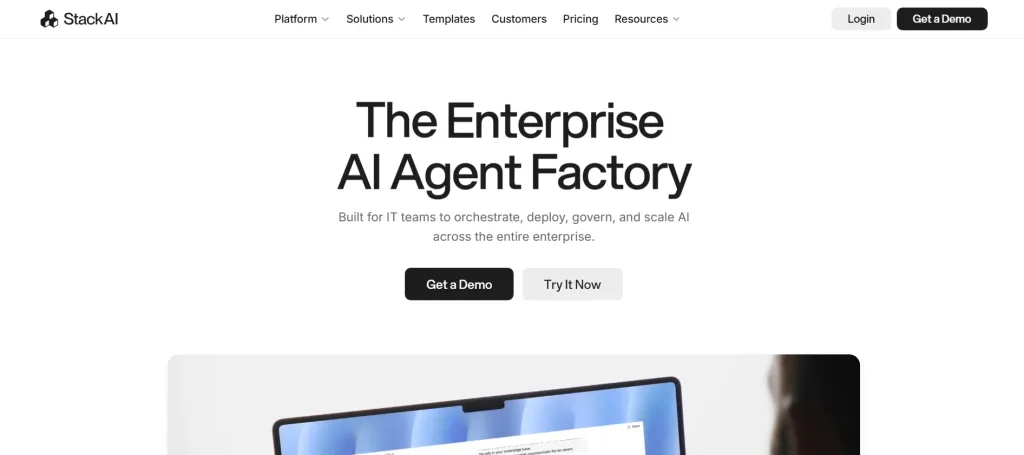
Stack AI is an enterprise AI platform orchestrated for building complex workflows without heavy coding; it works together as a team to complete multi-step business tasks.
The platform provides a visual builder, security controls, and compliance features. The individual agents handle specific tasks such as reading documents, searching databases, and extracting information. The manager agent can also coordinate several specialized subagents.
Key Features:
- Ask AI, a natural language builder that allows teams to describe what they want to build in natural language
- Human-in-the-Loop (HITL) Controls
- Orchestrator, with which subagent teams pair a manager agent to break down complex tasks and delegate them in parallel to specialized subagents
- Agentic RAG connects agents to private business data for grounded answers
Pricing
- The free plan is $0/month for 500 runs/month
Why Choose Stack AI
Choose Stack AI if your enterprise wants to build AI workflows quickly, especially for document-heavy processes. It has a visual builder that allows teams to create agents with limited coding.
Its document processing tools can work with PDFs, spreadsheets, and other business files. It also supports human approval steps and private deployment options, making it useful for sectors where security and control are important.
9. Lindy.ai
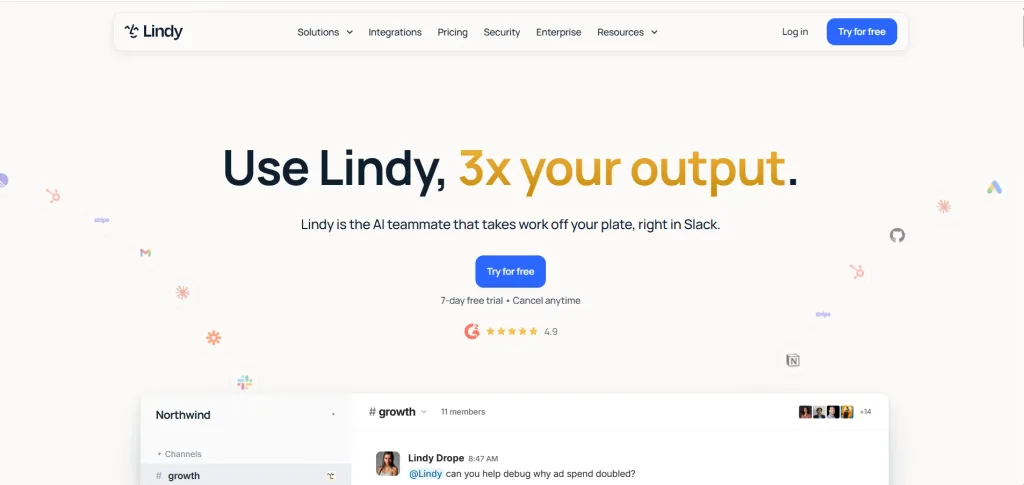
The Lindy Enterprise platform gives businesses a shared workspace for managing credentials, approved data sources, security controls, and audit logs. Within this environment, Lindy works as a role-based AI teammate.
The enterprise platform gives administrators control over access and company data, and Lindy handles the day-to-day tasks. It can work inside different tools to draft updates, run scheduled routines, and complete tasks through connected business applications.
Key Features:
- Ready-made AI role templates
- Recurring task automation
- Editable memory
- Working across native tools
Pricing
- Plus is $29.99/user/month
- Pro is $99.99
- Max is $199.99
- Enterprise is custom
Why Choose Lindy.ai
If your business wants easy-to-deploy AI assistants for everyday workplace tasks, choose Lindy.ai. It can work inside tools such as Slack, Gmail, Teams, and iMessage, with ready-made templates for roles such as SDRs, recruiters, and schedulers.
It also supports recurring tasks, editable memory, and human approval before sensitive actions. This makes it a practical choice for teams that want simple business automation without heavy development.
What to Consider When Choosing an Enterprise AI Agent
Here are a bunch of points to consider while choosing the best enterprise AI agent:
1. Define What You Want the Agent to Accomplish
Start with the problem you want the agent to solve for your business. Some enterprises need AI agents for customer support, while others may focus on sales, employee assistance, IT operations, research, or internal workflows. A clear use case makes it easier to compare platforms.
2. Evaluate Actions and Workflow Capabilities
Look beyond simple question-and-answer. A useful enterprise AI agent should be able to connect with business systems, retrieve information, update records, trigger workflows, and complete multi-step tasks.
3. Check Integrations With Your Existing Stack
The agent should work well with the systems your business already uses, such as CRM software, help desks, ecommerce platforms, databases, communication tools, and APIs.
4. Examine Security, Governance, and Access Control
Enterprise agents may handle sensitive customer and business data, so security is essential. Check for features such as role-based permissions, audit logs, data protection controls, and human approval for sensitive actions. Compliance requirements may also be important depending on your industry.
5. Consider Deployment and Scalability
Think about how the platform will perform as your business grows. Consider conversation volume, number of users, number of AI agents, supported channels, and regional requirements.
6. Understand the Full Cost
Do not judge a platform only by its advertised monthly price. Consider subscription fees, usage-based charges, implementation costs, integrations, AI consumption, maintenance, and enterprise support.
Conclusion
Enterprise AI agents are becoming a practical way for large businesses to automate complex workflows, improve customer and employee experiences, and reduce repetitive manual work. However, the right choice depends on what the business needs the agent to do, the systems it must connect with, and the level of security, control, and scalability required.
For businesses looking to automate customer-facing journeys across support, sales, and ecommerce, REVE Chat’s Wize AI Agent offers a strong combination of intelligent automation, connected workflows, and omnichannel engagement.
It also lets businesses hand off conversations to human agents when needed. You can sign up for REVE Chat to use the Wize AI Agent, or book a demo of the agent to see if it fits well for your enterprise.
KEY TAKEAWAY
The Best AI Agents for Enterprises
Choose an enterprise AI agent that balances automation, security, integrations, and human contribution, best suited for your enterprise business.
Frequently Asked Questions
Traditional chatbots are conversational but rigid, relying on scripted decisions and keyword matching to answer questions. By contrast, AI agents utilize reasoning and natural language understanding to interpret complex inputs.
Yes, production-ready enterprise platforms are built with strict security and compliance rules. These platforms support industry-standard compliance frameworks that align with established guidelines.
Yes. Depending on the platform, enterprise AI agents can connect with CRMs, help desks, ecommerce tools, databases, communication platforms, APIs, and other internal systems.
No. AI agents can handle many repetitive and high-volume tasks independently, but human oversight is still important. For sensitive or high-risk actions, businesses can set approval rules that require a human to review the action before it is completed.
Build AI-powered support with Wize AI
Connect business knowledge, automate support conversations, and improve response quality without managing a complex AI stack.
Explore Wize AI Agent Rate the article

Mohaimin Talha
Lead Product Manager
Mohaimin Talha is a seasoned Product Manager, known for his ability to combine creativity with analytical thinking. His strategic vision and customer-centric approach make him a key driver of product success and business growth.
View all articles