




Table of Content
AI SUMMARY
Quick Answer
AI agents and agentic AI are closely related, but they serve different roles. An AI agent handles specific tasks, while agentic AI focuses on planning, adapting, and completing broader goals. This blog explains their key differences, examples, use cases, benefits, and risks. It also covers how businesses can choose the right level of autonomy and where human oversight is needed.
You may have seen ‘AI agent’ and ‘agentic AI’ used in the same conversation and assumed they mean the same thing. That confusion can cause problems when you are deciding what kind of AI system your business needs. The two terms are connected, but they describe different things.
An AI agent can take a request, make a decision, use a tool, and finish a task. Agentic AI describes a broader way of working, where AI can plan several steps, choose actions, and work toward a goal with less instruction.
Knowing the difference helps you understand what you are actually buying or building. In this blog, you will learn about agentic AI vs AI agents. You will also learn about both with simple examples and practical use cases.
What Is an AI Agent?
An AI agent is software that works toward a specific goal and handles tasks for a person or organisation. It takes in information, understands what needs to happen, decides on the next step, and uses approved tools to get the job done.
For example, an AI agent can review a refund request, verify the customer’s details, retrieve the order, check the applicable policy, process an approved refund, update the relevant records, and confirm the outcome.
KEY TAKEAWAY
Choose the Right Level of AI
AI agents can handle defined tasks, while agentic AI can manage broader goals with greater flexibility. Start with a clear use case, set proper limits, and increase autonomy only when it delivers reliable results.
How an AI Agent Works
Most modern AI agents follow a recurring loop:
- Observe: The agent receives a message, event, file, system alert, or another form of input.
- Interpret: It identifies the request, relevant context, desired outcome, and constraints.
- Plan: It decides which action or sequence of actions could achieve the goal.
- Act: It searches data, calls an API, updates a record, or uses another permitted tool.
- Check: It reviews the result and determines if the task is complete, needs another step, or should be transferred to a person.
Main Components of an AI Agent
An AI agent usually combines several components:
- Model: Interprets the request, reasons about the goal, and selects an action.
- Instructions: Define the agent’s role, responsibilities, and limits.
- Tools: Connect the agent to a knowledge base, CRM, order platform, calendar, payment service, or another business system.
- Context: Provides information about the current user, task, and conversation.
- Memory: Preserves relevant details across steps or sessions when needed.
- Guardrails: Limit access, enforce policies, or require approval for sensitive actions.
- Monitoring: Records what the agent did, why an action was taken, and whether it succeeded.
The model alone does not make a complete agent. The combination of reasoning, access, instructions, controls, and the ability to act is what allows the system to perform useful work.
Examples of AI Agents
AI agents can support many defined tasks:
- A customer service agent checks an order and changes a delivery date.
- A sales agent qualifies a lead and schedules a meeting.
- An IT agent investigates an alert and opens an incident.
- A finance agent compares an invoice with a purchase order and flags a mismatch.
- A coding agent reads a codebase, updates files, and runs tests.
- A research agent gathers reliable sources and prepares a cited summary.
Some agents complete one narrow action. Others execute a connected series of steps. Both are AI agents, although the second group demonstrates a higher degree of agency.
What Is Agentic AI?
Agentic AI is an approach that lets AI systems work toward a goal with limited step-by-step instructions. The system receives an objective, decides what needs to happen, and chooses actions within set rules and permissions.
In customer service, an agentic system could review conversations, identify common issues, recommend improved responses, update approved workflows, and monitor the results. People set the goals, permissions, approval points, and limits while the system handles the work.
Core Characteristics of Agentic AI
- Goal-directed work: The system works toward an outcome instead of producing one isolated response. It can divide a broad objective into smaller tasks.
- Multi-step planning: It can arrange actions in a useful order and revise the plan if information is missing, a tool fails, or the result does not meet an expected condition.
- Tool selection: It can choose from its permitted tools based on the current need. It might search a knowledge base, check account data, call an order API, and request approval before making a financial change.
- Adaptation: Fixed automation follows a predefined path. An agentic system uses the result of one step to determine the next. It can try an approved alternative or stop and ask for help.
- State and memory: The system tracks what has happened, what remains unfinished, and which details affect the objective.
- Bounded autonomy: Agentic AI should not mean unlimited control. Production systems need permissions, approval thresholds, escalation paths, time limits, and clear stopping rules.
- Single-agent or multi-agent operation: Agentic behaviour does not need multiple agents. A single agent can handle complex, changing tasks. Multiple agents are useful when a task needs different roles, tools, permissions, or areas of knowledge.
Difference Between AI Agents and Agentic AI
The following agentic AI and AI agent comparison explains the distinction across scope, planning, tool use, autonomy, and human control.
| Factor | AI agent | Agentic AI |
|---|---|---|
| What it describes | A software system or component | A capability and approach to goal-directed operation |
| Main question | What system is doing the work? | How independently does the system perform the work? |
| Typical scope | One task or a defined workflow | A broader objective with a changing route |
| Autonomy | Can range from low to high | Usually higher, but should remain bounded |
| Planning | May follow a fixed path or create a plan | Commonly creates and revises multi-step plans |
| Tool use | Can use one or several connected tools | Often selects and coordinates tools as conditions change |
| Memory | Optional and sometimes limited to one task | Often maintains state across several steps or sessions |
| Adaptation | Depends on how the agent is designed | A central characteristic |
| Number of agents | Usually refers to one agent | Can involve one agent or a coordinated group |
| Human role | Assigns tasks, reviews results, and handles exceptions | Defines objectives, permissions, approvals, and accountability |
| Best fit | Clear tasks with predictable boundaries | Complex work in which the next step depends on new information |
AI Agent vs Agentic AI, Assistant, and Automation
Similar terminology can make different systems appear equal. Placing them on a spectrum makes their roles clearer.
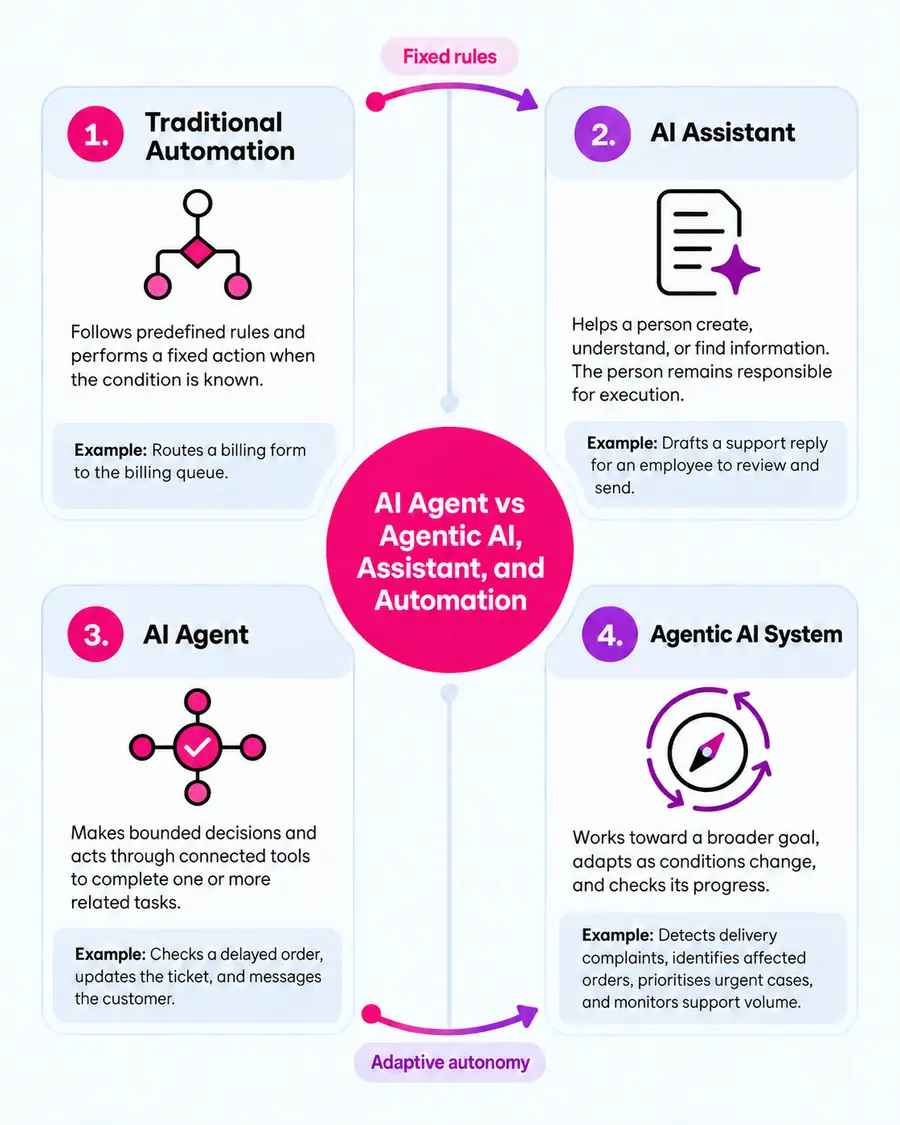
Traditional Automation
Traditional automation follows rules created in advance. When a known condition occurs, the system performs a predefined action. It is efficient and predictable, making it a suitable choice when the process is stable.
Example: If a support form contains the billing category, route it to the billing queue.
AI Assistant
An AI assistant helps a person create, understand, or find information. It may summarise a conversation, draft a response, or recommend an action. The person remains responsible for execution.
Example: A support copilot prepares a reply for an employee to review and send.
AI Agent
An AI agent can make a bounded decision and act through connected tools. It may complete one task or several related actions.
Example: The agent checks a delayed order, updates the ticket, and sends an approved message to the customer.
Agentic AI System
An agentic system works toward a broader objective, changes its actions as conditions evolve, and checks its progress. It may use one agent or coordinate several agents.
Example: The system detects an increase in delivery complaints, finds the affected region, identifies relevant orders, prepares an approved communication plan, prioritises urgent cases, and monitors the change in support volume.
How AI Agents and Agentic AI Work Together
An AI agent performs a specific task, while agentic AI provides the broader system that allows one or more agents to plan, act, and coordinate their work.
For example, in customer onboarding, one AI agent may verify account details, another may recommend the right setup, and another may identify customers who need assistance. The agentic AI system connects these activities, determines what should happen next, and moves the process toward a defined goal.
However, agentic AI does not always require multiple agents. A single capable AI agent may be enough for a focused workflow. Multiple agents are useful when tasks require different expertise, tools, permissions, or actions to run at the same time.
The relationship is simple:
- AI agent: Handles a task.
- Agentic AI: Guides the work toward a goal.
- Multi agent system: Uses several agents to handle different parts of the work.
Agentic AI vs AI Agents: Examples in Customer Service
Customer service makes the AI agent vs agentic AI distinction easier to understand because the work ranges from simple information requests to end-to-end resolution.
Scenario 1: Answering a Policy Question
A customer asks how long they have to return a product. An AI agent identifies the customer’s location, retrieves the correct policy, and provides an answer.
The task has a clear goal and a predictable path. It may require retrieval and customer context, but it does not need a broad agentic system.
Scenario 2: Changing a Delivery Date
A customer asks to move a delivery to Friday. The agent needs to:
- Understand the requested change.
- Verify the customer’s identity.
- Retrieve the correct order.
- Check available delivery dates.
- Update the order through a permitted action.
- Confirm the change with the customer.
One AI agent can complete this process. It demonstrates agentic behaviour because the result of each action affects the next step. If Friday is unavailable, the agent may offer valid alternatives instead of repeating the original action.
Scenario 3: Managing a Wider Service Problem
Suppose hundreds of customers begin asking about late orders in the same area. A more agentic system could detect the pattern, check delivery data, find affected customers, recommend an approved response, prioritise urgent cases, and monitor the resolution rate.
The system is no longer handling one conversation. It is pursuing a broader service outcome across data, tools, customers, and teams.
Scenario 4: Recovering From a Failed Action
A customer asks to reschedule an appointment, but the calendar service is unavailable. A basic workflow may stop and display an error. A more agentic system could check an approved alternative system, offer available times, create a pending request, or transfer the conversation with the failure details attached.
The important distinction is not simply the number of steps. It is the system’s ability to respond appropriately when the expected route no longer works.
Knowing When a Human Is Needed
Greater agency should improve access to human support, not make it harder.
A well-designed system should transfer cases involving:
- Emotional distress or urgent personal circumstances
- Legal, medical, or financial risk
- Unusual or high-value payments
- Unclear customer identity
- Policy exceptions
- Repeated tool or workflow failure
- Conflicting information
- Low confidence about the correct action
The handover should include the conversation, verified customer details, actions already attempted, tool results, and the reason for escalation. Customers should not have to explain the entire issue again because the AI reached its limit.
Business Benefits of AI Agents and Agentic AI
Let’s explore the business benefits of AI agents and agentic AI:
1. Completing Work, Not Just Generating Answers
AI agents can retrieve information, update records, schedule events, and complete approved service actions. This shifts the focus from generating responses to completing customer and business tasks.
2. Faster Service Across Connected Systems
An agent can gather relevant information from approved tools without requiring an employee to switch repeatedly between a CRM, knowledge base, order platform, and help desk.
3. More Consistent Process Execution
For suitable cases, the agent can apply the same identity checks, policy rules, and approval requirements consistently.This can reduce avoidable variation, although monitoring remains necessary to identify incorrect decisions.
4. Continuity Through Longer Tasks
More agentic systems can retain relevant state, adjust when conditions change, and check if an action produced the intended result. This is useful when a process cannot be completed in a single interaction.
5. Support Beyond Normal Operating Hours
Approved, low-risk requests can be handled when employees are unavailable. Sensitive decisions can remain protected by approval requirements and escalation rules.
Risks and Limits Businesses Need to Consider
Allowing AI to act introduces risks that do not exist when a model only drafts text. So, businesses need to consider:
1. Incorrect or Unverified Actions
An inaccurate answer can mislead someone. An inaccurate action can change a record, contact the wrong person, or create a financial loss. Critical facts should be verified before execution, and high-impact actions should require approval.
2. Prompt Injection
An agent may encounter misleading instructions inside a webpage, email, document, or retrieved record. If it treats untrusted content as operating instructions, an attacker could influence its decisions. External content must remain separate from trusted system instructions.
3. Weak Observability
Teams need to know which tools the agent used, what information influenced a decision, what changed, and where a process failed. Logs, traces, evaluations, and audit records are core requirements for an action-taking system.
4. Memory and Cascading Errors
Stored context can become outdated or incorrect. One early mistake can affect every later action. Memory needs retention rules, correction methods, access restrictions, and separation between customer accounts. Critical information should be checked again before irreversible steps.
5. Cost and Latency
Multi-step planning, system connections, retries, and agent coordination can increase response time and operating costs. A complicated system can cost more and respond more slowly without improving the outcome.
6. Governance and Accountability
Although it is not specific to agentic AI, NIST’s Generative AI Risk Management Profile recommends documented governance, testing, monitoring, incident response, transparency, and clearly assigned organisational responsibilities. The organisation remains accountable for actions performed by its systems.
Gartner predicted that more than 40% of agentic AI projects would be cancelled by the end of 2027 because of rising costs, unclear business value, or inadequate risk controls.
This is a forecast about project execution and value, not a claim that agentic AI as a technology will fail. The practical lesson is to begin with a valuable process and prove the result before expanding autonomy.
How to Choose the Right Level of Agency
Choosing the right level of agency means balancing authority, adaptability, risk, and operational complexity.
1. Define a Measurable Outcome
“Adopt agentic AI” is not a business outcome. “Reduce order-status handling time while maintaining accuracy” is measurable. A clear objective also prevents the system from optimising the wrong result.
2. Map the Complete Process
Document the systems, decisions, people, data, and exceptions involved. A stable process may work better with traditional automation or a focused agent. A changing process with several dependent steps may justify more agentic behaviour.
3. Separate Information From Action
Identify which steps provide information and which ones alter business data, contact customers, spend money, or create obligations. Action-taking steps need stricter permissions and validation.
4. Rate Risk and Place Approval Points
Consider the financial, legal, privacy, customer, and operational effect of an error. Low-risk and reversible actions can receive greater autonomy. High-risk actions need approval or human execution. Technical ability does not remove the need for review.
5. Check Data and Integration Readiness
An agent cannot complete a process reliably when information is missing, inconsistent, or trapped in disconnected applications. Improving data access and quality may create more value than adding another agent.
6. Start With the Smallest Useful Scope
Choose a process with clear value, sufficient volume, and manageable risk. Start with the minimum tools and permissions required to complete it. Expand only when evidence supports the change.
7. Test Exceptions, Not Just Ideal Cases
Happy-path demonstrations reveal little about reliability. Test missing data, conflicting policies, unavailable tools, ambiguous requests, duplicate records, timeouts, and attempts to manipulate the agent.
8. Measure Completed Work
Useful metrics include:
- Task completion rate
- Resolution rate
- Accuracy of actions
- Human handover rate
- Customer satisfaction
- Time to completion
- Cost per completed task
- Number of corrected or reversed actions
- Percentage of handovers with complete context
An agent that produces fluent replies but does not complete the customer’s request is not delivering the intended outcome.
Questions to Ask an AI Agent Vendor
Before selecting a platform, ask:
- What customer or business outcomes can the agent complete?
- Which tools and data sources can it access?
- How are permissions limited by role, action, and customer account?
- Can sensitive actions require human approval?
- What happens when a tool fails or returns conflicting information?
- What does the agent do when confidence is low?
- Can the business inspect the steps and tool calls behind an action?
- How are conversations, completed actions, failures, and handovers reported?
- How is customer information stored, separated, and protected?
- How is the system tested before and after release?
- Can autonomy be configured for different workflows?
- What is the cost per completed business outcome?
Clear answers matter more than a claim that a product is fully autonomous or agentic.
How Wize AI Agent Supports Customer Service Workflows
For customer service, the practical value of an AI agent comes from its ability to move a request forward.
Wize AI Agent by REVE Chat understands what customers need, finds answers from approved information, collects details, and completes tasks it is allowed to handle.
When a request requires human assistance, the conversation can be transferred to a human agent with the relevant context. The human agent can see what the customer requested, which information was provided, and which steps have already been completed.
Explore Wize AI Agent to see how AI-powered customer conversations can support faster, more connected service.
Final Thoughts
The agentic AI vs AI agents comparison becomes clearer when the terms are viewed as two parts of the same discussion. An AI agent is the software system that performs the work. Agentic AI describes the system’s capacity for goal-directed planning, adaptation, and action.
A business does not need the highest possible level of autonomy. It needs the right level for the process. A focused AI agent can resolve a defined customer request with less cost and risk. A more agentic system can help when work crosses tools, changes as it progresses, and must be followed from the initial signal to the final outcome.
Start with the customer or operational problem. Define success, restrict access, require approval where the impact is high, and measure completed work. Add greater agency only when it produces a result that a simpler system cannot deliver.
Frequently Asked Questions
No, although they are closely related. An AI agent is a software system that pursues a goal and takes action. Agentic AI describes a system’s ability to plan, adapt, select tools, and work through several steps with bounded independence.
An AI agent is the entity performing the task. Agentic AI refers to the level and style of agency demonstrated during the task. One agent can display a low or high degree of agentic behaviour.
No. A single agent can plan and complete a changing, multi-step workflow. A multi-agent design may be useful when separate roles need different instructions, tools, knowledge, or permissions.
A scripted chatbot that follows predefined rules and responses is better classified as conversational automation than as an AI agent. A conversational system may qualify as an AI agent when it reasons about a goal and uses tools to complete actions, such as changing an appointment or retrieving an order.
A narrowly scoped agent or fixed workflow generally costs less. Multi-step planning, repeated tool calls, persistent memory, retries, and multi-agent coordination add development and operating costs. Cost should be measured against completed outcomes rather than the number of model responses.
Build AI-powered support with Wize AI
Connect business knowledge, automate support conversations, and improve response quality without managing a complex AI stack.
Explore Wize AI Agent Rate the article

Mohaimin Talha
Lead Product Manager
Mohaimin Talha is a seasoned Product Manager, known for his ability to combine creativity with analytical thinking. His strategic vision and customer-centric approach make him a key driver of product success and business growth.
View all articles
See What Wize AI Can Do
Wize AI is an AI Agent that can handle customer requests, use business data, and complete tasks based on your rules. Start your free trial and see how it can support your customer service team.
Explore Wize AI Today