





Table of Content
AI SUMMARY
Quick Answer
Customer experience with agentic AI helps businesses handle customer requests from start to finish. AI agents can understand what customers need, check relevant information, take approved actions, and bring in a human when needed. They can help with tasks like tracking orders, changing bookings, processing returns, and solving common support issues. Businesses can get better results by starting with simple tasks, setting clear rules, protecting customer data, and keeping human oversight in place for complex or sensitive requests.
A customer asks a support chatbot to change a delivery date. The chatbot explains what to do, but it cannot check the order, find an available slot, or update the booking. The customer still needs to speak to a human agent and explain the issue again.
With agentic AI, the process can be much simpler. An AI agent can understand the request, verify the customer, check the order, find an available date, update the booking, and confirm the change. If the request needs human help, it can hand over the conversation along with the relevant details.
This changes the customer experience with AI from simply providing answers to helping customers get things done. However, businesses still need reliable data, clear permissions, proper escalation rules, and human oversight to use AI safely.
In this blog, you will learn about how agentic AI is changing customer experience, how AI agents handle customer tasks, where they can add value, and what businesses should consider before giving them access to business systems.
What Is Customer Experience With Agentic AI?
Customer experience with agentic AI refers to using AI systems that can work toward a customer’s goal, make limited decisions, use connected business tools, and complete authorized tasks.
A conventional chatbot may answer a question about a return policy. An AI agent can potentially check whether an order qualifies for a return, create the request, generate a return label, update the order record, and notify the customer.
The word “agentic” does not mean that the system has unlimited independence. The business should determine which information the agent can access, which actions it can perform, and when it must involve a human.
A well-designed AI agent should be able to:
- Understand the customer’s request and context
- Ask questions when information is missing
- Select the appropriate tool or workflow
- Follow business policies and permission limits
- Perform an authorized action
- Verify whether the action succeeded
- Record what it did
- Escalate the case when it cannot proceed safely
The important difference is not that the system can speak naturally. It is that the system can connect a conversation to a controlled business process.
KEY TAKEAWAY
Using Agentic AI for Better Customer Experience
Agentic AI can complete customer tasks, reduce effort, and speed up support. Businesses should start with simple tasks, set clear rules, protect customer data, and keep human support available.
How Agentic AI Differs From Traditional AI and Generative AI
Traditional AI follows rules, while generative AI creates content from a prompt. Agentic AI can take a goal, decide what steps are needed, and take action to complete the task.
| Aspect | Traditional AI | Generative AI | Agentic AI |
|---|---|---|---|
| Main purpose | Analyzes data and follows set rules | Creates content from a prompt | Works toward a specific goal |
| How it works | Uses predefined rules and patterns | Responds to instructions from users | Plans steps and decides what to do next |
| Decision-making | Makes limited decisions based on set rules | Generates a response but does not usually take action | Makes decisions within set rules and permissions |
| Working with systems | Usually handles tasks within a specific system | Mainly creates text or other content | Can work with connected tools and business systems |
| Customer service example | Sorts support tickets or predicts customer churn | Writes an apology for a late delivery | Checks the shipment, confirms the delay, and issues an approved credit |
| Final outcome | Provides a prediction or classification | Produces content | Completes a task by taking the required actions |
Why Agentic AI Matters for Customer Experience
Customer-service processes are often fragmented. A customer may receive an answer from one system, complete a form in another, wait for approval from a different team, and contact support again to confirm the result.
Agentic AI can reduce this effort by connecting customer conversations to the systems where the actual work happens.
Salesforce’s 2025 State of Service research surveyed 6,500 service professionals and decision-makers. Respondents estimated that AI handled 30% of service cases at the time of the research and expected the figure to reach 50% by 2027.
Gartner has also predicted that agentic AI could autonomously resolve 80% of common customer-service issues by 2029, contributing to a 30% reduction in operational costs.
These figures are forecasts, not guaranteed outcomes. The results will depend on the quality of each company’s workflows, integrations, business rules, and customer data. Connecting an AI agent to a poorly designed process may only allow the same problems to happen faster.
How Agentic AI Is Changing Customer Experience
Agentic AI is changing customer experience by helping businesses provide faster support and solve problems with fewer steps. Four key changes show where customer experience is heading.
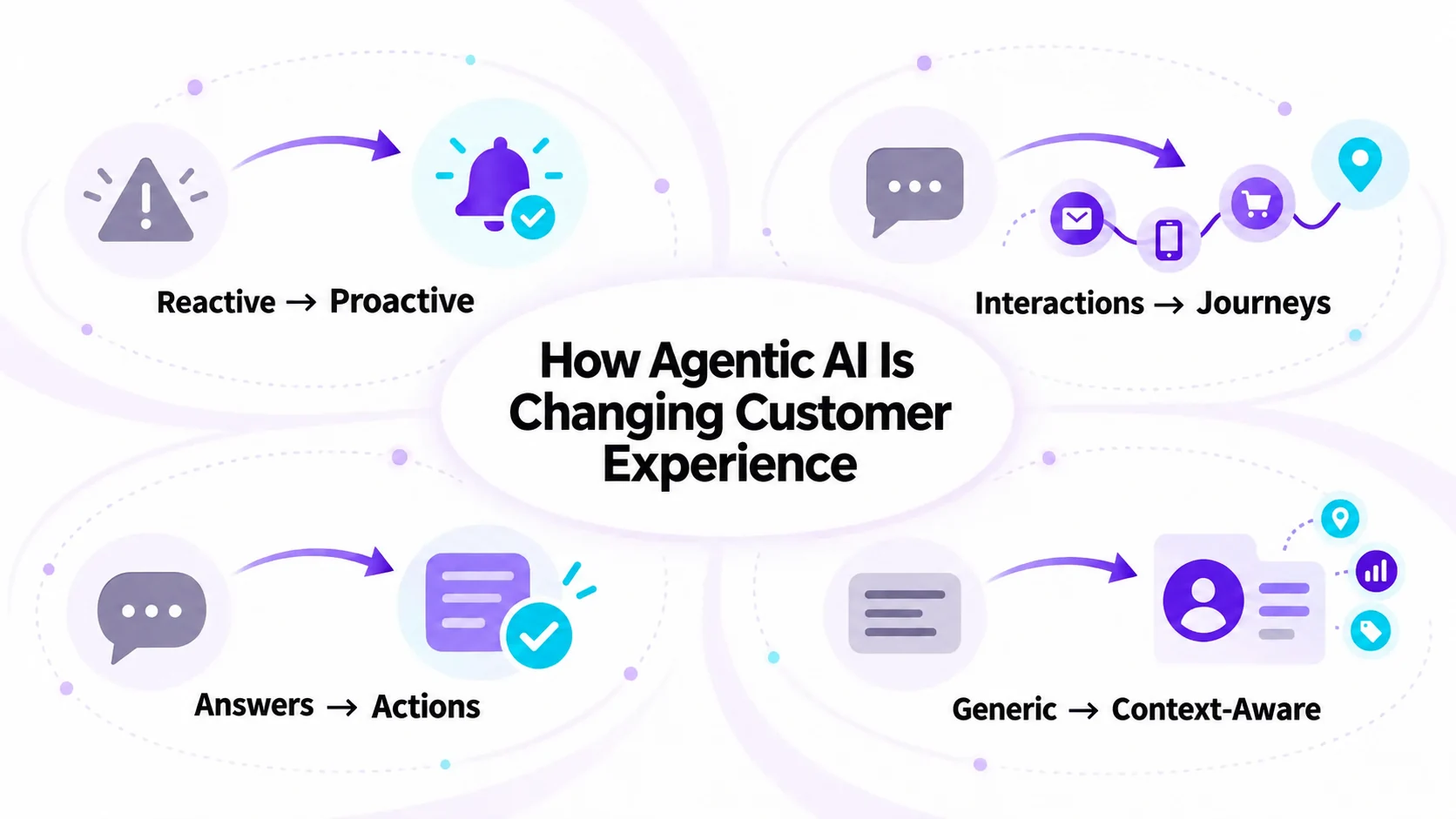
From Answering Questions to Completing Tasks
Customers rarely contact support because they only want information. They usually want something to happen.
They may want to change a booking, update an address, cancel a subscription, dispute a charge, or return an item. A chatbot that only explains the process still leaves the customer responsible for completing it.
An AI agent can connect the conversation to an approved workflow. It may retrieve the relevant record, apply a policy, perform an action, verify the result, and explain what changed.
Wize AI by REVE Chat can retrieve customer information, follow business rules, take the right action, verify the result, and explain what changed to the customer.
This reduces the distance between the customer’s request and the final outcome.
From Reactive Support to Proactive Service
Traditional support normally begins after a customer reports a problem. Agentic AI can respond to operational signals and offer help earlier.
For example, an agent may respond when:
- A delivery is delayed
- A payment fails
- A service outage affects the customer
- An onboarding process remains incomplete
- A customer repeatedly encounters the same error
The agent needs access to reliable information from order systems, payment platforms, product analytics, or CRM records. The business must also decide when proactive communication is genuinely helpful and when it may feel intrusive.
From Fixed Flows to Goal-Based Support
Traditional chatbots often follow predefined decision trees. They work well when customer requests match the available options but may struggle with unexpected language or requests containing several issues.
An AI agent can interpret the customer’s goal and determine which approved workflow is relevant. It can also ask a clarifying question when the request is ambiguous.
For example, “I need to change my order” could refer to the delivery address, product quantity, payment method, or delivery date. A responsible agent should identify the missing information rather than guess.
From Disconnected Channels to Continuous Context
Customers may begin on website chat, follow up through email, and later contact a business through WhatsApp. When these channels are disconnected, customers must explain the problem repeatedly.
Agentic AI can help maintain continuity, but only when the business has connected its channels and can identify the customer appropriately. The agent needs access to a unified conversation history or customer record.
Cross-channel continuity is not an automatic result of using AI. It requires connected systems, reliable identity matching, suitable consent, and well-managed data.
From Basic Personalization to Relevant Decisions
Using a customer’s name is not meaningful personalization. A more useful experience considers the customer’s current situation.
An AI agent may use an order status, service plan, previous support case, or product preference to determine the most relevant next step.
However, the agent should only access information required for the task. Giving it unrestricted access to customer data creates unnecessary risk.
How Agentic AI Completes Customer Tasks: Step-by-Step
An AI agent should not move directly from a customer’s message to a consequential action. A reliable workflow includes several stages.
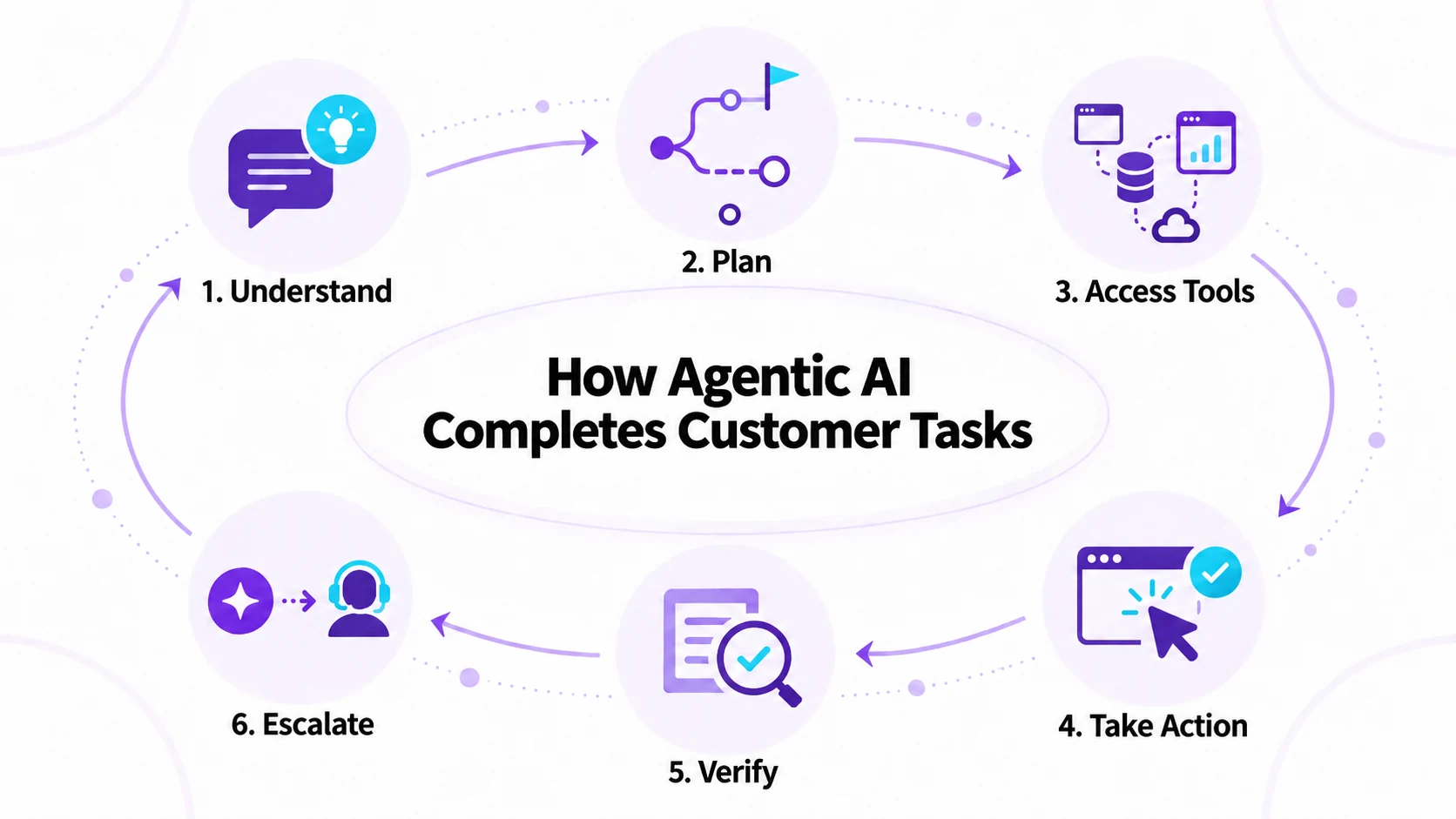
1. Understanding the Request
The agent identifies what the customer wants and extracts the relevant details.
If someone says, “Can you move my delivery to Friday?” the agent must determine which order the customer means, which Friday they mean, and whether the order can still be changed.
If important information is missing, the agent should ask a focused question.
2. Verifying Identity and Authority
Before accessing personal records or changing an account, the agent may need to verify the customer’s identity.
The required verification should reflect the risk. Reading a public policy requires no identity check. Viewing an order may require a verified session. Changing payment details may require stronger authentication.
3. Planning the Required Steps
Once the request is clear, the agent determines which actions and tools are required.
For a delivery change, it may need to retrieve the order, review its status, find available dates, confirm the choice, update the delivery system, and notify the customer. The plan should remain within a workflow approved by the business.
4. Accessing Connected Systems
The agent uses business systems such as a CRM, order-management platform, help desk, billing system, or knowledge base.
Access should follow the principle of least privilege. If an agent only needs to read an order status, it should not automatically receive permission to cancel the order or issue a refund.
5. Applying Business Rules
Before acting, the agent checks the relevant policies. These may define:
- Which orders can be changed
- The maximum refund the agent can approve
- Which changes require customer confirmation
- Which requests need human review
- When an issue must be escalated immediately
Important restrictions should be enforced by the business system or workflow whenever possible. A language model should not be the only mechanism protecting a critical process.
6. Taking and Verifying the Action
After all conditions are met, the agent sends the approved instruction to the relevant system.
It should then check the system’s response. A tool request is not proof that the task was completed. If the action fails or produces an uncertain result, the agent should not tell the customer that it succeeded.
The agent should only retry when doing so is safe. Otherwise, it should explain the situation and escalate the case.
7. Recording and Escalating
The system should record what the customer requested, which tools the agent used, which action it performed, and whether the task succeeded.
The agent should involve a human when:
- The customer’s request remains unclear
- Identity cannot be verified
- Information is unavailable or conflicting
- The action exceeds its authority
- The request involves a sensitive complaint
- A connected system fails
- The customer asks for a human
A good handoff should include the conversation, customer context, actions already attempted, and the reason for escalation.
Agentic AI Across the Customer Journey
Agentic AI can support customers at different stages, from choosing a product to getting help after a purchase.
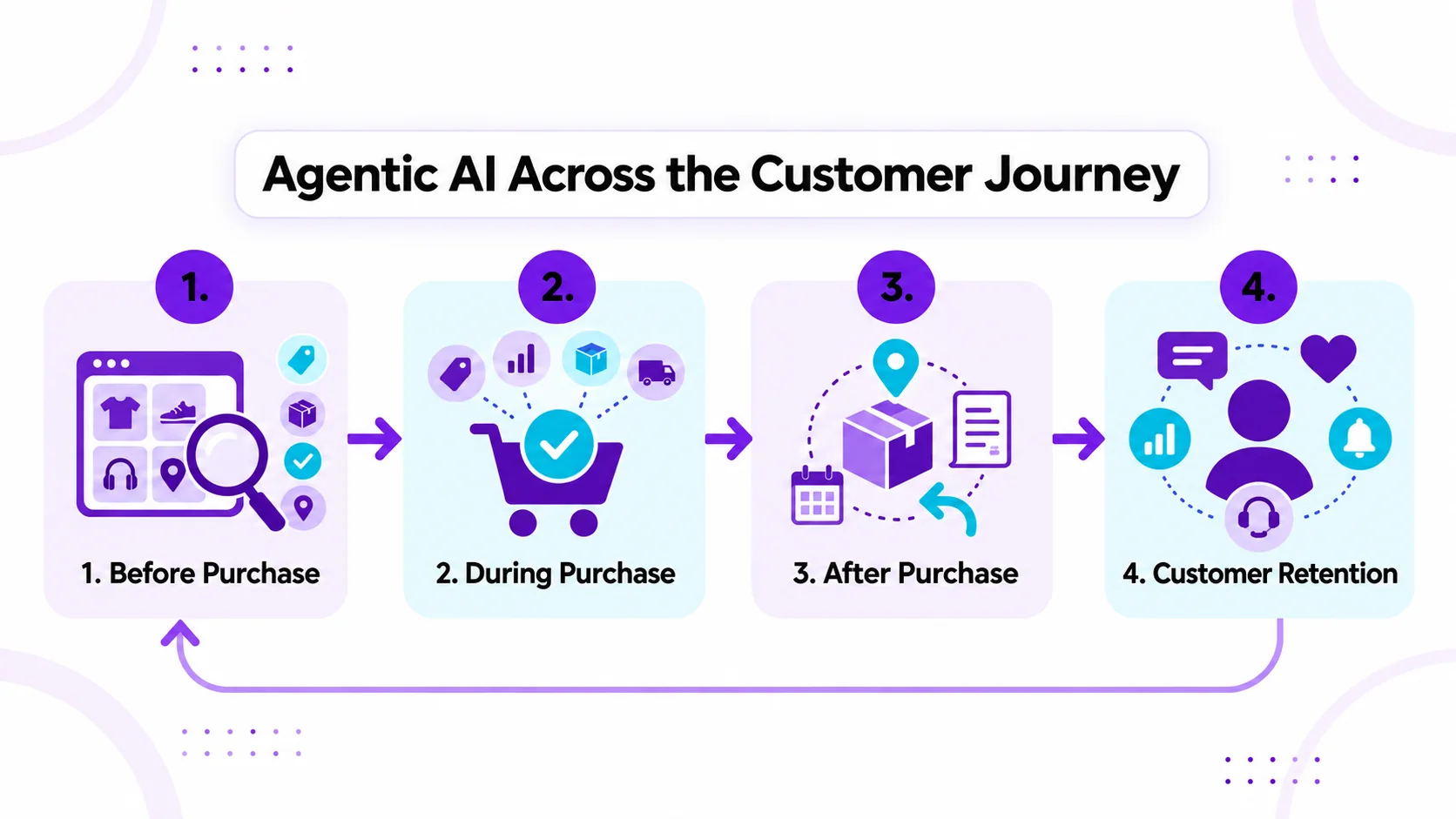
1. Before Purchase
AI agents can help customers explore products by asking about their requirements, searching a product catalog, and explaining suitable options.
Useful recommendations should consider factors such as budget, availability, compatibility, and delivery location instead of simply promoting the products a business wants to sell.
2. During Purchase
An agent can answer questions about price, features, stock, and delivery. It can also compare products or plans and guide the customer through the next step.
If a customer leaves the process, the business may use an agent to offer assistance. This outreach should follow consent, privacy, and communication-frequency rules.
3. After Purchase
An authorized agent can help customers track deliveries, retrieve invoices, update selected details, manage appointments, or begin a return.
These workflows are often good starting points because they are frequent, structured, and measurable.
4. Customer Retention
Agents can respond to signals such as declining usage, repeated errors, incomplete onboarding, or unresolved complaints.
However, an agent should not assume why a customer is disengaging. It may offer relevant assistance, while sensitive conversations and discretionary offers may still require a human.
Real Examples of Agentic Customer Experience
Here are a few real examples of companies using agentic AI to handle customer needs and improve service.
1. Fisher & Paykel
According to a Salesforce customer story published in September 2026, Fisher & Paykel introduced an AI agent to help customers troubleshoot appliance issues and manage service requests.
The agent can ask questions to identify an appliance model, retrieve relevant information from product manuals, and provide model-specific guidance. For service appointments, it verifies customer details before allowing customers to track, cancel, or reschedule a booking.
Salesforce reports that customers using the system resolve issues through self-service approximately 80% of the time and that 45% of service appointments are completed online.
The example shows that the conversation is only one part of the solution. The agent also depends on reliable product information, CRM data, identity verification, escalation paths, and monitoring.
2. Microsoft
Microsoft reports using an AI-driven web agent called Ask Microsoft to help visitors find product, pricing, support, and trial information.
The system uses specialized agents for different areas of Microsoft’s website and selects relevant sources based on the customer’s question. It can also transfer conversations to human agents.
According to Microsoft’s published case study, the updated system delivered up to 61% lower response latency, up to 70% fewer human escalations, and a 16% increase in product-trial initiations in one reported test.
Because this is Microsoft’s own case study, these figures should be treated as company-reported results rather than independent industry benchmarks.
Agentic AI Use Cases Across Industries
Different industries can use agentic AI to handle everyday customer requests and complete tasks with less manual work.
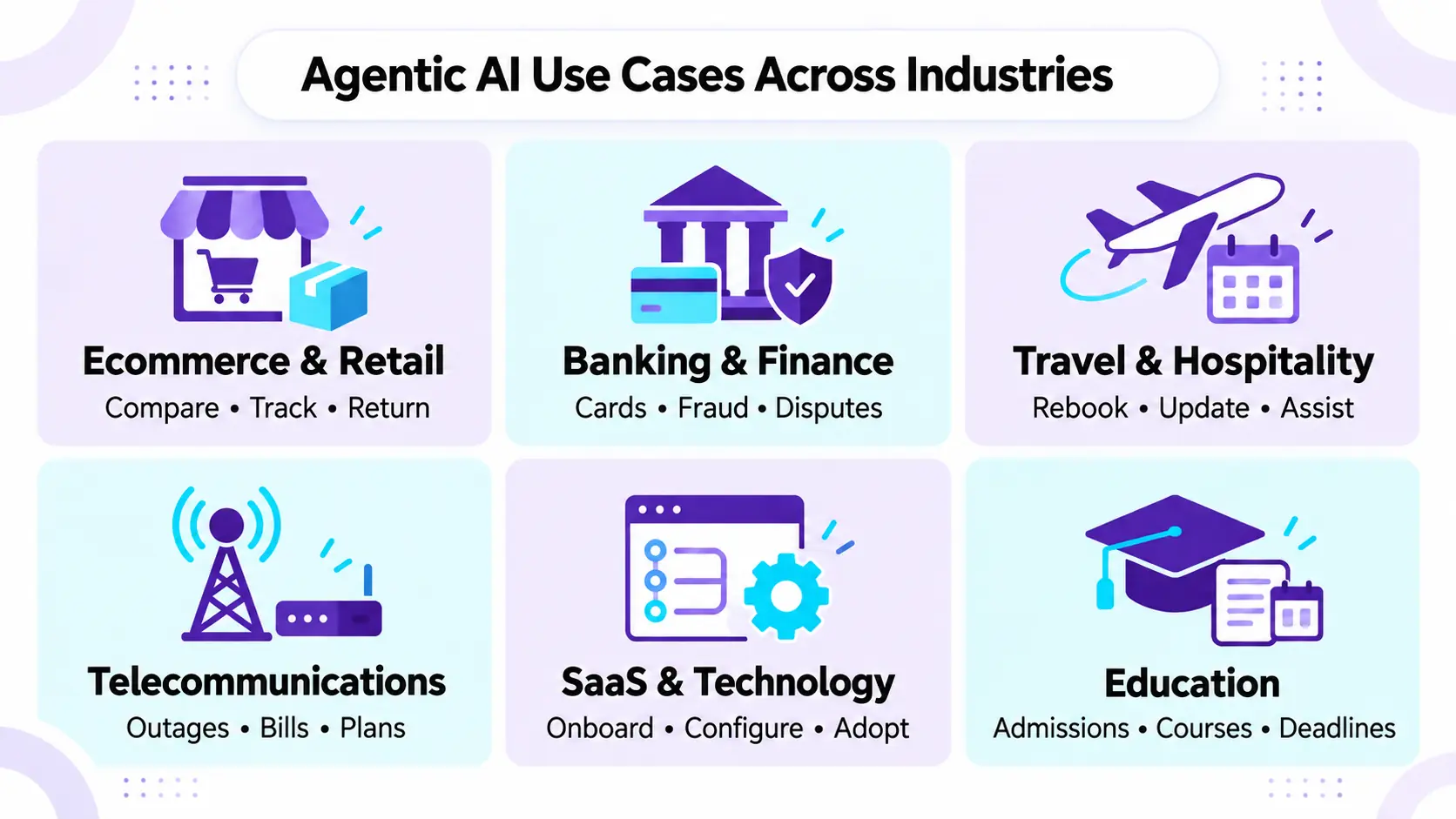
1. Ecommerce and Retail
AI agents can help customers compare products, check availability, track orders, manage deliveries, and start approved returns. Read-only tasks such as checking an order are usually easier to automate than high-value refunds or policy exceptions.
2. Banking and Financial Services
Agents can assist with transaction questions, lost-card reports, fraud alerts, and disputed charges. Financial actions require strict identity controls, system-level authorization, audit records, and clear escalation procedures.
3. Travel and Hospitality
AI agents can check reservations, identify alternative flights or rooms, and update eligible bookings. Complex rebooking, compensation disputes, and special circumstances may still require human judgment.
4. Telecommunications
Agents can check outages, guide customers through troubleshooting, explain bills, and manage selected plan requests. They should resolve the underlying service problem before recommending an upgrade.
5. SaaS and Technology
AI agents can support onboarding, retrieve product guidance, help users configure features, and identify customers struggling with adoption. Account changes should reflect the user’s role and permissions.
Benefits of Agentic AI for Customer Experience
Agentic AI can improve customer experience by helping customers complete tasks faster, with fewer steps and less need for human assistance.
1. Reduced Customer Effort
Customers can complete more tasks in one conversation instead of moving between channels, forms, and departments.
2. Faster Resolution
Agents can retrieve information and perform routine actions without waiting for an employee. The actual speed still depends on the connected systems.
3. More Consistent Service
Approved business rules can be applied across routine workflows. Companies must keep those rules updated and test whether the agent applies them correctly.
4. Greater Availability
AI agents can handle suitable requests outside normal support hours. Businesses still need a plan for urgent or complex cases.
5. Better Use of Human Expertise
Automating structured work allows employees to focus on complaints, exceptions, relationship management, and service recovery.
Challenges Businesses Must Address
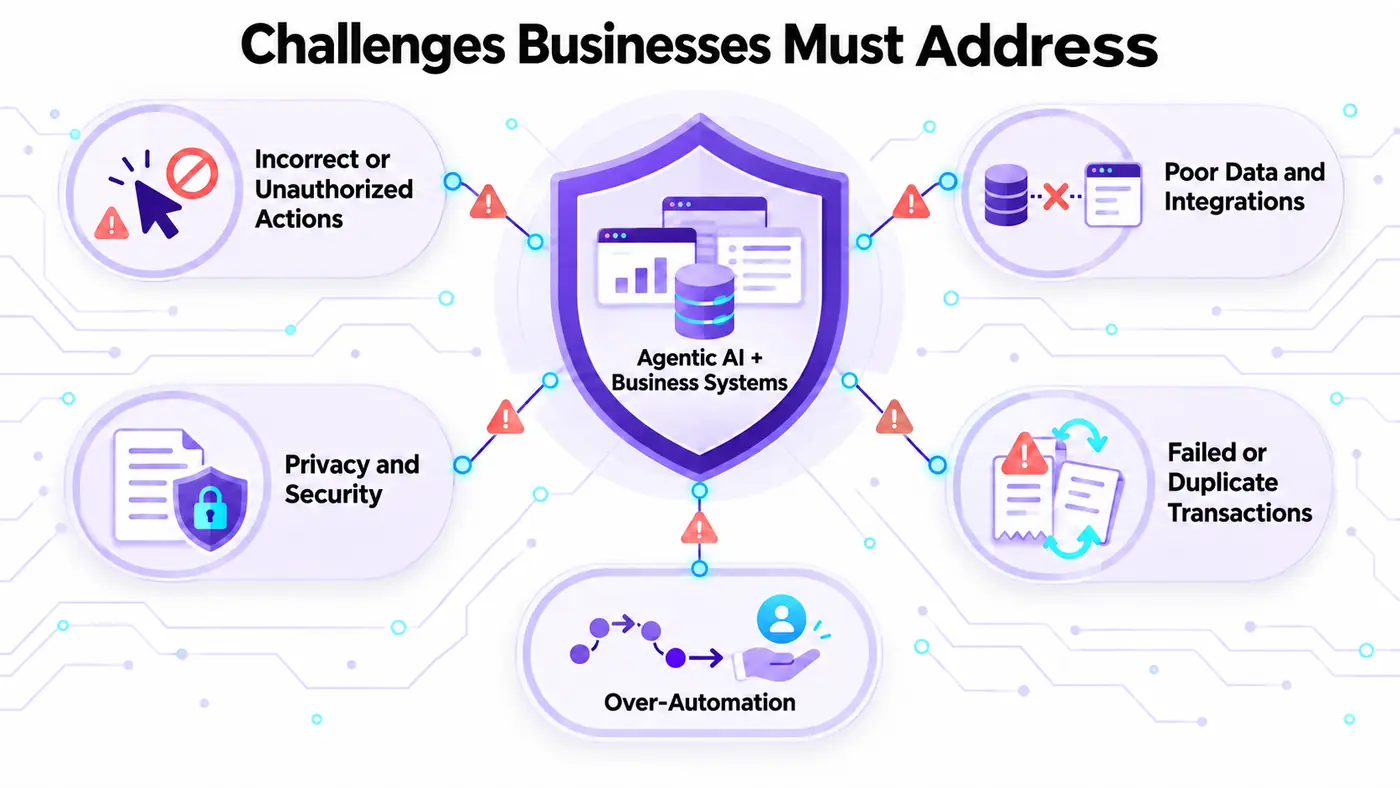
Agentic AI can bring new risks when it is given access to business systems and allowed to take actions. Businesses need to address these challenges before expanding its use.
1. Incorrect or Unauthorized Actions
A fluent response can still be wrong. Businesses should use strict permission limits, confirmation steps, system validation, and human approval for high-risk actions.
2. Poor Data and Integrations
Outdated policies, incomplete records, or failed system connections can lead to incorrect responses. Data sources and integrations require continuous maintenance.
3. Privacy and Security
Agents should only access the data required for a task. Sensitive information should be protected, and consequential actions should remain traceable.
4. Failed or Duplicate Transactions
An agent may lose its connection after sending an action without knowing whether it succeeded. Retrying could create duplicate refunds, bookings, or orders. Workflows need verification checks and safe retry rules.
5. Over-Automation
Sensitive complaints and unusual requests may require empathy, negotiation, or judgment. Customers should always have a clear route to human support.
How to Implement Agentic AI Responsibly
A careful approach starts with choosing a task where an AI agent can add value without creating unnecessary risk.
1. Choose the Right First Use Case
Start with a frequent, structured, low-risk, and reversible task. Order-status checks are generally safer than refunds or account cancellations.
Evaluate each task based on:
- Request volume
- Process complexity
- Data availability
- Potential impact of an error
- Reversibility
- Need for human judgment
2. Define Permissions and Escalation Rules
Specify what the agent can read, change, approve, and communicate. Establish financial limits, confirmation requirements, and situations that require human review.
3. Test Realistic Scenarios
Testing should include incomplete requests, ambiguous language, conflicting information, policy exceptions, system failures, and attempts to obtain unauthorized information.
4. Release Gradually
Begin with internal testing or a limited customer group. Monitor performance before expanding the agent’s authority or adding more workflows.
5. Measure Outcomes and Risks
Useful metrics include:
- Verified task completion rate
- Autonomous resolution rate
- First-contact resolution
- Repeat-contact rate
- Customer satisfaction
- Customer effort
- Escalation accuracy
- Human override rate
- Incorrect-action rate
- Tool failure rate
- Cost per successful resolution
A high automation rate does not necessarily mean customers are receiving better service. Customer outcomes, operational performance, and risk must be measured together.
The Future of Customer Experience With Agentic AI
Customer experience is likely to move from isolated chat interactions toward connected workflows spanning support, sales, onboarding, billing, and retention.
Businesses may also use several specialized agents instead of expecting one system to handle every customer need. One agent may manage product discovery, another may handle orders, and another may support human representatives.
As agents receive greater authority, governance will become more important. Companies will need stronger controls over identity, data access, decision boundaries, monitoring, reversibility, and human intervention.
The businesses that benefit most will not necessarily be those that automate the largest number of conversations. They will be those that identify where automation genuinely reduces customer effort while maintaining control over important decisions.
Final Thoughts
Now, you know ‘how agentic AI is changing customer experience’. Customer experience with agentic AI can help businesses provide faster support while giving human teams more time to handle complex customer needs.
Start with one clear use case, set simple rules, and keep human support available when needed. Track the results and improve the process over time. The goal is to make customer service faster and easier without losing the human side of the experience.
Frequently Asked Questions
It uses AI agents to understand customer requests, take approved actions, and complete tasks. It connects customer conversations with the systems needed to solve their issues.
It can reduce customer effort by handling tasks such as order tracking, returns, bookings, and support requests. Customers can get help without going through several steps or channels.
No. AI agents can handle routine tasks, while human agents manage complex or sensitive issues. Customers can also be transferred to a human when needed.
Agentic AI can check orders, update bookings, process eligible requests, answer questions, and use connected business systems. The tasks depend on the permissions and tools given to the AI agent.
Agentic AI can be when businesses use clear permissions, secure data access, proper escalation rules, and human oversight. Regular testing and monitoring can also help reduce errors.
Build AI-powered support with Wize AI
Connect business knowledge, automate support conversations, and improve response quality without managing a complex AI stack.
Explore Wize AI Agent Rate the article

Rahat Hassan
Product Marketing Manager
Rahat Hassan is a strategic Product Marketing Manager at REVE Chat specializing in customer experience & communication. He is passionate about creating compelling content for diverse audiences. Beyond work, he enjoys reading articles and watching videos on trending technological shifts in the IT industry.
View all articles
Let Wize AI Handle Customer Tasks
Wize AI handles customer requests, takes action, and brings in your team when needed. Give customers quick answers and helpful support.
Explore Wize AI Today