





Table of Content
Here’s a scenario for you! You have developed a great product or service, appointed a big team of talented salespeople, and have a specific market where people are interested in what you are offering. But despite having all in place, your sales figures are not quite good. Sounds bad, doesn’t it? You must be thinking about what went wrong, and how to fix things in the right direction. Here ‘Sales Optimization’ comes into the picture as your savior.
If you’re not happy with your sales process, you should invest in sales optimization. It will help your team in connecting with new customers and closing deals consistently.
Even if you think your sales process is good, you should still invest in optimization. Why? Because things change. What works today might not work tomorrow. You have to keep updating and improving your sales approach to stay ahead of the competition.
In this blog, we’ll talk more about what sales optimization is, its benefits, the 10 best strategies, and important tools to help you succeed.
What is Sales Process Optimization?
Sales process optimization is about making your company’s sales process better, faster, and more flexible. It means looking closely at each step of selling, from finding potential customers to closing deals and making it work better for the people buying your products.
Usually, it involves looking at information collected over time to find small ways to make things better in the long run. When we say “data,” we mean all sorts of information, like how often we win sales through different methods, how many calls each salesperson makes, or how big our deals are in different places.
There are two main ways to do this: top-down and bottom-up. In a top-down way, a boss keeps a close eye on these numbers and helps salespeople who need it. In the bottom-up way, everyone on the sales team learns how to understand and use these numbers themselves, so they can do a better job on their own. The second way is not only better for the boss’s stress levels but also for how happy the whole team is.
Importance of Sales Optimization
Certainly, competition is higher than ever nowadays. Gone are the times when salespeople relied on long lists of phone numbers, often not targeted toward any specific demographics. They would make calls and deliver sales pitches, only to be met with rude hang-ups most of the time.
Thankfully, things have changed a lot since then. Nowadays, salespeople have access to a wealth of information right at their fingertips. Many helpful sales tools make it much easier to identify potential customers before reaching out to them for a sales chat.
In this situation, to stay ahead of the competition, you need to put extra effort into improving your sales approach and increasing the conversion rate. Here’s why you should consider sales optimization:
- Adaptability: Optimization allows your sales process to evolve with changing customer behaviors and market trends, ensuring your business remains competitive.
- Data-Driven Decisions: By analyzing data related to sales activities, you can make informed decisions to enhance performance and maximize results.
- Enhanced Team Morale: Empowering your sales team with the tools and knowledge to monitor and improve their own performance will boost their morale and motivation.
- Financial Benefits: When sales teams study past sales processes and try out new strategies, they can sell more, which means they’ll make more money.
- Improved Lead Management: As a part of making sales better, it’s important to manage the leads in a better way and find ways for improvement. This helps to build stronger relationships with customers by identifying and fixing any issues in the sales process.
Top 10 Sales Optimization Strategies to Look Into
How do you optimize your sales process to get the optimal results? Well, there are many smart strategies that you can follow. Here’s a checklist for you.
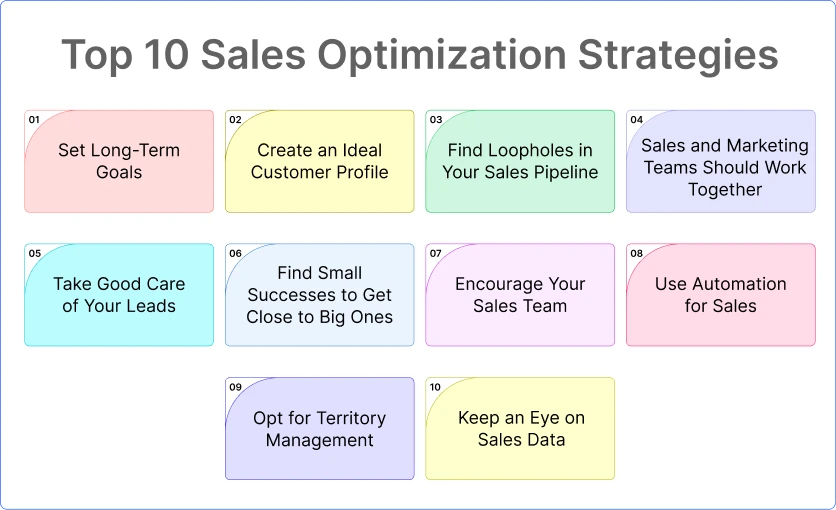
1. Set Long-Term Goals
First, set what you want to achieve in the long run. Instead of thinking about short-term wins, try to think big and focus on something called quality.
All business owners aim for higher sales revenue every year, but shorter wins will not give you bigger revenue. Remedy? Create a healthy sales culture and think about what best you can do for your customers. Instead of having parties for hitting monthly targets, celebrate client anniversaries or successful upsells.
2. Create an Ideal Customer Profile
Creating an ideal customer profile (ICP) is like making a detailed sketch of the perfect customer for your business. This sketch helps you know exactly who to target with your sales efforts. This profile serves as a blueprint for targeting and acquiring high-quality leads and ultimately driving sales.
It’s smarter to focus on creating a lasting connection with the right customers instead of going after quick wins that don’t last long. When you create a detailed buyer persona, you dig beyond basic details like their age or location such as:
- Their preferences
- Any concerns they might have (and how you can address them)
- Buying patterns
- Their gender, income, education etc.
- Preferred communication channels
- Lifestyles
3. Find Loopholes in Your Sales Pipeline
Find out what problems you are having in the sales pipeline. It can be not getting enough quality leads, a very low conversion rate, or issues with cross-selling and upselling. No matter what the problem is you have to identify to fix that.
The sales pipeline is the roadmap that helps move potential customers along the path to making a purchase. So, if there are gaps or problems in your pipeline, you might lose out on sales.
Many sales managers keep a close eye on the start and end points of the pipeline. It’s important to carefully monitor how new potential customers entering the pipeline to sales are made. But it’s also crucial to understand what’s happening in the middle stages. You need to know what’s going on there too.
4. Make Sure the Sales and Marketing Teams Work Together
The main job of both marketing and sales teams is to boost sales revenue, but often they find it challenging to collaborate effectively. It’s essential for them to always cooperate to achieve the best results.
A report by Marketo says that half of the leads generated by marketing are ignored by sales reps. Also, MarketingProfs discovered that when sales and marketing work closely together, businesses have better customer retention rates (36% higher) and win more sales (38% higher).
How to bring in the alignment? Here are some tips for you!
- Ensure open lines of communication between sales and marketing teams.
- Both teams should work together to map out the customer’s path and identify touchpoints where they can collaborate effectively.
- Offer opportunities for sales and marketing team members to learn about each other’s roles, challenges, and perspectives.
- Define common metrics and key performance indicators (KPIs) that both sales and marketing teams are accountable for.
- Foster a culture of collaboration by organizing joint strategy sessions, brainstorming meetings.
5. Take Good Care of Your Leads
It’s a very important sales optimization strategy aimed at guiding potential customers through the sales process and converting them into paying customers.
The process begins with lead generation, where potential customers are identified and attracted to your products or services through various marketing channels such as social media, email campaigns, content marketing, and events. Here the goal is to keep leads engaged and moving through the sales funnel by providing them with the information and support they need to make informed purchasing decisions.
Taking good care of leads means getting to know your potential customers better and building stronger connections. If a salesperson contacts a prospect too early or tries to sell them something they’re not interested in yet, they might lose that opportunity before they’ve even had a chance to engage with them.
Teaching your sales team about your ideal customer, targeting the right potential customers through marketing, and understanding how customers behave before they become your customers are the three main ways to improve lead nurturing.
Use Lead Scoring to Prioritize Sales Opportunities
Not every lead has the same likelihood of becoming a customer. Lead scoring helps your team identify which prospects should receive immediate attention and which ones require additional nurturing.
A lead score can combine two types of information.
Customer-Fit Data
This shows how closely the prospect matches your ideal customer profile.
It may include:
- Industry
- Company size
- Location
- Annual revenue
- Job role
- Use case
- Technology requirements
- Estimated budget
Engagement and Intent Data
This shows how actively the prospect is considering your solution.
It may include:
- Visiting pricing or product pages
- Requesting a demo
- Starting a live chat
- Downloading a sales resource
- Returning to the website several times
- Asking about integrations
- Comparing plans
- Responding to sales messages
- Inviting additional stakeholders to a meeting
Assign higher scores to actions that indicate buying intent. A pricing-page visit, for example, may carry more weight than reading a general educational article.
The scoring model should also include negative signals. A student using a personal email address, a company outside your service area, or an inactive lead may receive a lower score.
Lead scoring should not replace human judgment. Instead, it gives representatives a consistent starting point for prioritizing opportunities. Review the model regularly to ensure that the highest-scoring leads are actually producing stronger conversion rates.
6. Find Small Successes to Get Close to Big Ones
You need to achieve small things to get the big ones. Sales is no exception. Never see it as a win-or-lose game. You have to plan and strategize to win big deals. Apart from that, a series of small deals will help to reach closer to the big ones.
So, if you want to sell more and make more money, it’s important to find and make the most of every little success in your sales process. By doing this, you can make your sales process quicker, make sure everyone in your team knows what they’re doing, and get revenue faster.
7. Improve Sales Enablement and Coach With Performance Data
Sales representatives perform better when they have the knowledge, content, technology, and coaching required to handle real buyer conversations.
Begin by identifying where representatives are struggling. The problem may not always be a lack of effort. They may need better product knowledge, clearer messaging, faster access to content, or additional support when handling objections.
Use sales data and conversation reviews to examine:
- Conversion rates by representative
- Average deal size
- Time spent at each pipeline stage
- Follow-up consistency
- Common customer objections
- Reasons for lost deals
- Product questions representatives struggle to answer
- Messaging used in successful conversations
Managers can use these insights to provide targeted coaching instead of offering the same training to everyone.
Effective enablement activities may include:
- Reviewing successful and unsuccessful sales conversations
- Practising common objection-handling scenarios
- Creating standardized discovery questions
- Building sales playbooks for recurring situations
- Pairing experienced representatives with developing team members
- Maintaining updated competitor battlecards
- Making case studies and product materials easy to find
- Providing AI-generated summaries and reply suggestions
Measure whether the training improves actual sales outcomes. Course completion alone does not prove that enablement is working. Look for changes in conversion rates, sales cycle length, deal quality, and representative confidence.
8. Use Automation for Sales
Sales optimization strategy involves automating some of your sales processes whenever you can. This means using technology to handle tasks like sending emails, tracking leads, and updating customer information automatically, without needing a person to do it manually. This saves time and allows your sales team to focus on more important tasks like selling and building relationships with customers.
Numerous sales tools are available in the market to automate and streamline general tasks and processes. With such a tool, you can figure out which tasks your reps do over and over again and then set up the tool to do those tasks automatically. This makes the work smoother and saves time for everyone.

9. Territory Management
It’s one of the most important parts of sales performance optimization. Territory management means dividing sales regions among your team members strategically. Each salesperson gets their territory to focus on, allowing them to build relationships and understand the needs of customers in that area. By managing territories effectively, you can ensure better coverage, prevent overlap, and maximize regional sales opportunities.
There are numerous benefits which include:
- Territory management helps salespeople focus on certain areas, so they know the customers there really well.
- Clear territory boundaries prevent conflicts and overlaps between sales representatives.
- They can develop stronger relationships with customers in their assigned territories, leading to increased trust, loyalty, and satisfaction.
- Having territories also makes it simpler to track how well sales are going in each area, so you can figure out how to do even better.
10. Keep an Eye on Sales Data
All the strategies mentioned here are important but this one you should not ignore. You have to track and understand the data and analytics to get an idea about what’s going on and find out the loopholes if any for further improvements.
Yes, you can manually track the data in some cases but not everywhere. It will be very time-consuming and complex. To help you out here, there are many sales tools available in the market to choose from that can make the whole process much easier for you.
Many of these tools use a combination of AI and behavioral science to turn that data into high-impact, actionable insights that will help you refine every aspect of your sales cycle. You can get detailed insights on how your sales agents are performing, which sections in the sales pipeline are getting more importance, tasks that can be automated, the list goes on….
Improve Sales Forecast Accuracy
Sales forecasting estimates how much revenue the current pipeline is likely to generate within a particular period. An accurate forecast helps businesses plan hiring, spending, inventory, and growth more confidently.
Forecasts become unreliable when opportunities are placed in the wrong stages, sales representatives use different qualification standards, or inactive deals remain in the pipeline.
To improve forecast accuracy:
- Establish clear criteria for every sales stage
- Remove or requalify inactive opportunities
- Record expected close dates consistently
- Review historical win rates
- Compare forecasts with actual results
- Separate committed deals from early-stage opportunities
- Consider deal size, buyer engagement, and time in stage
- Review changes in the pipeline regularly
Businesses can also use predictive analytics to examine historical sales patterns and identify which opportunities resemble previously successful deals.
Technology can improve forecasting, but the quality of the prediction still depends on the quality of the sales data. Make CRM accuracy a shared responsibility across the sales team.
You will discuss these tools in more detail in the next part!
Sales Optimization Metrics You Should Track
Sales optimization requires more than monitoring total revenue. Revenue tells you the final result, but it does not explain where the sales process is improving or breaking down.
The following metrics provide a clearer picture.
Stage Conversion Rate
This measures the percentage of opportunities that move from one pipeline stage to the next.
Stage conversion rate = Opportunities that advanced ÷ Total opportunities in the stage × 100
For example, if 50 qualified leads enter the discovery stage and 20 move to product evaluation, the stage conversion rate is 40%.
A sudden decrease may indicate poor qualification, ineffective messaging, delayed follow-up, or a confusing buyer experience.
Win Rate
Win rate measures the percentage of completed opportunities that result in a sale.
Win rate = Closed-won deals ÷ Total closed opportunities × 100
Track win rate by lead source, customer segment, product, sales representative, and deal size. This helps identify where your strongest opportunities are coming from.
Average Sales Cycle Length
This measures how long it takes to convert a prospect into a customer.
Average sales cycle length = Total days required to close all won deals ÷ Number of won deals
Examine the average time spent in every pipeline stage. This can show whether deals are being delayed during qualification, evaluation, proposal approval, or negotiation.
Pipeline Velocity
Pipeline velocity estimates how quickly qualified opportunities are generating revenue.
Pipeline velocity = Number of opportunities × Average deal value × Win rate ÷ Average sales cycle length
The metric can improve when you create more qualified opportunities, increase the average deal value, improve the win rate, or shorten the sales cycle.
Lead Response Time
Lead response time measures how quickly your team responds after a prospect makes an inquiry.
Track response time across website forms, live chat, email, social media, and messaging channels. Slow responses can reduce engagement, particularly when prospects are actively comparing several providers.
Revenue per Sales Representative
This shows how much revenue each representative generates during a selected period.
Revenue per representative = Total sales revenue ÷ Number of sales representatives
Use it alongside pipeline quality and conversion data. Revenue alone may not reveal whether a representative received stronger territories or higher-value accounts.
Forecast Accuracy
Forecast accuracy compares predicted revenue with actual revenue.
Forecast accuracy = 1 − |Forecast revenue − Actual revenue| ÷ Actual revenue
Consistently inaccurate forecasts may indicate poor CRM data, inconsistent qualification, unrealistic close dates, or a lack of visibility into deal risk.
Customer Acquisition Cost
Customer acquisition cost estimates the average sales and marketing expense required to acquire a customer.
CAC = Total sales and marketing costs ÷ Number of new customers acquired
Monitor CAC together with average deal value, customer lifetime value, and retention. A lower acquisition cost is not necessarily beneficial if it brings low-value or poor-fit customers.
Common Sales Optimization Mistakes to Avoid
Sales optimization initiatives can create additional complexity when they are implemented without clear priorities.
Here are some common mistakes to avoid.
Optimizing Without a Baseline
Changing the process without recording current performance makes it impossible to measure improvement. Establish baseline metrics before implementing major changes.
Tracking Too Many Metrics
A large dashboard does not automatically create useful insight. Focus on a limited set of metrics linked to your current sales objective.
Relying on Inaccurate CRM Data
Incomplete contact records, outdated deal stages, and missing activity logs can produce misleading reports. Simplify data entry and automate data capture wherever possible.
Automating a Broken Process
Automation makes an existing process faster. It does not necessarily make it better. Remove unnecessary steps before automating the workflow.
Treating Every Lead the Same
Sending every lead through the same process wastes sales resources and creates irrelevant customer experiences. Segment leads according to fit, intent, value, and buying stage.
Changing the Process Too Frequently
Sales representatives need enough time to adopt and evaluate a new process. Constant changes make it difficult to determine which improvements are working.
Ignoring Sales Representative Feedback
Sales representatives work directly with prospects and often notice problems before they appear in a dashboard. Include them when identifying bottlenecks and testing process changes.
Overlooking the Customer Handoff
The sales process does not completely end when the contract is signed. Important information about objectives, expectations, stakeholders, and promised outcomes should be transferred to the onboarding or customer success team.
A clear handoff protects customer trust and creates stronger opportunities for retention, upselling, and long-term growth.
Top 8 Sales Optimization Tools that Help to Convert

Yes, sales optimization tools offer many great features that are beneficial to optimize your complete sales journey. This is the reason, why more and more companies have started using them a lot. But with so many choices available, how do you know which one is best for your business?
To make it easier for you, we’ve put together a list.
1. REVE Chat
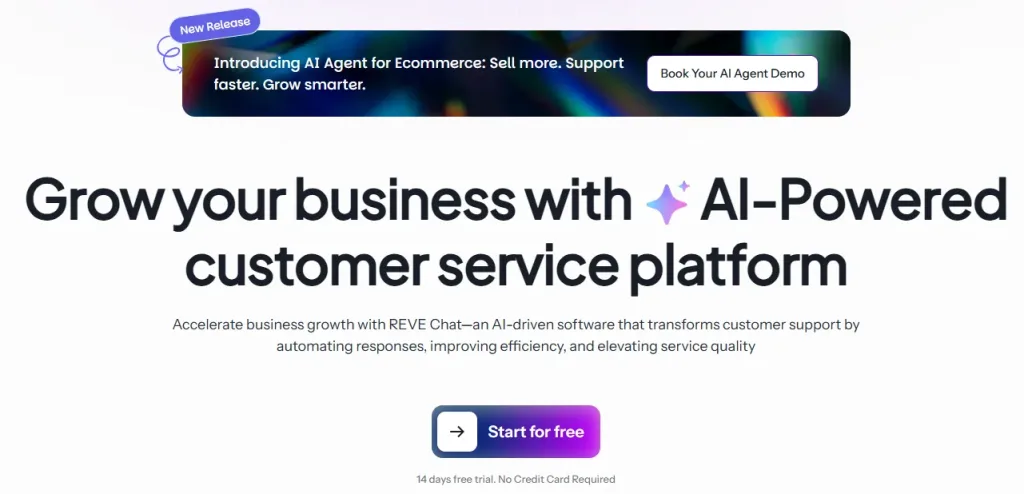
REVE Chat stands out as a top-notch omnichannel sales and customer engagement platform that you can consider for your business. It allows you to monitor how your target customers interact across various platforms like your website, mobile app, and social media channels such as Facebook, Viber, Telegram, Instagram, and WhatsApp in real-time.
With REVE Chat, your team can proactively engage with potential customers on their preferred platforms and offer instant assistance before they even request it. What’s great is that you can manage all these communications from one central location.
Additionally, REVE Chat offers an intelligent AI chatbot that automates many of your business operations, including customer support. This frees up your sales and support team to focus on more complex tasks, while the chatbot handles multiple customers simultaneously, 24/7. It’s highly recommended for businesses looking to enhance their customer engagement and streamline operations.
Core Features:
- Automate a variety of sales tasks, including customer service, using the REVE Chatbot.
- Provide personalized experiences to potential and existing customers through live chat, voice, and video chat.
- Centralize all social media interactions for a seamless customer experience.
- Effectively coordinate and monitor team performance to meet sales goals.
- Gain comprehensive insights into your business and sales team performance with key metrics on website visitors, customer charts, and agent performance.
- Also offers a smart ticketing system that links live chat with ticketing to solve visitor and customer problems quickly and smoothly.
Want to experience REVE Chat firsthand? Try out its unique features through a 14-day FREE TRIAL. Sign Up today!
2. Semrush
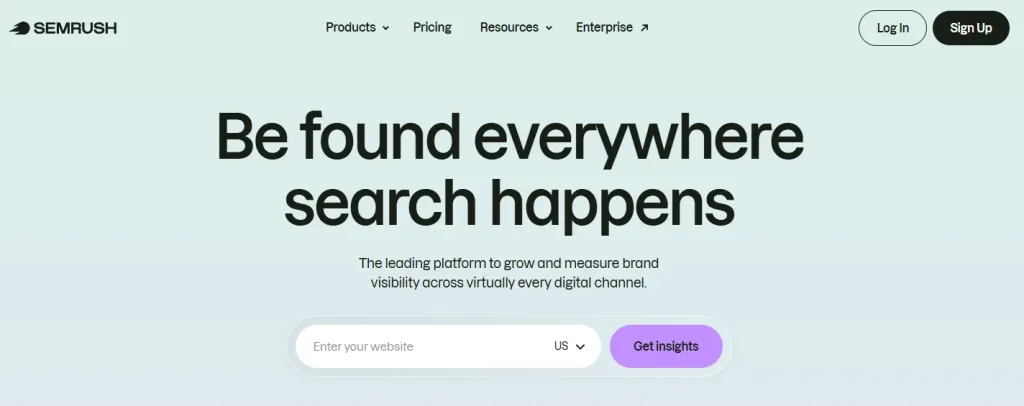
Semrush is an all-in-one digital marketing and sales platform that offers a wide range of tools and features to help businesses improve their online visibility, sales, and performance. It provides solutions for search engine optimization (SEO), pay-per-click (PPC) advertising, content marketing, social media management, and competitive research.
Semrush helps you attract more people to your website and find great sales leads by creating precise and focused content. It’s worth checking out later.
Core Features:
- Helps you to identify relevant keywords for the website content and advertising campaigns, as well as analyze keyword trends and search volume.
- Allows to conduct comprehensive audits of websites to identify and fix issues that may affect SEO performance.
- Provides insights into competitors’ online strategies, including their organic and paid search tactics, top-performing keywords, and advertising budgets.
- Offers tools for content creation, optimization, and distribution, as well as content performance tracking.
3. Freshsales
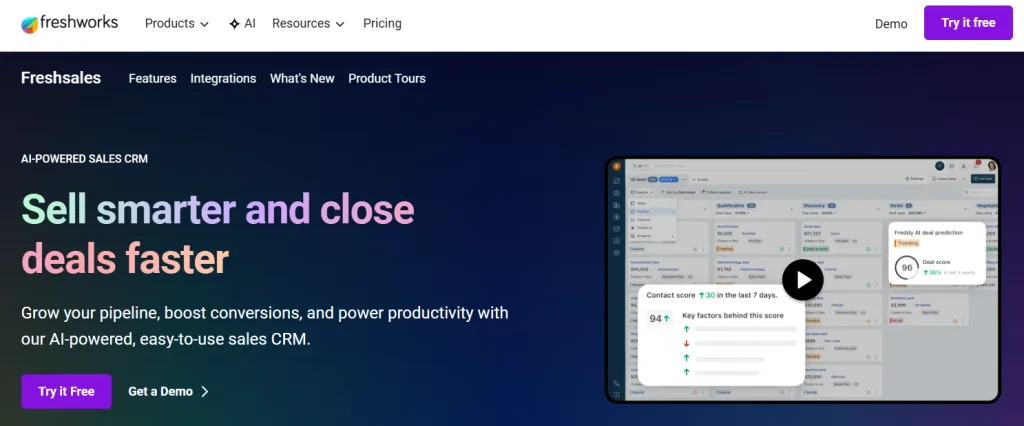
Freshsales is a customer relationship management (CRM) software developed to help companies manage and streamline their sales processes more effectively. It offers a range of features to streamline sales activities, improve customer interactions, and increase revenue.
Freshsales offers built-in features like email, phone, live chat, and telephony, which help sales teams save time by automating tasks and enhancing their efficiency each day.
Core Features:
- Allows businesses to store and organize customer contact information, interactions, and communication history in one centralized database.
- Helps businesses capture, qualify, and prioritize leads, as well as track their progress through the sales pipeline.
- Enables sales teams to manage sales opportunities, track deals, and forecast revenue accurately.
- Provides tools for sending personalized emails, tracking email interactions, and automating follow-up actions.
- Allows businesses to visualize and manage their sales pipeline, customize sales stages, and track the progress of deals.
4. Highperformr AI
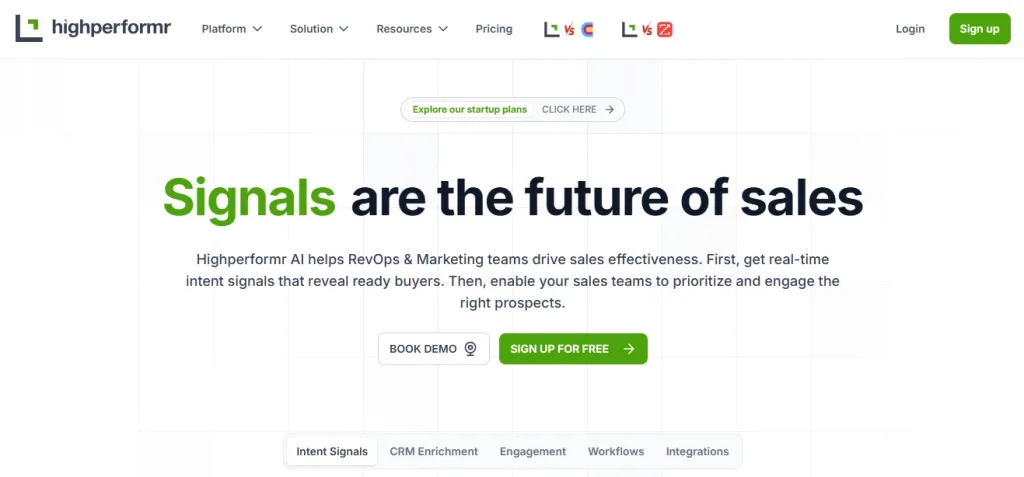
Highperformr AI is a real-time, AI-powered platform designed to help RevOps, Sales, and Marketing teams align around intent data and drive high-impact engagement. It enables businesses to identify ideal prospects, detect buying signals, and automate outreach.Ultimately accelerating sales cycles and boosting conversions.
With advanced capabilities in social listening, data enrichment, and CRM automation, Highperformr AI helps you reach the right buyers at the right time with the right message. It’s a powerful tool for teams looking to turn every signal into action and gain a competitive edge.
Core Features:
- Instantly identifies accounts that match your Ideal Customer Profile (ICP) using real-time intent signals and enriched contact data.
- Analyzes behavioral signals to uncover in-market buyers and triggers outreach at peak engagement windows.
- Auto-updates CRM records with firmographic and intent data, improving segmentation, lead scoring, and prioritization.
- Leverages AI and social signals like job changes, competitor activity, and events to enable timely, personalized outreach
5. ClickPoint
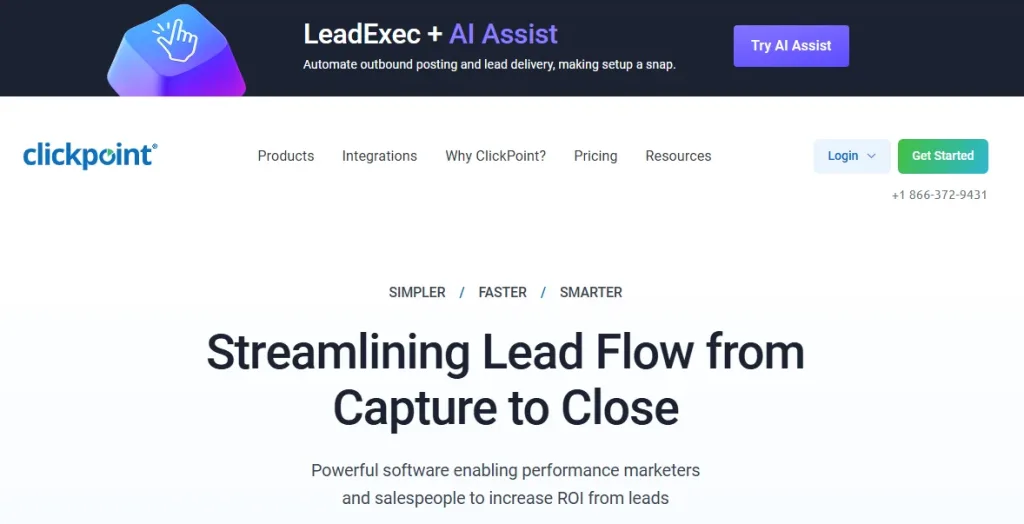
ClickPoint is a software designed to help businesses manage their leads more effectively. It offers features like lead tracking, lead scoring, lead routing, and automation tools to streamline the lead management process. Additionally, the software provides analytics and reporting capabilities to track lead performance and optimize lead generation strategies.
This software matches your salespeople with the trickier or more important potential customers, making it more likely that you’ll get better results. Also, it gives details about sales actions and has been proven to make closing deals faster.
Core Features:
- Helps businesses capture, organize, and prioritize leads effectively.
- Automatically assigns leads to the appropriate sales representatives based on predefined criteria, such as location or lead score.
- Allows businesses to monitor the progress of leads through the sales pipeline, from initial contact to conversion.
- Streamlines repetitive sales tasks, such as follow-up emails or appointment scheduling, to improve efficiency.
- Provides insights into sales performance, lead conversion rates, and other key metrics to help in decision-making and optimization strategies.
6. HubSpot CRM
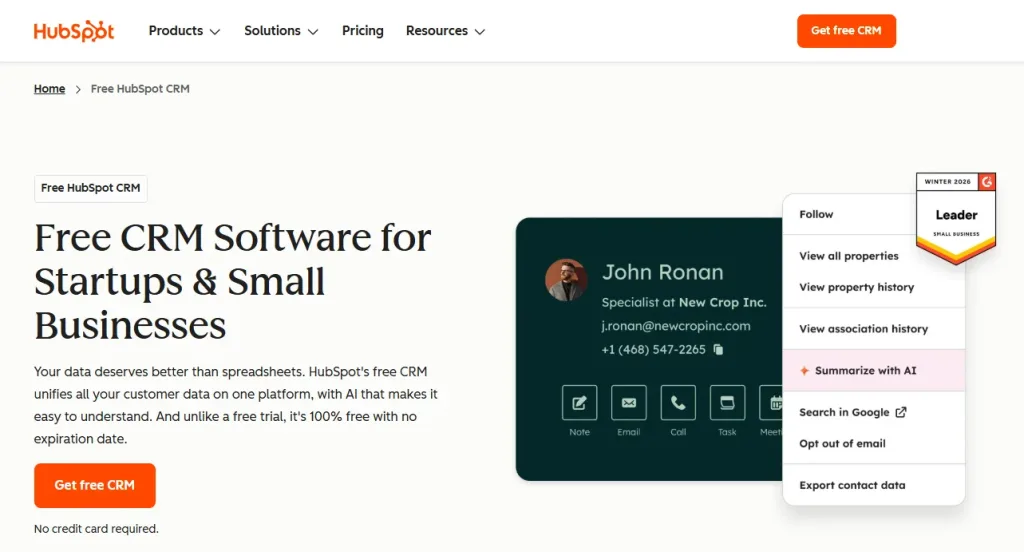
HubSpot is a great sales process optimization software that does everything for marketing, sales, and customer service. It’s made to help businesses work better, get more people interested, and turn those people into customers. With HubSpot, you can keep an eye on potential customers and get detailed insights into their activities and busing behavior. It also helps you automate your sales process easily. HubSpot offers great customer service and lots of features to pick from.
Core Features:
- HubSpot offers a free CRM that helps businesses organize, track, and nurture their leads and customers effectively.
- Your sales teams can track email opens, clicks, and replies, and create personalized email sequences to engage leads and prospects at the right time.
- The deal management features allow sales teams to track deals through the sales pipeline, set reminders, and forecast revenue accurately.
- Automates repetitive tasks such as follow-up emails, task creation, and lead assignment.
- Provides detailed sales reports and analytics.
7. LeadSquared
LeadSquared is a good cloud-based sales process optimization software that helps businesses with marketing and managing customer relationships. It offers tools to bring in potential customers, interact with them well, and turn them into paying customers.
This software makes tasks like capturing leads, handling marketing and sales activities, and tracking results easier. It also provides features like scoring leads, creating landing pages, and giving detailed insights into team performances. Plus, it lets different team members access the information they need based on their roles.
Core Features:
- Helps in capturing potential customers’ information through various channels like forms, emails, and social media.
- Automates several marketing tasks.
- Provides a Customer Relationship Management (CRM) system tailored for sales teams.
- Offers reporting tools to track campaign performance, lead quality, and sales metrics.
- Assigns scores to leads based on their behavior and engagement.
8. Zoho CRM
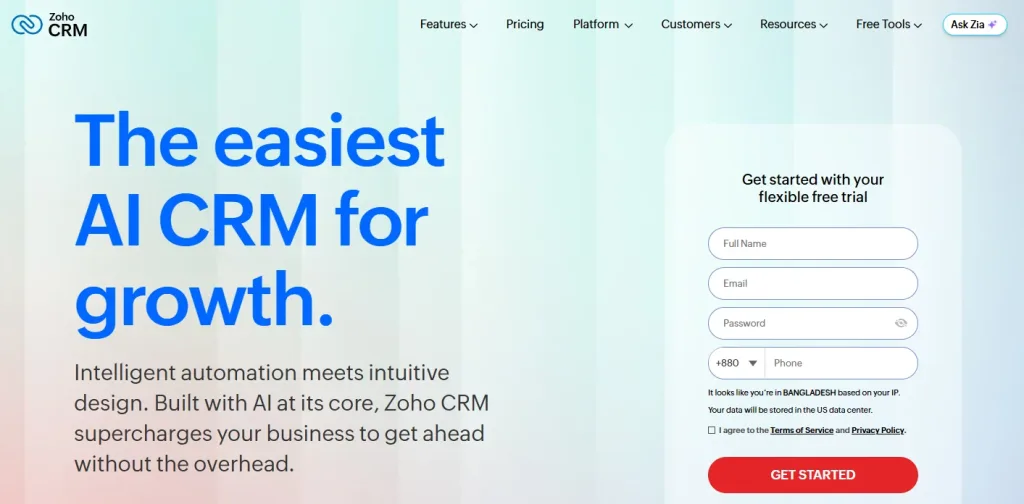
Zoho CRM is a comprehensive solution that helps businesses effectively manage their customer relationships, streamline sales processes, and drive growth. It offers tools for automating various aspects of the sales process, including lead management, pipeline management, and sales forecasting. Furthermore, Zoho CRM seamlessly integrates with more than 500 business applications making things much easier for you.
Core Features:
- Zoho CRM allows you to centralize and manage all your contacts and leads in one place.
- Offers automation features to streamline the sales process, including lead management, pipeline management, and sales forecasting.
- Zoho CRM integrates with most of the marketing tools.
- Provides built-in analytics and reporting tools to track sales performance, monitor key metrics, and gain insights into customer behavior.
9. Zendesk Sell
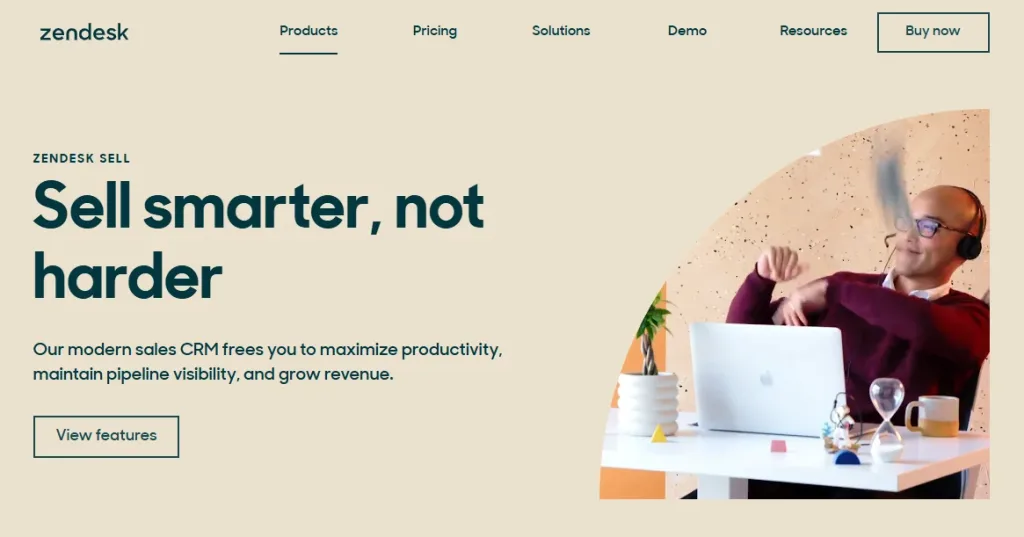
Zendesk Sell is a sales CRM (Customer Relationship Management) software developed by Zendesk, designed to help sales teams manage their customer relationships and drive sales growth. It is easy to configure and very user-friendly. You can customize Zendesk Sell to fit all your specific sales processes and workflows. This includes creating custom fields, sales stages, and workflows tailored to your specific requirements.
Core Features:
- Provides a centralized database for managing contacts, leads, and accounts.
- Offers tools for visualizing and managing the sales pipeline.
- Automates repetitive tasks such as data entry, lead scoring, and email follow-ups.
- You can track the sales activities, including calls, emails, meetings, and other tasks.
- Includes lead and deal scoring features to prioritize leads and opportunities based on their likelihood of conversions.
How to Optimize Your Sales Process Step by Step
Sales optimization works best when it is treated as a structured and continuous process rather than a collection of disconnected tactics. Before adding new tools or changing how your team sells, you need to understand how prospects currently move from their first interaction to becoming customers.
Here is a practical process you can follow.
1. Map Your Current Sales Process
Document every stage a potential customer goes through, from lead generation and qualification to product evaluation, negotiation, and closing.
For each stage, identify:
- The actions expected from the sales representative
- The information required from the prospect
- The criteria for moving the opportunity forward
- The teams involved in the process
- The average amount of time spent at that stage
- The tools used to manage the interaction
Do not document only how the process is supposed to work. Review recent deals and speak with sales representatives to understand what actually happens.
This may reveal undocumented steps, inconsistent follow-ups, unnecessary approvals, or important customer information that is lost during team handoffs.
2. Identify the Biggest Sales Bottlenecks
Once the process has been mapped, examine where opportunities slow down or leave the pipeline.
Look for warning signs such as:
- A large drop in conversion between two stages
- Deals remaining in one stage longer than expected
- Frequent missed follow-ups
- A high number of unqualified leads entering the pipeline
- Prospects repeatedly requesting the same missing information
- Sales representatives spending too much time on administrative work
- Opportunities reaching the proposal stage without a clear decision-maker
Not every problem deserves the same level of attention. Prioritize bottlenecks according to their impact on revenue, sales cycle length, customer experience, and representative productivity.
3. Define Clear Qualification and Exit Criteria
Each pipeline stage should have clear entry and exit conditions. A deal should not move forward simply because a sales representative has completed an activity.
For example, a prospect may only move from discovery to evaluation after the team has confirmed:
- A genuine business need
- The appropriate budget
- The relevant decision-makers
- The expected purchase timeline
- The required product capabilities
- A clear next step
Consistent qualification keeps poor-fit opportunities from consuming sales resources and makes pipeline forecasts more reliable.
4. Improve the Buyer’s Path
Review the process from the customer’s perspective. Identify where buyers have to wait, repeat information, search for answers, or coordinate with several disconnected people.
You may improve the experience by:
- Making product and pricing information easier to access
- Giving representatives faster access to sales content
- Providing instant assistance through live chat or AI Agents
- Simplifying demo and meeting scheduling
- Preparing responses to common objections
- Centralizing proposals, case studies, and technical documents
- Creating clearer next steps after every sales conversation
Removing small points of friction can prevent promising opportunities from becoming inactive.
5. Automate Repetitive Activities
Automation should reduce administrative work without making the experience feel impersonal.
Consider automating:
- Lead capture and assignment
- Meeting scheduling
- Follow-up reminders
- CRM data updates
- Lead enrichment
- Email and messaging sequences
- Sales conversation summaries
- Internal notifications
- Proposal approval workflows
- Re-engagement of inactive leads
Human involvement should remain available for negotiations, complex product questions, sensitive concerns, and high-value conversations.
6. Measure the Results
Establish a performance baseline before implementing major changes. Otherwise, it will be difficult to determine whether the new process has improved results.
Compare metrics such as conversion rate, win rate, sales cycle length, pipeline velocity, revenue per representative, and forecast accuracy before and after the change.
Sales optimization should then become a repeating cycle:
Measure → Identify → Improve → Test → Review
Continue making focused improvements instead of redesigning the entire process every time performance changes.
Opt for Sales Process Optimization to Get the Best Results
Yes, by now you have understood why it’s so important to optimize your sales strategies. Improving how you sell doesn’t happen fast or just once. Good sales teams keep working on their methods to grow over time. They even use different sales optimization tools based on their specific requirements and budget.
REVE Chat is a great tool for both big and small enterprises that want to offer great customer experience and boost their online sales.
Build AI-powered support with Wize AI
Connect business knowledge, automate support conversations, and improve response quality without managing a complex AI stack.
Explore Wize AI Agent Rate the article

Ehsanur Rahman
Head of Customer Communication
Ehsanur Rahman, the Head of Customer Communication at REVE Chat is dedicated to implementing advanced solutions that boost customer interactions and satisfaction. Ehsanur's passion for technology and customer service drives his commitment to delivering exceptional experiences.
View all articles