




Table of Content
AI agents are becoming a practical way for businesses to automate customer support, sales, lead qualification, and other repetitive tasks. The key technology that makes it easier and faster to build these AI agents is an AI agent framework.
An AI agent framework is a collection of pre-built tools, components, and libraries that helps developers build, manage, and deploy AI agents without starting from scratch. It provides the foundation needed to create AI agents more efficiently while reducing development time and complexity.
In this guide, we’ll explain AI agent frameworks in simple terms, compare popular options, and help you choose the right framework for your business. We’ll also discuss when it makes more sense to use a complete AI agent platform instead of building everything yourself.
The Best AI Agent Frameworks at a Glance
Quick takeaway: If you want the fastest working prototype, CrewAI or the OpenAI Agents SDK are the easiest starting points. If you’re building something mission-critical that needs to run reliably for months, LangGraph is the industry’s most battle-tested choice – it’s already powering agents at companies like Uber and LinkedIn.
| Framework | Best For | Ease of Use | Cost | Ideal Business Use Case |
|---|---|---|---|---|
| LangChain / LangGraph | Complex, reliable AI agents that need precise control | Steep learning curve (needs developers) | Free (open source); paid hosting optional | Large-scale support systems, workflow automation with approval steps |
| CrewAI | Fast-to-build teams of AI agents with defined "roles" | Easiest to get started | Free (open source); paid enterprise tier available | Research, content pipelines, ops tasks handled by a "team" of agents |
| Microsoft Agent Framework | Businesses already using Microsoft/Azure tools | Moderate | Free (open source); Azure usage costs apply | Companies standardized on Microsoft 365, Teams, or Azure |
| OpenAI Agents SDK | Simplest, fastest path to a working agent | Very easy | Free framework; pay only for OpenAI API usage | Small, well-defined assistants (e.g., a single support or booking agent) |
| LlamaIndex (Workflows) | Agents that need to search and reason over company documents | Moderate | Free (open source) | Internal knowledge assistants, document Q&A, research tools |
| Google ADK | Businesses built on Google Cloud | Moderate | Free (open source) | Companies already using Google Cloud infrastructure |
| Mastra | Web/product teams building agents into an existing app | Moderate (developer-friendly for JavaScript teams) | Free, with some paid components | SaaS products adding AI agent features to their own app |
What is an AI Agent Framework?
An AI agent framework is a software system used to build autonomous AI assistants. It defines how an agent receives information, reasons through a task, interacts with external tools, maintains context, and generates a response or takes an action.
Rather than writing every capability from the ground up, developers use a framework to handle the core building blocks of an AI agent. Most frameworks include features such as prompt management, memory, workflow orchestration, tool integration, model connectivity, and agent communication.
For example, if you want to build an AI customer support agent, the framework helps connect the AI model with your knowledge base, CRM, APIs, and business workflows. This allows the agent to answer questions, retrieve information, perform tasks, and interact with other systems in a structured way.
In simple terms, an AI model provides the intelligence, while an AI agent framework provides the structure that enables the AI to work effectively in real-world applications.
Benefits of Using AI Agent Frameworks
There are lots of benefits to using AI agent frameworks, including:
1. Faster AI Agent Development
Building an AI agent from scratch requires creating logic for reasoning, memory, tool integration, and workflows. Frameworks provide these capabilities out of the box, allowing developers to build and test AI agents much more quickly.
2. Easier Integration with Business Tools
Most AI agents need access to business systems such as CRMs, help desks, calendars, payment platforms, or internal databases. AI agent frameworks make it easier to connect these tools so agents can retrieve information and perform real actions instead of only answering questions.
3. Better Support for Complex Workflows
Modern AI agents often need to complete multiple steps before reaching a goal. For example, an agent might verify a customer’s identity, check an order, update delivery details, and send a confirmation. Frameworks help manage these multi-step workflows reliably.
4. More Flexible and Scalable
As business needs evolve, AI agents often need new capabilities. Frameworks make it easier to add new tools, automate additional tasks, or support more users without rebuilding the entire solution from scratch.
5. Improved Testing and Reliability
Many frameworks include built-in features for testing, debugging, and monitoring AI agents. This helps developers identify issues early and ensure the agent performs consistently before it is deployed to customers.
Learn More: What are AI Agents & How It Works? Types, Benefits & Examples
Key Features to Look for in an AI Agent Framework
Choosing an AI agent framework becomes easier when you know what features actually matter. For business use, focus on these core capabilities:
- Reasoning and Decision-Making: The framework should help the agent understand requests, decide the next step, and complete tasks instead of only giving answers.
- Tool and API Integration: A good framework should connect with business tools like CRMs, help desks, databases, calendars, and payment systems.
- Memory and Context: The agent should remember conversation details so customers don’t need to repeat the same information again and again.
- Workflow Orchestration: Business tasks often involve multiple steps. The framework should help agents manage those steps in the right order.
- Multi-Agent Support: For complex use cases, one agent may not be enough. Multi-agent support allows different agents to handle different jobs, such as support, sales, or booking.
- Security and Monitoring: The framework should support secure data handling, logs, permissions, and monitoring, especially when dealing with customer information.
- Scalability: Your AI agent should be able to handle more conversations, users, and workflows as your business grows.
For non-technical teams, these same features are also available in many AI agent platforms, but without the need to build everything from scratch.
Which Framework Should You Use
The right AI agent framework depends on your goals, technical expertise, and available resources. Here’s a simple way to choose:
1. Learning or Building a Prototype
If you’re experimenting with AI agents or building your first project, CrewAI is a great starting point. It’s beginner-friendly and makes it easy to create multi-agent workflows with minimal setup.
2. Building a Custom Business Solution
If your company has a development team and needs a production-ready AI agent with complex workflows, LangGraph, OpenAI Agents SDK, or Microsoft Agent Framework are strong choices. These frameworks offer greater flexibility, scalability, and integration capabilities for enterprise applications.
3. Want to Launch an AI Agent Quickly?
If your goal is to automate customer support, sales, or lead qualification without spending months on development, you may not need a framework at all. A complete AI agent platform lets you build, train, and deploy AI agents much faster with little or no coding.
Do You Need an AI Agent Framework or an AI Agent Platform?
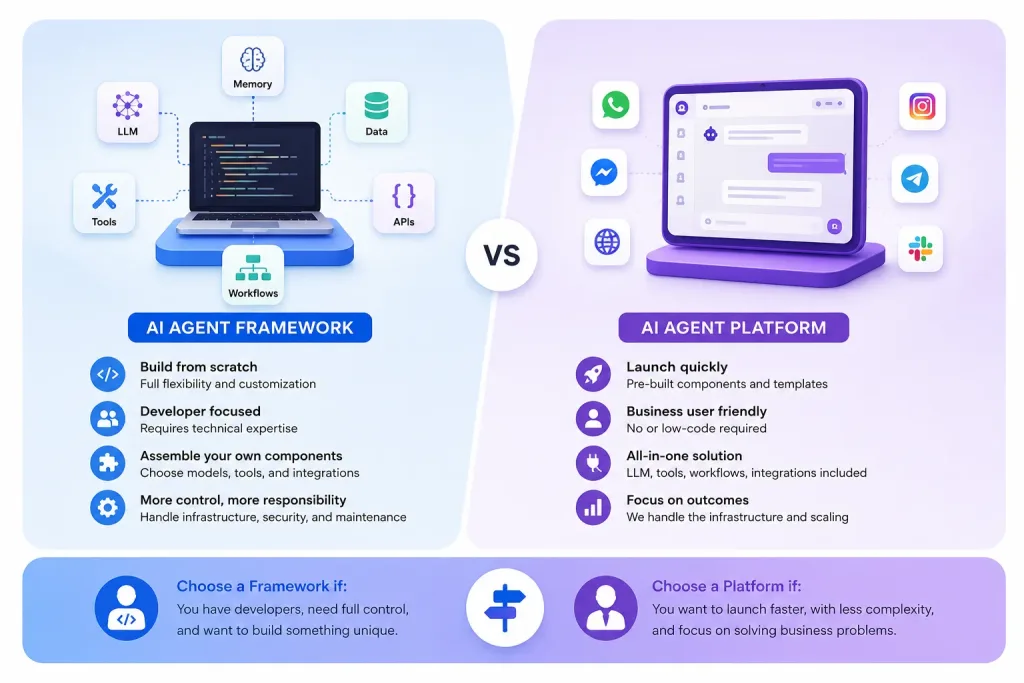
Choosing between an AI agent framework and an AI agent platform comes down to one question:
Do you want to build the technology, or do you want to use it?
An AI agent framework is best for developers who want full control over how an AI agent is designed, integrated, and deployed. It offers flexibility but also requires programming, testing, maintenance, and ongoing updates.
An AI agent platform, on the other hand, is designed for businesses that want to deploy AI agents without building the underlying infrastructure. Most platforms provide everything needed in one place, including knowledge management, workflow automation, integrations, analytics, and deployment tools.
| AI Agent Framework | AI Agent Platform |
|---|---|
| Requires development skills | Little or no coding required |
| Built from scratch | Ready to deploy |
| Full customization | Faster implementation |
| Managed by developers | Managed by business teams |
| Longer deployment time | Faster time to value |
For example, REVE Chat’s Wize AI Agent is a complete AI agent platform that helps businesses launch AI agents for customer support, sales, and lead generation without starting from scratch. You can train the agent using your website or documents, connect it with your business tools, deploy it across multiple channels, and seamlessly hand conversations over to human agents whenever needed.
If your objective is to solve customer problems and improve business operations, not build AI infrastructure, an AI agent platform is often the faster and more practical choice.
How to Build a Customer Support AI Agent in 45 Minutes
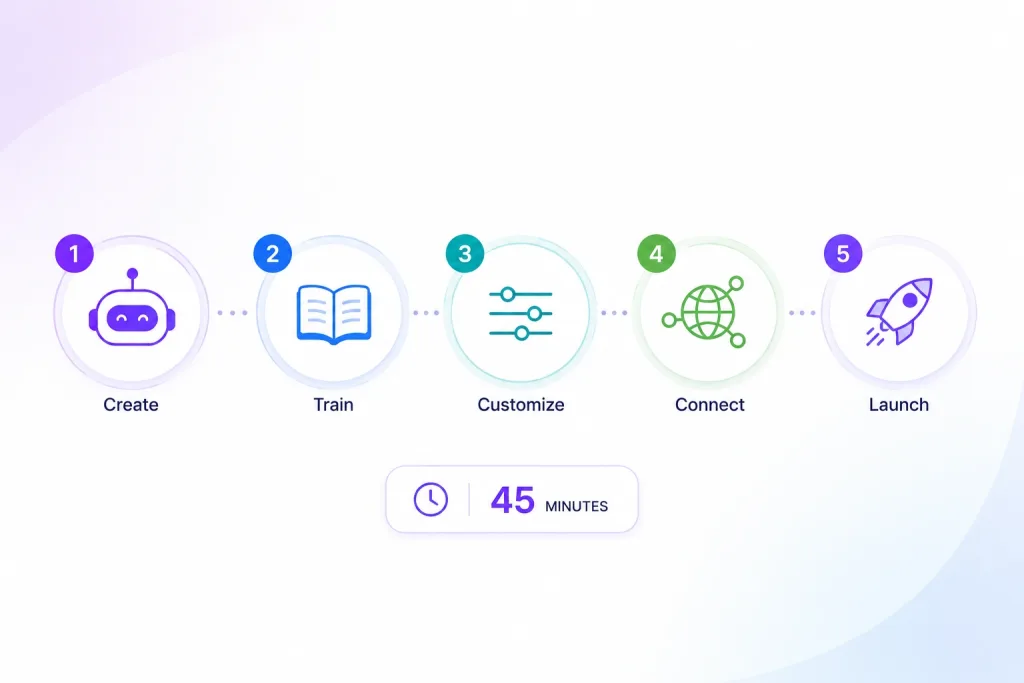
Building a customer support AI agent no longer requires coding or a team of developers. With REVE Chat’s Wize AI Agent, you can create, train, and deploy an AI agent in a few simple steps.
Step 1: Create Your AI Agent
Sign up for REVE Chat and open the Wize AI Agent dashboard. From there, you can create a new agent, give it a name, define its role, and set basic instructions for how it should assist customers. You can follow the setup process in this Wize AI Agent guide.
Step 2: Train Your AI Agent with Business Knowledge
Next, add your business information so the agent can answer customers accurately. You can train it using your website, Help Center, PDFs, FAQs, and other documents. To do this properly, follow this Knowledge Base guide.
Step 3: Customize How Your Agent Works
Personalize your AI agent by defining its tone, instructions, conversation goals, and handover rules. This helps the agent know when to answer directly and when to transfer the conversation to a human agent.
Step 4: Connect Your Customer Channels
Deploy your AI agent where your customers already contact you, such as your website, WhatsApp, Facebook Messenger, Instagram, Telegram, and other channels. You can check the available options in the Integrations guide.
Step 5: Test, Publish, and Improve
Before going live, test the agent with common customer questions to make sure it responds correctly. Once everything looks good, publish it and keep improving it by reviewing conversations and updating your knowledge base when needed.
Final Word
AI agent frameworks give businesses a structured way to build agents that can reason, use tools, follow workflows, and handle more than simple conversations.
The right framework depends on what you want to build, how much control you need, and whether your team has the technical resources to manage it. A good framework should make AI agent development clearer, faster, and easier to scale.
So before choosing one, start with your business use case. Then choose the framework or platform that helps you move from idea to working AI agent with the least unnecessary complexity.
Frequently Asked Questions
Not always. Businesses with development teams may use frameworks, but non-technical teams often benefit more from AI agent platforms that are ready to deploy.
A framework helps developers build AI agents from scratch. A platform provides ready-made tools to create, train, and deploy AI agents with little or no coding.
Yes. AI agent platforms like REVE Chat allow businesses to create and deploy customer support AI agents without writing code.
Look for reasoning, tool integration, memory, workflow orchestration, security, monitoring, and scalability. These features help agents complete real business tasks reliably.
Mostly, yes. AI agent frameworks are designed for technical teams, while AI agent platforms are better suited for business users and managers.
With a framework, it may take days or weeks depending on complexity. With a ready-made AI agent platform, a simple customer support agent can be launched much faster.
Build AI-powered support with Wize AI
Connect business knowledge, automate support conversations, and improve response quality without managing a complex AI stack.
Explore Wize AI Agent Rate the article

Khalid Hassan Emran
Sr. Technical Content Writer
Khalid Hassan Emran is a Senior Technical Content Writer with more than 5 years of experience in technical documentation, content marketing, and blog writing. He specializes in simplifying complex technical concepts into clear, engaging content. In addition, he is an AI Agent Specialist and SEO Expert, helping businesses improve their digital presence through AI-driven solutions and search-optimized content strategies.
View all articles