

Table of Content
AI SUMMARY
Quick Answer
AI voice agents can support customer service through order tracking, appointment booking, troubleshooting, billing enquiries, and other routine tasks. This blog explores 12 practical use cases, the connected systems and permissions they require, and when human support should take over. It also explains how to choose a platform, launch a focused pilot, address privacy and calling requirements, and measure success through accurate resolutions, completed tasks, customer satisfaction, and cost per resolved enquiry.
Customers rarely call a business just to have a conversation. They want to track an order, change a booking, question a charge, or get help fixing a problem.
AI voice agents can handle many of these requests by answering questions, retrieving information, and completing approved tasks through connected business systems. When a request needs human judgement, they can transfer the call to the right person.
So, where can businesses use this technology? Here, in this blog, you will learn 12 practical AI voice agent use cases for customer service. You will also explore how voice agents support everyday customer service tasks, what each task requires, and when human support should take over.
What Is an AI Voice Agent
An AI voice agent is software that listens to spoken requests and responds through a voice conversation. Depending on its configuration, it can retrieve information, update records, complete transactions, or transfer a call.
Many systems combine speech recognition, language processing, and speech generation. Others use models that process audio and produce spoken responses directly. Google’s voice API documentation describes audio interaction and tool use.
Compared with a basic phone menu, a voice agent lets callers describe what they need in their own words. However, natural speech is not exclusive to voice agents. Modern conversational IVR systems can also understand spoken requests, as AWS documentation explains.
What matters is how well the system understands callers and completes the work.
How an AI Voice Agent Handles a Call
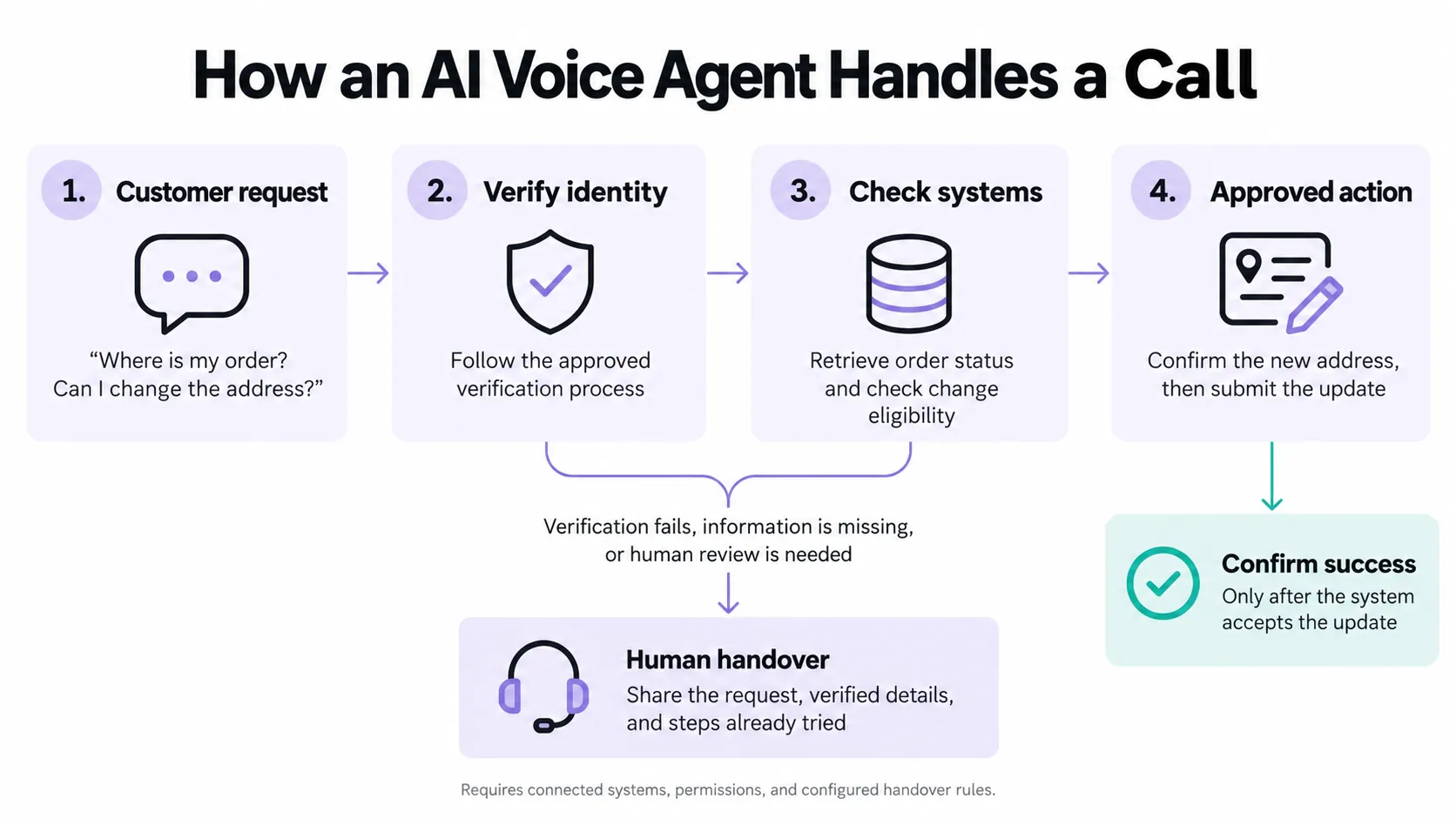
A customer calls an online store and asks, “Where is my order, and can I change the delivery address?”
The agent identifies both requests, collects the required verification details, and checks the order system. It shares the latest shipment status, then checks whether an address change is still allowed.
If the business permits the change, the agent asks the customer to confirm the new address and submits it. It confirms success only after the order system accepts the update. If the parcel has already shipped, it explains the available options or transfers the call.
This is an illustrative workflow. It requires access to order data, an approved verification process, and permission to make changes. Without those connections, the agent can explain the policy but cannot update the order.
The same principle applies to every use case below.
12 Practical AI Voice Agent Use Cases for Customer Service
AI voice bots or agents answer common customer questions even when your support team is unavailable. Customers can get information about business hours, services, pricing, and other basic queries without waiting for a human agent.
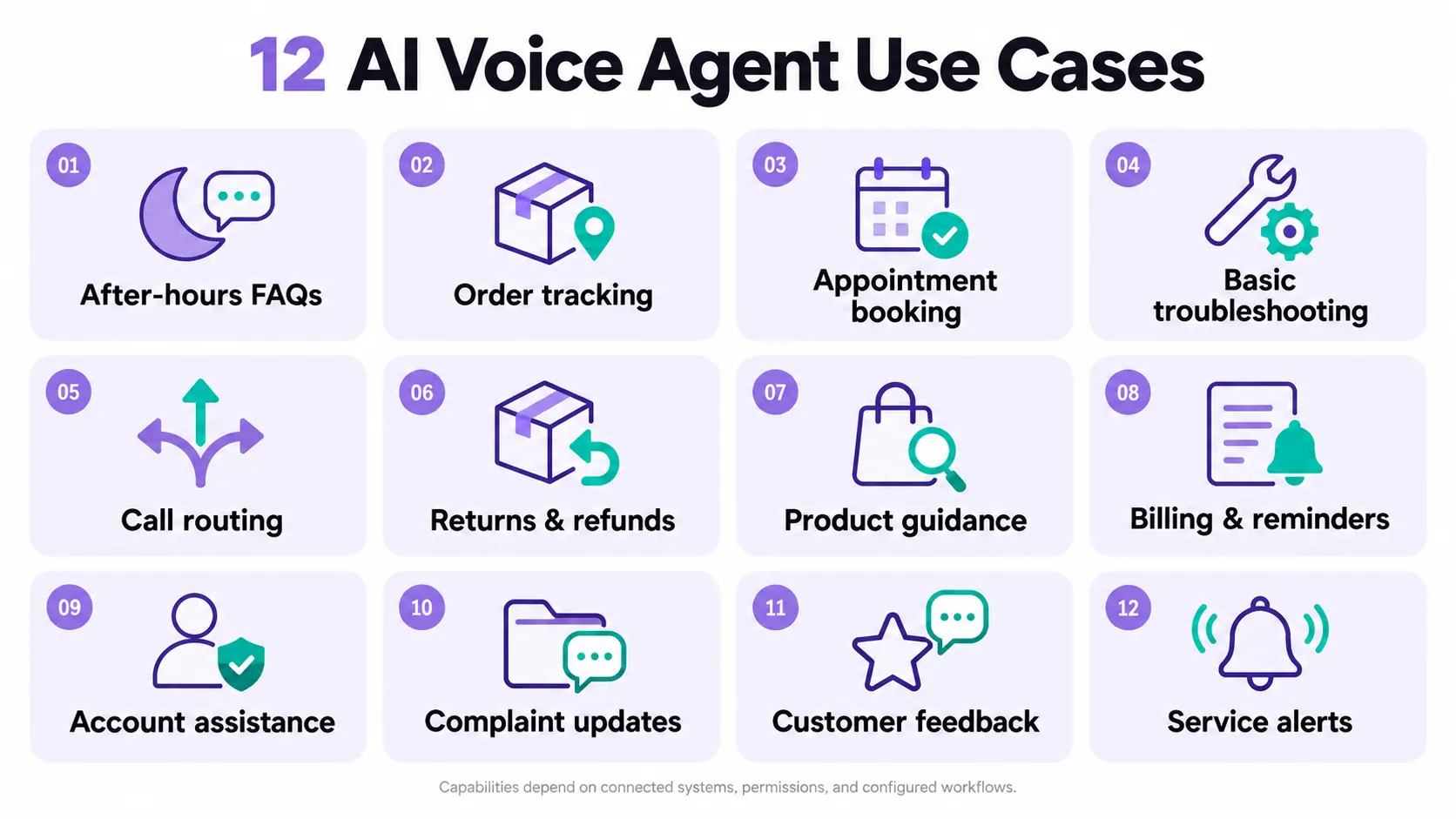
Let’s explore the best use cases of AI voice agents for customer service.
1. Answer Routine Questions Outside Business Hours
Customers may need help when your team has finished work. An agent can answer questions about opening hours, delivery coverage, service availability, and published policies.
For example, someone calling a repair business on Sunday could ask whether it services their area. The agent checks the approved service information, explains availability, and collects a callback request.
The business needs an accurate knowledge source and a clear process for requests that cannot wait. Automated availability does not mean a human specialist is available around the clock.
Measure: Correct answers, useful callbacks captured, and customer satisfaction.
2. Provide Order Tracking and Delivery Updates
An agent connected to an order or courier system can retrieve the latest available shipment information.
A customer asks whether their parcel will arrive today. After completing the required verification, the agent checks the tracking record and shares the recorded delivery estimate.
If no estimate is available, it says so. It should not turn an uncertain status into a guaranteed arrival time. Missing parcels, disputed deliveries, and conflicting updates need a defined support route.
An order number may help locate a record, but it should not automatically authorise disclosure of personal information.
Measure: Accurate updates and fewer repeat calls about the same shipment.
3. Book and Reschedule Appointments
Voice agents can help customers find available appointments, make bookings, and request changes through a connected scheduling system.
A customer calls a salon to move a Friday appointment to Sunday. The agent checks availability, confirms the selected service and time, then submits the change.
A successful conversation is not enough. The booking must appear correctly in the calendar, with the right location, service, and time zone. Cancellation fees and scheduling restrictions must also be respected.
Healthcare examples should stay focused on administrative tasks such as booking, rather than implying medical assessment.
Measure: Confirmed bookings, scheduling errors, and appointments that require manual correction.
4. Guide Customers Through Basic Troubleshooting
Some technical problems have clear, approved checks that customers can complete themselves.
An internet customer reports a connection problem. The agent checks for a known outage and, where appropriate, walks the caller through basic router checks.
It should remember which steps the customer has already tried. Repeating the same instructions after they fail creates frustration.
If the checks do not resolve the issue, the agent can create a ticket or transfer the call with a summary of the problem and completed steps.
Measure: Verified resolutions, repeat contacts, and unnecessary troubleshooting steps.
5. Route Calls to the Right Team
An agent can identify why someone is calling and send the call to an appropriate department.
For example, “I was charged twice” should lead to billing support, while “I cannot access my account” may require account assistance.
Routing should use the customer’s actual request and the business’s service rules. Sensitive account information requires a separate verification process.
If the chosen team is unavailable, the agent should offer an approved alternative, such as a callback or support ticket.
Measure: Correct routing, avoidable transfers, and time taken to reach the appropriate team.
6. Start Return Requests and Check Refund Status
Returns often involve repetitive questions about eligibility, deadlines, collection arrangements, and refund progress.
An agent can explain the return policy and check an order against the business’s rules. With suitable permissions, it can submit a return request after the customer confirms the details.
Refund status enquiries require access to the relevant payment or order record. A refund marked as issued is different from money appearing in the customer’s bank account.
Disputed eligibility and requests outside policy should go to someone authorised to review exceptions.
Measure: Correctly submitted requests and accurate refund updates.
7. Help Customers Choose Suitable Products
Presales service includes helping people understand products before they buy.
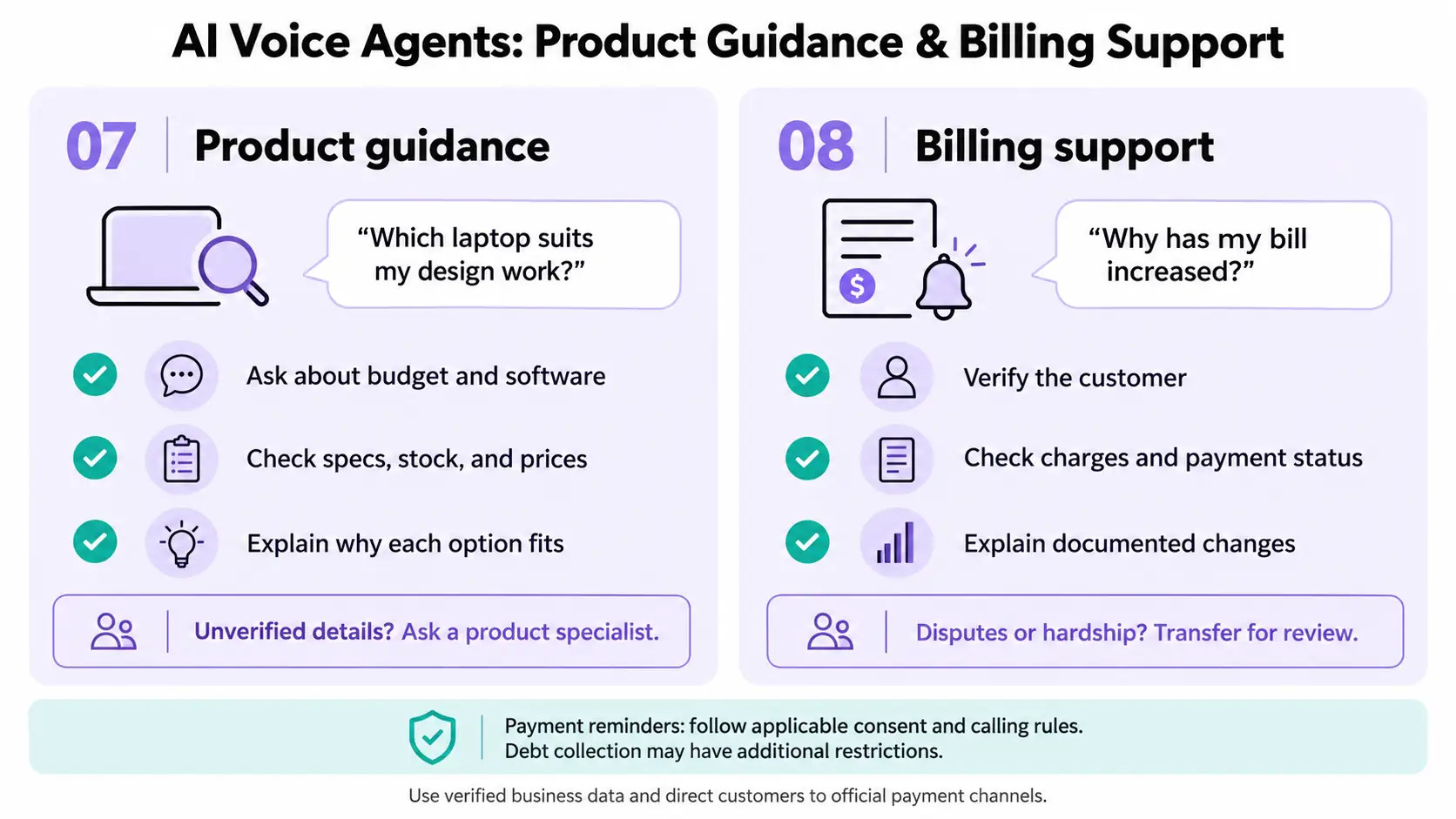
A customer calls an electronics store looking for a laptop for design work. The agent asks about budget, software requirements, and preferred size, then checks the approved catalogue.
Recommendations should reflect verified specifications, compatibility, availability, and current prices. The agent should explain why an option fits instead of simply recommending the most expensive product.
Questions that the catalogue cannot answer should go to a product specialist.
Measure: Recommendation accuracy, useful sales handovers, and customer feedback.
8. Explain Bills and Send Payment Reminders
An agent can explain approved billing information, retrieve payment status, and direct customers to official payment channels.
A subscriber questions an increase in their bill. After verification, the agent checks the account and explains a documented plan change or additional charge.
Outbound reminders need appropriate consent and calling controls. Disputed charges, hardship requests, and payment arrangements may require human review.
Routine reminders should be distinguished from debt collection. Where US debt collection rules apply, additional communication restrictions can matter, as CFPB guidance explains.
Measure: Accurate explanations, resolved billing enquiries, and appropriate escalations.
9. Assist With Account Access and Profile Updates
Customers frequently need help accessing an account or updating contact details.
An agent can guide a caller through an approved recovery process or submit an authorised profile change. For example, it might trigger a secure reset link through an existing account system.
Recognising a caller’s name or phone number should not be treated as sufficient proof of identity. Sensitive changes require the business’s approved authentication controls.
Failed verification should lead to a secure alternative rather than repeated attempts to collect more personal information.
Measure: Successful authorised requests, verification failures, and incorrect changes.
10. Record Complaints and Provide Case Updates
A customer who has already reported a problem wants to know what is happening next.
An agent can record a complaint, create a case, retrieve its current status, and explain the next documented step. It should distinguish an expected update from a confirmed resolution.
For example, a delivery complaint may be awaiting a courier investigation. The agent can explain that status without promising compensation or a completion date it cannot verify.
Serious complaints and policy exceptions need human ownership.
Measure: Complete complaint records, accurate updates, and escalation time.
11. Collect Feedback After a Service Interaction
An agent can ask customers whether a repair, delivery, or support interaction met their expectations.
After a technician visit, it might ask, “Was the problem resolved?” and “How would you rate the service?”
Keep the conversation short and make participation optional. Low ratings or unresolved problems should trigger an appropriate response.
A customer’s stated rating is different from sentiment inferred by software. Report these separately, and follow applicable rules for outbound contact and recording.
Measure: Response rate, reported satisfaction, and unresolved issues identified.
12. Notify Customers About Service Disruptions
Businesses can use voice agents to communicate verified service changes, including outages, appointment cancellations, and delivery delays.
A utility provider could notify affected customers about an interruption and share the latest approved restoration estimate. The agent can also answer basic questions from the same operational information.
If the estimate changes or remains unknown, the message should reflect that uncertainty.
An ordinary customer service agent should not be presented as an emergency response system. Reports of immediate danger need an approved urgent response process.
Measure: Customers reached, notification accuracy, and appropriate handling of urgent reports.
Benefits and Limits of AI Voice Agents
Well-configured agents can reduce waiting for routine enquiries, provide assistance outside office hours, and save staff from repeating the same checks.
Connected records can also help the next person understand what has already happened.
These benefits depend on answer accuracy, reliable integrations, available call capacity, and sensible handover rules. A service that accepts calls quickly but gives incorrect information has not improved customer support.
Approved knowledge sources can improve consistency, but they do not eliminate mistakes. NIST’s guidance on generative AI risks identifies the risk of plausible but incorrect output.
Human agents remain essential when customers need judgement, discretion, negotiation, or personal attention.
When Should a Voice Agent Transfer a Call
A handover is appropriate when the customer requests a person, verification fails, necessary information is unavailable, or the requested action exceeds the agent’s authority.
Repeated misunderstandings, serious dissatisfaction, sensitive complaints, and urgent safety concerns also need a clear response.
A useful handover includes the customer’s request, relevant verified details, steps already attempted, and any failed action. Context sharing must be configured; transferring a call alone does not guarantee that information reaches the human agent.
Define what happens when nobody answers. Offer a callback, create a ticket, or provide another approved route.
How to Choose an AI Voice Agent
Ask providers to demonstrate your actual calls, including difficult ones.
Check these areas before committing:
- Conversation quality: Test local accents, mixed languages, background noise, names, reference numbers, interruptions, and corrections.
- Response speed: Listen for pauses that make callers repeat themselves or assume the call has disconnected.
- System access: Confirm what the agent can read and change, and how permissions are enforced.
- Task reliability: Test unavailable appointment slots, missing orders, failed updates, and disconnected systems.
- Human handover: Check routing, context sharing, unanswered transfers, and callbacks.
- Capacity: Verify simultaneous call limits and what happens when demand exceeds them.
- Data controls: Review recordings, transcripts, retention, deletion, access, and relevant service agreements.
- Total cost: Include telephony, AI usage, setup, integrations, recording, support, and transfer charges where applicable.
Providers may bill different components separately. For example, Twilio lists voice costs separately from Conversation Relay usage.
How to Start With One Use Case
Choose a frequent request with clear rules and reliable data. Order tracking, appointment enquiries, or case status updates are useful candidates to assess.
Define the outcome before building. For appointment booking, success means the correct appointment exists in the calendar and the customer has received accurate confirmation.
Prepare the required information, connect the systems, and set permissions and handover rules. Then test realistic variations, including requests the agent must decline or escalate.
Start with a limited pilot. Review calls and system records together, correct recurring failures, and expand only when the workflow performs reliably.
How to Measure Performance
Call volume alone cannot tell you whether customers received useful help.
Track these measures with clear definitions:
- Resolution rate: The share of enquiries confirmed as resolved, using a stated review method and follow-up period.
- Task completion rate: Successfully completed eligible tasks divided by eligible tasks attempted.
- Containment rate: Calls completed without a human transfer. This does not prove resolution.
- Transfer rate: Calls passed to humans, separated where possible into appropriate and avoidable transfers.
- Repeat contact rate: Customers who contact the business again about the same issue within a defined period.
- Customer satisfaction: Direct customer feedback, reported with response volume or response rate.
- Error rate: Incorrect answers, failed actions, or inaccurate record changes identified through review.
- Cost per resolved enquiry: Relevant operating costs divided by confirmed resolutions.
A short call is not necessarily successful. A correct transfer is not necessarily a failure.
Privacy and Calling Rules to Consider
Voice agents may process personal details, account records, recordings, and transcripts. Collect only what the task requires and control who can access it.
Check the rules that apply to your business, the customer’s location, the purpose of the call, and whether it is recorded. Establish appropriate notices, consent records, retention periods, and opt-out processes.
In the United States, the FCC confirmed that AI-generated voices fall within TCPA provisions for artificial or prerecorded voices. Consent requirements and exceptions depend on the call. Covered telemarketing calls generally require prior express written consent.
A submitted enquiry or a phone number entered at checkout should not automatically be treated as permission for automated marketing calls. FTC guidance explains requirements for prerecorded telemarketing.
For US healthcare organisations subject to HIPAA, processing electronic protected health information through a cloud provider may require a business associate agreement and suitable safeguards. HHS guidance explains these conditions.
Frequently Asked Questions
Can an AI Voice Agent Replace Human Customer Service Agents
It can take responsibility for selected tasks within defined permissions. Human support remains important for exceptions, sensitive conversations, and decisions requiring judgement.
Can AI Voice Agents Make Outbound Calls
Some platforms support outbound calling for reminders, feedback, and other configured workflows. Businesses must assess the consent and communication rules that apply to each use.
Are AI Voice Agents Suitable for Small Businesses
They can be useful when repeated calls take time away from other work. Compare your call patterns and staffing needs with the full cost of the service. Low call volume may not justify a complex implementation.
Can a Voice Agent Handle Several Requests in One Call
Some systems can identify multiple requests and work through them. Each action still needs the correct data, permissions, and confirmation process. Test that the agent addresses every request without losing context.
How Much Does an AI Voice Agent Cost
Pricing varies by provider and implementation. Compare subscriptions or usage charges alongside phone services, integrations, setup, and ongoing support. Estimate cost per resolved enquiry rather than comparing headline rates alone.
Final Thoughts
The best starting point is a customer request your business understands well. Choose one task, give the agent accurate information and appropriate access, and define when a person should take over. Review whether customers received the right answers and whether promised actions actually happened.
The most effective ai voice agent use cases focus on making customer service and its trends easier to access, more reliable, and more helpful. That is a better measure of value than the number of calls an agent handles.
Want to make customer conversations easier? Explore REVE Chat’s AI Voice Bot to automate customer calls, answer common questions, and provide support when your team is unavailable. Book a demo to see how it can support your customer service operations.
Frequently Asked Questions
It can take responsibility for selected tasks within defined permissions. Human support remains important for exceptions, sensitive conversations, and decisions requiring judgement.
Some platforms support outbound calling for reminders, feedback, and other configured workflows. Businesses must assess the consent and communication rules that apply to each use.
They can be useful when repeated calls take time away from other work. Compare your call patterns and staffing needs with the full cost of the service. Low call volume may not justify a complex implementation.
Some systems can identify multiple requests and work through them. Each action still needs the correct data, permissions, and confirmation process. Test that the agent addresses every request without losing context.
Pricing varies by provider and implementation. Compare subscriptions or usage charges alongside phone services, integrations, setup, and ongoing support. Estimate cost per resolved enquiry rather than comparing headline rates alone.
Build AI-powered support with Wize AI
Connect business knowledge, automate support conversations, and improve response quality without managing a complex AI stack.
Explore Wize AI Agent Rate the article

Tabassum Kabir
Sr. Content Writer
Tabassum Kabir is a Senior Content Writer with 5+ years of experience. She specializes in SaaS, AI, customer service, and ecommerce. She writes about technology, business, and digital trends. Her work is simple, clear, and useful. She aims to give readers information they can understand and use.
View all articles
Make Customer Support Easier with REVE Chat AI Voice Bot
Let AI Voice Bot answer calls, respond to common questions, and help your customers anytime.
Try our Voice Bot today