




Table of Content
AI SUMMARY
Quick Answer
LLMs and agentic AI serve different purposes but often work together. LLMs mainly understand and generate language, while agentic AI can plan, use tools, interact with business systems, and complete multi-step tasks. The blog explains their relationship, business use cases, limitations, risks, and implementation considerations. It also highlights the importance of permissions, monitoring, security, and human oversight when giving AI greater autonomy.
Nowadays, Artificial Intelligence (AI) is one of the most widely discussed and rapidly adopted technologies in the world. It is already being used across industries such as technology, healthcare, education, and business to solve problems and automate different tasks.
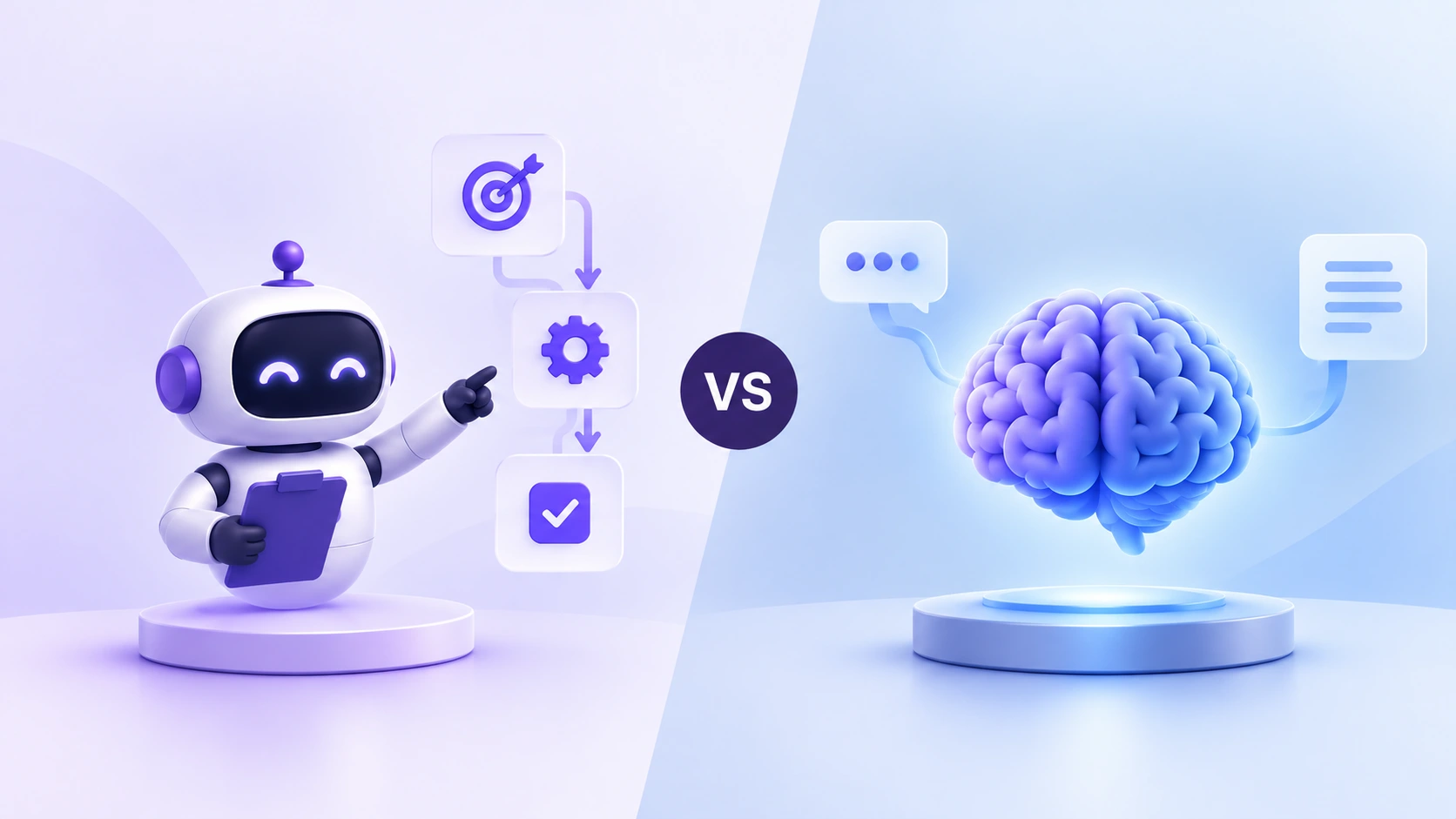
Depending on the use case, AI can work in different ways. LLMs (Large Language Models, e.g., ChatGPT, Gemini) are commonly used for messaging, content generation, research, and other language-based tasks. On the other hand, Agentic AI is designed to go beyond generating responses by taking actions, making decisions, and providing automated support.
So having a clear idea about Agentic AI and LLM has become necessary for both our personal work and business growth.
In this blog, we’ll learn what Agentic AI and LLMs are, how they work, how they differ, and where each can be useful. We’ll also look at how businesses can use these technologies to improve their workflows, customer support, and overall productivity.
What Is an LLM?
LLM is a type of AI model that is trained on massive amounts of text from the internet, books, articles, and conversations. In simple words, it learns the patterns of how language works – how sentences are formed, how people usually reply, and what words normally come next.
You’ve probably used ChatGPT, Gemini, or Claude at some point. You type something, and within seconds you get a full answer, an email, a summary, or even a piece of code. The technology behind these tools is called an LLM.
KEY TAKEAWAY
So, the easiest way to think about an LLM is:
LLM = AI that understands and generates language.
What Is Agentic AI?
Agentic AI is a type of AI system designed to work toward a specific goal and complete tasks with limited human supervision. Instead of only giving you an answer, it can decide what needs to happen next, create a plan and take actions to complete the task.
For example, imagine a customer asks, “Where is my order?”
A regular AI assistant may explain how to track the order. An agentic AI system could go further-it can understand the request, check the order system, find the latest delivery status, and provide the customer with the result.
The key idea is that agentic AI combines reasoning with action. It can work through multiple steps and interact with external systems rather than depending on a person to guide every individual step.
KEY TAKEAWAY
So, the easiest way to think about agentic AI is:
Agentic AI = AI that can understand a goal, decide what to do, and take actions to achieve it (Understand → Plan → Act → Evaluate → Complete).
How Are They Actually Related To Each Other?
LLMs and agentic AI are closely connected, but they play different roles. In many modern agentic AI systems, an LLM works as the reasoning engine that helps the system understand instructions, interpret information, and decide what should happen next. The agentic system then adds other capabilities around it, such as tools, memory, business data, APIs, and workflows.
A simple way to understand the relationship is:
LLM = The brain that understands and reasons
Agentic AI = The complete system that uses that brain along with tools and actions to achieve a goal
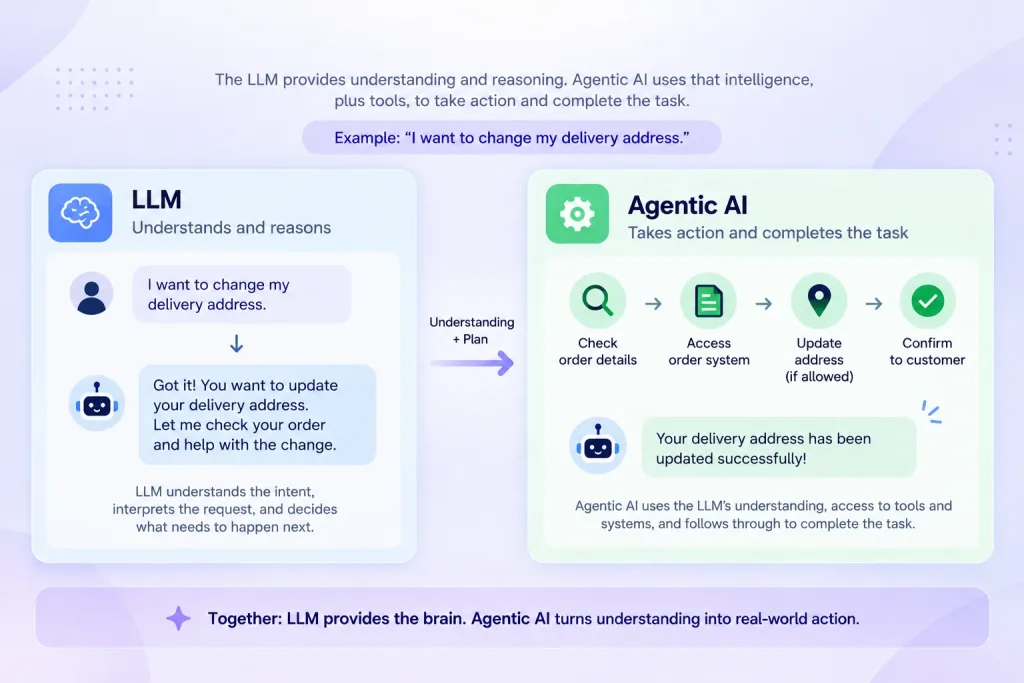
For example, an LLM can understand that a customer wants to change a delivery address and explain how to do it. An agentic AI system can use that understanding to check the order, access the relevant system, update the address if allowed, and confirm the change to the customer.
Modern AI-agent architectures commonly connect LLMs with external tools and systems for this kind of task execution.
So, agentic AI does not necessarily compete with or replace LLMs. Instead, it can build on LLM capabilities and extend them from generating responses to completing goal-oriented tasks.
Agentic AI vs LLM: Side-by-Side Comparison Table
Now that we understand both concepts, here is a simple comparison of how LLMs and agentic AI differ in practice.
| Area | LLM | Agentic AI |
|---|---|---|
| Main purpose | Understands information and generates responses | Works toward a goal, action and completes tasks |
| How it works | Responds mainly to the prompt or instruction it receives | Can decide the next steps based on the goal and situation |
| Ability | Usually requires the user to guide each request | Can perform several steps with limited human guidance |
| Planning | Can suggest or describe a plan | Can create a plan and follow the required steps |
| Tool & API use | Needs additional systems to interact with external tools | Can be designed to use APIs, databases, software, and other tools |
| Memory & context | Mainly relies on the context available during the interaction | Can use memory or stored information to support ongoing tasks |
| Taking action | Mainly generates information, content, or recommendations | Can take approved actions in connected systems |
| Example | Writes an email explaining an order delay | Checks the order, identifies the delay, updates the customer, and takes the next approved action |
Agentic AI or LLM: Which Is Right for Your Business?
The choice between an LLM and agentic AI mainly depends on how much you want the AI to do. If the task is mostly about understanding or generating information, an LLM may be enough. If the AI needs to make decisions, work through several steps, and interact with business systems, agentic AI becomes more useful.
1. Customer Support
Choose an LLM when: You mainly want AI to answer customer questions, summarize conversations, explain policies, or help support human agents write better responses. It works well when the main job is providing useful information .
Choose agentic AI when: You want AI to handle more of the support process on its own. It can be connected to systems such as your CRM, order platform, or ticketing software to retrieve information, take approved actions, and move the request toward resolution.
Example: An LLM can explain your refund policy. Agentic AI can check the customer’s order, verify refund eligibility, and start the refund process.
2. Sales and Marketing
Choose an LLM when: Your team needs help creating sales emails, campaign copy, product descriptions, lead summaries, or personalized messages. The LLM works as an assistant that helps people create and understand information faster.
Choose agentic AI when: You want AI to perform parts of the sales process, not just create content for it. It can analyze lead information, update CRM records, schedule follow-ups, or trigger the next approved step based on predefined goals and rules.
Example: An LLM can draft a follow-up email. Agentic AI can identify that a lead needs follow-up, prepare the message, update the CRM, and trigger the next action.
3. E-commerce
Choose an LLM when: You want customers to get quick answers about products, policies, specifications, or recommendations. It is useful when the goal is helping shoppers understand their options and make better purchase decisions.
Choose agentic AI when: You want AI to go beyond answering questions and interact with commerce systems. It could check inventory, retrieve order details, perform permitted order-related actions, or coordinate several steps needed to solve a customer’s request.
Example: An LLM can recommend a suitable pair of shoes. Agentic AI can check whether the recommended size is available and then help complete the next steps in the buying process.
4. Internal Business Operations
Choose an LLM when: Employees need a faster way to find information, summarize reports, understand company documents, or draft internal content. In this case, the AI mainly acts as a knowledge and productivity assistant.
Choose agentic AI when: You want AI to carry out repeatable business processes that involve several systems or steps. It can gather information, create tasks, update records, trigger workflows, and check whether the required work has been completed.
Example: An LLM can summarize an internal report. Agentic AI can analyze the report, identify required follow-up actions, create tasks for the relevant teams, and update connected systems.
5. IT and Technical Support
Choose an LLM when: You need an AI assistant that can explain technical problems, summarize error messages, generate troubleshooting steps, or help employees find information from technical documentation.
Choose agentic AI when: You want the system to investigate an issue and take approved technical actions. Depending on its permissions, it could check system information, run predefined diagnostic tools, create or update incidents, and escalate unresolved problems.
Example: An LLM can tell an employee how to reset an account. Agentic AI could verify the request, trigger the approved reset process, and confirm when it is complete.
A simple way to remember the difference is:
- Need AI mainly to create, explain, or answer? → LLM
- Need AI to plan, interact with systems, and complete a process? → Agentic AI
And it does not always have to be an either-or choice. In many real-world applications, an LLM provides the language and reasoning capabilities, while the Agentic system adds the tools, data access, workflows, and actions needed to complete the task.
Limitations, Risks and Implementation Considerations
Both LLMs and agentic AI can be useful for businesses, but they also come with some limitations and risks. As AI gets more ability to make decisions or take actions, businesses need to pay more attention to accuracy, security, permissions, and human control.
1. Limitations of LLMs
LLMs are powerful at understanding and generating language, but their answers are not always correct. Because they generate responses based on learned patterns and available context, they can sometimes produce inaccurate or unsupported information. This makes verification important, especially for sensitive business decisions.
LLMs also cannot automatically access your latest customer, order, inventory, or CRM data unless those information sources are properly connected to the application using the model.
2. Risks of Agentic AI
Agentic AI introduces an additional level of risk because it can take actions, not just generate responses. If an agent misunderstands a request or makes a poor decision, the result could affect a real business system. For example, updating the wrong record, triggering an incorrect workflow, or performing an action that should have required human approval.
Businesses therefore need to control what an AI agent can access and what actions it is allowed to perform. Sensitive or high-impact actions may still require human approval. Security practices such as limited permissions, logging, monitoring, and clear governance become especially important as AI systems gain more autonomy.
3. Data Privacy and Security
Both technologies may work with customer conversations, internal documents, account information, or other business data. Organizations should understand what information the AI can access, where that information comes from, and how it is handled.
For agentic AI, this becomes even more important because agents may connect with multiple business systems through APIs and other tools.
4. Implementation Considerations
You do not need to give an AI system maximum autonomy from day one. A safer approach is to start with a specific, well-defined use case, test how the system behaves, and gradually expand what it can do.
Before implementation, businesses should clearly define:
- The goal: What exact problem should the AI solve?
- Data sources: What knowledge and business data does it need?
- Integrations: Which CRM, database, API, or other systems should it access?
- Permissions: What can the AI view, change, or execute?
- Human handover: When should the AI stop and involve a person?
- Monitoring: How will you check accuracy, actions, failures, and overall performance?
Agentic AI architecture is usually developed iteratively, meaning organizations may need to test and adjust models, tools, permissions, workflows, and monitoring as the system moves toward production.
Building everything from scratch is also not the only option. For customer engagement and support use cases, businesses can consider platforms such as REVE Chat, where AI automation can be introduced alongside existing customer communication and human support processes. The important part is still choosing the right use case, connecting the right business information, and setting clear limits on what the AI is allowed to do.
The key takeaway is simple: more autonomy creates more opportunity, but it also requires more control. An LLM needs good information and proper evaluation; agentic AI needs those things plus stronger permissions, monitoring, integrations, and governance.
Summary
LLMs and agentic AI are closely related, but they are built for different levels of work. Most importantly, this is not always an LLM vs. agentic AI decision. In real-world systems, LLMs provide the language and reasoning capabilities, while agentic AI builds on them to complete more complex tasks.
The right choice depends on what your business needs. If you mainly want AI for answering questions, creating content, summarizing information, or assisting employees, an LLM may be enough. But if the task involves multiple steps, system access, decision-making, and real actions, agentic AI can be a better fit.
Frequently Asked Questions
An LLM understands and generates language. An AI agent uses a model plus tools and instructions to complete tasks, while agentic AI refers more broadly to systems designed to reason, plan, use tools, and act with greater autonomy.
An LLM is a specific type of generative AI model focused mainly on language. Generative AI is the broader category that also includes systems that generate images, audio, video, and other content.
Not always. If your use case only requires content generation, Q&A, or summarization, an LLM may be enough. Agentic AI becomes more valuable when you need AI to execute workflows or interact with business systems.
ChatGPT is an AI application powered by large language models. However, ChatGPT can also provide agentic capabilities through features such as ChatGPT agent, which can use tools and take actions to complete multi-step tasks.
Many modern agentic AI systems use LLMs for understanding, reasoning, and planning, but the LLM is only one part of the system. Tools, memory, APIs, data sources, and workflows help turn reasoning into action.
Not necessarily. An LLM is often enough for tasks such as writing, summarizing, and answering questions, while agentic AI is more suitable when the task requires multiple steps, tools, decisions, or actions.
Yes. Agentic AI can understand customer requests, use business data, connect with tools, and help complete support or sales tasks. Platforms such as REVE Chat’s Wize AI Agent apply these capabilities to customer engagement while also supporting human handover when needed.
Build AI-powered support with Wize AI
Connect business knowledge, automate support conversations, and improve response quality without managing a complex AI stack.
Explore Wize AI Agent Rate the article

Khalid Hassan Emran
Sr. Technical Content Writer
Khalid Hassan Emran is a Senior Technical Content Writer with more than 5 years of experience in technical documentation, content marketing, and blog writing. He specializes in simplifying complex technical concepts into clear, engaging content. In addition, he is an AI Agent Specialist and SEO Expert, helping businesses improve their digital presence through AI-driven solutions and search-optimized content strategies.
View all articles
Turn customer conversations into action with Wize AI
It helps businesses to engage with visitors, answer every question, recommend next steps, qualify leads, and support customers across every conversation.
Learn more