





Table of Content
In 1959, Peter Drucker introduced the term “knowledge worker” in his book, The Landmarks of Tomorrow. Drucker characterized them as highly skilled workers who mastered their skills using theoretical and analytical training.
A 2023 survey by iHire found that 72% of recruiters are planning to increase their use of skills-based hiring methods. This shows the rising demand for knowledge-based workers in every industry. Even, companies like Unilever and IBM have successfully implemented knowledge-based hiring and reported positive results.
Now, the question is, how do all these companies manage to source their knowledge workers? There comes knowledge process outsourcing. KPO connects skilled individuals with skill demands beyond the geographic region.
What Is Knowledge Process Outsourcing (KPO)?
Knowledge process outsourcing is delegating complex, knowledge-based tasks to external service providers with a core focus on the subject matter. This may sound a bit similar to business process outsourcing. KPO and BPO both have third-party involvement as a similarity. However, KPO necessitates required individuals to have high skill or domain knowledge.
The sectors of this outsourcing type are diverse since almost every job can benefit from employees with high domain knowledge. Some common sectors of knowledge outsourcing are accounting, legal, healthcare, technical, and research.
Types of Knowledge Process Outsourcing Services
As we have said before, the sector is so diverse that it’s difficult to fit all the types within a box. Thus, we have selected a few high-demand types of KPO.
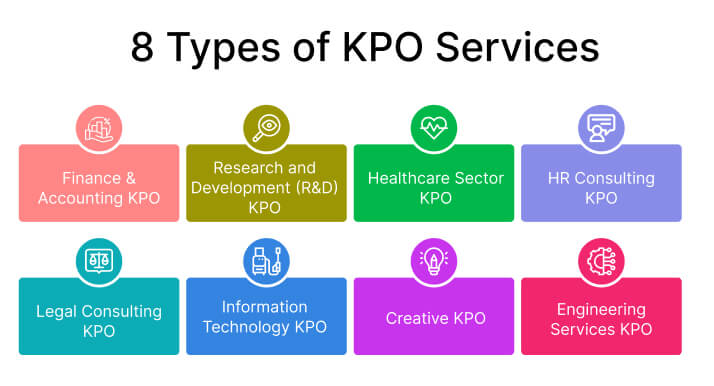
1. Finance & Accounting KPO
This involves outsourcing financial and accounting functions such as bookkeeping, tax preparation, auditing, and financial analysis to specialized service providers. The service provider must have expertise in the following field principles and regulations.
2. Research and Development (R&D) KPO
R&D projects are very uncertain. They often lack pre pre-determined roadmap that professionals can follow. It’s all you have to start from scratch. Preparing all the research materials and skilled employees often becomes a big challenge. A type of KPO involves outsourcing research-related activities such as market research, scientific research, and product development.
3. Healthcare Sector KPO
The healthcare sector goes beyond just treating patients. Many other tasks require an extensive skill set. Healthcare KPO involves outsourcing tasks related to healthcare information management, medical billing and coding, clinical research, and other specialized healthcare services. Additionally, the integration of advanced technologies in the industry has led to the development of healthcare chatbots, which play a crucial role in improving patient engagement, providing timely information, and enhancing overall healthcare communication.
4. HR Consulting KPO
HR functionalities have constantly evolving roles and responsibilities. With skilled HR consultants, companies can manage human resources with the best policies and practices. Outsourcing human resources functions includes recruitment, training, employee relations, and talent management. HR consulting KPO incorporates many HR technologies that improve your overall operations.
5. Legal Consulting KPO
Legal KPO offers cost-effective solutions to legal tasks. They connect you to skilled professionals, ensuring efficient handling of legal processes such as research, document review, and compliance. This approach allows organizations to tap into specialized legal expertise without the need for significant in-house investments.
6. Information Technology KPO
These tasks usually have high development costs. Some companies require a particular skill for only the short term. For example, you need an app developer to develop a CRM app. When the app is done, you will no longer need to keep this person working full-time. In such cases, outsourcing is a good solution. Tasks like data management, cybersecurity, cloud services, software maintenance, website development, and maintenance, etc,– you can outsource to an IT KPO.
7. Creative KPO
Creative knowledge process outsourcing involves creative services such as graphic design, content creation, video production, and other artistic endeavors. Creative KPO services leverage the expertise of professionals in design, multimedia, and content development. You no longer need to worry about getting day-to-day regular tasks done.
8. Engineering Services KPO
Companies that offer Engineering Services KPO should have expertise in different types of engineering, like mechanical, electrical, civil, and software. They often use advanced software tools and technologies to perform tasks efficiently. Whether it’s core or non-core tasks, KPOs bring the best skills within an affordable budget.
Common Knowledge Process Outsourcing Examples
The exact form of KPO depends on the industry and the type of expertise required. The following examples show how businesses can apply it in practice.
1. Investment Research
A venture capital firm may outsource initial company research, market sizing, competitor analysis, and financial modelling. Its internal investment team can then use the findings to evaluate opportunities and make final decisions.
2. Legal Research and Document Review
A law firm may use a legal KPO provider to research previous cases, review contracts, organize evidence, or monitor regulatory changes. Licensed lawyers within the firm remain responsible for legal judgment and client advice.
3. Healthcare Data and Billing Analysis
Hospitals and healthcare organizations may outsource medical coding, billing analysis, clinical data management, or healthcare research. Because these activities involve sensitive information, the provider must follow the applicable privacy and security requirements.
4. Product and Market Research
A business preparing to enter a new market may hire a KPO team to study customer demand, competitors, pricing, regulations, and market risks. The resulting analysis can support the company’s market-entry strategy.
5. Engineering and Product Development
Manufacturers may outsource computer-aided design, simulation, technical documentation, or specific parts of product development. This provides access to specialized engineering skills without expanding the permanent team.
6. Data Analytics and Performance Reporting
A company may outsource the collection, cleaning, and analysis of operational data. The KPO provider can create dashboards, identify trends, and produce reports that help internal leaders make informed decisions.
These examples demonstrate that KPO is not simply about transferring work. It involves using external expertise to turn complex information into useful business outcomes.
8 Key Benefits of Knowledge Process Outsourcing
According to Grand View Research, the global KPO market is expected to reach USD 33.07 billion by 2027, growing at a CAGR of 14.11% from 2022 to 2027.

It suggests that more companies will adopt KPOs due to their noteworthy underlying benefits. Some examples of these benefits are,
1. Get 10X Enhanced Productivity in Services
KPO companies are highly efficient with the core functions they provide. Imagine having the top talent performing on your given tasks. It will bring service excellence ten times more. In the meantime, you will have access to modern technologies that will boost productivity.
2. Access Global Talent Pool of Skills
Hiring skilled professionals in certain domains can be expensive, especially in developed countries. KPO providers, often operate in regions with lower labor costs. They can offer access to the same level of expertise at a more competitive price. Knowledge Outsourcing enables you to connect with a global talent pool and leverage their skills.
3. Save Subsequent Time From Hiring Hassel
Let’s say that you need a cybersecurity specialist to work with the firewalls of your system. The entire project will take 15 days. Will you spend months hiring someone for a 15-day project? I guess you won’t. Whether it’s short-term or long-term, recruitment is a time-consuming task. KPO agencies save this time by connecting you to on-demand talents without recruitment hassles.
4. Employee Turnover Risk Management
Employee turnover negatively impacts a company’s productivity. It’s even more challenging when it comes to the knowledge of employees. It may take you months to find your desired employee and then he leaves within a few months. KPO saves you from situations like this. KPO providers deal with the employees and under unwanted circumstances, they take full responsibility for finding replacements.
5. 24/7 Service Availability
Most KPO companies operate round the clock. Thus, you can keep the service operating 24/7 when it comes from a KPO agency. In an emergency, you can have your knowledge- employees work odd hours. This is highly beneficial for time-sensitive businesses.
6. Reduce the Cost of Specialized Work
Recruiting full-time specialists can involve salaries, benefits, training, technology, and other long-term expenses. KPO allows a business to pay for the expertise and capacity it needs without carrying the full cost of an internal team.
However, the business should evaluate total cost rather than hourly rates alone. Transition, management, communication, and quality-control expenses must also be considered.
7. Scale Resources More Flexibly
A KPO partnership allows a business to increase or reduce specialized resources based on project requirements. This can be particularly useful during seasonal demand, rapid expansion, research-intensive projects, and periods of organizational change.
8. Help Internal Teams Focus on Priorities
Outsourcing research, analysis, reporting, or other knowledge-intensive work can reduce pressure on internal employees. They can spend more time interpreting results, serving customers, developing products, and making strategic decisions.
Limitations of Knowledge Process Outsourcing
Just like every other sector, KPO too has some limitations. Once you know them, you will be able to incorporate pro-tips to make the limitations manageable.
1. Communication Barriers
One of the challenges in Knowledge Process Outsourcing (KPO) is the potential for communication barriers. The prospected employee may come from different languages, cultures, and time zones. They may need time to adapt to your company’s culture and politics.
Pro-tip: Arrange a training session while onboarding outsourced employees. Acknowledge and respect other’s perspectives.
2. Quality Control
By outsourcing, you allow some control over your processes to a third party. This can be concerning for tasks involving strategic decisions. It often takes longer times for outsourced employees to reach the expected quality.
Pro-tip: Prepare a service level agreement (SLA). Make sure that your outsourced employees have a clear vision of your business’s mission, vision, and expectations.
3. Data Security Risks
Data security is another major concern. Sharing sensitive data with a third party inherently carries security risks. Usually, reputed KPO providers assure you that your sensitive data will be safe with them.
Pro-tip: Ensure your KPO provider has robust data security measures in place, including encryption, access controls, and regular security audits.
4. Compliance and Intellectual Property Concerns
A KPO provider may handle regulated information, proprietary methods, product designs, or confidential research. Unclear data ownership and intellectual property terms can create legal and operational risks.
Pro tip: Define data ownership, intellectual property rights, confidentiality requirements, and regulatory responsibilities in the contract.
5. Dependence on the Provider
A company can become too dependent on its KPO partner when important processes and knowledge are not documented internally. This can make switching providers or returning the work in-house difficult.
Pro tip: Maintain internal process documentation, require regular knowledge transfer, and prepare an exit plan before the engagement begins.
6. Hidden Costs
The quoted service fee may not include onboarding, technology integration, management time, travel, quality reviews, or the cost of correcting errors.
Pro tip: Calculate the total cost of the engagement and specify all expected charges before signing the agreement.
Difference Between KPO and BPO (Comparison chart)
| Comparison Basis | KPO | BPO |
|---|---|---|
| Definition | Knowledge process outsourcing defines sourcing unique skills that an organization requires from a third-party provider. | Business process outsourcing defines sourcing organization tasks from a third-party provider. |
| Service | High-end services. | Low-end services. |
| Process | The process of KPO requires an extensive understanding of business and the dedicated task. | The process of BPO is simple since most of the tasks are repetitive simple requirement tasks. |
| Complexity | KPO tasks involve high-level complexity due to unique demands. | BPO tasks comparatively take low to moderate levels of complexity. |
| Qualification | High domain knowledge. | Non-core general knowledge. |
Who Manages KPO?
KPO management is a joint effort between the client and the KPO provider. The client organization wants to outsource knowledge-intensive business processes. They are in charge of defining project requirements and making sure they align with its business objectives.
The KPO service provider is responsible for hiring and managing skilled professionals, scaling up efficient processes, and delivering top-notch results. Both the client and service provider have project managers who oversee daily operations.
When Should a Business Consider KPO?
Knowledge process outsourcing is most useful when a company needs specialized expertise but cannot efficiently develop or maintain that expertise internally. It can support a one-time project, an ongoing business function, or a temporary increase in workload.
Here are some common signs that a business may need KPO:
1. Specialized Knowledge Is Not Available Internally
Some projects require expertise that the existing team does not have. A business may need financial analysts, legal researchers, cybersecurity specialists, engineers, medical coders, or market researchers for a particular assignment.
Using a KPO provider gives the company access to qualified professionals without requiring it to build an entirely new internal department.
2. The Existing Team Is Overloaded
Even when employees have the necessary expertise, they may not have enough time to manage additional research, analysis, or documentation. Outsourcing part of the workload can help the internal team focus on higher-priority decisions.
3. The Requirement Is Temporary
Hiring a full-time employee may not be practical for a three-month research project, a compliance review, or a short product-development cycle. KPO allows businesses to access expertise for the period in which it is actually needed.
4. The Business Needs to Scale Quickly
Demand for specialized work may increase during an expansion, acquisition, product launch, or entry into a new market. A KPO partner can provide additional capacity without the delays associated with traditional hiring.
5. The Company Needs Independent Analysis
Businesses sometimes need an external perspective for market research, risk analysis, investment evaluation, or operational improvement. A qualified KPO provider can offer evidence-based recommendations without being influenced by internal assumptions.
KPO may not be the right choice when a task requires constant executive oversight, depends heavily on confidential institutional knowledge, or forms a critical capability that the company should retain internally.
How to Choose the Right KPO Provider
Choosing a KPO partner requires more than comparing service lists and prices. The provider may work with valuable business information and influence important decisions, so its expertise, processes, and security controls must be evaluated carefully.
1. Evaluate Its Domain Expertise
Check whether the provider has professionals with relevant qualifications and practical industry experience. General outsourcing experience may not be sufficient for specialized legal, financial, medical, engineering, or technical work.
Ask who will work on the project, what qualifications they have, and whether the provider can maintain that expertise throughout the engagement.
2. Review Previous Work
Request relevant case studies, client references, work samples, or measurable project results. A provider’s experience with similar assignments can indicate how well it understands the required standards and challenges.
3. Examine Its Security Measures
Find out how the provider stores, transfers, and accesses information. Important controls may include encryption, role-based access, multifactor authentication, employee background checks, confidentiality agreements, and regular security audits.
The required controls will depend on the type of data and the regulations governing the industry.
4. Define Quality Standards
Agree on how quality will be checked before the engagement begins. This may include review procedures, accuracy targets, approval stages, error thresholds, and requirements for correcting unsatisfactory work.
A small pilot project can help both parties test quality before transferring a larger process.
5. Assess Communication and Availability
Confirm the provider’s communication channels, meeting schedule, response times, working hours, and escalation procedures. Differences in language and time zone can be managed when expectations are established early.
6. Check Its Ability to Scale
The provider should be able to increase or reduce capacity without significantly affecting quality. Ask how it manages sudden increases in workload and how quickly additional qualified specialists can be assigned.
7. Review the Contract and Exit Terms
The agreement should clearly address deliverables, timelines, pricing, intellectual property ownership, confidentiality, data retention, dispute resolution, and termination.
It should also explain how documents, data, and process knowledge will be returned or transferred at the end of the partnership.
7 Best Practices for Implementing Knowledge Process Outsourcing

Now, if you are looking to adopt KPO, you must know the best practices. We’ve listed the seven best practices to streamline this for you.
- Plan Your Objectives and Expectations: Have you decided why you need to outsource the knowledge process? And, what do you expect from outsourcing? Before assigning your core task to a third-party agency, you must plan a set of objectives. Only then, you will be able to dedicate the tasks well.
- Robust Service Level Agreements (SLAs): A service level agreement is a contract between you and your KPO provider. SLA ensures that both of you have agreed on the service expectations and outcomes.
- Establish Clear Communication Channels: Since most of the KPOs operate remotely, you should establish clear communication channels. List down project management tools, employee communication tools, and all other platforms needed throughout the knowledge management.
- Imply Data Security Measures: Previously we’ve mentioned that data security is a concerning factor in outsourcing. Have a detailed talk with your service provider regarding the security measures they will be following.
- Organize Welcoming Onboarding: An outsourced employee might feel lost when assigned to a new company. A welcoming onboarding session will bring comfort. He/she will be more encouraged to bond with company culture.
- Transition Planning and Training: Knowledge employees are usually well-trained in their professional fields. They still need training to cope with organizational objectives. Prepare brief transition planning and training for your KPO employees. Introduce new employees to helpful systems like Vistacreate, Hubspor CRM, Jira, etc.
- Continuous Performance Monitoring: We are almost at the end. They have been onboarded, received training, and started their assigned jobs. The final stage is to monitor performance. Continuously monitor the performance of the employee. Communicate with the service provider if they miss meeting any KPIs.
How to Measure KPO Performance
Businesses need clear performance indicators to determine whether a KPO partnership is delivering the expected value. The right metrics depend on the service, but common KPO performance indicators include:
- Accuracy: The percentage of work completed without errors.
- Turnaround time: How quickly the provider completes assigned work.
- SLA compliance: Whether agreed service levels and deadlines are consistently met.
- Rework rate: The amount of work that must be corrected or repeated.
- Cost efficiency: The total cost compared with performing the work internally.
- Productivity: The volume of work completed within a given period.
- Insight quality: Whether research or analysis supports useful business decisions.
- Security compliance: Whether data-handling and access requirements are followed.
- Stakeholder satisfaction: How satisfied internal teams are with communication, quality, and usefulness.
- Knowledge transfer: How effectively information and processes are documented and shared.
These metrics should be agreed upon in the service-level agreement. Businesses should review performance regularly instead of waiting until the end of the contract to identify quality or delivery problems.
End Note
Knowledge process outsourcing ( KPO ) helps to fill human resources gaps within a company. In the meantime, it introduces cost-effective and sustainable solutions. By leveraging KPO, any company can level up its existing skills. This is a highly effective work process model.
Build AI-powered support with Wize AI
Connect business knowledge, automate support conversations, and improve response quality without managing a complex AI stack.
Explore Wize AI Agent Rate the article

Juwel Rana
Senior Content Writer
Juwel is a Sr. Content Writer at REVE Chat. He specializes in writing about customer service and customer engagement. He is passionate about helping businesses create a better customer experience.
He strongly believes that businesses will be able to understand their customers better and ultimately create more meaningful relationships with them.
View all articles