Business competition has been more fierce than ever before in the insurance market. Therefore, generating high-quality leads is getting more and more challenging. Plus customers are looking for faster, helpful, and personalized experience. Studies show that 78% of customers buy from the first company to respond to their inquiries.You know, several insurance companies follow several […]
Ehsanur Rahman Head of Customer Communication
Updated Jul 13, 2026 • 19 min read
Table of Content
Business competition has been more fierce than ever before in the insurance market. Therefore, generating high-quality leads is getting more and more challenging. Plus customers are looking for faster, helpful, and personalized experience. Studies show that 78% of customers buy from the first company to respond to their inquiries.
You know, several insurance companies follow several lead-generation ideas or techniques.
But how do you know which strategies work best for your insurance business?
In this case, you can follow the trendy and most effective lead generation technique for the insurance industry: lead generation from live chat and chatbot.
Here, we are going to discuss some of the best lead-generation strategies for insurance through live chat and chatbot, SEO, content marketing, inbound marketing, and so on.
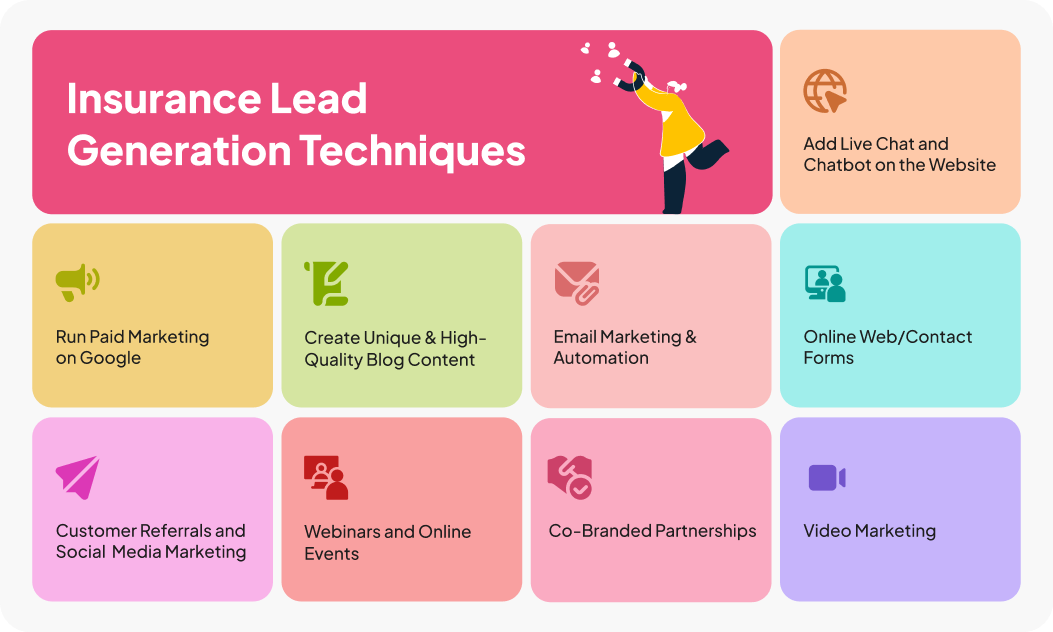
10 Best Insurance Lead Generation Techniques for Insurance
It is essential to highlight the need to have a well-defined strategy, with specific KPIs (Key Performance Indicators) that can be measured and reviewed periodically. Below, we present some of the most effective strategies to get insurance leads:
1. Add Chatbot & Live Chat on the Website
The incorporation of a Chatbot and Live Chat system on your website allows real-time interaction between visitors and you or a representative of your company while they browse your page. These tools provide a direct and fast means of communication so that visitors can make inquiries, obtain information instantly, and receive help when they need it.
With instant messaging, you can collect valuable contact information from visitors such as names, emails, or phone numbers during the conversation, which is useful for following up on their queries or providing additional information later on. With Chatbot you can provide round-the-clock services.
Take REVE Chat as an example where both Live Chat and Chatbot work side by side. By implementing REVE Chatbot you can provide 24/7 services to your customers, increase support volume, personalized resolution, and enhance customer retention rate.
REVE Live Chat offers features like Instant communication, Omnichannel support, Offline messaging, Visitor analytics, and Customizable chat widgets. These are all designed to help you connect with potential customers and turn them into leads.
These tools not only enhance customer satisfaction but also strengthen your ability to meet the needs of your clients efficiently.
2. Run Paid Marketing on Google
Currently, paid ads allow you to directly target the audience of your choice. You can customize your campaign with precise demographic filters, such as age, gender, location, and audience interests. This allows you to ensure that your ads are shown to the people most likely to engage with your brand, driving relevant traffic and improving conversion rates. With paid marketing, you also gain access to valuable data insights, helping you refine your strategy and maximize your return on investment (ROI).
3. Create Unique & High-Quality Blog Content
In the field of digital marketing, Inbound Marketing is about generating content in various online formats with the purpose of attracting visitors and potential leads organically, without the need to use paid advertising.
Particularly in written content, SEO (Search Engine Optimization) is essential, it is important to optimize your content for keywords that have a high monthly search volume so that a greater number of users can find it.
4. Email Marketing & Automation
Email marketing is a powerful tool for nurturing leads by offering personalized communication and regular updates. By segmenting your audience based on their interests (e.g., life insurance versus car insurance), you can tailor your messages to each group, providing relevant information and offers. This personalized approach increases engagement and helps build trust with potential customers.
Additionally, automated email campaigns allow you to stay connected with prospects who may not be ready to purchase right away. Regular follow-ups ensure your brand stays top-of-mind while retargeting emails can re-engage leads who visited your site but didn’t convert, giving you another chance to turn them into customers.
5. Social Media Marketing
Social media is one of the highly converting lead generation tactics insurance businesses should include in their campaigns. Platforms like Instagram, Facebook, TikTok, and LinkedIn make it possible to engage with potential leads, pay for paid advertisements, and grow your brand.
You can advertise on social media platforms. The most popular approach is to create ads that redirect people to a landing page where a “lead magnet” is offered, which can be a webinar, e-book, free course, etc. If a user who has visited your landing pages or ads does not convert, you have the option to create social media or WhatsApp marketing campaigns. These are campaigns designed to impact people who have already visited your website before, which significantly increases the chances that they will ultimately become quality leads.
6. Video Marketing- Create Educational Video Content
Explainer videos, testimonials, and case studies can effectively convey complex insurance concepts in an easy-to-understand format. Video content is increasingly favored by consumers and can increase engagement.
It boosts engagement by capturing attention and being more shareable, helping your brand reach more people. It also simplifies complex insurance topics, making it easier for potential leads to understand their needs. Additionally, video testimonials from satisfied customers can build trust and convince prospects to take action.
7. Online Web/ Contact Form
Online web and contact forms are essential tools for generating insurance leads by providing an easy, direct way for potential customers to express interest or ask questions. These forms should be prominently displayed on your website, whether on your homepage, landing pages, or specific service pages, making it simple for visitors to fill in their details.
To maximize conversions, keep the form concise, asking for key information such as the user’s name, email, and insurance needs. You can also add fields for specific inquiries or options for requesting a quote, which helps qualify leads instantly.
8. Arrange Different Webinars and Online Events
Hosting educational webinars on topics like “Choosing the Right Health Insurance” or “Understanding Auto Insurance Policies” can attract interested leads and establish your brand as an expert.
Webinars help you capture leads by requiring registration. It allows you to collect valuable contact details. They also position your company as a trusted expert by sharing in-depth knowledge. After the webinar, you can nurture attendees through follow-up emails with more content and offers, keeping your brand at the forefront of your mind.
9. Customer Referrals
Word-of-mouth referrals are one of the most trusted forms of lead generation, especially for products like insurance, where trust is critical. Offering incentives to current customers for referring friends or family can create a steady stream of high-quality leads. When satisfied clients recommend your services to their friends, family, or colleagues, they provide a powerful endorsement that can lead to new business. An Exploding Topics report states, 92% of consumers trust referrals from friends and family.
You can implement a structured referral program that rewards your clients for bringing in new customers. This could be in the form of discounts, gift cards, or even cash incentives. Regularly remind your clients of the program, and make it easy for them to refer others by providing referral links, emails, or social media sharing options. Actively encourage and reward referrals, by this, you can create a steady stream of new leads that are already primed to become loyal customers.
10. Co-Branded Partnerships
Partnering with related businesses (e.g., car dealerships for auto insurance or real estate agents for homeowner’s insurance) can provide access to new customers in a trusted context.
It gets mutual benefits from Cross-promotion and access to each other’s customer base. Co-branded content like webinars, guides, or events can help you capture leads from a larger audience. Moreover, partnering with a trusted business expands your reach without increasing your ad budget.
Additional Insurance Lead Generation Strategies That Improve Conversion
Generating more insurance leads is only one part of the process. Insurance companies and agencies also need to reach prospects at the right moment, provide a convenient quoting experience, follow up quickly, and measure which channels produce actual policyholders.
Here are several additional strategies that can help turn insurance marketing activities into a more predictable lead-generation system.
Build a Strong Local SEO Presence
Many insurance searches have local intent. Prospects commonly look for terms such as “car insurance agent near me,” “home insurance in [city],” or “business insurance broker in [location].” Appearing in these searches can connect your business with people who are already considering a policy.
Start by creating and optimizing your Google Business Profile. Add accurate business hours, contact details, service areas, photographs, insurance categories, and a clear description of the policies you offer. Keep the profile updated and respond professionally to customer reviews.
Your website should also contain location-specific pages rather than relying on one general service page. For example, an agency serving several cities could create separate pages for:
Auto insurance in each service area
Home insurance for local property owners
Commercial insurance for industries common in that region
Health or life insurance for local families
Each page should provide genuinely useful information about the location, customer needs, available coverage, and the next step for requesting a quote. Avoid publishing nearly identical pages with only the city name changed.
Positive reviews also influence whether prospects trust the agency enough to make contact. Ask satisfied policyholders for honest reviews after successful onboarding, policy renewal, or claim support. Reviews can also be reused as social proof on landing pages, social posts, and advertising campaigns.
Replace Long Quote Forms With Guided Quote Funnels
A traditional insurance form may ask visitors to complete many fields before they receive any value. Long and complicated forms can make the quotation process feel like work, particularly for mobile visitors.
A guided quote funnel breaks the process into a series of shorter steps. Instead of displaying every question at once, it asks one or two relevant questions at each stage.
For example, an auto insurance funnel could begin with:
What type of vehicle do you want to insure?
What is your location?
When do you need the policy?
Do you currently have insurance?
How should an advisor contact you?
Use a progress indicator so visitors understand how much of the process remains. Collect essential contact information before introducing highly detailed questions, but clearly explain how the information will be used.
An AI Agent or chatbot can make this process more conversational. It can ask relevant follow-up questions, identify the insurance product the visitor needs, capture contact details, and route qualified prospects to the appropriate agent.
Keep the initial qualification process short. Additional underwriting information can be collected after the prospect has shown genuine interest or connected with an advisor.
Target Customers Around Important Life Events
Insurance demand is often connected to a change in a person’s life or business. Instead of promoting the same policy to everyone, insurance marketers can build campaigns around events that create an immediate need for coverage.
Common insurance triggers include:
Buying a new home
Purchasing or financing a vehicle
Getting married
Having a child
Starting a business
Hiring employees
Moving to a new city
Approaching a policy renewal date
Expanding a commercial property
Experiencing a change in income or employment
For example, a new homeowner may need home insurance, life insurance, and additional liability coverage. A growing business may require commercial property, workers’ compensation, cyber insurance, or commercial vehicle coverage.
Create landing pages, advertisements, email sequences, and educational resources for each important trigger. The message should address the customer’s current situation rather than simply promoting an insurance product.
A message such as “Protecting your first home: five coverage questions to ask before closing” is likely to feel more relevant than a general advertisement for home insurance.
Reactivate Old Insurance Leads
Not every person who requests a quote will purchase immediately. Some prospects may delay their decision, choose another provider, forget to reply, or wait until their current policy approaches renewal.
These contacts should not automatically be treated as lost leads.
Segment old leads in your CRM based on factors such as:
Insurance product requested
Original lead source
Previous quotation date
Reason the opportunity was lost
Current provider
Expected renewal date
Last interaction
Level of interest
You can then create a reactivation campaign through email, SMS, WhatsApp, or another permitted communication channel. The message should provide a relevant reason to restart the conversation.
For example:
“Your auto insurance renewal may be approaching. Would you like us to review your current coverage and prepare an updated quote?”
Avoid sending the same generic promotion to every old contact. Someone who abandoned an application needs a different message from someone who rejected a quote because of price.
Automation can schedule follow-ups at suitable intervals, while an AI Agent can answer common questions, verify whether the person is still interested, update contact information, and transfer qualified opportunities to a human advisor.
Generate Opportunities From Existing Policyholders
Your current customer base can be one of your most valuable sources of new insurance opportunities.
Review existing accounts to identify customers who have only one policy or may have experienced a change in their insurance needs. For example:
An auto insurance customer may also need home or renters insurance.
A homeowner may need umbrella or life insurance.
A small business may need cyber, commercial auto, or workers’ compensation coverage.
A family policyholder may need to update coverage after marriage or the birth of a child.
Schedule periodic coverage reviews instead of waiting for customers to ask. These reviews can identify gaps, prevent underinsurance, and create appropriate cross-selling opportunities.
The purpose should not be to sell every available policy. Recommendations should be based on the customer’s circumstances and genuine coverage needs.
AI-powered customer engagement tools can help identify intent during conversations, recommend relevant educational materials, and route customers to specialists. However, final policy recommendations should follow your organization’s regulatory, suitability, and disclosure requirements.
Recover Missed Calls and Unanswered Inquiries
Insurance prospects often contact several providers within a short period. When a call, form submission, chat, or social media message remains unanswered, the prospect may move to another company.
Create a process for responding to every missed inquiry. It may include:
Sending an immediate acknowledgement
Offering the prospect another communication channel
Asking for a preferred callback time
Assigning the lead to an available advisor
Escalating high-intent quote requests
Reminding the assigned agent when follow-up is overdue
For example, when a call is missed, an automated message could say:
“Sorry we missed your call. Are you looking for a new quote, help with an existing policy, or support with a claim?”
The response can help qualify the inquiry before an agent calls back.
An omnichannel platform can also bring website chat, social media, messaging apps, email, and other conversations into one inbox. This reduces the risk of leads being overlooked when they contact the insurer through different channels.
Track Insurance Lead Generation KPIs
Lead volume alone does not show whether a campaign is successful. A channel might generate many inquiries but very few qualified prospects or policy sales.
At minimum, track the following insurance lead generation metrics:
Leads by Source
Measure how many leads come from organic search, paid ads, referrals, social media, live chat, partnerships, events, and other channels.
This shows which channels contribute to the pipeline, but it should always be reviewed alongside lead quality and sales results.
Lead-to-Policy Conversion Rate
This measures the percentage of leads that become policyholders.
Formula:
Lead-to-policy conversion rate = (Number of policies sold ÷ Total number of leads) × 100
Cost per Lead
Cost per lead shows how much you spend to generate each inquiry.
Formula:
Cost per lead = Total campaign cost ÷ Number of leads generated
Customer Acquisition Cost
Customer acquisition cost measures how much it costs to gain a new policyholder, not merely an inquiry.
Formula:
Customer acquisition cost = Total sales and marketing cost ÷ Number of new customers acquired
Contact Rate
The contact rate indicates how many captured leads your team successfully reaches.
Formula:
Contact rate = (Number of leads contacted ÷ Total leads captured) × 100
A low contact rate may indicate slow follow-up, inaccurate contact details, poor timing, or an ineffective communication channel.
Quote-to-Bind Rate
This measures how many completed quotations turn into active policies.
Formula:
Quote-to-bind rate = (Number of bound policies ÷ Number of quotes delivered) × 100
Response Time
Measure the time between a prospect’s inquiry and the first meaningful response. Review response time separately for live chat, forms, messaging channels, social media, email, and phone calls.
Revenue by Lead Source
Connect closed policies and expected customer value to their original lead source. This prevents the business from investing heavily in channels that generate inexpensive but low-value leads.
Review these metrics monthly. Compare channels based on policy sales, acquisition cost, lead quality, retention, and revenue—not just clicks or form submissions.
Should You Buy Insurance Leads?
Purchased leads can provide quick access to people who have expressed an interest in insurance. However, their value depends heavily on how the leads were collected, how recently they were generated, and whether they are sold to other agents.
An exclusive lead is normally offered to one agency or agent, while a shared lead may be sold to several providers. Shared leads generally require faster follow-up because multiple agents may contact the same prospect.
Before choosing a lead provider, ask:
How was the prospect’s consent obtained?
How old is the lead?
Is the lead exclusive or shared?
How many agents receive each shared lead?
Can leads be filtered by policy type and location?
What happens when the contact information is invalid?
Does the provider meet applicable privacy and marketing regulations?
Can the source be connected with your CRM for attribution?
Begin with a limited test rather than purchasing a large volume immediately. Track the contact rate, qualification rate, quote rate, close rate, acquisition cost, policy value, and cancellation rate for every provider.
Purchased leads can supplement your pipeline, but they should not replace owned channels such as local SEO, useful content, referral programs, customer relationships, and direct website engagement.
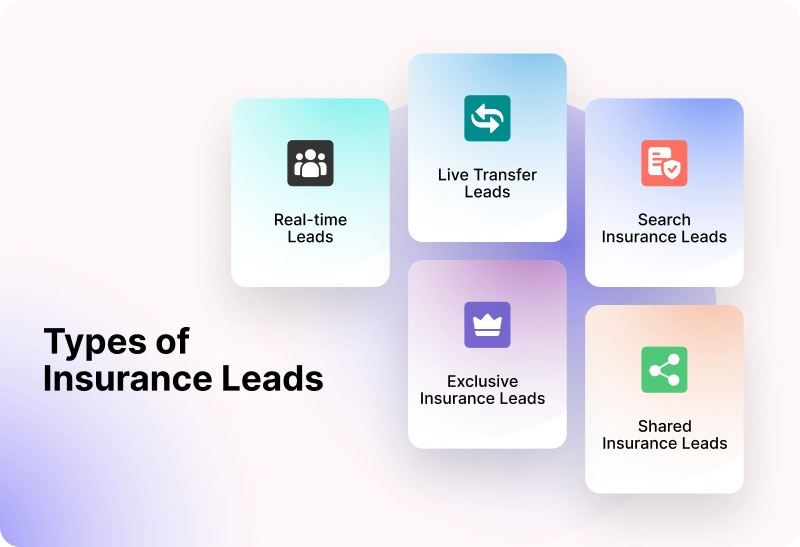
Types of Insurance Leads
When you’re in the insurance business, getting the right leads is key to growing your client base. But not all leads are the same. Here’s a quick guide to the different types of insurance leads you might come across:
Real-time Leads
Real-time leads are those who come to you and show interest in your product or service. They fill out a request form or demo. Usually, these leads are considered fresh or good leads. And, there is a high chance that these leads will convert into customers.
Live Transfer Leads
Live transfer leads are those potential customers who talk to you over the call. This might include video/audio or voice calls. First, the call center rep attends the call (Inbound or an outbound call). After finding the potential they transfer the lead to the head of the company or the sales specialists. These leads give you a chance to convince the client who is already interested in your product and successfully close the deal.
Search Insurance Leads
Search insurance leads are those who are actively searching for your service online. They might find your website through Google or clicks from search engine optimization. Since these prospects are already looking for insurance, they tend to be highly motivated.
Exclusive Insurance Leads
Exclusive insurance leads are sold to only one insurance agent or company. This means you don’t have to compete with others for the same lead. You get the sole opportunity to reach out and build a relationship with the potential client.
Shared Insurance Leads
Shared insurance leads are sold to multiple agents or companies. While these leads might be cheaper, you’ll need to move fast and offer something unique to stand out from the competition.
Knowing the types of insurance leads helps you with real-time, live transfer, search, exclusive, and shared approaches. These offer unique opportunities to grow your client base effectively.
Insurance Lead Generation Examples
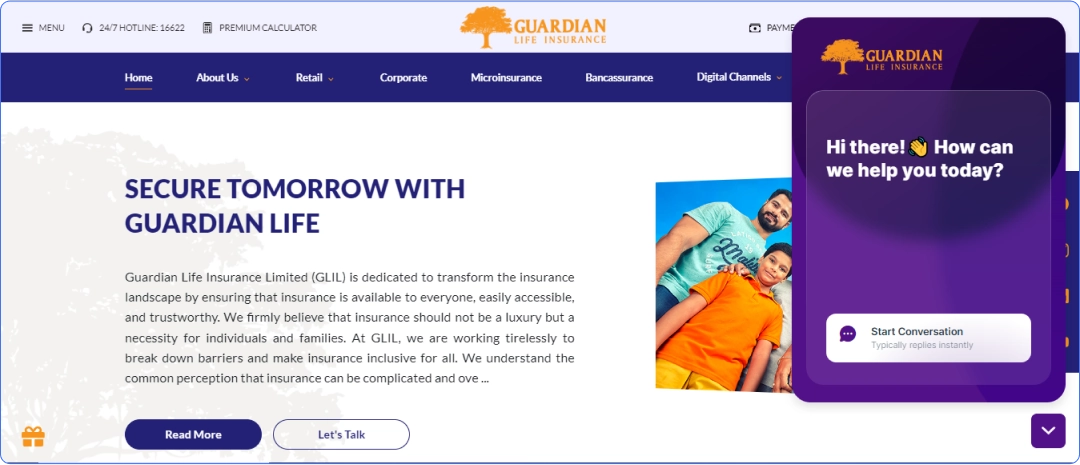
1. Guardian Life Insurance
Guardian Life Insurance established in 2014, has quickly built a strong reputation in the insurance industry, driven by good governance and exceptional service. They are using Live Chat and Chatbot and have seen a 30% increase in lead generation.
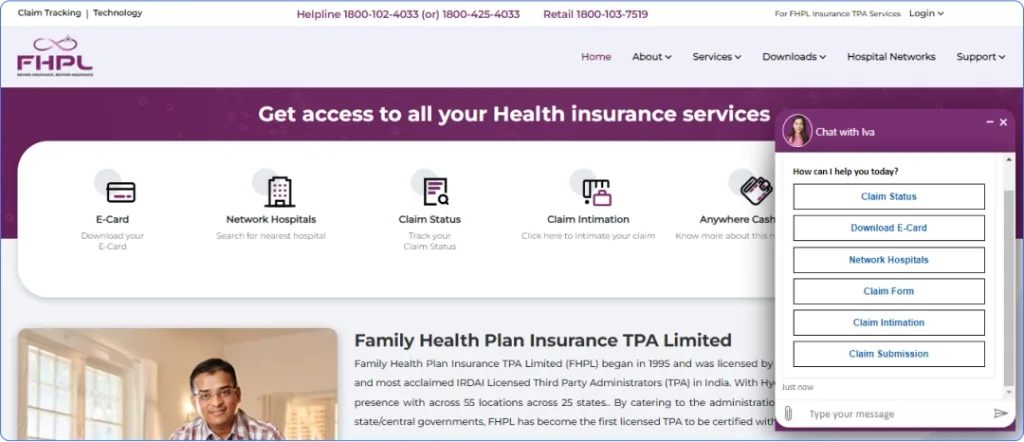
Family Health Plan Insurance TPA Limited (FHPL) is a leading health insurance administrator in India, known for its extensive coverage, innovative solutions, and commitment to quality since 1995. They have achieved a 35%increase in lead generation by implementing Live Chat and Chatbot.
FHPL is Generating Qualified Leads with REVE Live Chat & Chatbot
How are They Generating Qualified Leads with Live Chat?
Whenever a customer comes to their website and is not able to get the proper answer or find any issue, they get immediate answers. They just click on the popped-up Live chat icon where they are assisted by the agent of Guardian Life. With this implementation of Live chat, this insurance company is now able to generate qualified leads.
Not only this, but to provide 24/7 support Guardian Life Insurance implemented a Chatbot along with Live Chat. The Chatbot answers 80% of customer queries and provides round-the-clock service to the customers. This way they are now able to generate more and more leads at any time.
Benefits of Using Live Chat & Chatbot for Lead Generation
Both insurance companies find multiple benefits by using REVE live chat and chatbot:
It helps their agents to manage queries faster than phone or email.
Agents can greet visitors by name and refer to their past interactions which helps them to provide personalized support
They are now able to generate more qualified leads
They are providing 24/7 availability, which is helping them capture leads at any time.
They can qualify the leads, whereas bots can filter out unqualified leads. It leaves agents to focus on high-quality prospects
Chatbots reduce the need for additional staffing while increasing lead engagement. They are now able to save on cost
Conclusion
Lead generation in the insurance industry requires agility, personalization, and real-time responsiveness. It is an essential and multifaceted process that requires a well-defined strategy and the effective use of digital marketing tools.
Whether it is through search engine and social media advertising, inbound marketing, website instant messaging, marketing p, or customer retention techniques, each method can significantly contribute to attracting and converting high-quality prospects.
By incorporating solutions like live chat, chatbots, and omnichannel engagement, insurance companies can stay ahead of the competition and meet the evolving needs of their customers. REVE Chat is here to help you drive better results and create more meaningful connections with your leads. Get in touch with our team to learn more about how REVE Chat can help your insurance business grow, or sign up for a free demo today!
Frequently Asked Questions
Insurance leads refer to potential customers who have shown interest in purchasing insurance products or services. Insurance lead generation is the process of identifying and attracting those prospects with the goal of transforming them into real customers.
To create leads in insurance, follow these steps:
Step 1: Firstly, identify your target audience
Step 2: Then, develop a strong online presence
Step 3: You can use digital marketing
Step 4: Therefore, leverage referrals
Step 5: You should utilize conversational AI
Step 6: Offer free resources to your leads
Step 7: Finally, follow up on the customers
Managing insurance leads effectively is crucial for converting potential clients into policyholders. Here’s how you can manage your leads efficiently:
Firstly, you need to organize your leads
Secondly, prioritize your leads
You need to follow up on your leads promptly
Then personalize your communication
You need to nurture your leads
Lastly, track your progress
Finding potential customers for insurance involves being active in your community and engaging with people in various settings. Here are some effective ways to connect with prospective clients:
1. Join Professional Networking Groups
2. Attend Industry Trade Shows
3. Participate in Local Community Fairs
4. Engage in School Board Meetings
5. Support Charity Events
6. Attend Business Seminars
AI is transforming the insurance industry by enhancing efficiency, improving customer experience, and reducing costs. Here’s how AI can be used in insurance:
Live chat is a powerful tool for generating insurance leads by providing instant, personalized communication with potential customers. Here’s how it can help:
Ehsanur Rahman, the Head of Customer Communication at REVE Chat is dedicated to implementing advanced solutions that boost customer interactions and satisfaction. Ehsanur's passion for technology and customer service drives his commitment to delivering exceptional experiences.







 Rate the article