
Table of Content
AI SUMMARY
Quick Answer
Multilingual AI voice agents help businesses support customers in different languages through spoken conversations. They can answer questions, retrieve information, complete approved tasks, and transfer complex requests to human agents. This blog explains how they work, practical customer support use cases, and key platform features to evaluate. It also covers language testing, implementation, recovery from misunderstandings, and performance measurement to help businesses assess accuracy, reliability, and service outcomes.
A customer calls about a delayed order. They know what went wrong, but explaining it in an unfamiliar language makes the conversation harder. If the business cannot offer suitable language support, a routine request can lead to repeated explanations, transfers, or an unresolved call.
A multilingual AI voice agent can handle spoken requests in several languages, answer from approved business information, and complete permitted tasks through connected systems. It can also pass a call to a human when the request exceeds its capabilities.
The practical question is whether it can resolve your customers’ requests accurately in the languages they actually speak. In this blog, you will learn how multilingual AI voice agents work, where they can help, and how to evaluate them before launch.
What Is a Multilingual AI Voice Agent
A multilingual AI voice agent is a conversational system that understands and responds to spoken requests in more than one language. Depending on its configuration, it can retrieve information, collect details, perform approved actions, and route calls to support teams.
For example, a shopper could call in Spanish to check a delivery. After completing any required verification, the agent retrieves the order status and explains it in Spanish. If the order record is unavailable, it should explain that limitation and offer an appropriate next step.
Compared with a fixed-menu IVR, a conversational agent allows callers to describe their requests in their own words. Some IVR systems also accept speech, so the useful distinction is how flexibly the system understands and handles the conversation.
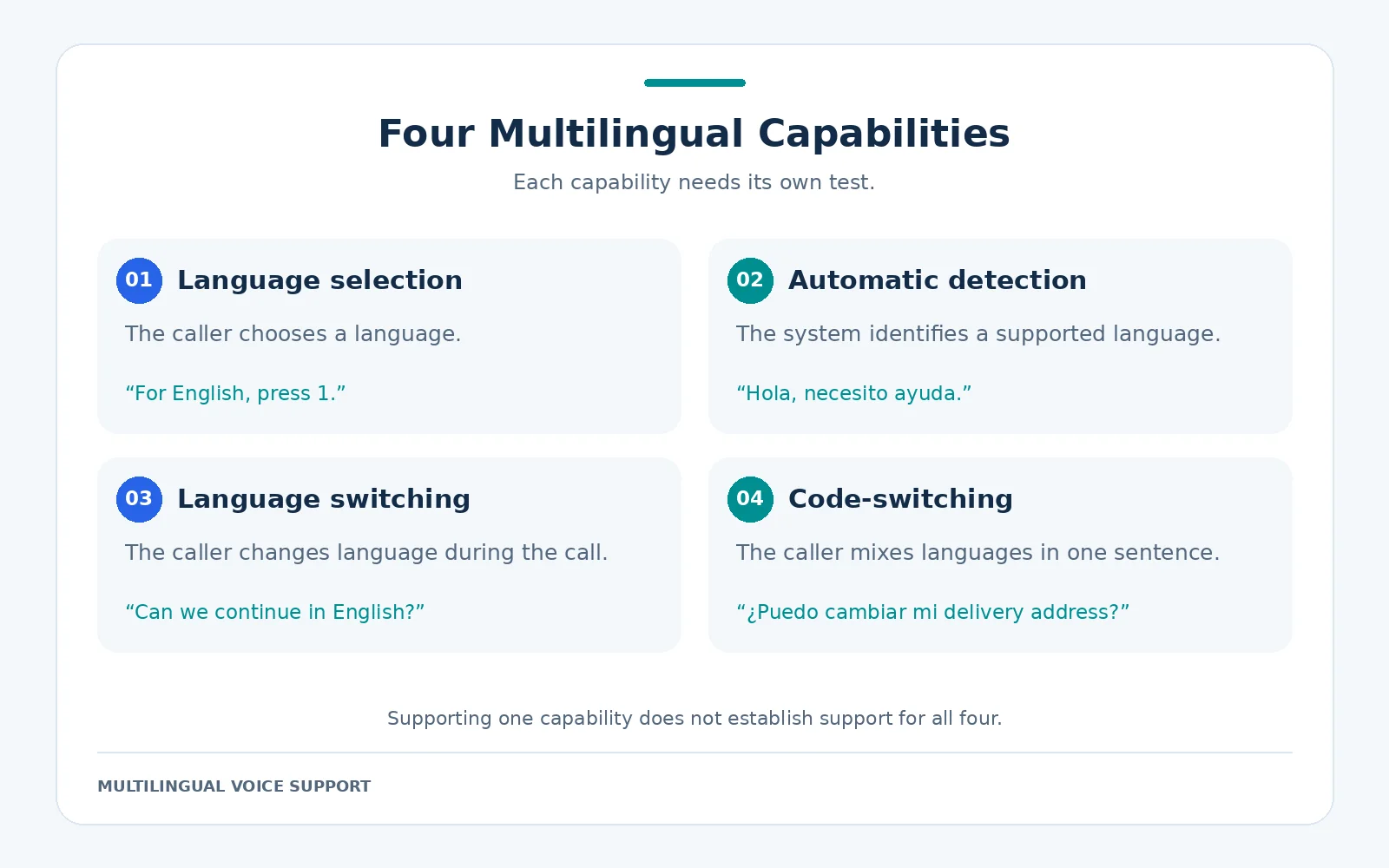
Multilingual support has several separate capabilities:
- Supporting a language selected before the call begins.
- Detecting which supported language a caller is using.
- Following a change of language during the call.
- Understanding code-switching, where someone mixes languages within a sentence or conversation.
- Support for one capability does not establish support for all four.
Why Businesses Use Multilingual Voice Support
Customers can often describe a problem more precisely in a familiar language. For support teams, that can make it easier to collect the right details and explain the next step.
When configured for suitable tasks, multilingual voice automation can help businesses:
- Handle routine enquiries without waiting for a particular language specialist.
- Provide approved information and collect requests outside office hours.
- Give callers consistent policy information across supported languages.
- Reduce repetitive work so human agents have more time for complex cases.
- Assess support demand in additional markets before expanding staffing.
These are potential benefits to measure during a pilot. An unresolved call still needs a workable follow-up route, especially when no human agent speaks the caller’s language or the team is closed.
How a Multilingual AI Voice Agent Works
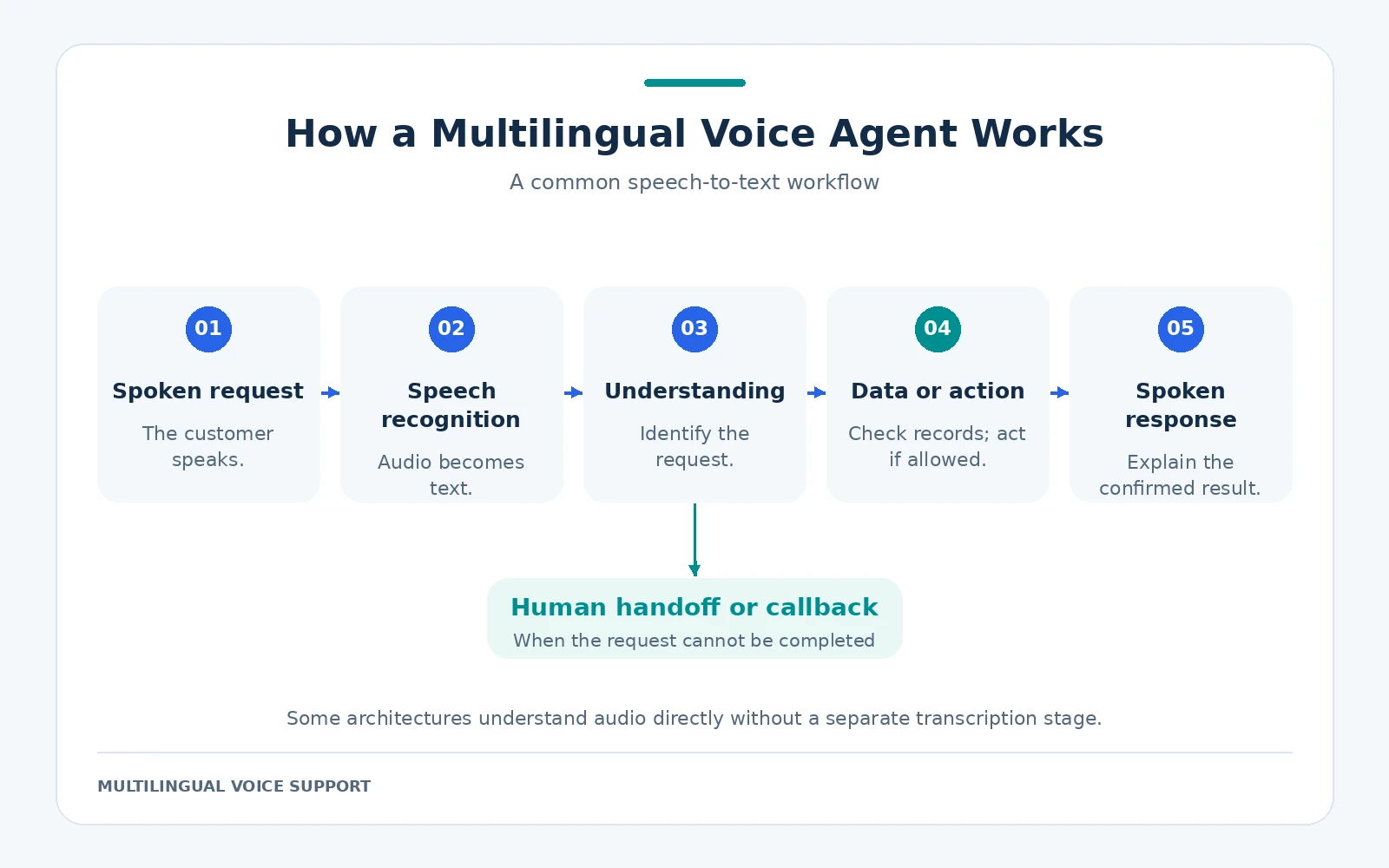
Many voice agents use a sequence of speech recognition, language processing, and speech generation. Other architectures process incoming audio directly.
Ultravox, for example, documents speech understanding without a separate automatic speech recognition stage. The following AI voice agent workflow describes a common implementation, not a requirement for every platform.
Establish the Caller’s Language
The system may use a selected language, an existing preference, or automatic detection. Short greetings and shared words can be ambiguous, so callers should have a simple way to correct the choice.
Ask vendors to demonstrate language detection on the actual voice channel you plan to use. A capability available in a chat interface may have different limits in telephony. Google’s Dialogflow CX documentation, for example, describes its language auto-detection feature as available for chat conversations only.
Understand the Request and Retain Context
In a transcription-based system, automatic speech recognition converts audio into text. Language processing then identifies the request and relevant details, such as an order number or appointment date.
Conversation history helps the agent connect follow-up questions. If a caller checks an order and then asks to change its address, the agent needs to retain the order context while checking whether that change is allowed.
Retrieve Information and Check Permissions
The agent retrieves policies from an approved knowledge base and current records through authorised integrations. A knowledge base can explain the return policy; an order-system connection is needed to check a specific return.
Access should match the task. Reading an order status and changing its delivery address require different permissions. Personal information should only be disclosed after the business’s required verification steps.
Respond and Complete the Approved Task
The agent prepares a response in a supported language. In a text-to-speech pipeline, a voice model turns that response into audio. Pronunciation, pauses, numbers, and local terms all affect whether the answer is understandable.
When an action is allowed, the agent requests confirmation where needed, submits it through the connected system, and reports the confirmed result. If a booking update fails, it must not tell the caller that the booking has changed.
Calls that cannot be completed should move to a defined fallback, such as a human transfer, callback request, or support ticket.
Direct Multilingual Processing and Translation Based Systems
Some systems process the caller’s language directly. Others translate the request into an intermediate language, process it, and translate the reply back. A platform may combine these approaches for different languages or tasks.
| Comparison | Direct multilingual processing | Translation-based processing |
|---|---|---|
| Request handling | Processes the original language without an explicit intermediate translation step | Uses translation before some or all reasoning steps |
| Main checks | Understanding, retrieval, and response quality in the original language | Preservation of meaning and details through translation |
| Dependencies | Language support across the speech and reasoning components | Speech, translation, and reasoning components working together |
| Evaluation | Test the complete call in each target language | Test the complete call and inspect translation-related errors |
Neither label proves better performance. Compare completed tasks, misunderstandings, response delay, and caller feedback using the same scenarios. A multilingual language model alone does not establish that the full voice system supports a language reliably.
Practical Customer Support Use Cases of Multilingual AI Voice Agents
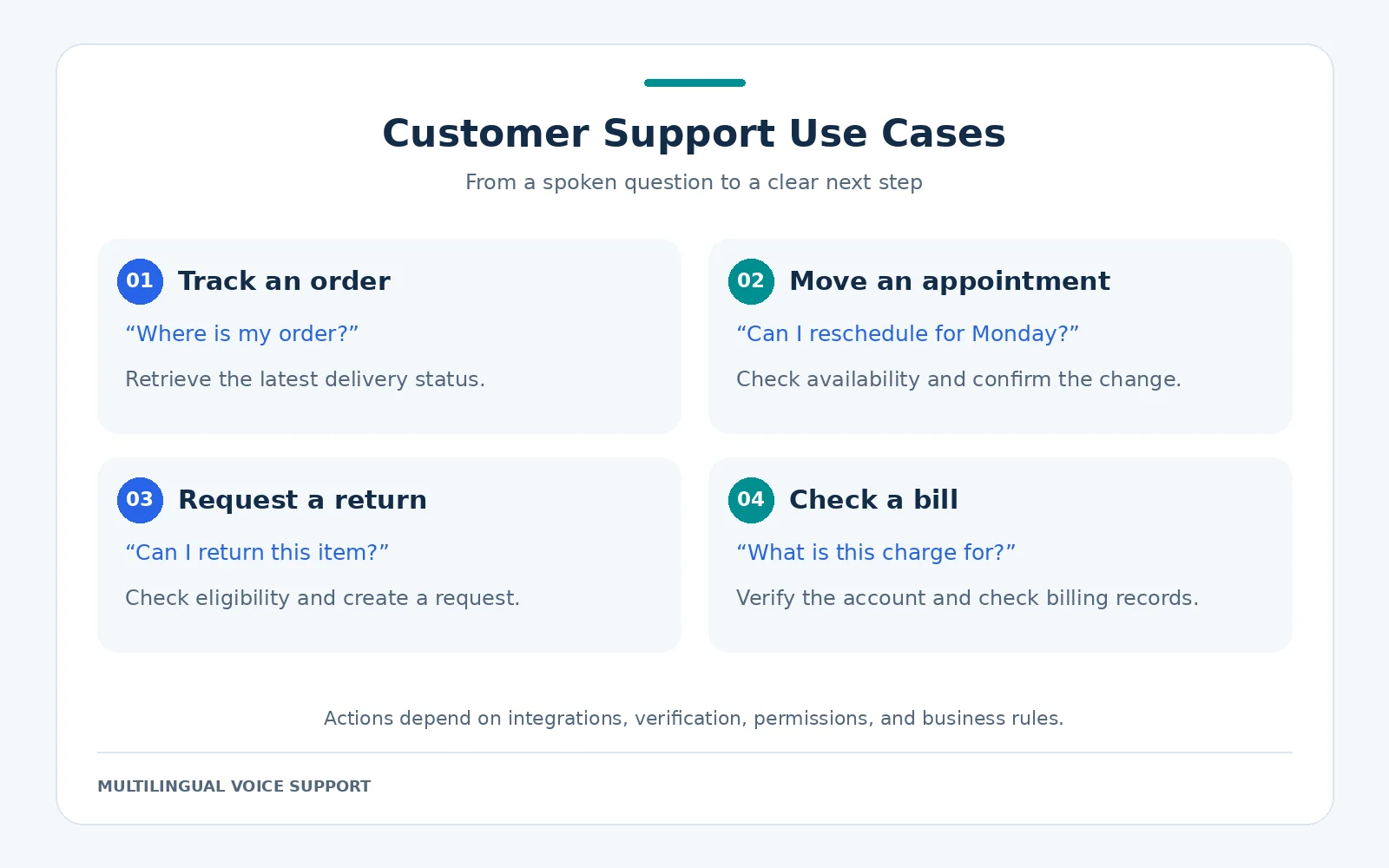
The following are illustrative scenarios, not reported customer deployments. Actions of an AI voice agent for customer service depend on integrations, permissions, verification, and the rules set by the business.
Order Tracking and Delivery Changes
An online shopper asks where an order is and whether the delivery address can change. The agent checks the order record, shares the confirmed status, and determines whether the shipment is still eligible for an address update.
If the parcel has already shipped, it explains the available options instead of promising a change the system cannot make.
Appointments and Reservations
A caller wants to move an appointment. The agent retrieves the booking after verification, checks available slots, and repeats the selected date and time before submitting the change.
Dates and time zones need explicit handling. “Next Friday” should become a confirmed calendar date before the booking is updated.
Returns and Refund Enquiries
A customer asks whether an item can be returned. The agent explains the applicable policy and checks eligibility if the necessary order data is available.
It may create a return request within its permissions. Creating a request does not mean a refund has been approved or paid.
Technical Troubleshooting
A customer reports an internet connection problem. The agent follows approved diagnostic steps and checks whether they resolved the issue.
If the caller needs further assistance, the handoff should include the symptoms and steps already attempted. This helps the next agent avoid repeating the same troubleshooting.
Billing and Account Enquiries
A caller asks about a payment or charge. The agent can explain general billing policies and retrieve permitted account information after verification.
Disputes, sensitive changes, or uncertain records should follow the business’s escalation process. The agent must not infer why a charge occurred when the available records do not explain it.
Policy and Claim Updates
An insurance customer wants to know which documents are needed for a claim. The agent explains approved requirements and, where authorised, retrieves the recorded claim status.
Decisions about coverage, liability, or claim approval should remain within the business’s designated decision process.
After Hours Support
A customer calls while the team is closed. The agent answers supported questions, collects relevant details, and creates a ticket when necessary.
It should explain when and how follow-up is available. Around-the-clock call answering does not guarantee immediate resolution of every request.
Features and Limits to Evaluate Before Choosing a Platform
Before choosing a multilingual AI voice agent, check how well it handles calls, connects with your existing systems, and helps customers when issues arise.
Language Quality Across the Entire Call
Request a clear list of supported languages, locales, voices, and channel restrictions. Test regional accents, mixed-language speech, and language changes separately.
Check whether the agent retrieves the right policy for the customer’s market. Translating a policy correctly does not make it applicable in another country.
Conversation Timing and Interruptions
Measure how long callers wait after speaking. Test pauses, corrections, interruptions, and requests to repeat information.
A useful test is to correct an order number while the agent is replying. Check whether it stops, accepts the correction, and uses the updated value.
Knowledge and Business Integrations
Ask the provider to demonstrate the specific records the agent can read and the actions it can perform. Include an unavailable system, a rejected update, and an outdated knowledge article in the test.
The agent should explain unavailable information accurately and avoid reporting success when a tool fails.
Human Handoff and Recovery
Check routing by language, department, operating hours, and issue type. Confirm what happens when a suitable person is unavailable.
The receiving team should get the caller’s request, preferred language, verification status, relevant details, and actions already attempted, subject to access controls.
Security and Data Handling
Review recording settings, retention, access permissions, sensitive data handling, and where recordings and transcripts are processed. Confirm the requirements that apply in your markets with the people responsible for privacy and security.
Treat a spoken request as untrusted input. A caller asking the agent to ignore verification or reveal another person’s records should not be able to override the workflow’s controls.
Total Operating Cost
Request a breakdown covering platform fees, call minutes, telephony, speech services, integrations, implementation, and support where applicable. Confirm whether charges continue during transfers, waiting time, or failed calls.
Compare cost per confirmed resolution alongside call quality. A lower cost per minute can be offset by longer calls or more repeat contacts.
What Should Happen When the Agent Misunderstands a Caller
A recovery process should help the caller make progress without repeatedly restarting the conversation.
- Clarify the uncertain detail. Ask for the specific digit, date, or phrase that needs correction.
- Confirm important information before acting. Read back an address, amount, or booking date when the consequence of an error matters.
- Offer another input method where available, such as keypad entry for a reference number.
- Stop after a defined number of unsuccessful attempts and offer an available support route.
- Pass verified details to the receiving team while keeping uncertain details clearly identified.
Confidence signals can help trigger recovery, but they do not guarantee that an answer is correct. Missing records, contradictory information, caller corrections, and failed actions should also trigger checks.
An Illustrative Recovery Example
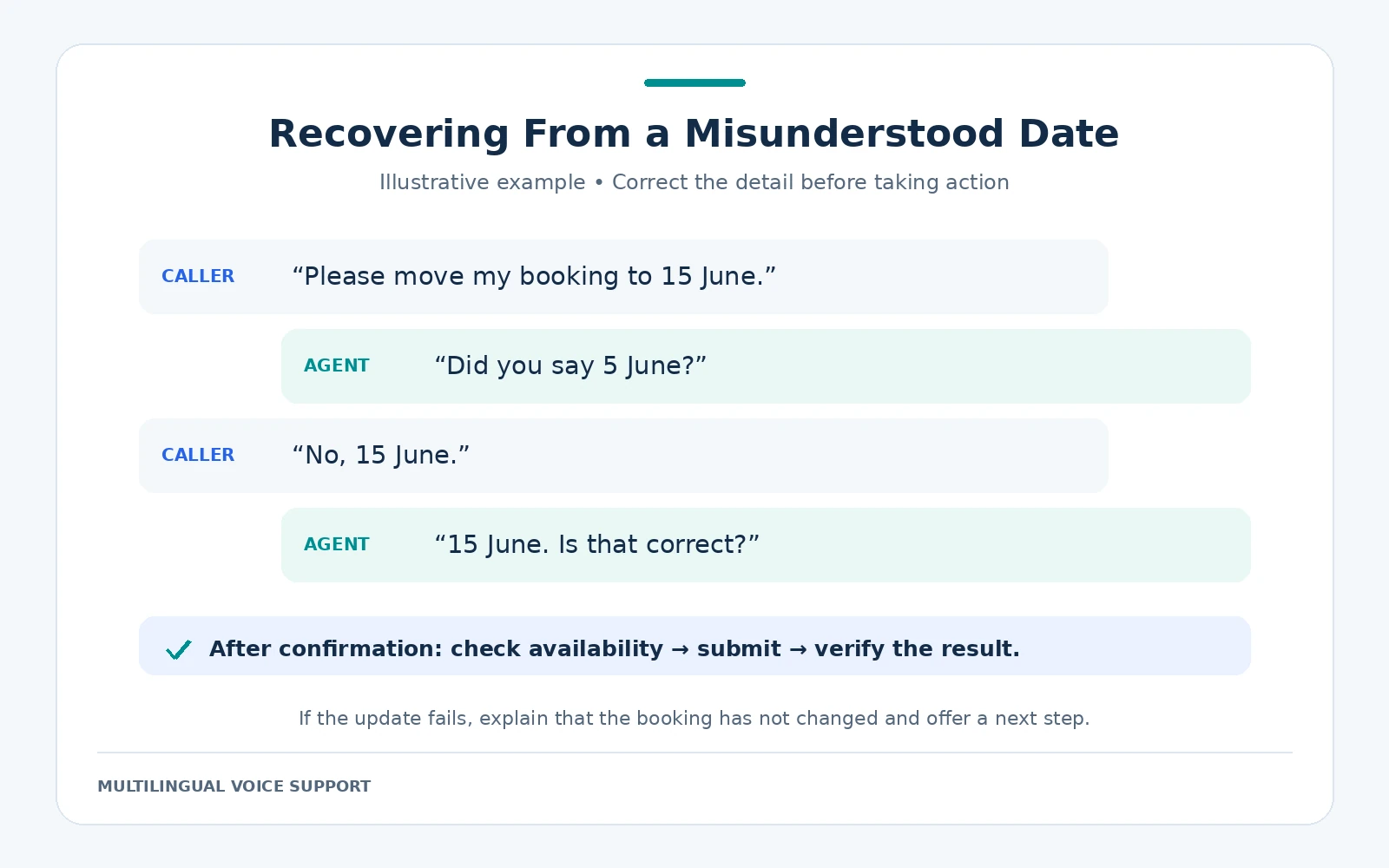
A caller asks to move a booking to 15 June. The system interprets the date as 5 June and reads it back. The caller corrects it.
The expected behaviour is to accept the correction, repeat 15 June for confirmation, and check availability before submitting the change. If the booking system rejects it, the agent explains that the change was not completed and offers the next available option.
Use a scenario like this in testing. Assess the final booking record as well as the spoken response.
How to Test Performance in Each Language
Create a shared set of customer scenarios and have fluent reviewers adapt them into natural local speech. Literal translations alone may miss regional vocabulary and normal ways of asking for help.
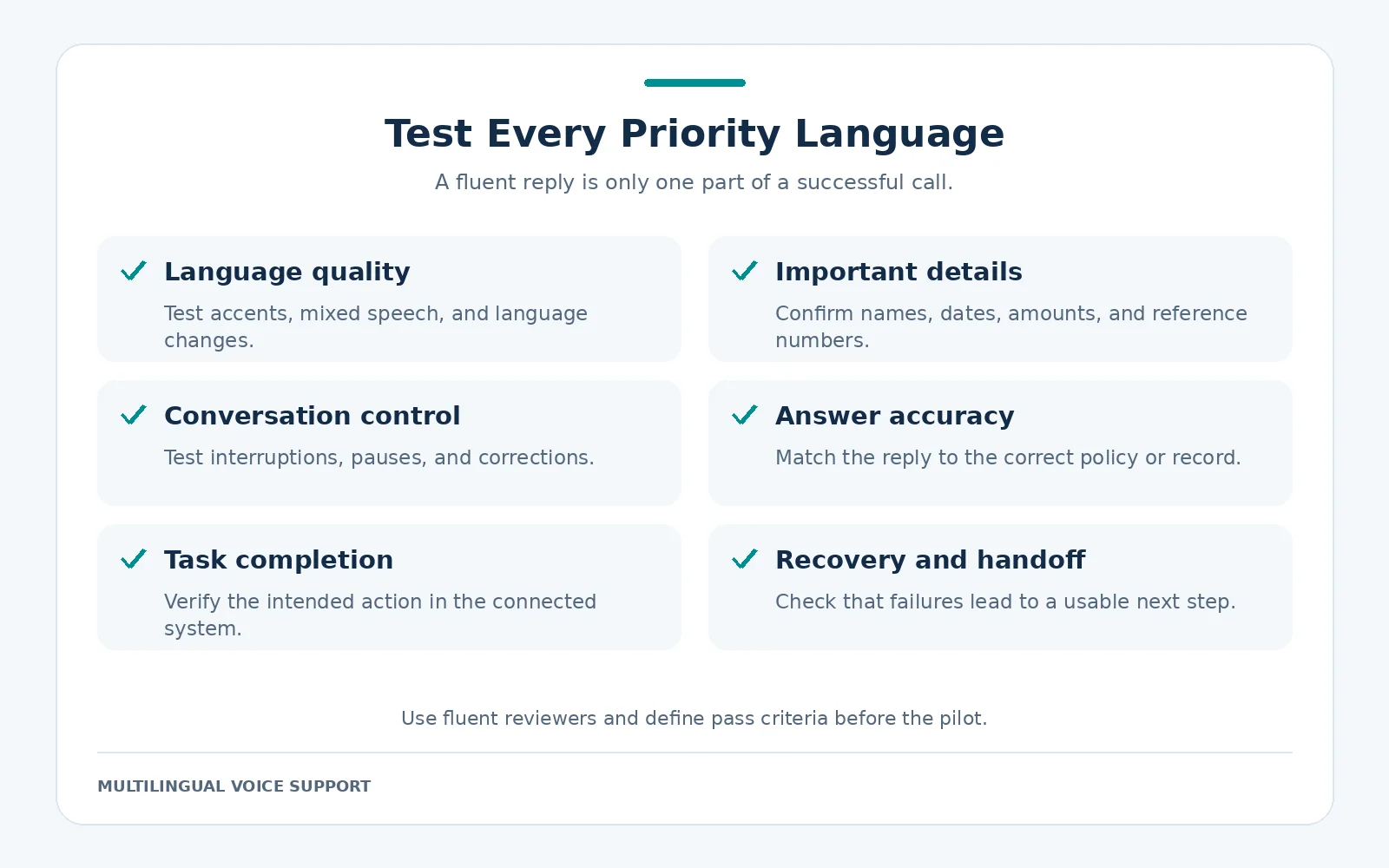
Include routine requests, corrections, background noise, mixed languages, and failed integrations. Use consented recordings or synthetic test data that does not expose customer information.
| Test area | What a successful result should show |
|---|---|
| Language selection | The caller reaches the intended supported language and can correct a wrong choice |
| Important details | Names, identifiers, dates, and amounts are captured or clarified correctly |
| Intent and context | The agent follows the request and retains relevant details after corrections or language changes |
| Answer quality | The response matches the correct policy or connected record |
| Speech and timing | Fluent reviewers can understand the response, interrupt it, and follow its pace |
| Task completion | The connected system confirms the intended authorised action |
| Recovery and handoff | Failure leads to a usable next step with relevant context preserved |
| Access controls | Attempts to bypass verification or permissions fail |
Define pass criteria before the pilot. For example, an address-change test should require correct verification, eligibility checking, address confirmation, and a successful update in the order system. A fluent reply alone should not pass that test.
Review results by language and task, including the number of calls assessed. A strong overall average can conceal a weak language or a small sample. Repeat the relevant tests after changes to models, prompts, policies, integrations, or voices.
How to Implement Multilingual Voice Support
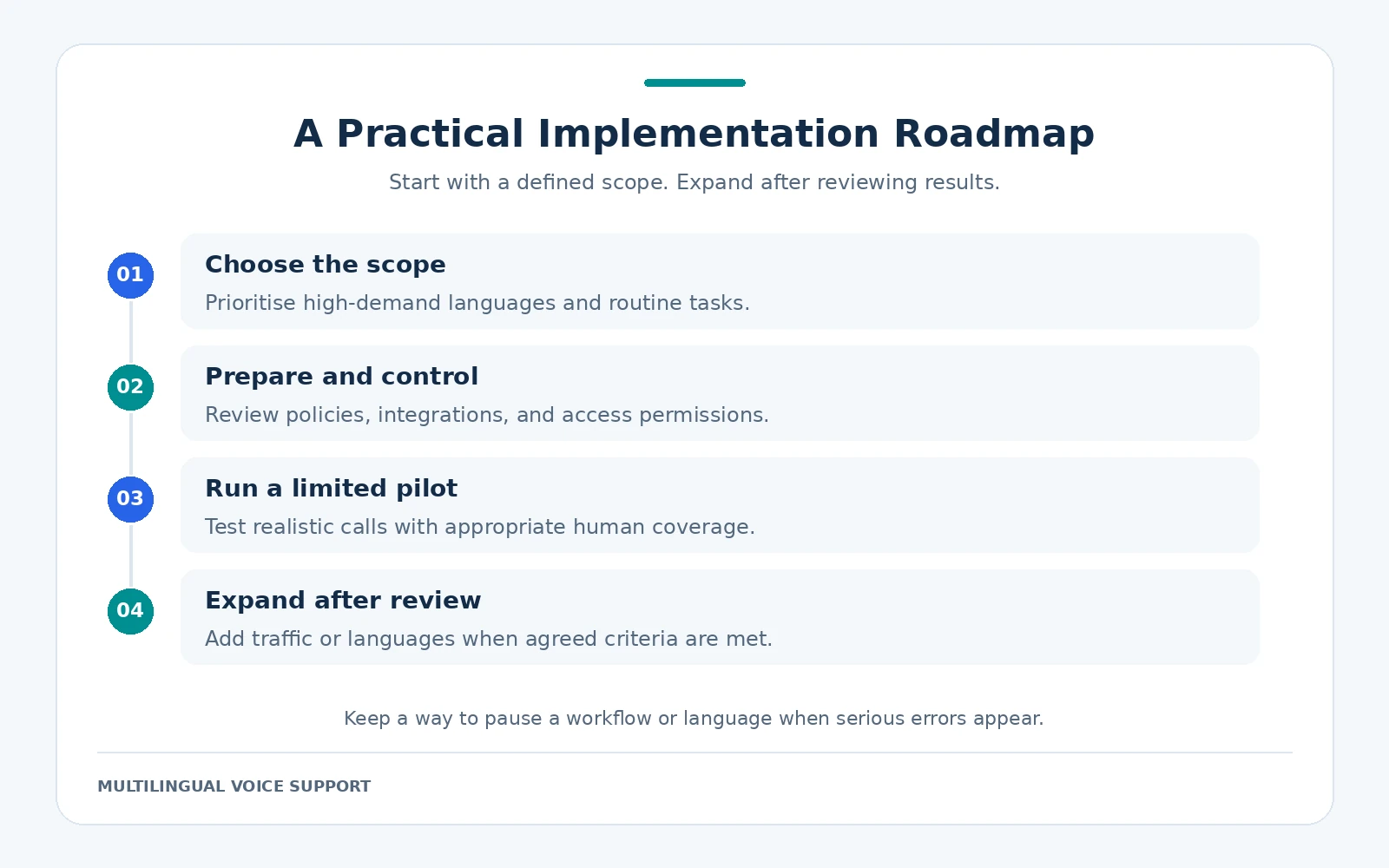
The ways to start implementing multilingual voice support are the following:
Start With Languages and Tasks That Matter Most
Review call records, transfers, unresolved enquiries, and requests for language assistance. Start with a manageable set of high-demand languages and routine tasks.
Choose workflows with clear outcomes and reliable data. Order-status checks may be easier to evaluate initially than complicated disputes.
Prepare Content and Controlled Access
Assign owners to product information, policies, and workflows. Have fluent reviewers check customer-facing wording, especially terminology, dates, currency, and market-specific rules.
Give each integration only the access required. Define verification, confirmation, failure handling, and escalation before allowing the agent to change records.
Pilot With Realistic Conditions
Test with speakers who reflect your customer base. Include the phone connections, accents, and call conditions they are likely to use.
Launch with limited traffic and appropriate human coverage. Record failures by language and task so the team can fix the underlying cause.
Expand Based on Reviewed Results
Increase traffic or add languages after the pilot meets your agreed criteria. Recheck quality after expansion and keep a way to pause a workflow or language when serious errors appear.
How to Measure Multilingual Customer Support Performance
Review outcomes separately for each language and compare them with the previous support process where comparable data exists.
| Metric | Working Definition | Interpretation |
|---|---|---|
| Confirmed resolution rate | Reviewed enquiries confirmed resolved divided by reviewed enquiries, using a stated method and follow-up period | Define how resolution is verified |
| Task completion rate | Successful eligible tasks divided by eligible tasks attempted | Verify success in the connected system |
| First call resolution | Eligible issues resolved on the first call without related repeat contact during a defined period | Requires reliable issue and repeat-contact tracking |
| Containment rate | Calls completed without human transfer divided by calls in scope | Does not establish that the issue was resolved |
| Escalation rate | Calls transferred or referred to humans divided by calls in scope | Separate necessary escalations from avoidable ones |
| Repeat contact rate | Customers contacting again about the same issue within a defined period divided by customers in scope | Review whether the original answer or action failed |
| Response delay | Time from the end of a caller’s turn to the start of the reply | Review typical delays and slow calls |
| Customer satisfaction | Feedback from callers, reported with response count or rate | Low response volume limits conclusions |
| Action error rate | Incorrect or unauthorised completed actions divided by completed actions reviewed | Review serious incidents individually |
Also inspect speech and intent errors involving dates, amounts, addresses, and reference numbers. These failures may matter more operationally than a minor transcription error that does not change the outcome.
Explore Multilingual Customer Support With REVE Chat Voice Bot
REVE Chat Voice Bot supports multilingual conversations and provides tools for transcription, intent recognition, visual voice flows, call recording, routing, and human handoff. Its product page also describes API and integration options for connecting calls with business systems.
To assess the fit for your business, bring your priority languages, common support requests, and required integrations to a demonstration. Ask to test a complete conversation, including a correction, a system failure, and a human handoff. Confirm the available languages, dialect coverage, and deployment requirements with the team.
Explore REVE Chat Voice Bot and request a demonstration around your customer support scenarios.
Frequently Asked Questions
Yes, depending on the platform and configuration. Confirm the languages supported across speech understanding, response generation, and voice output on your intended channel. Test complete calls in each priority language.
Some systems support language switching. Test whether the agent retains context after the change. Separately, test code-switching, where callers mix languages within the same sentence.
That depends on the retrieval system and language coverage. Some platforms can retrieve information across languages, but customer-facing terminology and market-specific policies still need review. Verify the result through actual support questions.
Yes, when the necessary integrations and permissions are configured. Reading an order, creating a ticket, and approving a refund are different actions. Each needs its own access rules, checks, and confirmation of success.
Define the fallback before launch. Depending on available support, this could be a scheduled callback, an approved translated channel, or a ticket with a clear follow-up expectation. Do not promise immediate assistance that the team cannot provide.
It can be, especially when routine calls interrupt staff or arrive outside business hours. Compare implementation effort and ongoing cost with the actual call volume. A limited pilot can show whether it improves service enough to justify the investment for multilingual conversations.
Build AI-powered support with Wize AI
Connect business knowledge, automate support conversations, and improve response quality without managing a complex AI stack.
Explore Wize AI Agent Rate the article

Tabassum Kabir
Sr. Content Writer
Tabassum Kabir is a Senior Content Writer with 5+ years of experience. She specializes in SaaS, AI, customer service, and ecommerce. She writes about technology, business, and digital trends. Her work is simple, clear, and useful. She aims to give readers information they can understand and use.
View all articles
Support Customers in Their Language With REVE Chat Voice Bot
Answer customer questions in multiple languages and connect them with your team when needed.
Try Our Voice Bot Today