



Table of Content
AI SUMMARY
Quick Answer
Agentic RAG combines AI agents with Retrieval-Augmented Generation to help AI systems find, evaluate, and use relevant information before responding. Unlike traditional RAG, it can refine searches, retrieve data from multiple sources, and handle multi-step tasks. This guide explains how Agentic RAG works, its architecture, business use cases, implementation options, and key challenges such as data quality, security, cost, and monitoring.
Agentic RAG is a smart AI approach that combines AI agents with RAG (Retrieval-Augmented Generation) to help systems find useful information and give more accurate answers.
In simple terms, Agentic RAG helps businesses build AI that can understand customer intent, gather the right data, and complete tasks before delivering the most relevant answer.
A normal chatbot may answer based only on what it already knows. That can lead to generic or incomplete replies. But an AI agent using Agentic RAG can search business data, check the right source, understand the customer’s problem, and then respond with a more accurate answer.
In this guide, I’ll explain what agentic RAG is, how it works, how it’s different from the simpler AI tools most companies already use, and where it’s worth considering for your own business.
What is Agentic RAG?
Agentic RAG stands for Agentic Retrieval-Augmented Generation.
In simple terms, it combines two powerful AI concepts:
- AI Agents that can think through tasks, make decisions, and take actions.
- Retrieval-Augmented Generation (RAG) is when an AI looks up information from documents or databases before answering, instead of relying only on what it already knows. This helps it give accurate, up-to-date answers.
When these two technologies work together, the AI doesn’t just answer questions; it actively looks for the information it needs before responding.
Think of it like the difference between answering from memory and doing research before giving an answer.
For example, if someone asks an AI agent about a company’s latest pricing policy, the agent can first search the company’s knowledge base, review the most recent policy documents, and then provide an accurate response. This helps reduce mistakes and ensures the answer reflects the latest information available.
Because of this, Agentic RAG is often used to build intelligent AI assistants that can:
- Answer customer questions more accurately
- Search company knowledge bases
- Handle complex support requests
- Assist employees with information retrieval
- Support decision-making processes
- Complete multi-step tasks using real-time data
Simply put, Agentic RAG helps AI agents move beyond basic conversations and become more capable problem-solvers.
Fundamentals and Architecture of Agentic RAG
To understand Agentic RAG, it helps to first understand how a traditional AI system works.
Most AI models generate responses based on the information they learned during training. While this works well for general questions, it can become a problem when users need current, company-specific, or highly detailed information.
Retrieval-Augmented Generation (RAG) solves this by allowing AI to access external knowledge sources before generating a response.
Agentic RAG takes this one step further.
Instead of performing a single search and generating an answer immediately, an AI agent can decide what information it needs, search multiple sources, evaluate the results, and then determine the best response.
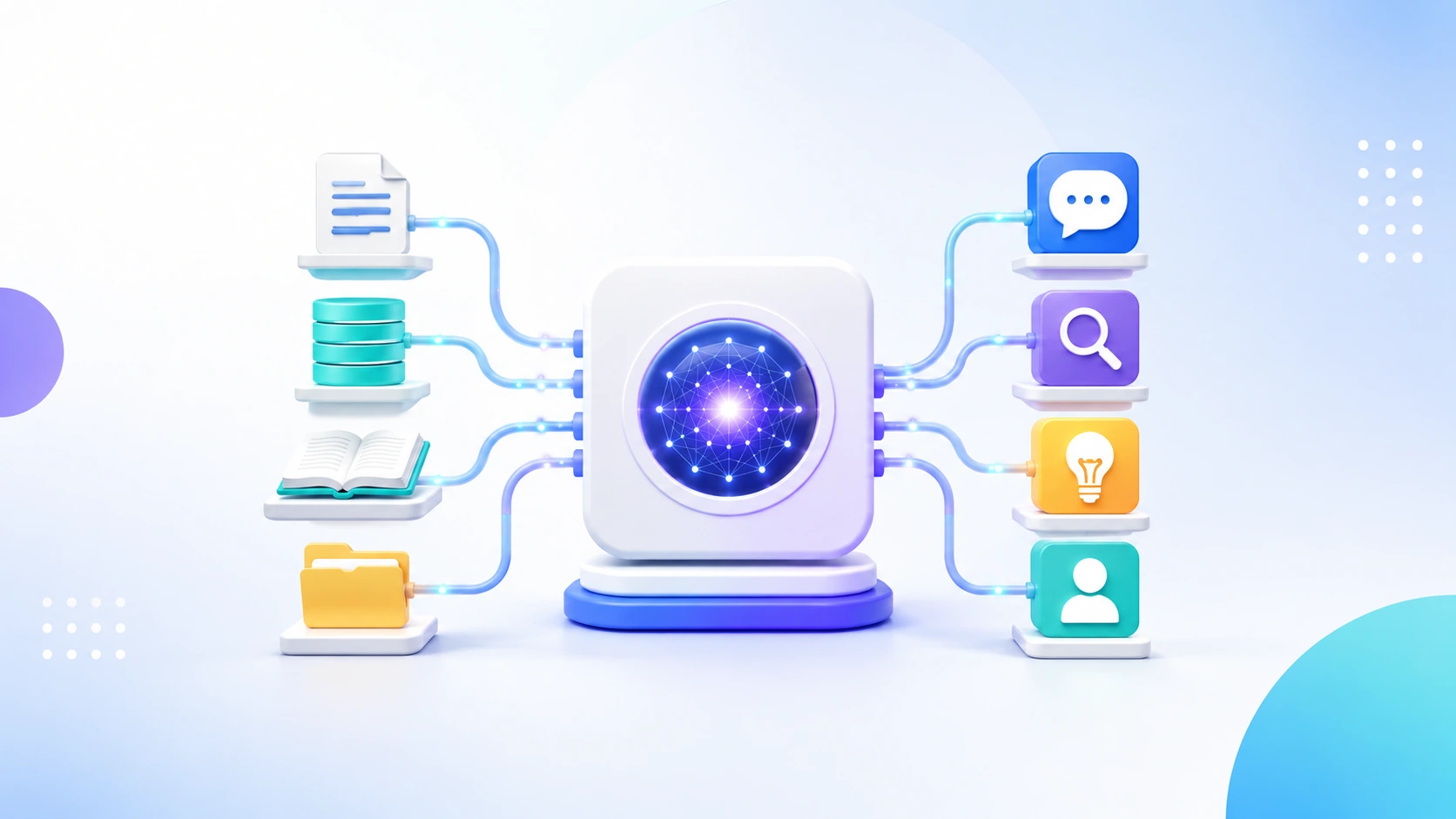
A typical Agentic RAG architecture includes:
- An AI agent that plans and makes decisions
- A retrieval system that searches for relevant information
- Knowledge sources such as documents, databases, or company knowledge bases
- A language model that generates the final response
- Validation steps that help improve accuracy
Think of it as having a research assistant working alongside the AI. Rather than answering from memory alone, the agent actively gathers information, reviews it, and uses it to provide a more reliable response.
This combination of reasoning and retrieval is what makes Agentic RAG more effective for complex business tasks than traditional AI systems.
How Does Agentic RAG Work?
Agentic RAG helps AI agents gather the right information before responding to a user. Basically, Agentic RAG works in a loop. The AI agent looks for information, evaluates whether the information is sufficient and reliable, and searches again if needed. It only responds once it has gathered enough context to provide a confident answer.
The key difference is that the process isn’t always linear. If the AI agent determines that the retrieved information is incomplete, outdated, or irrelevant, it can refine its search and continue gathering information before responding.
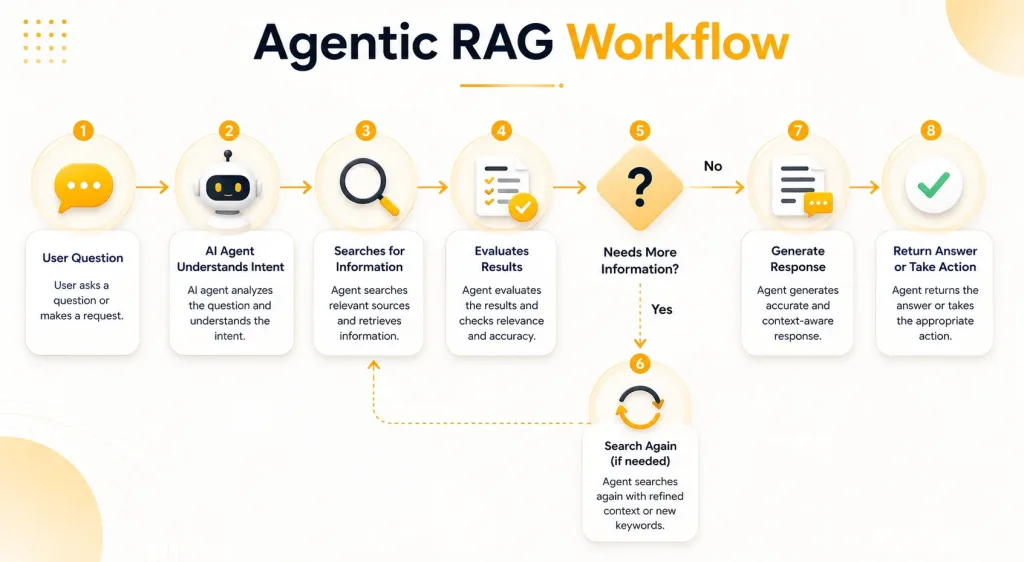
Let’s look at a simple customer support example.
Suppose a customer asks:
“Why was my subscription bill higher this month?”
In a traditional AI system, the process might look like this:
Customer Question → AI Generates Response
An Agentic RAG system follows a more thoughtful workflow:
Customer Question → AI Agent Analyzes Request → Checks Billing Policies → Reviews Customer Account Data → Evaluates Findings → Needs More Information? → Checks Recent Plan Changes or Additional Charges → Generates Personalized Response
Because the AI agent can continuously retrieve and validate information before answering, the response is typically more accurate, relevant, and personalized.
This ability to search, evaluate, and search again when necessary is what makes Agentic RAG particularly valuable for customer support, enterprise search, sales assistance, and other business applications where accuracy matters.
Agentic RAG vs. Traditional RAG systems
Now that you understand how Agentic RAG works, let’s compare it with traditional RAG systems.
Both approaches help AI access external knowledge instead of relying solely on training data. However, the way they retrieve and use information is very different.
| Feature | Traditional RAG | Agentic RAG |
|---|---|---|
| Information Retrieval | Retrieves information once before generating a response | Can search multiple times until enough information is gathered |
| Decision Making | Limited decision-making capability | Can evaluate information and decide what to do next |
| Query Handling | Uses the user's original query | Can refine and rewrite queries to improve results |
| Data Sources | Usually searches a single knowledge source | Can search multiple knowledge sources and systems |
| Problem Solving | Best for simple question-answering | Better for complex, multi-step tasks |
| Personalization | Limited context awareness | Can use customer, business, and historical context |
| Accuracy | Depends on initial retrieval quality | Often higher due to continuous retrieval and validation |
| Flexibility | Follows a fixed process | Adapts based on the information it finds |
This is why many modern AI agents use Agentic RAG as part of their architecture. It gives them access to current, relevant, and business-specific knowledge instead of relying only on what they learned during training.
Implementing Agentic RAG into Business Support
Implementing Agentic RAG is much easier today than it was a few years ago.
Businesses no longer need to build everything from scratch. With modern AI agent platforms, you can connect your knowledge sources, train AI agents on your business information, and create intelligent support experiences without developing a complex AI infrastructure yourself.
Two Ways to Implement Agentic RAG
Depending on your business goals, technical resources, and budget, there are generally two ways to implement Agentic RAG.
Option 1: Build Your Own Agentic RAG System Using AI Development Platforms
If you want complete control over your AI agent, you can build a custom Agentic RAG solution using platforms and frameworks such as:
- OpenAI Assistants API
- LangChain
- LlamaIndex
- Microsoft Azure AI
- Google Vertex AI
- Amazon Bedrock
This approach allows you to create highly customized AI agents tailored to your specific workflows and business requirements.
Note: However, it typically requires technical expertise, development resources, ongoing maintenance, and continuous optimization to ensure the system performs effectively.
Option 2: Use a Ready-Made AI Customer Support Platform
If your primary goal is to improve customer support without managing a complex AI stack, a ready-made platform can be a faster and more practical option.
REVE Chat can provide such a solution with its AI agent, Wize AI, which helps businesses create customer engagement workflows with more accurate results. It also includes live chat, AI chatbots, AI Copilot, and other customer engagement capabilities within a single platform.
Instead of integrating multiple tools separately, businesses can manage customer conversations, automate support, build AI agents, and leverage their knowledge base from one centralized solution.
This makes it easier to deploy AI-powered support experiences where agents can retrieve relevant information, understand customer intent, and deliver contextual responses across different channels.
‘Agentic RAG’ Other Use Cases in Real World
Agentic RAG is not limited to answering customer questions. Its ability to retrieve information, reason through tasks, and take context-aware actions makes it valuable across many industries and business functions.
Here are some practical ways organizations are using Agentic RAG today:
Enterprise Search
Instead of manually searching through hundreds of documents, employees can ask questions in natural language and receive accurate answers sourced from company knowledge bases, policies, and internal documentation.
Sales Enablement
Sales representatives can quickly access product specifications, pricing information, competitor insights, and customer data without switching between multiple systems, helping them engage prospects more effectively.
Human Resources
HR teams can use AI agents to assist employees with onboarding, company policies, benefits information, training resources, and workplace procedures, reducing repetitive inquiries.
Financial Operations
Financial institutions and finance teams can use Agentic RAG to retrieve relevant reports, compliance documents, transaction records, and policy information, helping teams work more efficiently and accurately.
Healthcare Information Access
Healthcare providers can streamline access to clinical guidelines, operational procedures, research materials, and administrative information, enabling staff to find critical information faster.
IT Help Desk Support
IT teams can deploy AI agents that analyze support requests, search technical documentation, review previous resolutions, and guide users through troubleshooting steps.
Legal and Compliance Research
Legal and compliance professionals can use Agentic RAG to locate regulations, contracts, policies, and case-related information more efficiently, reducing the time spent on manual research.
As organizations continue to adopt AI-driven workflows, Agentic RAG is emerging as a powerful way to connect AI agents with trusted business knowledge, enabling faster decisions, improved productivity, and more reliable outcomes.
Challenges and Limitations of Agentic RAG
Although Agentic RAG is powerful, it is not a perfect solution for every business. Like any AI system, its success depends on how well it is designed, connected, and managed.
Some common challenges include:
- Data quality: If the knowledge base contains outdated, incomplete, or incorrect information, the AI agent may still provide inaccurate responses.
- Implementation complexity: Agentic RAG often needs multiple systems to work together, such as knowledge bases, AI models, business tools, and customer data sources.
- Cost and performance: Since the AI agent may search, evaluate, and process information several times before answering, it can be slower and more expensive than a simple chatbot.
- Security and privacy: AI agents must only access the information they are allowed to use, especially when handling customer data, financial records, or internal documents.
- Ongoing monitoring: Businesses need to regularly review AI responses, update knowledge sources, and improve workflows to maintain accuracy.
That is why businesses should start with clear use cases, reliable data, proper access control, and regular monitoring. With the right setup, Agentic RAG can deliver strong results while reducing common risks.
Summary
Agentic RAG is simply a smarter way to help AI agents give better answers.
It allows an AI agent to search, check, and understand the right information before responding. That is why it can be more useful than a basic chatbot or traditional RAG system, especially when the question needs real business context.
For any business planning to use AI agents in customer support or daily operations, Agentic RAG is worth understanding. However, If you’re looking for AI-powered customer support, REVE Chat can help you get started faster AI Agent assistants in Agentic RAG.
Frequently Asked Questions
Agentic RAG (Agentic Retrieval-Augmented Generation) is an AI approach that combines AI agents with retrieval systems. It allows AI to search for information, evaluate what it finds, and then generate a more accurate and context-aware response.
Traditional RAG typically retrieves information once and generates a response. Agentic RAG can retrieve information multiple times, evaluate the results, and decide whether additional information is needed before responding.
Yes. REVE Chat’s Wize AI Agent helps businesses create AI-powered customer support workflows that can leverage business knowledge, understand customer intent, and provide more contextual responses across customer conversations.
Yes. REVE Chat combines live chat, AI chatbots, AI assistants, knowledge management, and AI agent capabilities within a single platform, helping businesses deliver a more complete customer support experience.
REVE Chat provides the tools businesses need to build intelligent customer support experiences without having to manage a complex AI infrastructure. Instead of integrating multiple solutions, businesses can manage conversations, automate support, and deploy AI agents from one centralized platform.
Many experts believe so. As businesses demand more accurate, context-aware, and action-oriented AI systems, Agentic RAG is becoming a key architecture for building AI agents that can reason, retrieve information, and assist users more effectively.
Build AI-powered support with Wize AI
Connect business knowledge, automate support conversations, and improve response quality without managing a complex AI stack.
Explore Wize AI Agent Rate the article

Khalid Hassan Emran
Sr. Technical Content Writer
Khalid Hassan Emran is a Senior Technical Content Writer with more than 5 years of experience in technical documentation, content marketing, and blog writing. He specializes in simplifying complex technical concepts into clear, engaging content. In addition, he is an AI Agent Specialist and SEO Expert, helping businesses improve their digital presence through AI-driven solutions and search-optimized content strategies.
View all articles