


Table of Content
AI SUMMARY
Quick Answer
Inbound and outbound AI voice agents help businesses automate customer communication, but they serve different purposes. Inbound AI voice agents handle incoming calls, answer inquiries, and provide customer support, while outbound agents initiate calls for lead follow-ups, appointment reminders, and customer engagement. Both offer benefits such as faster responses, reduced workloads, and improved efficiency. However, challenges like complex inquiries, unanswered calls, and compliance requirements remain. By combining inbound and outbound AI voice agents with human support and CRM integration, businesses can deliver more personalized, consistent, and efficient customer experiences.
Phone calls are more seamless and spontaneous than chats. During phone calls, you are allowed to express whatever is on your mind without having to ponder too much. This spontaneity is what customers need for instant, swift communication and service.
However, your business may not always be ready for customer phone calls, leading to missed communication opportunities. Moreover, manual call-handling creates bottlenecks of long hold times, inconsistent service quality, high operating costs, and agent burnout from repetitive dialing.
You can automate these calls through AI voice calling agents. There are inbound AI voice calling agents that handle customers calling your business for service, and outbound AI voice calling agents that proactively reach out to customers for reasons like reminders or updates.
Both types of AI voice calling agents have different purposes, challenges, and use cases, which we will discuss in this blog.
What Are AI Voice Calling Agents?
AI voice calling agents are software systems that use artificial intelligence for a two-way phone call with customers. This is not like traditional automated voice messages, but interactive communication technology that understands customers’ intent and context, navigating the layers of the topic of discussion and natural conversational interruptions.
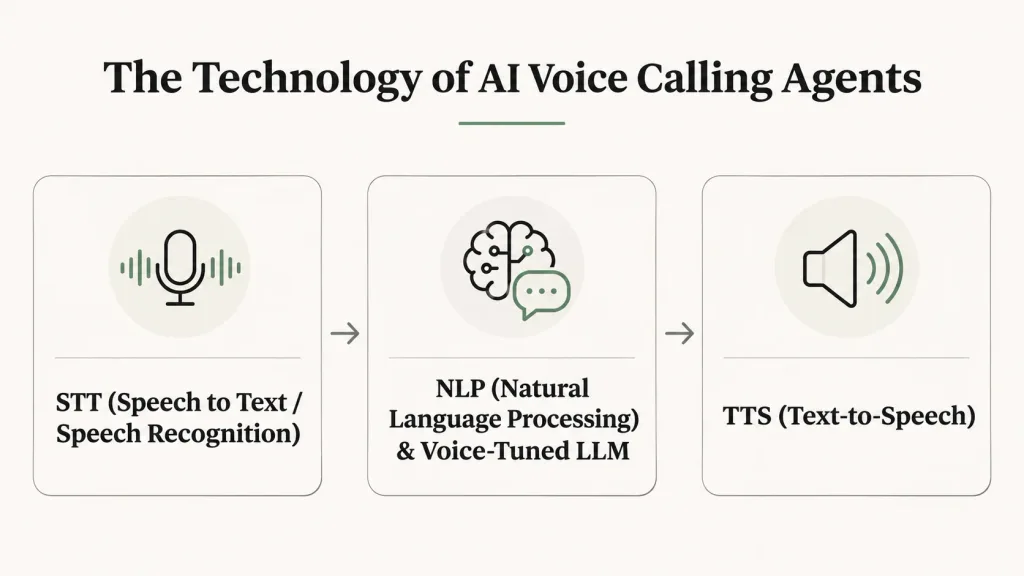
The Technology of AI Voice Calling Agents
- STT (Speech to Text/Speech Recognition): Converting the audio speech of the customer into text in real time, sent to the AI Agent.
- NLP (Natural Language Processing) & Voice-Tuned LLM: Analyzing the text converted from speech to understand intent, context, entities, and create an accurate response.
- TTS (Text-to-Speech): Converting the generated text into realistic-sounding audio in response.
The AI voice calling agents can also integrate with the existing business systems such as the CRM and scheduling software. The agents can pull caller profiles automatically during or before a call and can even book appointments during the call.
These AI voice calling agents take a different turn from traditional IVR (Interactive Voice Response), which used to require customers to follow a rigid menu. Now, the agents have removed the concept of these fixed menus, making it more natural and reducing caller frustration.
What Is An Inbound AI Voice Calling Agent?
An inbound AI voice calling agent is an AI-powered calling system that answers incoming calls from customers. It works as a round-the-clock available virtual receptionist and support agent representing your business.
Inbound AI voice calling agents are built to understand customer intent, evaluate context, and help complete specific tasks.
How Does It Work?
- Customer calls: The interaction begins as the customer reaches out via a call to the agent.
- AI identifies intent: Using STT and NLP, the AI voice agent understands the caller’s statements, identifies the intent, and evaluates the context.
- Retrieves information or performs an action: The agent retrieves relevant information from the integrated knowledge base, database, or CRM, and performs the necessary authorized actions.
- Resolves or transfers the call: The AI voice agent solves the customer’s issue or transfers the call to a human if required.
Common Use Cases
- Customer service and FAQ handling: Answering common and routine questions about products, service policies, or other business information.
- Order status and delivery inquiries: Fetching real-time shipping details, order tracking updates, and return policies by integration with e-commerce platforms.
- Appointment booking and rescheduling: Helping customers book, cancel, or reschedule appointments.
- Technical support and call routing: Trying to solve technical issues before routing them to human agents.
What Is An Outbound AI Voice Calling Agent?
An outbound AI voice calling agent is an AI-powered automated system designed to proactively initiate outgoing phone calls on behalf of your business.
An outbound voice agent engages with leads, prospects, and existing customers for business communication purposes like follow-ups, reminders, confirmations, etc.
How Does It Work?
- Campaign or event trigger: A call schedule gets triggered by a business campaign or an event.
- Customer selection: The platform selects a targeted list of customers to reach out to, from the agent’s CRM integration.
- AI initiates call: The AI voice agent places the call and detects if there is a human responder.
- Personalized conversation: If the customer receives the call, the agent greets them by their name and also introduces itself and the purpose of the call.
- Outcome recorded or follow-up scheduled: At the end of the call, the agent updates the call records and transcripts in the CRM for that customer and schedules follow-ups accordingly.
Common Use Cases
- Lead qualification and sales follow-ups: Contacting new potential customers after lead collection to verify their interests.
- Appointment and payment reminders: Placing proactive reminder calls for payments, appointments, and schedules.
- Customer feedback surveys: Reaching out after a delivery to collect customer feedback.
- Delivery confirmations: Contacting customers to confirm delivery schedules or availability.
- Customer re-engagement campaigns: Following up with existing customers and former clients for renewals and upcoming offers.
Inbound vs. Outbound AI Voice Calling Agents: Key Differences
The key differences between inbound and outbound AI voice calling agents:
Call Initiation, Intent, and Context
Inbound: The interaction starts as the customer dials your business number and reaches an AI voice calling agent. Their intent often involves trying to solve an issue or receive a service or information. They also have complex and personal context behind every issue, because the agent needs to resolve the issues based on the customized details of each customer.
Outbound: The agent automatically initiates the call by dialing, having been triggered by an event, schedule, or CRM entry. As the customer receives the call from the agent instead of actively initiating it, the relevant intent from the agent must be established immediately.
Outbound calls benefit from contextual knowledge because the agent already knows the customer’s details before calling and can converse accordingly.
Opening Structure and Conversation Design
Inbound: The agent must rapidly capture the customer’s intent following the greetings that identify the company’s name and set basic business expectations. After the greetings and identification, the agent’s job will start with listening to the customer’s problem.
Outbound: In outbound, the agent reaches out, so the identity disclosure must be legitimate and credible to the receiver. Because the recipient does not necessarily expect the phone call, establishing trust is important before proceeding with the purpose of the call.
Operating Metrics and Performance Benchmarks
Inbound: For inbound, the operating metrics include Call Containment Rate, First Call Resolution, Average Handle Time, and Customer Satisfaction.
Outbound: Outbound calling evaluates contact reach and conversation velocity. Key metrics include Contact/Answer Rate, Speed-to-Contact, Completed Conversation Rate, and Goal Conversion Rate
| Comparison Factor | Inbound | Outbound |
|---|---|---|
| Call Initiation | Customer | Agent |
| Caller Intent | Active Intent | Requires Proactive Engagement |
| Primary Purpose | Support and Resolution | Outreach and Follow-up |
| Typical Applications | Support, Bookings, Inquiries | Campaigns, Reminders, Qualification |
| Success Metric | Resolution Rate, CSAT, Wait-Time/Handle-Time | Answer Rate, Conversation Rate, Completion |
| Greeting Objective | Intent Capture and Service Establishment | Establishing Identity, Legitimacy and Credibility |
| Main Challenge | Complex Inquiries, Escalation, Interruption in Understanding | Barrier in Engagement, Consent and Timing |
Benefits of Inbound and Outbound AI Voice Calling Agents
Depending on how they are used, inbound and outbound AI voice calling agents have different benefits.
Benefits of Inbound AI Voice Calling Agents
1. 24/7Aavailability
Inbound AI voice calling agents are especially useful for being available to handle customer calls when a human agent may not be available, providing immediate assistance.
2. Reduced Waiting Time
AI voice agents can handle multiple calls simultaneously, reducing waiting time and bottlenecks for customer calls with faster response even during rush hours.
3. Consistent Answers
Inbound AI voice agents provide answers based on the business’s available knowledge and information, maintaining consistency and accuracy.
4. Lower Repetitive Workload
By handling routine inquiries, AI voice agents reduce the number of repetitive calls human agents need to manage.
Benefits of Outbound AI Voice Calling Agents
1. Faster Follow-ups
Outbound AI voice calling agents automate and speed up follow-ups based on specific events and schedules. They can reach prospects exactly when the intent is at its peak.
2. Scalable Outreach
Businesses can use outbound AI voice agents to reach large numbers of customers without increasing their calling teams.
3. More Consistent Campaign Execution
An outbound AI voice agent of a business follows the predefined campaign structure, guidelines, and schedules of the business itself, maintaining consistency in the outreach.
4. Personalized Communication Using Customer Data
Outbound voice outreach is not always generic. By fetching live customer profiles from the CRM before dialing, the conversation flow gets customized to the customers’ details.
Inbound and Outbound AI Voice Calling Agents Challenges
Both inbound and outbound AI voice calling agents improve customer communication, but they also come with certain challenges that cannot be ignored.
Inbound AI Voice Calling Agents Challenges
1. Discussing Unclear Requests
The customer on the other end of the call may not always speak clearly. They might interrupt, pause, or give incomplete information. As a result, the voice agent struggles to understand everything the customer says, and the conversation does not go smoothly.
2. Complex Issues
Some customer issues can be too complex for the AI voice agent to comprehend and solve, requiring a transfer of the call to a human agent.
3. Emotional Conversations
Certain emotions of customers, such as anger or frustration, need to be handled with patience and empathy. Though the agents are capable of detecting emotions, a human agent is often required to handle an expressively emotional customer.
4. The Need for Accurate Backend Data
An inbound AI voice calling agent and its given information are only as credible as the knowledge base and sources it is connected to. If any sources of information are outdated or incorrect, it may also answer incorrectly.
Outbound AI Voice Calling Agents Challenges
1. Unanswered Calls
The biggest obstacle of outbound AI voice calling agents is that customers do not always answer the automated calls. The calls may remain unanswered in the first place.
2. Customer Resistance
If the automated calls interrupt the customer’s day, or if they feel uncomfortable with an automated call, the agents will face customer resistance, and it will be harder to reach the customers.
3. Consent Requirements
Businesses must follow applicable consent and privacy regulations before making automated calls. Depending on the location and purpose of the call, they may need prior customer permission and must respect opt-out requests.
4. Calling Restrictions
Beyond consent, outbound campaigns must comply with state and national Do-Not-Call (DNC) registries. Failing to maintain continuous suppression list updates can lead to phone line carrier blocks or legal action.
5. Lack of Campaign Personalization
Generic and robotic or artificial-sounding messages are often received poorly. AI voice agents need accurate customer information, relevant messages, and properly configured workflows to make conversations useful.
Inbound vs. Outbound AI Voice Calling Agents: Which Should You Choose?
Choosing between inbound and outbound AI voice calling agents depends on the requirements of your business. Both types of voice AI agents serve different purposes. You can segment your business requirements and decide which voice AI calling agent works best for a specific situation.
Choose Inbound AI Voice Calling Agents
- Frequent Support Calls: If your business receives many customer calls daily, automation becomes a strong requirement to handle calls.
- Missed Inquiries: If you keep missing customer calls due to human agents’ unavailability, AI voice agents will be there to handle inbound calls without missing out.
- Long Wait Times: Again, if there is a rush of incoming calls, resulting in longer waiting times for customers, inbound AI voice agents can manage those calls immediately.
- High Volumes of Repetitive Questions: If customers repeatedly ask similar questions that can get monotonous for human agents to answer, AI voice agents can handle them.
Choose Outbound AI Voice Calling Agents
- Following up with Leads: If your sales team struggles to follow up with every lead from a huge group of leads, outbound AI voice calling agents can automate the process and follow up with a large chunk of leads.
- Confirming Appointments: If calling each customer and confirming their appointments gets tiresome, outbound voice agents can call clients to confirm appointments and schedules on a bulk basis.
- Run Permitted Calling Campaigns: When you need to reach a big number of leads or potential customers to run permitted campaigns or take surveys and feedback, outbound AI voice calling agents speed up the process.
- Reaching Existing Customers Proactively: For a proactive approach, the outbound AI voice agents can contact existing customers automatically and dynamically.
KEY TAKEAWAY
Inbound and Outbound AI Voice Agents Work Better Together
Inbound AI voice agents handle incoming customer calls, while outbound agents initiate proactive communication; combining both helps businesses deliver faster, more efficient, and personalized customer experiences.
A Hybrid Architecture: Inbound and Outbound AI Voice Agents Working Together
Instead of having to choose one, you can combine inbound and outbound AI voice agent systems and function with a smarter hybrid architecture where human-in-the-loop will also remain as a backup to fall on when automated systems get stuck. Let’s see how:
1. Combining AI Automation with Human Support
- AI Automation: Serving as the first line of engagement for high-volume calls for routine questions and tasks.
- Call Transfer to Human Support When Needed: Human representatives can be there to handle complex situations, such as an emotional customer, when automation fails to handle them.
2. Connecting AI Voice Agents with CRM and Business Systems
- CRM Integration: With CRM integration, AI agents access relevant information and customer records needed to answer and inform customers correctly.
- Call Recording and Transcription: Every inbound and outbound conversation is automatically recorded and converted into searchable, time-stamped text transcripts for quality assurance, auditing, and performance analytics.
- Follow-up Messages: Spoken details like addresses, confirmation codes, or payment links can be hard to remember over the phone. Integrated voice systems trigger instant multi-channel follow-ups right after the call ends.
3. Closed-Loop Workflows: Connecting Inbound and Outbound Calls
- Automated Call Follow-ups: If an inbound call is missed or a customer issue remains unresolved, the system can schedule an outbound callback to continue the conversation.
- Connected Customer Information: Both inbound and outbound agents can share a knowledge or information base for communicating with customers in a personalized way.
- Automatic Task Updates: Information collected during calls, such as appointment confirmations, lead responses, or service requests, can automatically update connected business systems.
- Continuous Customer Support: Customers can continue their inbound call conversation later through an outbound call, without having to start over their conversation.
Closing Remarks: Unified Customer Experience with AI Voice Agents.
Combining inbound and outbound AI voice agents helps businesses create a more connected and efficient customer communication experience.
Both inbound and outbound AI voice agents deliver standardized, policy-compliant answers and greetings on every call. They eliminate human error, forgotten scripts, or inconsistent service quality. By referencing CRM data during live calls, agents address callers by name and tailor conversation paths based on prior interactions and purchase history.
Instant pick-up on the first ring, zero queue hold times, and immediate database lookups enable routine caller requests to be resolved in seconds. Businesses can respond to customer questions and proactively reach out with reminders, updates, and follow-ups when appropriate.
Ultimately, inbound and outbound AI voice agents work best when they complement each other. For businesses looking to bring both capabilities together, book REVE Chat’s Wize AI Voice Agent demo. It supports inbound customer calls and outbound voice campaigns, helping teams automate conversations and stay connected with customers.
Frequently Asked Questions
The main difference is who initiates the call. Inbound AI voice agents answer customer-initiated calls to provide support, resolve inquiries, or complete tasks. Outbound AI voice agents make calls on behalf of businesses for reminders, lead follow-ups, appointment confirmations, and customer engagement campaigns.
Yes, an AI voice platform can support both inbound and outbound calls, depending on its capabilities. Businesses can use inbound AI agents to answer customer questions and outbound AI agents to automate follow-ups, reminders, and campaigns. When connected to shared business systems, both can provide a consistent customer experience.
Yes, AI voice agents can transfer calls to human representatives when a request is too complex, sensitive, or requires personal assistance. Depending on the platform, the AI can also share relevant customer information and conversation details to help human agents continue the discussion.
Yes, outbound AI voice agents can support sales and lead generation by contacting prospects, asking qualifying questions, following up with interested leads, and scheduling appointments. However, businesses must follow applicable calling regulations, consent requirements, and customer preferences when conducting automated outreach.
Build AI-powered support with Wize AI
Connect business knowledge, automate support conversations, and improve response quality without managing a complex AI stack.
Explore Wize AI Agent Rate the article

Noshin Nisa
Sr. Content Writer
Noshin Nisa is a senior content writer at REVE Chat with 3 years of experience in blog and website content writing. Her interests include SaaS, AI Technologies, and Customer Communication. Nisa likes to stay up to date with tech trends and new updates in this field. She likes to convey meaningful communication through her writing.
View all articles
Try REVE Chat's AI Voice Agent
Automate inbound customer calls and outbound campaigns with REVE Chat's Wize AI Voice Agent for faster, smarter customer communication.
Sign Up