
Table of Content
AI SUMMARY
Quick Answer
AI Voice Agent ROI measures the financial return businesses receive from automating customer calls compared with implementation and operating costs. To calculate it, businesses first assess existing call-handling expenses, estimate setup and ongoing AI costs, and identify actual savings or additional profit. The ROI formula compares net financial benefits with the total AI investment. Key performance metrics include cost per resolution, successful automation rate, human handover rate, repeat call rate, and conversion rate. Businesses should distinguish reduced workloads from real cost savings and use realistic assumptions to evaluate returns accurately.
AI Voice Agents are becoming a practical solution for businesses that want to automate customer communication while reducing operational costs. Adopting an advanced technology like an AI voice agent requires a certain level of investment, and businesses need to know if the financial return and benefits are worth the investment.
AI Voice Agent ROI calculation clarifies this question for businesses. It helps businesses measure how much they saved or gained financially in comparison to what they’ve spent on AI voice agent implementation and operation.
In this article, we will give an overview of AI voice agent ROI calculation, alongside explaining how to calculate AI voice agent ROI.
What is AI Voice Agent ROI?
AI Voice Agent ROI, or Return on Investment, measures the financial value a business gains from using AI-powered voice agents versus the costs of implementing and operating them. This ROI helps businesses determine whether deploying an AI voice agent is worthwhile.
ROI vs AI Voice Agent ROI
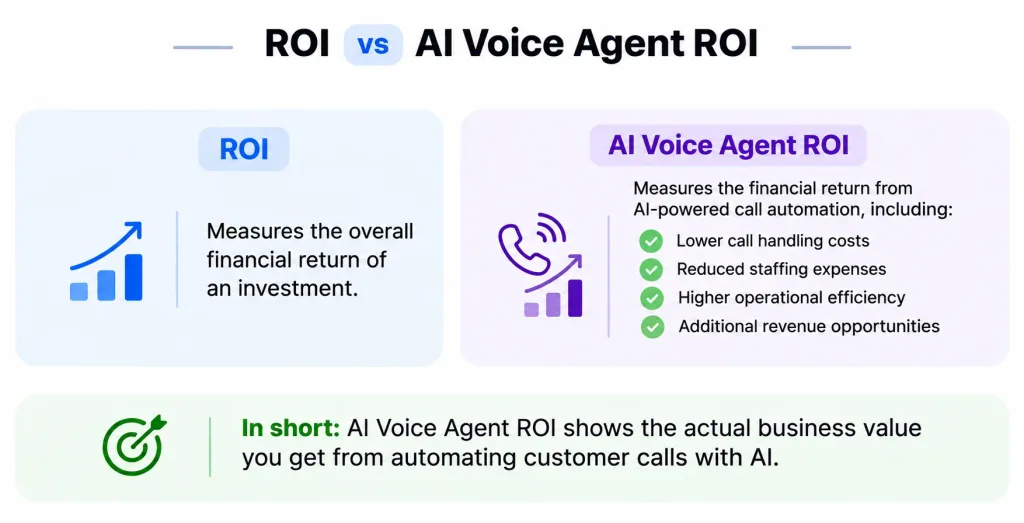
ROI (Return on Investment) is a financial metric that evaluates the profitability of an investment, comparing the financial gains against the cost.
On the other hand, AI Voice Agent ROI specifically measures the return generated by AI-powered call automation. Factors include reduced call handling costs, lower staffing expenses, improved operational efficiency, and additional revenue opportunities.
Calculating AI Voice Agent ROI helps businesses determine if the technology they’re using is delivering measurable financial value and where further improvements can increase returns.
How is ROI Different from Cost Savings
Despite being closely related, ROI and Cost Savings measure two different investment aspects.
Cost Savings is the amount of money a business saves from spending. For example, AI Voice Agents save a certain amount of money by handling repetitive routine tasks, saving the cost of additional staff recruitment.
On the other hand, ROI is the amount of financial value a business gains in relation to the invested cost. Significant measurable financial benefits, such as additional profits from increased sales, along with cost savings, are considered here.
For example, a business may spend $2,000 on an AI Voice Agent and save $3,000 in customer support costs. In that case:
Cost savings: $3,000
Investment cost: $2,000
Net financial benefit: $1,000
ROI: 50%
Cost Savings is the amount of money a business saves, and ROI is the percentage of financial value a business gains.
How Do AI Voice Agents Generate Savings and Financial Returns?
The main ways AI voice agents generate savings and financial returns:
1. Reducing Customer Support Costs
To handle customer calls, businesses need to spend on staffing, training, and daily operations. AI voice agents automate repetitive inquiries and reduce expenses.
When AI Voice agents successfully resolve these routine calls, businesses can cut off or at least reduce outsourced call-handling expenses, or the need to hire additional support agents.
2. Improving Employee Productivity
With AI voice agents, customer support teams will not have to spend time answering repetitive questions. They can spend more time on complex issues where human involvement and expertise are much needed. This helps businesses manage higher call volumes without proportionally increasing their workforce
3. Reducing Missed Calls and Lost Opportunities
Human agents may not always be available, leading to the possibility of missed calls from customers and lost sales opportunities. Even outside regular business hours or during periods of high call volume, AI voice agents can answer customer calls and provide support without losing an opportunity.
4. Generating Additional Revenue Opportunities
AI voice agents are limited in reducing expenses. They can also contribute to revenue-generating activities such as lead qualification, appointment scheduling, product inquiries, and outbound follow-up calls.
For example, an AI Voice Agent can contact potential customers, collect relevant information, and schedule appointments for the sales team. As these interactions result in further conversions, businesses can generate substantial financial returns.
5. Reducing the Cost of Scaling Operations
Customers’ call volume will increase as the sales of the business grow. This creates a demand for additional employees and an extended infrastructure. AI Voice Agents can handle more conversations without requiring businesses to expand their support teams at the same rate.
This allows businesses to manage seasonal demand, peak-hour traffic, and business growth while controlling additional operating expenses. t6
Why Should Businesses Calculate AI Voice Agent ROI?
Calculating AI Voice Agent ROI helps businesses understand whether the investment is financially worthwhile and how effectively it contributes to their business goals. Here are the key reasons businesses should measure AI Voice Agent ROI:
1. Better Budget Decisions
AI voice agents require some expenses, such as platform subscriptions, call usage, setup, integration, and maintenance. Calculating ROI helps businesses estimate these expenses by comparing them with the financial benefits they’re expected to receive.
This allows decision-makers to set realistic budgets, assess potential returns, and determine whether investing in AI voice agents will be beneficial for the business or not.
2. Clear Comparison between Human and AI Call-Handling Costs
Reducing the cost of employing more human agents is one of the major reasons behind investing in AI voice agents. ROI calculation helps the business compare the costs between human-handled calls and AI-handled calls.
This calculation lets the business decide whether human agent call handling or AI voice agent call handling will be more beneficial for the business in managing costs and reviewing the financial benefits.
3. Measurement of the Actual Financial Value of Automation
AI voice agents may handle a volume of calls, but the volume alone does not prove the profitability of the AI voice agent.
Calculating ROI helps in measuring the financial benefit and particular value of the deployed automation. The benefits can include reduced operating expenses, avoided hiring costs, and added customer retention benefits from AI conversations.
4. Finding Opportunities to Improve Performance
Regular ROI calculations help businesses understand which aspects of their AI Voice Agent are delivering the greatest value.
For example, a higher rate of human handoff may indicate that the agent needs better knowledge, improved integration, and more effective conversation handling capability.
Tracking ROI alongside performance metrics allows businesses to identify areas for improvement and make adjustments that may increase financial returns.
5. Planning for Long-Term Business Growth
With the increase in customer volume and growth in the business, the business owner needs to determine whether the existing customer service operations can support the increasing demands efficiently.
Calculating AI Voice Agent ROI helps businesses estimate the financial impact of expanding automation across departments, use cases, or locations.
It also helps them evaluate whether the AI Voice Agent can support higher call volumes without a proportional increase in staffing and operations.
AI Voice Agent ROI Calculation Process: 5 Steps
Calculating AI Voice Agent ROI involves comparing the cost of existing call-handling operations with the cost and benefits of implementing an AI voice agent.
With these five steps, businesses can complete the AI Voice Agent ROI calculation process.
Step 1: Calculate Current Cost
Start by estimating the current cost of your business in handling customer calls. This provides a baseline for comparison between the existing operations and the AI-powered operations.
Consider the following expenses:
Staffing costs: Salaries, benefits, overtime, and training expenses.
Call-handling costs: The average expense of handling each customer call.
Operational costs: Telephony systems, software subscriptions, and other related expenses.
Suppose your business handles 1,000 calls monthly at an average cost of $5 per call.
Current Monthly Cost = Total Monthly Calls Average Cost per Call
1,000 $5 = $5,000 per month
Your annual call-handling cost would be $60,000.
Step 2: Estimate AI Voice Agent Cost
Next, estimate the cost of an AI voice agent implementation. The expenses may include:
- Setup costs such as initial configuration, customization, and implementation
- Subscription fees like monthly or yearly platform charges
- Usage charges such as per-minute or per-call charges for AI conversations
- Integration costs for connecting the AI Voice Agent with existing business systems
- Maintenance costs for monitoring, testing, and ongoing improvements.
Suppose your AI Voice Agent costs $800 per month, with a one-time setup fee of $2,400.
First-Year AI Investment = (Monthly AI Costs 12) + One-Time Setup Costs
($800 12) + $2,400 = $12,000
Step 3: Estimate Financial Benefits
Once you know your AI investment costs, estimate how much money the AI Voice Agent could save or generate for the business.
The benefits may include reducing human-handled call expenses, hiring costs that you’ve avoided, and additional benefits from improved sales conversions.
However, not every AI-answered call creates financial savings. You should focus only on those calls that are handled by AI and the costs that your business has saved.
According to our example, the AI Voice Agent successfully resolves 60% of the 1,000 monthly calls.
Calls resolved by AI: 600 per month
Calls handled by human agent: 400 per month
Previous monthly call handling cost: $5,000
Let’s say that since AI now handles 600 calls, your human support team has fewer calls to manage. This allows the business to reduce overtime, staffing expenses, and other operating costs, bringing monthly human support expenses down to $3,000.
Monthly cost savings: $2,000
Annual cost savings: (12 $2,000) = $24,000
This particular example shows that before deducting the AI Agent expenses, the business generates $24,000 in annual savings.
Step 4: Apply the ROI Formula
Once the financial benefits and the AI investment costs are calculated, apply the ROI formula.
Using our example:
Annual financial benefits = $24,000
First-year AI investment = $12,000
As explained by Harvard Business School Online, ROI compares the net financial return of an investment with its total cost. Businesses can use the same approach to evaluate their AI Voice Agent investment.
AI Voice Agent ROI Formula
ROI= {(Financial Benefits – AI Investment Cost) AI Investment Cost} 100
ROI (%) = {(24,000 – 12,000) 12,000} 100
ROI= 100%
Step 5: Evaluate the Results
After calculating the ROI, the next step is to determine whether the AI Voice Agent delivers the expected financial benefits.
In our calculation, the (annual) ROI is 100%, which means that it invests $12,000 in the AI Voice Agent, gains $24,000 in annual cost savings, and receives a net benefit of $12,000. It shows that the business not only recovers its AI investment, but also saves an additional profit of $12,000 in the first year.
However, ROI is not the only thing that shows how effectively the AI Agent performs. Businesses should also monitor:
- The average cost per resolved customer inquiry
- AI resolution rate/percentage without human assistance
- Human handover rate
- Additional profit from conversions and sales
- Recovery time from initial investment
While the example shows a positive ROI of 100%, actual results may be nuanced and vary depending on call volumes, automation performance, AI expenses, and reductions in operating costs.
KEY TAKEAWAY
Measure the Real Financial Value of AI Voice Automation
AI Voice Agent ROI helps businesses measure actual cost savings, compare investment expenses, and determine whether voice automation delivers measurable financial value.
Key Metrics to Track AI Voice Agent ROI
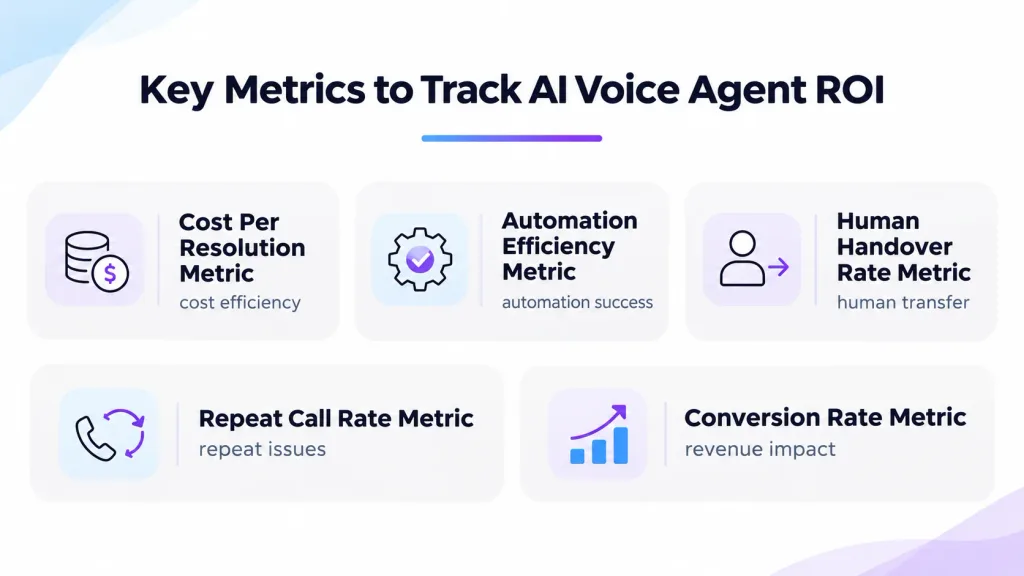
Five key metrics businesses should monitor to evaluate AI Voice Agent ROI:
1. Cost Per Resolution Metric
This metric helps businesses compare the cost of AI-automated calls with human-handled calls. It considers the resolved customer issues along with the expense of AI voice agent operations. A lower cost per resolution may indicate better cost efficiency.
2. Automation Efficiency Metric
The successful automation rate measures the percentage of calls an AI Voice Agent resolves without human assistance. A higher automation rate can reduce the workload of human support teams and create opportunities to lower operating costs.
Nonetheless, businesses should focus on calls that are genuinely resolved rather than simply answered or ended by AI.
3. Human Handover Rate Metric
This rate measures the percentage of human transfers of customer issues from AI voice agents. There may be some situations where human expertise is necessary. But frequent handovers increase operating expenses because of incurring AI processing costs alongside human support costs.
This metric clarifies the scope for improvement of the AI voice agent to resolve issues independently.
4. Repeat Call Rate Metric
Repeat call rate measures how frequently customers contact a business about the same issue within a specific period. A high repeat call rate may indicate incomplete resolutions or inaccurate responses.
It can also increase operational costs because the business must handle the same issue multiple times. Reducing unnecessary repeat calls helps businesses improve customer satisfaction.
5. Conversion Rate Metric
The conversion rate metric measures how many relevant AI-assisted conversations result in a resolved outcome. A higher conversion rate can contribute to additional revenue opportunities as well.
Conclusion
Properly and accurately calculating AI voice Agent ROI lets businesses understand how much of their invested cost has been recovered and has returned something additional to the business, helping the business make informed decisions for future investment.
Nevertheless, achieving a positive ROI goes beyond automating customer calls. Businesses need to consistently ensure good performance of their AI voice agents with successful call resolution, reducing unnecessary expenses.
The next step is choosing an AI Voice Agent that can deliver these benefits in practice, understanding customer needs and handling customer issues accurately. Get a demo or sign up to REVE Chat to try Wize Voice AI Agent provides all these benefits with a positive customer experience.
Frequently Asked Questions
To calculate AI Voice Agent ROI, subtract the total AI investment costs from the financial benefits generated, divide the result by the total investment costs, and multiply by 100. Financial benefits may include reduced operating expenses, avoided staffing costs, and additional profit from AI-assisted sales.
A positive ROI indicates that the financial benefits exceed the investment costs. For example, a 100% ROI means the business earns $1 in net financial benefit for every $1 invested. However, a good ROI depends on the business’s operating expenses, automation goals, and expected returns.
The time required depends on implementation costs, monthly usage expenses, call volumes, and actual cost savings. Businesses with high call volumes and repetitive inquiries may recover their investment sooner. Tracking the payback period helps determine how quickly the financial benefits cover the investment.
Not necessarily. Handling more calls through AI does not automatically reduce business expenses. If staffing and operating costs remain unchanged, the financial savings may be limited. Higher automation rates improve ROI when they lead to measurable cost reductions or additional financial gains.
Build AI-powered support with Wize AI
Connect business knowledge, automate support conversations, and improve response quality without managing a complex AI stack.
Explore Wize AI Agent Rate the article

Noshin Nisa
Sr. Content Writer
Noshin Nisa is a senior content writer at REVE Chat with 3 years of experience in blog and website content writing. Her interests include SaaS, AI Technologies, and Customer Communication. Nisa likes to stay up to date with tech trends and new updates in this field. She likes to convey meaningful communication through her writing.
View all articles
Try REVE Chat's AI Voice Agent
Automate order tracking, appointment bookings, and routine customer inquiries with REVE Chat's AI Voice Agent.
Sign Up