


Upcoming Pricing Updates for WhatsApp Business
- September 21, 2026
- 6 mins read
Table of Content
Meta new pricing rules starting to roll out on October 1, 2026
From October 1, 2026, WhatsApp will charge for Service messages beyond the monthly free allowance of 1,000 per business number and for Utility messages sent within the 24-hour service window.
Meta has constantly evaluated their WhatsApp pricing model and has always made adjustments every year. This time around from October 1st, Meta is set to make a big change that will impact how businesses are able to operate in WhatsApp in terms of cost effectiveness.
Businesses will begin paying for some messages that are currently free within the 24-hour customer service window. Service messages will move to per-message billing after the applicable monthly free allowance, and Utility template messages sent in response to customers will also become chargeable.
The underlying 24-hour customer service window itself will continue to work as it does now. Meta’s official pricing model charges based on delivered messages, message category, and the recipient’s market. (WhatsApp Business)
For the latest rules and rates, refer directly to:
Official documentation: Meta: Non-template Message Pricing
Official pricing calculator: WhatsApp Business Platform Pricing
Note: WhatsApp rates can vary by market, message category, billing currency, and volume. Instead of relying on fixed prices in documentation, use Meta’s current rate card or pricing calculator when estimating costs.
What Changes on October 1, 2026 in WhatsApp Business
The October update mainly affects Service messages and Utility messages sent within an active customer service window.
| Message type | Until September 30, 2026 | From October 1, 2026 |
|---|---|---|
| Service messages | Free within an open 24-hour customer service window | First 1,000 Service messages per business phone number each month are free; additional delivered Service messages become chargeable |
| Utility templates inside the 24-hour window | Free when sent in response to the user | Charged per delivered message |
| Utility templates outside the 24-hour window | Charged per delivered message | No change |
| Marketing templates | Charged per delivered message | No change |
| Billing trigger | Meta charges applicable messages when they are successfully delivered | No change |
1. Service messages become billable
A Service message is a regular non-template message sent by a business while the customer’s 24-hour customer service window is open. These can include replies from human support agents, chatbots, automations, or third-party AI agents.
From October 1, Meta will apply per-message pricing to these replies. Current updated pricing guidance also provides 1,000 free Service messages per month for each business phone number, with charges applying after the allowance is used. The allowance applies specifically to Service messages and resets monthly.
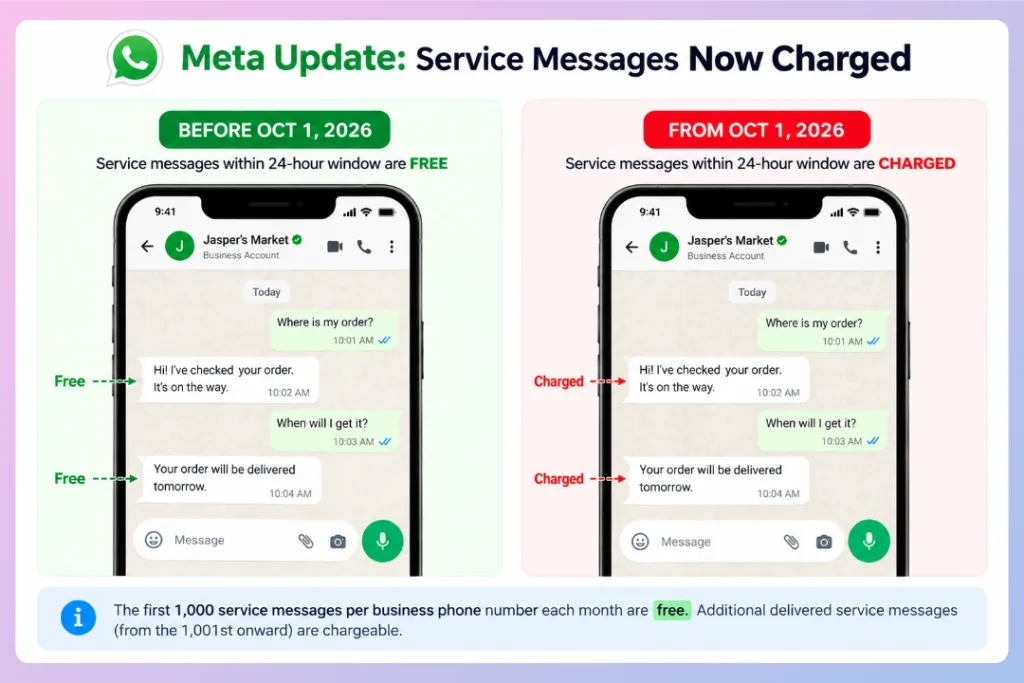
After the free monthly tier of 1,000 service messages per business phone number is used, charges apply starting with the 1,001st service message, based on the applicable Utility Message rate. View Utility Pricing
2. Utility messages inside the customer service window become chargeable
Currently, an eligible Utility template sent in response to a customer while the 24-hour window is open can be delivered without a Meta messaging charge.
That exemption ends on October 1. Utility messages such as order confirmations, delivery updates, account notifications, or other transactional updates will be charged even when the customer service window is still active.
Meta is also updating individual rate cards for some markets. Because these rates can change independently, businesses should use Meta’s current pricing page rather than storing a fixed global rate in their internal documentation.
What Isn’t Changing?
The pricing is changing, but several important WhatsApp messaging rules remain the same.
- The 24-hour customer service window will continue to exist. It opens when a customer sends a message to your business and resets whenever the customer sends another message. Service messages can still only be sent while this window is open. What changes is their billing status, not when they can be sent.
- Messages sent by customers to businesses remain free. Meta charges for applicable business-to-customer messages, not for the customer’s incoming message.
- The 72-hour free entry point window also remains available for qualifying conversations started through an Ad that Clicks to WhatsApp or an eligible Facebook Page call-to-action. During this window, Marketing, Authentication, Utility, and Service message delivery can remain free under Meta’s Free Entry Point rules.
- Volume-based pricing also continues for eligible Utility and Authentication messages. Service messages do not use the same volume-tier discount model. Meta’s summary table in the official pricing guide shows volume tiers for Utility and Authentication, but not Service messages.
Finally, Meta still charges based on successful delivery, rather than simply because a business attempted to send a message. The applicable rate continues to depend on the recipient’s market and message category.
How WhatsApp Business Platform Pricing Works Now
Before the October 1 update takes effect, WhatsApp Business Platform already operates primarily on a per-message pricing model.
Businesses are charged when applicable messages are delivered to customers. Meta recognizes four main WhatsApp Business Platform categories: Marketing, Utility, Authentication, and Service. Rates vary according to the recipient market and message category.
Under the rules in effect through September 30, 2026, Marketing and Authentication template messages are generally chargeable when delivered. Utility templates are chargeable when applicable, but eligible Utility messages sent in response to a customer during an open 24-hour window are currently free. Service messages sent within that window are also currently free.
The October update therefore does not introduce an entirely new billing system. Instead, it extends the existing per-message model to more customer-service interactions, including Service replies and Utility messages that are currently exempt when sent inside the customer service window.
What Should I Do to Prepare for This Change?
Before October 1, businesses should review how WhatsApp is currently being used across customer service, automation, and transactional messaging.
1. Review your Service-message volume. Check how many free-form replies your agents, chatbots, workflows, and AI agents send each month. Because Service billing is message-based, a conversation containing several business replies may produce several billable messages after the monthly allowance is exhausted.
2. Review Utility messages sent during active conversations. Order confirmations, delivery notifications, appointment updates, and similar Utility templates sent within the 24-hour window will no longer receive the current pricing exemption.
3. Estimate costs by customer market. Rates depend on the recipient’s market rather than using one universal WhatsApp price. Use Meta’s official pricing calculator and current rate cards when preparing your messaging budget.
4. Check your Meta billing setup. Make sure the payment method and billing configuration associated with your WhatsApp Business Account are current before the new charges begin.
5. Review automated and agent reply patterns. Avoid unnecessarily splitting one answer into several short messages. After Service messages become billable, several separate replies may cost more than one clear, complete response.
6. Continue monitoring Meta’s pricing documentation. Meta can update market-specific rates and pricing rules. Use Meta’s official documentation as the source of truth rather than permanently storing individual country prices in internal or customer-facing documentation.
For businesses using REVE Chat, Meta’s WhatsApp messaging charges are separate from applicable REVE Chat subscription, Wize AI Agent usage, tax, or other platform charges. Meta determines the underlying WhatsApp message rates and message categories.
Frequently Asked Questions
From October 1, 2026, some business messages that are currently free will become chargeable. This includes Service messages sent within the 24-hour customer service window after the applicable monthly free allowance is used, as well as Utility template messages sent during an active customer service window.
Yes. The 24-hour customer service window is not being removed. It still opens when a customer messages your business and resets whenever that customer sends another message. The change affects how messages sent during the window are billed.
Each business phone number will receive an allowance of 1,000 free Service messages per month. Once this allowance is used, additional eligible Service messages delivered during the month will be chargeable according to Meta’s applicable pricing.
The new allowance applies to individual Service messages rather than complete customer conversations. If several business replies are sent during one customer interaction, each delivered Service message can count separately toward the allowance.
No. Customers can continue sending messages to a business without creating a Meta messaging charge for the incoming message. Applicable charges relate to eligible messages delivered by the business to the customer.
Yes. Qualifying conversations initiated through an Ad that Clicks to WhatsApp or an eligible Facebook Page call-to-action can continue to receive Meta’s 72-hour free entry point benefits, subject to Meta’s eligibility and messaging rules.
There is no single global WhatsApp message price. Rates can vary according to the recipient’s market, message category, billing currency, and applicable pricing tier. Businesses should use Meta’s latest rate cards and WhatsApp Business Platform pricing calculator when estimating costs.
No. WhatsApp Business Platform messaging charges are determined by Meta and are separate from REVE Chat subscription fees, Wize AI Agent usage, taxes, or other applicable platform charges. The exact WhatsApp charge depends on Meta’s pricing rules and the messages delivered through the WhatsApp Business Platform.

 Start free trial